Key takeaway
- Management reporting vs financial reporting: audience, rules, timing and IFRS 18 changes, with a decision table for CFOs and data leaders. Updated 2026.
Management reporting is internal, flexible and forward-looking: it helps leaders steer the business by department, product or region. Financial reporting is external, standardised and backward-looking: it presents audited results to investors, lenders and regulators under accounting standards such as IFRS or US GAAP. Most enterprises need both, built from the same governed numbers.
The risk is not choosing one over the other. It is letting the two drift apart, so that the board pack, the management dashboard and the filed accounts tell three different stories. This guide gives CFOs, CIOs and data leaders a decision table, the current standards position, and a way to keep both sets of reports consistent. For the data foundations behind both, see our guide to data governance.
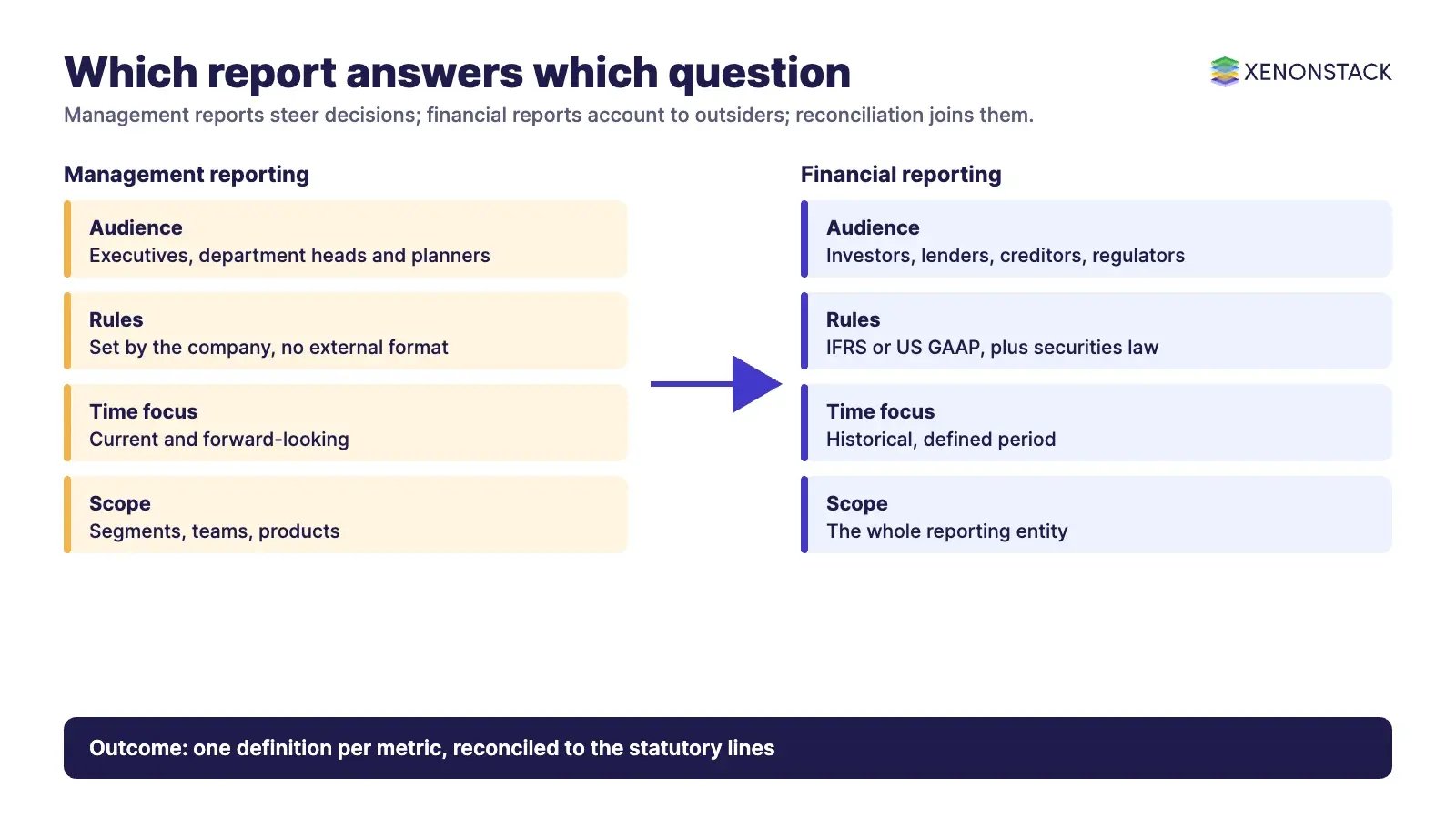
What is the difference between management reporting and financial reporting?
| Dimension | Management reporting | Financial reporting |
|---|---|---|
| Audience | Executives, department heads, planners | Investors, lenders, creditors, regulators |
| Purpose | Decisions, planning, resource allocation | Accountability and comparable results |
| Rules | Set by the company; no external standard prescribes the format | Prepared under IFRS or US GAAP and, for listed companies, securities law |
| Time focus | Current and forward-looking: forecasts, variances | Historical: a defined reporting period |
| Scope | Segments, teams, products, projects | The whole reporting entity |
| Frequency | As often as the decision needs: weekly, daily or on demand | Fixed cycles: interim and annual |
| Assurance | Internal review | External audit for annual statements, where required |
One nuance matters for governance. Financial reporting is not mandatory for every company in the same way. Listed companies face the strictest rules, while private companies follow the requirements of their jurisdiction, lenders and shareholders. Management reporting is never required by a standard setter, but a company that skips it is flying without instruments.
What does management reporting include?
Management reporting turns financial and operational data into views a leader can act on. Typical outputs are department performance packs, sales and marketing reports, operations and inventory reports, budget versus actual variance, and cash and forecast views. Its value depends on four choices: clear goals, the right KPIs, data fresh enough for the decision, and sound data visualisation.
Teams that want finance and operations users to question this data without waiting for a report cycle can use AgentAnalyst, which lets teams ask questions of enterprise data in plain language and get real-time insights.
What does financial reporting include?
Financial reporting presents an entity's financial position, performance and cash flows to outside parties. The core outputs are the balance sheet, income statement, cash flow statement and notes, plus the auditor's report and, for listed companies, management's discussion and analysis. The IFRS Foundation describes its Conceptual Framework as helping the Standards provide useful information for investors, lenders and other creditors.
In the United States, the SEC's Form 10-K is the annual report used by companies reporting under Section 13 or 15(d) of the Exchange Act. Item 7 requires management's discussion and analysis, so even the filed report contains management's own narrative. Filing deadlines depend on filer status: 60 days after year end for large accelerated filers, 75 for accelerated filers and 90 for all other registrants.
Which standards apply, and what is changing?
| Item | What it governs | Current status |
|---|---|---|
| IAS 1 Presentation of Financial Statements | Overall requirements for presenting financial statements | Being replaced by IFRS 18 |
| IFRS 18 Presentation and Disclosure in Financial Statements | Statement of profit or loss, new defined subtotals, disclosure of management-defined performance measures | Effective for annual periods beginning on or after 1 January 2027; earlier application permitted |
| SEC Form 10-K | Annual report for registrants under the Exchange Act, including MD&A | In force; deadlines depend on filer status |
| SEC non-GAAP guidance | Use of measures such as EBITDA in filings | GAAP measure must appear with equal or greater prominence; EBITDA is reconciled to net income |
IFRS 18 is the change to plan for. It replaces IAS 1, requires operating profit and profit before financing and income taxes as defined subtotals, and requires entities to disclose management-defined performance measures, which the IFRS Foundation describes as subtotals of income and expenses not specified by IFRS Accounting Standards. In effect, the measures management uses to run the business, once confined to management reports, become auditable disclosures when they are used in public communications.
Where do the two types of reporting overlap?
The overlap is where most reporting failures start. Management defines adjusted profit, EBITDA or a segment margin, publishes it, and then must explain how it ties to the audited statements. The SEC's published guidance on non-GAAP measures asks for the most directly comparable GAAP measure to appear with equal or greater prominence and for EBITDA to be reconciled to net income. IFRS 18 moves IFRS reporters in a similar direction for management-defined measures.
- One definition per metric. Keep a governed metric catalogue so "revenue" and "active customer" mean the same in the board pack and the filing.
- Reconciliation by design. Store the bridge from each management measure to the statutory line it derives from.
- Lineage. Be able to trace a reported figure to its source ledger and transformation. See our guide to data quality metrics for what to monitor.
- Evidence. Keep the approvals and decisions behind adjustments so that auditors can follow them.
For that last point, the Audit Agent gathers the decision history, the policy versions in force and the approval records behind a past decision, so auditor questions can be answered without manual reconstruction.
Which report should you use, and when?
| Question | Use | Why |
|---|---|---|
| Should we cut spend in one region? | Management report | Segment detail and forecasts |
| Are we meeting lender covenants? | Financial reporting | Audited, comparable figures |
| What will next quarter look like? | Management report | Forward-looking and unconstrained by statutory format |
| What do we tell investors about performance? | Financial reporting plus reconciled non-GAAP measures | Standards and securities rules apply |
| Which product line earns its cost of capital? | Management report | Needs allocation that statutory accounts do not provide |
What are the trade-offs and risks?
- Flexibility versus consistency. Management reports can change shape quickly, but unmanaged flexibility creates competing versions of the truth.
- Speed versus assurance. Management numbers are fast but unaudited; do not quote them externally without reconciliation.
- Cost. Maintaining two views costs effort. A shared data layer and governed definitions reduce it, but do not remove the need for both.
- When not to over-engineer. A small private company with one lender may need little beyond statutory accounts and a monthly management pack.
How should you sequence the improvement?
- List every report, its audience, owner and source system.
- Agree one definition for each shared metric and record who approves changes.
- Build reconciliations from management measures to the statutory lines.
- For IFRS reporters, assess which management measures will count as management-defined performance measures under IFRS 18 before 1 January 2027.
- Automate recurring packs, keep an evidence trail, then add self-service analysis on governed data.
Our own work with finance and operations teams points the same way: the hard part is rarely the report layout, but agreeing metric definitions and showing where each number came from. The ElixirData Context OS keeps governed context, versioned policy and decision traces in one decision layer above AI agents.
To map one reporting decision your agents should make, and the context and policy it depends on, book a Context Workshop. See what happens in the workshop.
Frequently asked questions
Is management reporting mandatory?
No standard setter requires it, and its format is set by the company. Financial reporting is required for listed companies and, in other cases, by law, lenders or shareholders.
Who reads financial reports?
Investors, lenders and other creditors are the users the IFRS Foundation names for general purpose financial reporting. Regulators and auditors also rely on them.
What is IFRS 18 and when does it apply?
IFRS 18 Presentation and Disclosure in Financial Statements replaces IAS 1. It applies to annual reporting periods beginning on or after 1 January 2027, with earlier application permitted.
Does the SEC regulate management-defined measures such as EBITDA?
In filings, SEC staff guidance expects the most directly comparable GAAP measure to appear with equal or greater prominence and EBITDA to be reconciled to net income.
Does a 10-K contain management reporting?
Partly. Item 7 requires management's discussion and analysis, which is management's own narrative inside the filed report.
Ready to put AI agents to work? Explore ElixirClaw, the agentic OS platform to build, orchestrate and govern AI agents.
Explore the XenonStack platform family: ElixirData · ElixirClaw · ElixirHub · NexaStack · MetaSecure · Neural AI · AgentGRC · AgentSRE · AgentAnalyst · AgentInstruct · AgentRAI · AgentScrum · AgentSearch · AgentForce · AI Aviator · SAIF Aviator · CohortIQ · XenonStack AI · XenonStack UAE