Key takeaway
- Compare Apache Kafka, Azure Event Hubs and Confluent Cloud for streaming data: protocol, operations, governance, cost factors and a short decision path.
Apache Kafka, Azure Event Hubs and Confluent Cloud are three ways to run a streaming backbone: self-managed Kafka gives you full control, Event Hubs is Microsoft's managed service with a Kafka-compatible endpoint, and Confluent Cloud is a fully managed platform built on Kafka. The right choice depends on who operates the platform, how much of the Kafka ecosystem you need, and where your data already lives.
This guide is for data architects and platform leads choosing a messaging and streaming layer for analytics, including lakehouse designs on Azure. It covers what each option is, a comparison table, the decision factors, migration, and how AI agents change the requirements.
Why do streaming services matter for data integration?
Batch pipelines move data on a schedule, so every consumer sees yesterday's state. A streaming service keeps events in an ordered log that many systems can read at their own pace. That decouples the systems that produce data from those that consume it, and it lets analytics, operational applications and AI agents share one feed of events instead of building point-to-point integrations.
What is each option?
Apache Kafka is an open-source distributed log. You run the brokers yourself, or have someone run them for you. Azure Event Hubs is a managed service. The Microsoft Event Hubs for Apache Kafka documentation says it provides an Apache Kafka endpoint on an event hub, so users can connect with the Kafka protocol, and that you can often do this without code changes by updating only the connection configuration. Confluent Cloud is described in the Confluent Cloud documentation as a fully managed data streaming platform available on AWS, Google Cloud and Azure.
Event Hubs is not Kafka itself. Microsoft's page says the two are conceptually very similar, since both are partitioned logs, and it supports Kafka version 1.0 and later through the Kafka endpoint, only in the standard, premium and dedicated tiers. Some features are narrower: Kafka Streams and Kafka transactions are in public preview in premium and dedicated tiers, and only gzip compression is supported.
How do they compare?
| Factor | Apache Kafka (self-managed) | Azure Event Hubs | Confluent Cloud |
|---|---|---|---|
| Who operates it | Your team | Microsoft; no brokers to configure, per Microsoft | Confluent, as a managed service |
| Kafka compatibility | Native | Kafka protocol endpoint, Kafka 1.0 and later, with listed feature limits | Built on Apache Kafka |
| Ecosystem extras | Whatever you install | Also supports AMQP and HTTP protocols | Managed connectors, Schema Registry, Stream Governance and managed Flink, per Confluent |
| Where it runs | Anywhere you can run servers | Azure | AWS, Google Cloud and Azure |
| Main trade-off | Most control, most operations work | Fewest moving parts if you are on Azure; check feature limits | Broadest managed Kafka features; a separate vendor and billing relationship |
How should you choose?
Work through the factors in this order and write down the answer for each.
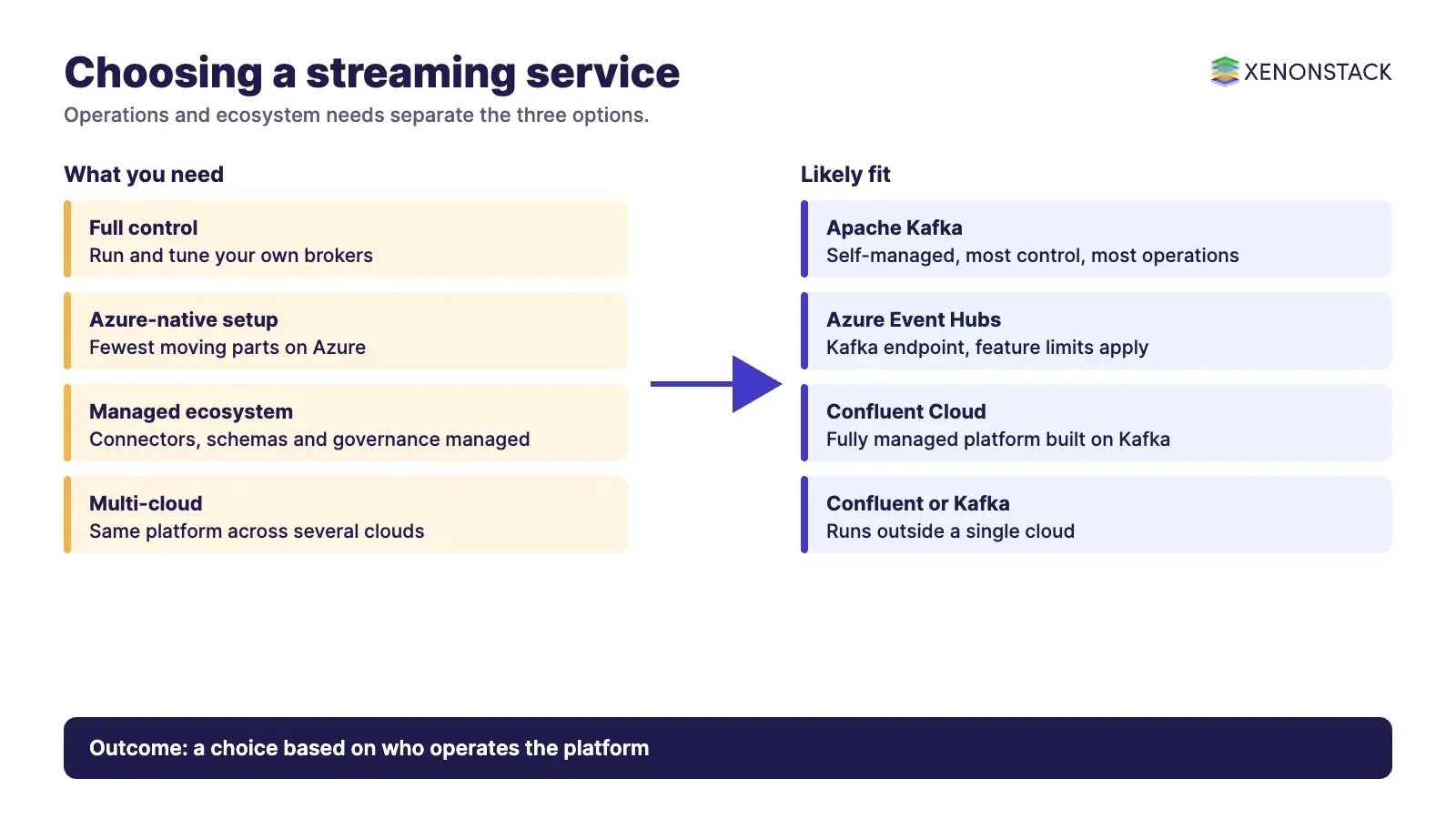
- Operations: can your team run brokers, upgrades, storage and recovery? If not, a managed option is usually the better starting point.
- Ecosystem: if you rely on Kafka Streams, transactions or a wide set of connectors, check each against the Event Hubs feature limits and Confluent's managed features before committing.
- Integration with your analytics platform: if your target is a Microsoft Fabric lakehouse, confirm the supported event sources in Microsoft Fabric documentation rather than assuming.
- Scalability model: Event Hubs capacity comes from throughput units or processing units, per Microsoft; Kafka and Confluent scale by brokers and cluster tier.
- Delivery semantics: Event Hubs is at-least-once, so consumers can receive events more than once and should be idempotent.
- Total cost of ownership: count licence or service fees, cloud network traffic, engineering time and incident cost, not only the unit price. Confluent's billing documentation explains how its spend is tracked.
What changes when you implement each option?
With self-managed Kafka you design the cluster, storage, security and monitoring. With Event Hubs you create a namespace, which is an endpoint with a fully qualified domain name, and event hubs (the equivalent of topics) inside it. Microsoft recommends Microsoft Entra ID with OAuth 2.0 over shared access signatures for authentication, and connections require TLS. With Confluent Cloud you choose a cluster tier and use managed connectors, which the documentation says run on managed or self-managed infrastructure.
The concept mapping is direct: a Kafka cluster maps to a namespace, a topic to an event hub, and partitions, consumer groups and offsets stay the same.
How do you migrate between them?
- Inventory topics, partition counts, retention needs, client versions and the features you use.
- Test the target with one low-risk topic, using the same client code and changed configuration.
- Run old and new side by side, with consumers able to read either, and compare results.
- Move producers last, then retire the old path after a rollback window.
How do AI agents change the requirements?
Agents react to events, so the stream becomes the trigger for actions. That raises three requirements: reliable replay so an agent can be re-run on the same events, schema control so a changed field does not silently change an agent's decision, and an audit trail linking each action to the events behind it. Confluent lists Schema Registry and Stream Governance features for schema and lineage, and any option can meet these needs with the right design. ElixirData, XenonStack's Context OS, is the data and governance layer for holding the context and policy an agent uses when it acts on an event.
What should you do first?
- Name one event flow, such as inventory or orders, and who consumes it.
- Score the three options against the factors above for that flow only.
- Prototype the shortlisted option with realistic volumes and measure delivery behaviour and cost.
- Decide ownership, schema rules and retention before adding more topics.
To map one decision your agents make from an event stream, and the data and policy it depends on, book a Context Workshop. See what happens in the workshop.
Frequently asked questions
Is Azure Event Hubs the same as Apache Kafka?
No. Event Hubs provides an Apache Kafka endpoint so Kafka clients can connect, and Microsoft describes the two as conceptually very similar partitioned logs, but Event Hubs is a managed Azure service with its own feature limits.
Can I use Kafka applications with Event Hubs?
Often yes. Microsoft says you can often use an event hub's Kafka endpoint without code changes, by updating the connection configuration to point to the endpoint.
What is Confluent Cloud?
The Confluent documentation describes it as a fully managed data streaming platform, available on AWS, Google Cloud and Azure.
Does Event Hubs guarantee exactly-once delivery?
No. Microsoft documents at-least-once delivery for Event Hubs, so consumers can receive events more than once and should implement the idempotent consumer pattern.
How do I choose between them?
Compare who operates the platform, the Kafka features you need, where your analytics platform runs, scaling model, delivery semantics and total cost of ownership, then prototype your shortlist.
Follow XenonStack on LinkedIn: XenonStack on LinkedIn for new guides on agentic AI, data and platform engineering.
Ready to put AI agents to work? Explore ElixirClaw, the agentic OS platform to build, orchestrate and govern AI agents.
Explore the XenonStack platform family: ElixirData · ElixirClaw · ElixirHub · NexaStack · MetaSecure · Neural AI · AgentGRC · AgentSRE · AgentAnalyst · AgentInstruct · AgentRAI · AgentScrum · AgentSearch · AgentForce · AI Aviator · SAIF Aviator · CohortIQ · XenonStack AI · XenonStack UAE