Key takeaway
- Enterprise AI platform guide: components of an intelligent enterprise, capabilities, 2026 SAP changes, governance, adoption steps and when not to start.
An intelligent enterprise platform is the set of data, analytics, AI and automation capabilities that lets a business see what is happening, decide what to do and act on it faster, with controls around every automated decision. It is a layered operating model, not a single product, and most large vendors now describe their version of it.
In 2026 the emphasis has moved from analytics to agents. SAP, for example, now frames its direction as an autonomous enterprise built on a unified AI platform, as set out in its SAP press release of 12 May 2026. For CTOs, CIOs and enterprise architects the practical question is which layers you own, which you buy, and where governance sits. For related reading, see our guide to intelligent decisioning systems.
What is an intelligent enterprise platform?
An intelligent enterprise applies data and AI inside core business processes and customer journeys, so that people, processes and data work as one system. The term was popularised by SAP as a way to describe enterprises that use their data to reach outcomes faster and with less risk, using machine learning, IoT, analytics and related technologies.
The platform is the technical foundation under that idea. It connects data sources, runs analytics and models, and exposes the results to business applications and, increasingly, to AI agents.
Which capabilities does an intelligent enterprise platform provide?
| Capability | What it gives the business | What it needs underneath |
|---|---|---|
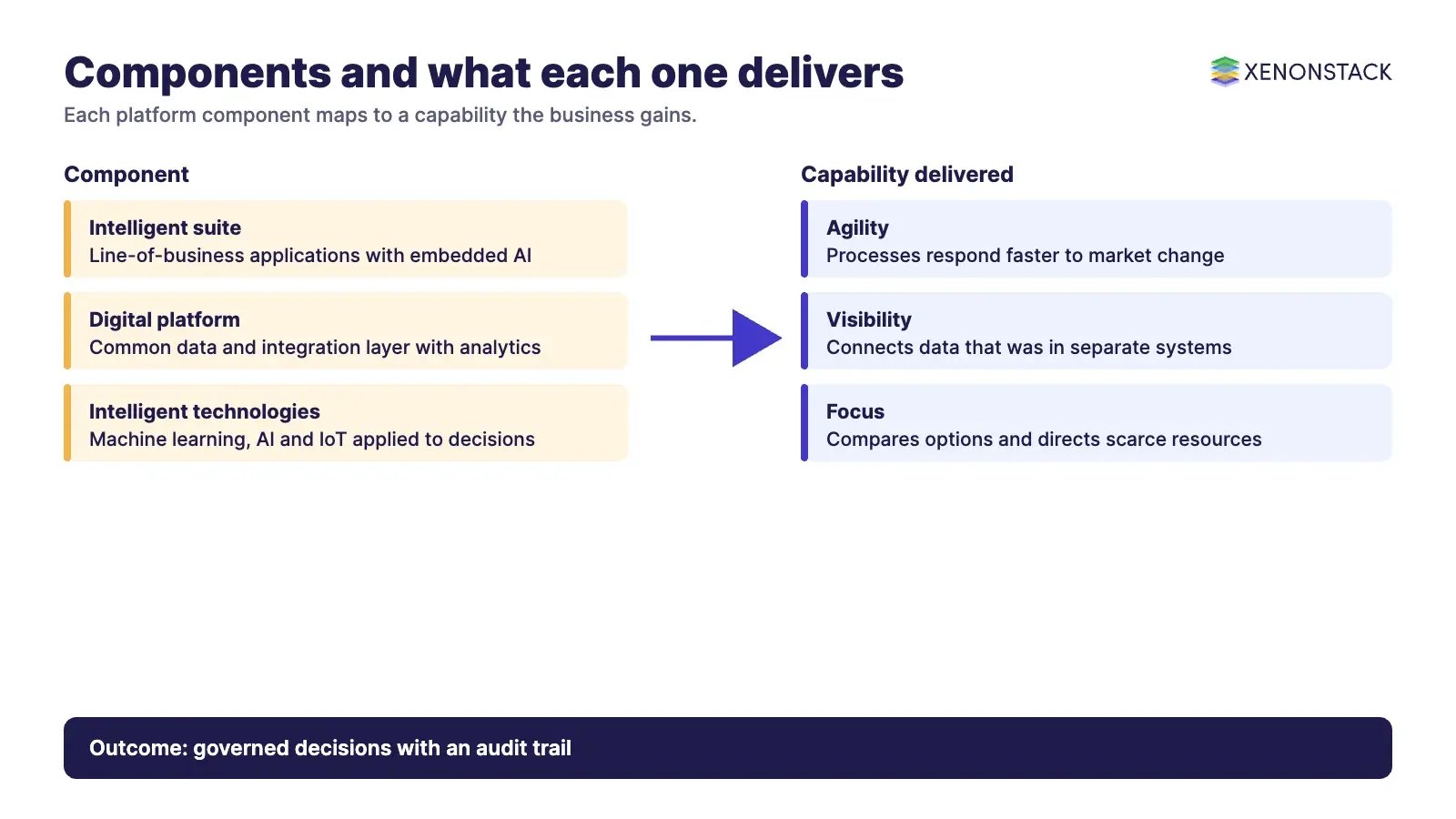
| Visibility | Connects information that sat in separate systems and surfaces patterns that were hidden | Integrated data, lineage and a shared business vocabulary |
| Focus | Lets leaders compare the likely impact of options and direct scarce resources to the highest-value areas | Predictive and prescriptive models, simulation, quality data |
| Agility | Lets processes respond faster to market and customer change | Automation, event-driven integration, clear decision ownership |
What are the components of an intelligent enterprise platform?
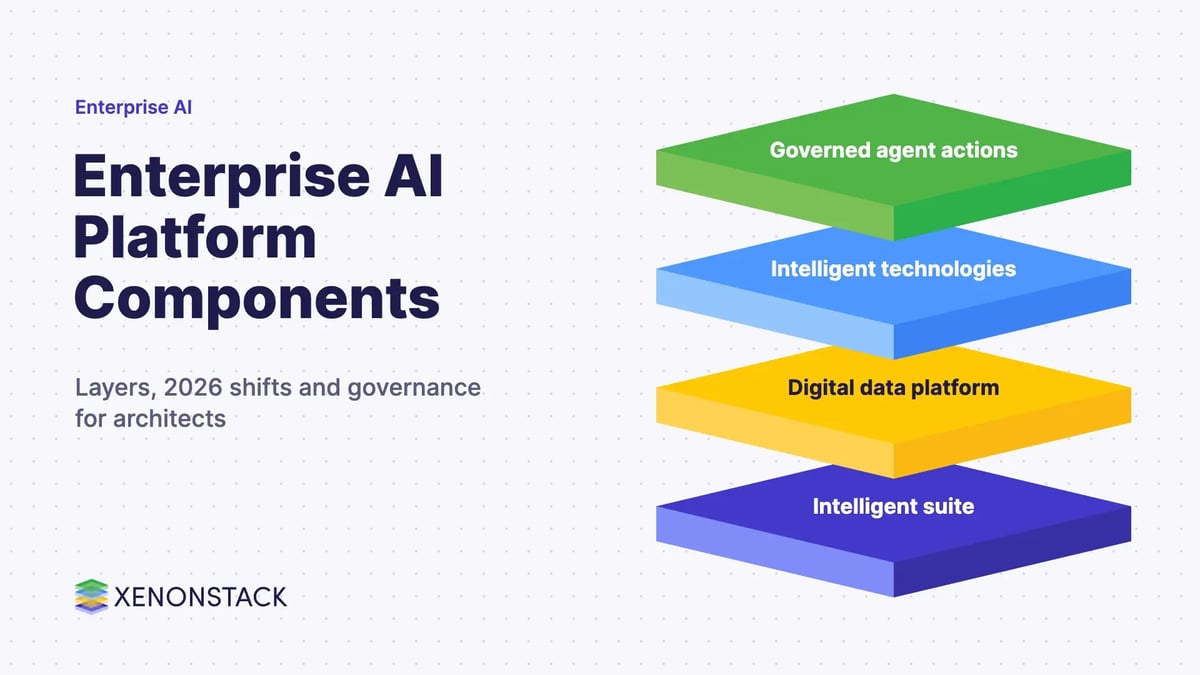
SAP describes its intelligent enterprise as three parts. The same split is a useful checklist for any vendor or in-house design.
| Component | What it is | When it fits | Current status (2026) |
|---|---|---|---|
| Intelligent suite | Business applications for each line of business, such as finance, supply chain and customer experience | You want AI embedded in the systems of record | SAP now adds agents to these applications. Its press release describes more than 50 domain-specific Joule Assistants, orchestrating a subset of over 200 specialised agents |
| Digital platform | A common data and integration layer with analytics | You need one governed view across many systems | SAP merged Business Technology Platform, Business Data Cloud and Business AI into the SAP Business AI Platform |
| Intelligent technologies | Machine learning, AI, IoT and related technologies applied to the business | You have a specific decision or process to improve | Now centred on foundation models and agents, including Joule Studio for building agents |
Source for the status column: the SAP press release of 12 May 2026, which gives no general availability dates or pricing for most offerings. Check current availability with the vendor before planning around any of them.
What has changed since the first intelligent enterprise models?
| Era | Technology shift | Typical business effect |
|---|---|---|
| 1960s to 1980s | Mainframes and the silicon revolution | Industrial automation |
| 1990s to 2000s | Client-server, the internet and wide PC adoption | Business process automation |
| 2000s to 2010s | Mobile, cloud and big data | Digital transformation |
| 2010s to 2020s | Machine learning, IoT and blockchain | The intelligent enterprise |
| 2026 | Agents working across business workflows | Autonomous operations with human oversight |
The earlier rows summarise broad technology eras and are indicative. The 2026 row reflects SAP's description of its autonomous enterprise: humans and AI agents working together on core business workflows.
How do analytics techniques fit into the platform?
Four analytics types form the usual path from reporting to action.
| Technique | Question it answers | Typical methods |
|---|---|---|
| Descriptive | What happened? | Reporting and dashboards on revenue, sales and operations |
| Predictive | What will happen next? | Clustering, classification and regression |
| Prescriptive | What should we do? | Optimisation, neural networks and machine learning |
| Cognitive | What does this mean in context? | AI and language understanding, as covered in our guide to cognitive analytics tools |
Where do intelligent enterprise platforms apply?
| Sector | Example use | Value to the business |
|---|---|---|
| Banking and financial services | Fraud detection, risk management, sentiment analysis of customer feedback | Earlier detection and a clearer view of the market |
| Insurance | Risk and fraud management using customer data | Better underwriting and claims decisions |
| Healthcare | Machine learning for image-based screening support | Faster, more consistent triage |
| Logistics and transport | Dynamic pricing and traffic management | Pricing and routing that follow demand |
| Retail and automotive | Spotting customer interest from social posts and recommending next steps | Timely, relevant outreach |
| Media, travel and education | Recommendations, conversational assistants, adaptive learning | Personalised experiences at scale |
These are illustrative patterns, not measured results. Quantify the benefit in your own environment before committing budget.
What do governance, security and cost look like?
When agents act on business data, the platform needs controls that sit outside any one model. Four questions to settle early: which data an agent may read, which actions need human approval, how every decision is recorded, and who owns exceptions.
One way to do this is a decision layer above your existing systems. ElixirData Context OS keeps governed context, versioned policy and decision traces in one decision layer above AI agents, and AgentGRC keeps autonomous agent actions inside policy, with the audit trail risk teams need. To build and run the agents themselves, ElixirClaw is an agentic OS platform to build, orchestrate and govern AI agents and automation workflows while keeping humans in control. After go-live, the Decision Review Agent analyses outcomes, detects patterns and recommends improvements. Our connected intelligent enterprise page describes how we approach delivery.
In what order should an enterprise adopt it?
| Step | Action | Exit check |
|---|---|---|
| 1 | Pick one decision or process with a clear owner and measurable outcome | Baseline metric agreed |
| 2 | Connect and clean the data that decision depends on | Lineage and access rules documented |
| 3 | Start with descriptive and predictive analytics, then add prescriptive recommendations | Recommendations beat the baseline |
| 4 | Add automation or agents with approval gates | Every action traceable |
| 5 | Review and extend to the next process, replacing obsolete tools as you go | Retired systems removed from the stack |
What are the trade-offs, and when should you not do this?
A single-vendor platform reduces integration work but increases dependence on that vendor's roadmap. A multi-vendor design keeps choice but needs a strong integration and governance layer. Avoid a platform-wide programme if you have no data owner, if your core data is not yet trustworthy, or if the use case is a one-off report. Fix the data first, then automate.
Related reading: intelligent automation with agentic AI.
To map one decision your agents should make, and the context and policy it depends on, book a Context Workshop. See what happens in the workshop.
What should you plan for in 2027?
Treat the platform as a set of layers, and settle who owns each one before the next budget cycle.
- Name an owner for every layer. Decide whether the intelligent suite, the digital platform and the intelligent technologies are bought from a vendor or run in house, and record where governance sits.
- Start with one decision. Pick a process with a clear owner and a measurable baseline, connect and clean its data, and add automation or agents only behind approval gates.
- Confirm vendor status before committing. Vendor announcements often give few availability dates or prices, so check current availability with the vendor before planning around any offering.
Frequently asked questions
What is an intelligent enterprise platform?
It is the combination of data, analytics, AI and automation that lets a business see, decide and act faster, with controls around automated decisions.
What are the main components of an intelligent enterprise?
SAP describes three: an intelligent suite of business applications, a digital platform for data and analytics, and intelligent technologies such as machine learning and AI.
What has SAP announced for 2026?
On 12 May 2026 SAP announced its Autonomous Enterprise vision, including the SAP Business AI Platform, which merges Business Technology Platform, Business Data Cloud and Business AI.
What is the difference between predictive and prescriptive analytics?
Predictive analytics estimates what will happen next. Prescriptive analytics recommends the best action for a given situation.
Where should an enterprise start?
Start with one decision that has a clear owner and a measurable outcome, prepare its data, then add automation with approval gates.
Follow XenonStack on LinkedIn: XenonStack on LinkedIn for new guides on agentic AI, data and platform engineering.
Explore the XenonStack platform family: ElixirData · ElixirClaw · ElixirHub · NexaStack · MetaSecure · Neural AI · AgentGRC · AgentSRE · AgentAnalyst · AgentInstruct · AgentRAI · AgentScrum · AgentSearch · AgentForce · AI Aviator · SAIF Aviator · CohortIQ · XenonStack AI · XenonStack UAE