.webp?width=1921&height=622&name=usecase-banner%20(1).webp)
What is Cognitive Analytics and Why is It Important?
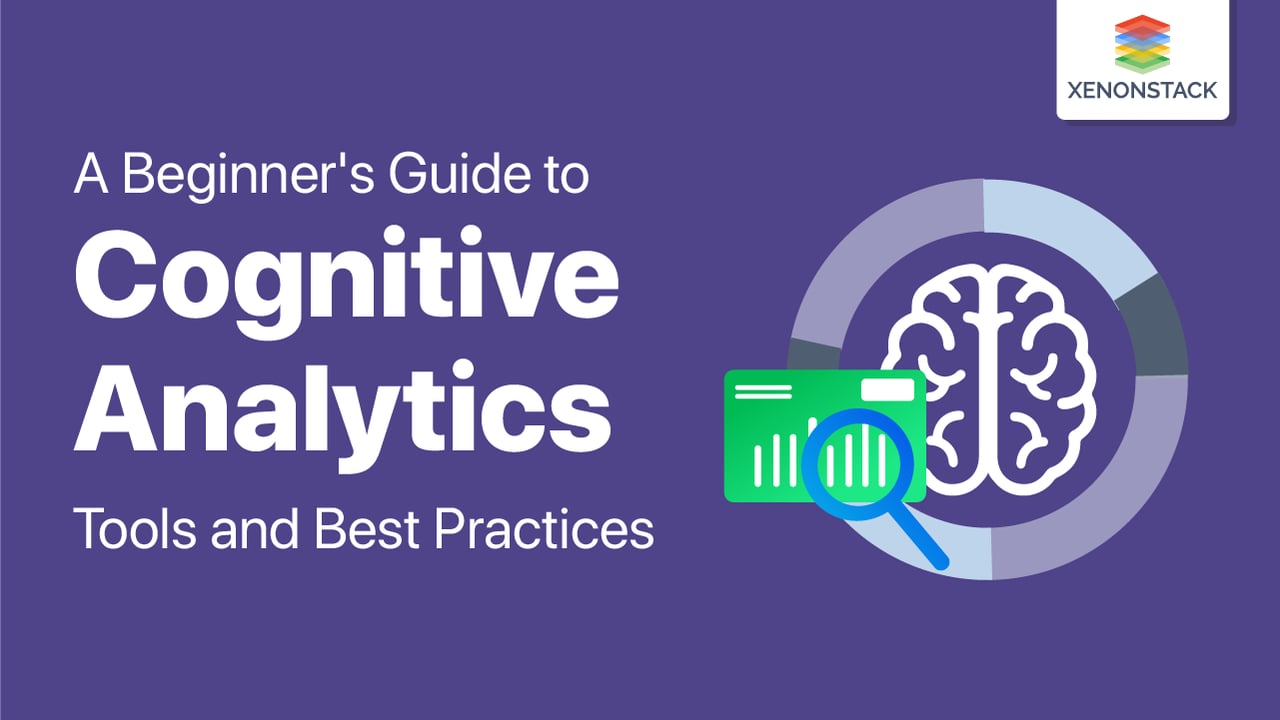
Cognitive Analytics simulate the human thought process to learn from the data and extract the hidden patterns from data. It brings all the data sources, such as audio, video, text, and images, within the reach of Analytics processes that are further used for Decision-Making and Business Intelligence.
It applies Human-like intelligence to tasks such as extracting the full-text summary rather than individual words. Therefore, it uses a combination of technologies such as Semantics, algorithms of Artificial Intelligence, Machine Learning, and Deep Learning. When these technologies are applied, the respective Cognitive application will become more effective by learning with time from the interactions with the data and humans. A Cognitive Analytics System searches through the entire data within the knowledge base to determine the Real-Time solutions.
Key Takeaways
- Cognitive Analytics uses Deep Learning, Neural Networks, and NLP to simulate human reasoning over complex, multi-modal data.
- It moves beyond structured metrics to process text, audio, video, and images as analytical inputs.
- Core value: smarter decisions, improved customer experience, and continuous learning from data interactions.
- Applied across logistics, healthcare, cybersecurity, banking, retail, and public services.
- Best adopted with a clear data strategy, purpose-built tooling, and domain-specific implementation.
The sub-branch of Advanced Analytics, the key area of Data Science that uses Statistical concepts to output an event's maximum likelihood.” Click to explore about, Predictive Analytics Tools
How does Cognitive Analytics work?
Cognitive Computing is highly dependent upon Deep Learning and Neural Networks. Deep Learning is based on the architecture known as Deep Learning Neural Network that emerges from the Neural Network architecture. You may also read more about Predictive Analytics in this insight.
The structure of the human brain influences the Neural Network. It is made up of neurons connected with weighted interconnections. The Deep Learning Neural Network consists of multiple layers of neurons. Learning occurs when the weights are updated between the interconnection of consequences. The Learning is composed of three phases -
The learning process in a cognitive system operates across three phases:
- Understanding natural language and human interactions — processing unstructured inputs (speech, text, queries) into structured meaning using NLP.
- Generating and evaluating evidence-based hypotheses — reasoning over the knowledge base to produce ranked, probabilistic answers.
- Adapting from user selections and responses — refining model behaviour based on feedback, improving accuracy over time without manual reprogramming.
This three-phase architecture is what distinguishes cognitive analytics from static rule-based systems: it learns continuously rather than operating on fixed decision trees.
How does Cognitive Analytics learn from data?
It uses Deep Learning Neural Networks to update weights through interactions, enabling continuous learning and improvement.
How Is Cognitive Analytics Different from Traditional Analytics?
| Aspect | Traditional Analytics | Cognitive Analytics |
|---|---|---|
| Input types | Structured, numerical data | Structured + unstructured (text, audio, video, images) |
| Reasoning model | Rule-based, predefined logic | AI-driven, hypothesis generation and reasoning |
| Learning capability | Static — requires manual updates | Adaptive — learns from interactions over time |
| Output | Metrics, aggregations, dashboards | Contextual insights, summaries, recommendations |
| Human language | Not natively supported | Core capability via NLP |
The fundamental distinction: traditional analytics measures what happened; cognitive analytics interprets what it means and suggests what to do next.
What are the benefits of Cognitive Analytics?
Users can understand the growth of the business from their cognitive initiatives. This method enhances customer engagement, which increases efficiency quickly and further increases the company's development. The Benefits are -
Customer Engagement
- Improved Customer Service.
- Personalized Customer/User Experience.
- Increased Customer engagement.
- Enable faster response to customer/market needs.
- Improved productivity and efficiency.
- Improved decision-making and planning.
- Improved security and compliance, reduced security.
- Reduced costs.
- Enhance the learning experience.
- Expanded ecosystem.
- Expanded business into new markets.
- An accelerated innovation of new products/services.
If you don’t want the future technologies to catch you off guard, pay attention to these current trends in big data analytics and succeed!” Click to explore about, Latest Trends in Big Data Analytics
Why is Cognitive Analytics important?
Technology plays a vital role in improving society. To tackle society's challenges, the best combination of Human and Machine intelligence is required. Therefore, cognitive technology is applied. The Cognitive technique is involved in various domains, such as -
- Social Services - With cognitive technology, insight is extracted from the dataset. This further helps build personalized service plans and understand the vulnerability from a microscopic view. It also provides better provisions for protecting at-risk groups.
- Environment - With the growing impact of humans on the natural world, there is a need to protect it for future generations. Cognitive Analytics helps deal with fundamental problems such as climate change, food availability, water, and energy. Therefore, the government can point out the pollution sources more effectively. It also helps to determine the anomalies or problem areas that further decrease deforestation, track urbanization, mitigate diseases, and better control the ecosystem.
- Public Safety - Using cognitive technology, better insights are extracted to achieve better situational awareness. Therefore, new capabilities are introduced, such as combatting epidemics, managing disasters, and fighting crime.
How Should Enterprises Adopt Cognitive Analytics?
Problem: Large organisations deal with data at a scale and complexity where generic analytics tooling cannot capture the full value of their knowledge base. Custom cognitive systems require careful architectural design.
Approach:
- Design domain-specific algorithms rather than relying on generalised models — industry context significantly improves accuracy.
- Implement cognitive search capabilities to improve knowledge retrieval across internal document stores, files, and systems. Cognitive search learns from previous queries and user selections, boosting both speed and relevance.
- Integrate machine learning feedback loops so the system continuously refines outputs based on real-world usage.
Business outcome: Faster information retrieval, reduced time-to-insight, and a knowledge infrastructure that compounds value over time as the model learns.
What Are the Best Practices for Implementing Cognitive Analytics?
- Use the full distribution of calculations — not just averages — to understand data behaviour accurately.
- Account for data outliers explicitly; cognitive models trained on outlier-free data may fail on real-world inputs.
- Report and quantify noise within datasets before model training.
- Visualise data to assess complexity prior to selecting model architecture.
- Slice datasets by relevant dimensions (time, geography, segment) to surface patterns hidden in aggregated views.
- Evaluate practical significance, not just statistical significance, before acting on model outputs.
- Test for consistency of data patterns over time — concept drift in input data will degrade model accuracy

What Are the Leading Cognitive Analytics Tools?
Natural Language Processing (NLP)
- Statistical NLP, Deep-learning NLP, Rule-based NLP
- OpenNLP, GATE — open-source NLP frameworks
- Apache Lucene Core — full-featured text search engine (Java)
- GPText (Greenplum) — statistical text analysis for parallel computing platforms
- SyntaxNet / Parsey McParseface — neural network NLP frameworks for language understanding
Machine Learning and Cognitive Compute
- TensorFlow — machine intelligence library for deep learning model development
- NuPIC — cognitive computing platform based on Hierarchical Temporal Memory (HTM)
Computer Vision and Audio
- OpenCV, ImageJ — computer vision libraries for image analysis
- Praat — speech manipulation, analysis, and synthesis
- OpenSMILE — real-time audio feature extraction
Tool selection should be driven by data modality (text, image, audio), deployment environment, and the specific cognitive task — not by tooling popularity alone.
Which tools are commonly used in Cognitive Analytics?
Tools like TensorFlow, OpenNLP, Apache Lucene, SyntaxNet, and OpenCV are widely used.
What Are the Primary Applications of Cognitive Analytics?
Cognitive Analytics is applied across industries where large volumes of unstructured data contain decision-relevant signals that traditional analytics cannot surface:
- Logistics and Transportation — route optimisation, demand forecasting, anomaly detection in supply chains
- Retail — personalisation engines, sentiment analysis, inventory intelligence
- Cybersecurity — threat pattern recognition, anomaly detection in network behaviour
- Healthcare — clinical data interpretation, patient risk stratification, medical imaging analysis
- Banking and Finance — fraud detection, regulatory compliance, customer behaviour modelling
- Education — adaptive learning platforms, performance prediction, content personalisation
- Power and Energy — predictive maintenance, consumption anomaly detection, grid optimisation
A Holistic Strategy for Cognitive Analytics
- Learn about Text Analytics Techniques and Tools
- Get more insights about the Learning Analytics Platform.
Conclusion: Why Cognitive Analytics Is the Foundation of Intelligent Enterprise Operations
Cognitive Analytics is not an incremental improvement over traditional analytics — it is a distinct capability class that enables enterprises to reason over the full breadth of their data, including the unstructured majority that conventional systems ignore.
By combining Deep Learning, Neural Networks, and AI-driven reasoning, organisations gain the ability to:
- Extract insight from text, audio, video, and image data at scale
- Generate evidence-based hypotheses rather than static reports
- Adapt continuously from operational feedback without manual reprogramming
- Apply human-like intelligence to decisions that affect customers, operations, and strategy
Enterprises that embed cognitive analytics into their data infrastructure move from reactive reporting to proactive, intelligent decision-making — with systems that become measurably more capable over time.