Key takeaway
- GAN architecture explained for enterprise teams: generator, discriminator, training loop, variants, failure fixes, GANs vs diffusion and EU AI Act duties.
GAN architecture is a design in which two neural networks are trained against each other. A generator turns random noise into synthetic samples, and a discriminator judges whether each sample came from the real training data or from the generator. Each network improves by trying to beat the other, and training succeeds when the generator's output matches the real data distribution closely enough that the discriminator can no longer tell the difference.
For enterprise teams, GANs are no longer the default choice for general-purpose image generation, where diffusion models have overtaken them on image quality since 2021. They remain a practical option where fast single-pass generation, synthetic data, anomaly detection or image enhancement matter, provided the team plans for unstable training and for the governance duties that apply to synthetic content.
What is GAN architecture?
The architecture was introduced by Ian Goodfellow and colleagues in the paper Generative Adversarial Networks, submitted to arXiv in June 2014. The paper frames training as a minimax two-player game: the generator (G) learns the data distribution, and the discriminator (D) estimates the probability that a sample came from the training data rather than from G. When both are multilayer perceptrons, the whole system trains with ordinary backpropagation, and neither training nor sampling needs Markov chains.
The authors also showed a theoretical end point: across arbitrary functions there is a unique solution in which G recovers the training distribution and D outputs 1/2 everywhere, meaning it can do no better than a coin toss. For a broader view of where GANs sit among other model families, see our guide to generative AI model types, training and evaluation, and the short GAN glossary entry.
How does GAN architecture work, step by step?
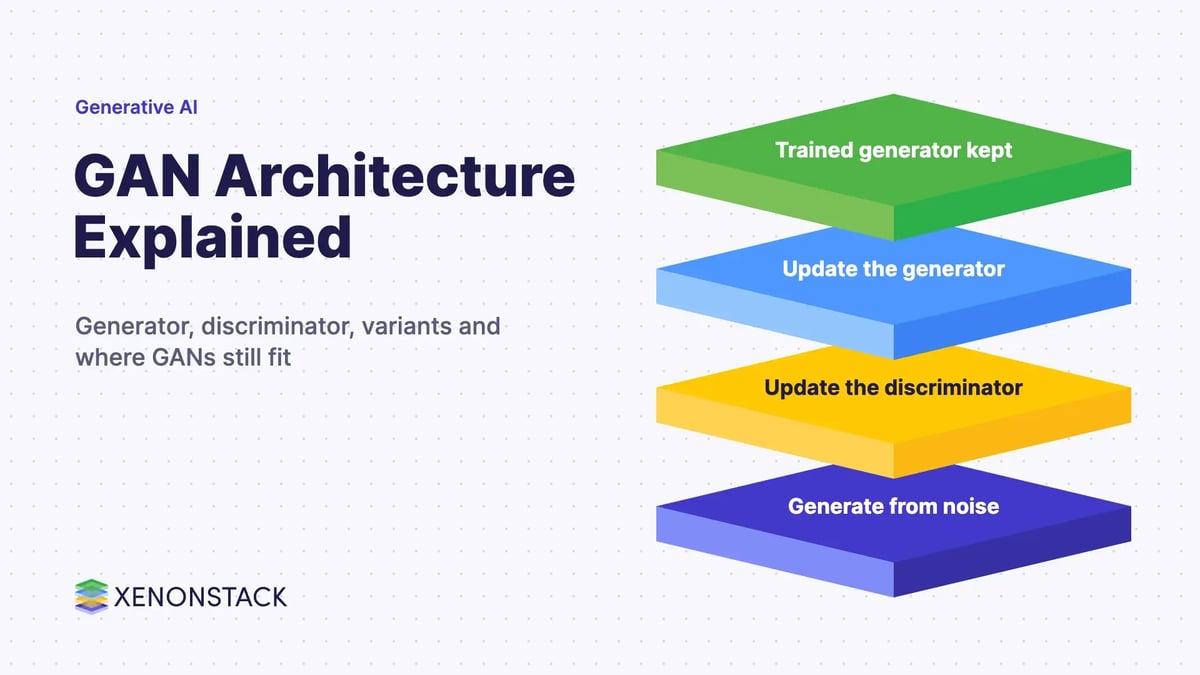
A standard GAN training loop repeats the same cycle many thousands of times:
- Sample noise. Draw a batch of random latent vectors (and, in a conditional GAN, the matching labels or other conditioning data).
- Generate. The generator maps each latent vector to a synthetic sample, such as an image or a table row, in a single forward pass.
- Mix with real data. Take a batch of real samples from the training set.
- Update the discriminator. The discriminator scores real and synthetic samples, and its weights are updated to separate them more accurately.
- Update the generator. Holding the discriminator fixed, the generator's weights are updated so that its samples are more likely to be scored as real. The only learning signal the generator receives is the gradient that flows back through the discriminator.
- Monitor and repeat. Track sample quality and diversity, and stop when quality stops improving or training begins to diverge.
In production the generator is the asset you keep. The discriminator exists to train it and is usually discarded, although in anomaly detection it can be reused as a scorer, as described later.
How are the generator and discriminator designed?
Generator
The generator takes a latent vector and upsamples it into the target output. In image GANs this is usually a stack of convolutional layers that grow spatial resolution layer by layer. Radford, Metz and Chintala's DCGAN paper (November 2015) set out architectural constraints for convolutional GANs and showed that both networks learn a hierarchy of representations, from object parts to whole scenes. Later designs such as StyleGAN (Karras, Laine and Aila, December 2018) borrowed from style transfer research so that high-level attributes, such as pose and identity in faces, are separated from stochastic detail, giving control over synthesis at specific scales.
Discriminator
The discriminator is a classifier, in images usually a convolutional network that downsamples the input to a single realness score. Its quality sets the ceiling on the generator: if it is too weak, the generator learns little; if it overpowers the generator, the gradients it passes back carry little useful signal. Many stabilisation methods therefore target the discriminator directly, for example spectral normalisation (Miyato et al., February 2018), a cheap weight normalisation that the authors report gives equal or better image quality than earlier stabilisation techniques.
Loss function
The original loss is the minimax objective above. Two important alternatives followed. The Wasserstein GAN (Arjovsky, Chintala and Bottou, January 2017) replaces the classifier with a "critic" and, according to its authors, makes training more stable, reduces mode collapse and produces loss curves that are useful for debugging. Relativistic losses ask whether a real sample looks more realistic than a fake one, rather than scoring each in isolation; ESRGAN uses this idea for super-resolution, and the 2025 R3GAN baseline builds on a regularised relativistic loss.
Which GAN variant fits which problem?
Most production GANs are built on one of a handful of published designs. Dates below are the arXiv submission dates of the original papers.
| Variant | Original paper | What it changed | When it fits |
| Original GAN | Goodfellow et al., June 2014 | Introduced adversarial training of a generator and discriminator | Teaching and baselines; rarely used unmodified in production |
| Conditional GAN (cGAN) | Mirza and Osindero, November 2014 | Feeds conditioning data, such as class labels, to both networks | When you need to control what is generated, for example a specific class or attribute |
| DCGAN | Radford et al., November 2015 | Convolutional design constraints for both networks | Small to mid-sized image tasks and as a starting architecture |
| WGAN and WGAN-GP | Arjovsky et al., January 2017; Gulrajani et al., March 2017 | Wasserstein critic; gradient penalty replaces weight clipping | When standard GAN training is unstable or collapses |
| CycleGAN | Zhu et al., March 2017 | Unpaired image-to-image translation using a cycle-consistency loss | Translating between two image domains when paired examples do not exist |
| Progressive GAN | Karras et al., October 2017 | Grows both networks from low to high resolution during training | High-resolution output; the authors report 1024 x 1024 CelebA images |
| StyleGAN family | Karras et al., December 2018; December 2019; June 2021 | Style-based generator; later artefact fixes, path length regularisation and alias-free, rotation and translation equivariant layers | High-fidelity, controllable image synthesis and editing in a narrow domain |
| GigaGAN | Kang et al., March 2023 | Scales GANs to text-to-image synthesis beyond the point where StyleGAN becomes unstable | Where generation latency matters; the authors report 0.13 seconds for a 512px image |
| R3GAN | Huang et al., January 2025 (NeurIPS 2024) | Regularised relativistic loss with local convergence guarantees and a modernised backbone, without ad-hoc tricks | New GAN projects that want a simpler, more stable starting baseline |
What goes wrong in GAN training, and how do teams fix it?
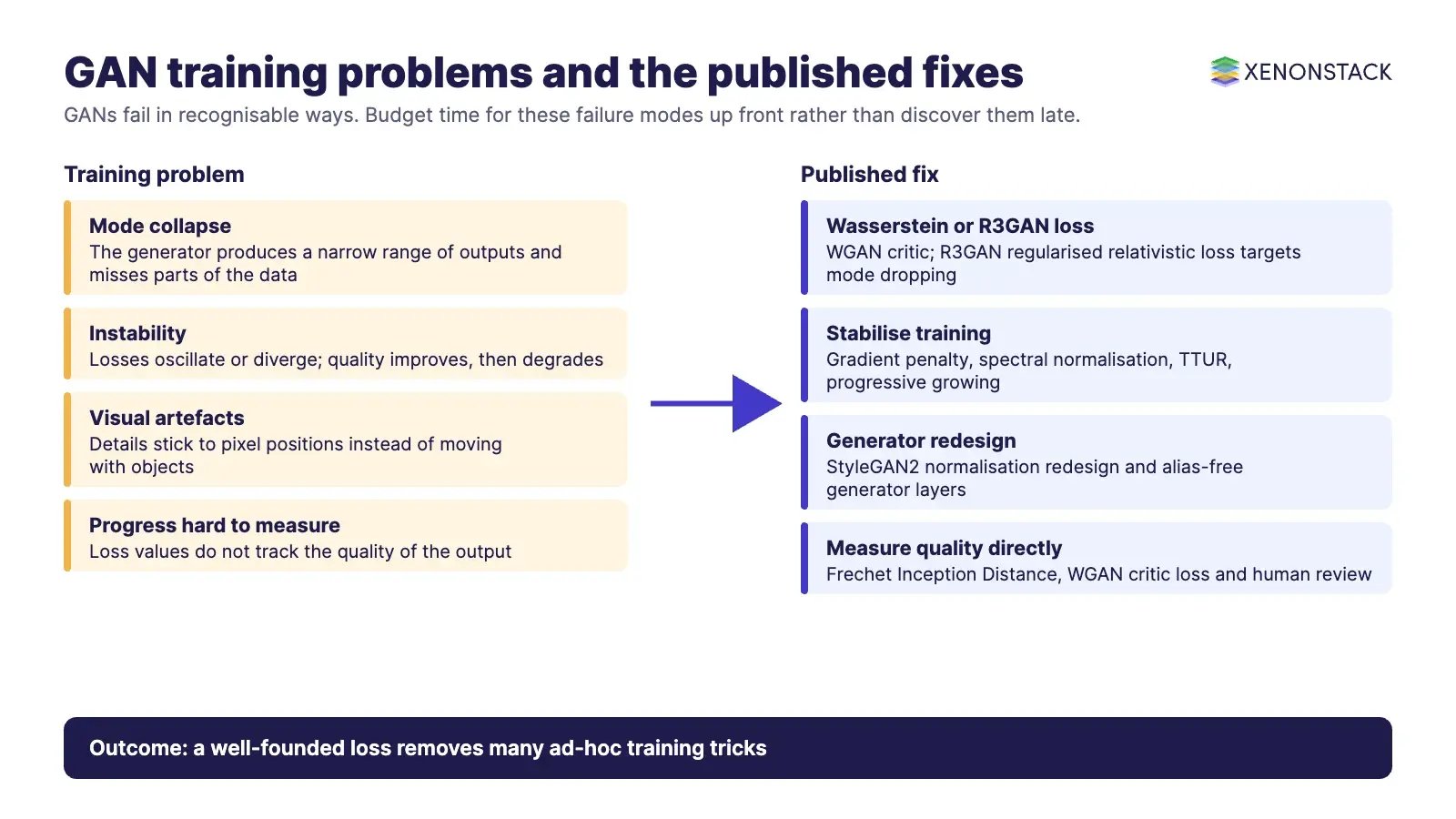
GANs fail in recognisable ways. Knowing the failure modes up front lets an engineering lead budget time for them rather than discover them late.
| Problem | What you see | Published fixes |
| Mode collapse | The generator produces a narrow range of outputs and ignores parts of the real data distribution | Wasserstein loss (WGAN); regularised relativistic loss (R3GAN), which targets mode dropping directly |
| Non-convergence and instability | Losses oscillate or diverge; quality improves then degrades | Gradient penalty (WGAN-GP); spectral normalisation; separate learning rates for the two networks (TTUR, Heusel et al., June 2017); progressive growing |
| Visual artefacts | Characteristic artefacts in generated images; details that stick to pixel positions instead of moving with objects | StyleGAN2 normalisation redesign; alias-free generator layers |
| Hard to measure progress | Loss values do not track output quality | Fréchet Inception Distance (FID), introduced in the TTUR paper; WGAN critic loss as a training signal; human review for domain-specific quality |
A useful sign of how far the field has moved: the R3GAN authors argue that the reputation of GANs as hard to train comes largely from the many empirical tricks earlier work relied on, and that a well-founded loss lets those tricks be removed.
Are GANs still relevant now that diffusion models lead?
Yes, but in a narrower role. In 2021 Dhariwal and Nichol showed in Diffusion Models Beat GANs on Image Synthesis that diffusion models could exceed the best GANs on image quality, reporting FID scores on ImageNet of 2.97 at 128 x 128, 4.59 at 256 x 256 and 7.72 at 512 x 512, and matching BigGAN-deep with as few as 25 forward passes per sample while covering the data distribution better.
GANs keep three advantages. First, a trained generator produces a sample in one forward pass, which suits latency-sensitive or high-volume workloads. Second, research continues: GigaGAN (2023) scaled GANs to text-to-image synthesis and R3GAN (2025) reports results that compare favourably with diffusion models on its benchmarks. Third, the adversarial idea now lives inside diffusion systems. Adversarial Diffusion Distillation (Sauer et al., November 2023) adds an adversarial loss to distil a large diffusion model so it can produce images in one to four steps, with the authors reporting SDXL-level performance in four steps.
Transformers are a third family. Esser, Rombach and Ommer (December 2020) combined a convolutional network that learns a vocabulary of image parts with a transformer that models how those parts compose, reaching megapixel synthesis. The practical comparison for an architect looks like this:
| Factor | GANs | Diffusion models | Transformer (autoregressive) models |
| Generation | One forward pass | Many denoising steps, reducible by distillation | Token by token over a learned vocabulary |
| Diversity and coverage | Risk of mode collapse | Strong distribution coverage | Strong, depends on tokeniser and scale |
| Training | Adversarial, needs careful tuning | Stable, compute-heavy | Stable, compute-heavy for long sequences |
| Best enterprise fit | Narrow-domain synthesis, super-resolution, anomaly scoring, real-time output | General-purpose and prompt-driven image generation | Multimodal systems that share a backbone with language models |
Where do GANs still earn their place in the enterprise?
Synthetic tabular data
Tables mix continuous and categorical columns, often with multi-modal distributions and imbalanced categories. Xu et al. (2019) used a conditional GAN to handle these properties and report that it beat Bayesian network baselines on most of the real datasets in their benchmark. Trade-off: synthetic tables can still leak information about real records, so privacy must be tested, not assumed. Our post on GANs and synthetic patient data covers this for healthcare.
Data augmentation for rare cases
Conditional GANs can generate extra examples of under-represented classes, such as rare defects or rare findings in biomedical image analysis. Trade-off: synthetic examples can teach a model the generator's artefacts, so validation must use real held-out data only. Where real examples of rare cases still need annotating, AgentLabel supports AI data labelling and annotation.
Anomaly detection
AnoGAN (Schlegl et al., March 2017) learns the range of normal anatomical variation and scores new images by how well they fit it, flagging retinal OCT scans with fluid or hyperreflective foci without annotated examples of disease. The same pattern applies to visual inspection where defects are rare. Trade-off: anything absent from the normal training data is flagged, so false-positive handling needs a human review path.
Super-resolution and image restoration
ESRGAN improved on SRGAN's textures and artefacts and placed first in the PIRM2018-SR challenge. Use cases include upscaling legacy imagery and enhancing low-resolution captures. Trade-off: the network invents plausible detail, so restored images should not be treated as evidence where exact fidelity matters.
Domain translation
CycleGAN learns mappings between two image domains without paired examples, with reported results on style transfer, season transfer and photo enhancement. More examples of image-focused uses are in our post on GANs for image synthesis, and marketing uses are covered in GANs in digital marketing.
What governance and risk controls do GAN deployments need?
GANs produce realistic synthetic content, which brings three classes of risk: privacy leakage from synthetic data, misuse for deepfakes, and regulatory transparency duties.
In the EU, Article 50 of the AI Act (Regulation (EU) 2024/1689) requires providers of systems that generate synthetic audio, image, video or text to ensure outputs are marked in a machine-readable format and detectable as artificially generated or manipulated (Article 50(2)), with exceptions for assistive editing that does not substantially alter the input. Deployers that publish deepfake image, audio or video content must disclose that it has been artificially generated or manipulated (Article 50(4)). The European Commission states that Article 50(2), (4) and (5) apply from 2 August 2026, and that the AI Omnibus agreed by the co-legislators envisages a grandfathering rule giving systems placed on the market before that date until 2 December 2026 to meet the marking duty. Content published before 2 August 2026 does not need retroactive labelling. The Commission's code of practice on transparency of AI-generated content is voluntary. The ElixirData Compliance Agent monitors operations in real time, identifying risks and recommending actions to keep them within regulatory and policy requirements.
Architecture can help with provenance: the StyleGAN2 authors note that their path length regulariser makes the generator easier to invert, so a generated image can be reliably attributed to the network that produced it. A practical control set for enterprise GAN work:
- Privacy testing of synthetic data before release, including checks that no real records are reproduced.
- Machine-readable marking of generated media, and a disclosure process for any deepfake-style content.
- Model and data lineage: which data trained which generator, who approved it and where its outputs go.
- Access controls on generators that can produce realistic faces, voices or documents.
- Human review for anomaly flags and for any output used in decisions about people.
How should an enterprise team decide whether to use a GAN?
A GAN is a good fit when the domain is narrow and well defined, output must be produced quickly or in volume, the team has real data to train on and capacity to tune training, and governance for synthetic outputs is in place. Prefer a diffusion or transformer model when you need broad, prompt-driven generation, strong diversity, or a pre-trained foundation model you can adapt instead of training from scratch. Many teams will use both, for example a diffusion model for creative generation and a GAN for real-time enhancement or anomaly scoring. Where GAN outputs feed decisions made by AI agents, ElixirData Context OS keeps governed context, versioned policy and decision traces in one decision layer above those agents.
To map one generative AI decision your agents should make, and the context and policy it depends on, book a Context Workshop. See what happens in the workshop.
Frequently asked questions about GAN architecture
What are the two main parts of a GAN?
A generator, which turns random noise into synthetic samples, and a discriminator, which classifies samples as real or generated. They are trained together in a minimax game.
Who invented GANs?
Ian Goodfellow and colleagues introduced GANs in a paper submitted to arXiv in June 2014.
What is mode collapse?
Mode collapse is when the generator produces only a narrow range of outputs and misses parts of the real data distribution. Wasserstein losses and the regularised relativistic loss used in R3GAN are published responses.
Are diffusion models better than GANs?
On image quality and distribution coverage, diffusion models have outperformed the best GANs on published benchmarks since 2021. GANs remain faster at generation, because they need one forward pass, and adversarial losses are now used to speed up diffusion models.
Does the EU AI Act apply to GAN outputs?
Yes, where a GAN-based system generates synthetic audio, image, video or text. Article 50 requires machine-readable marking by providers and disclosure of deepfakes by deployers, applicable from 2 August 2026.
Follow XenonStack on LinkedIn: XenonStack on LinkedIn for new guides on agentic AI, data and platform engineering.
Ready to put AI agents to work? Explore ElixirClaw, the agentic OS platform to build, orchestrate and govern AI agents.
Explore the XenonStack platform family: ElixirData · ElixirClaw · ElixirHub · NexaStack · MetaSecure · Neural AI · AgentGRC · AgentSRE · AgentAnalyst · AgentInstruct · AgentRAI · AgentScrum · AgentSearch · AgentForce · AI Aviator · SAIF Aviator · CohortIQ · XenonStack AI · XenonStack UAE