Key takeaway
- FOCUS is an open billing data specification and Vantage is a cost management platform. See how they differ, how AWS supports FOCUS and which you need.
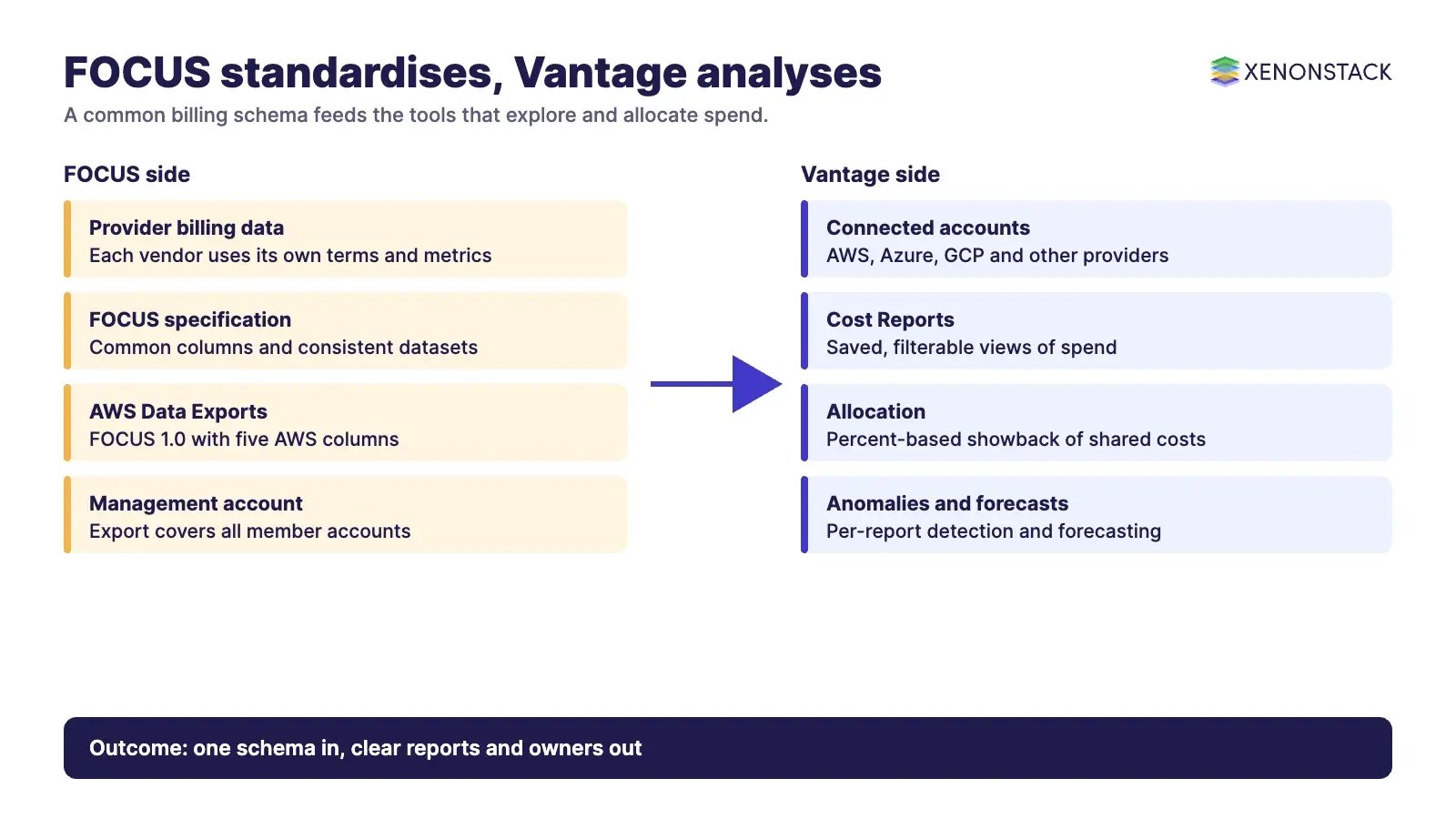
FOCUS and Vantage are not two competing AWS tools: FOCUS is an open specification for the format of cloud billing data, and Vantage is a cloud cost management platform that analyses spend and can work with FOCUS-format data. One defines how billing data should look. The other helps you explore and act on it.
Earlier comparisons of the two often described both as AWS cost services, which is not accurate. This guide is for FinOps practitioners, cloud finance teams and platform engineers who need to decide how to standardise billing data and which tool to use to analyse it.
What is FOCUS?
According to the FOCUS project page, FOCUS (the FinOps Open Cost and Usage Specification) is "an open specification that defines clear requirements for technology billing data generators to produce consistent datasets." It is supported by the FinOps Foundation, and releases are ratified by a steering committee. The problem it addresses is that vendors use different terms, taxonomies and metrics, so practitioners spend time ingesting and normalising billing data before analysis can start.
The same page says FOCUS 1.4 was ratified on 4 June 2026 and adds two datasets and 47 columns. Because the specification keeps evolving, check which version each of your providers exports.
What is Vantage?
Vantage's documentation describes it as a cloud cost management platform that pulls spend data from connected accounts. Its Cost Reports are saved, filterable views of spending, with a default view of all costs across connected accounts and an automatic forecast for each report. The page names providers such as AWS, Azure, GCP, Datadog and MongoDB Atlas, and says custom providers can be connected and FOCUS-format data is supported.
Documented features include filters by provider, account, service, region and tag, groupings by dimensions such as account, service and region, percent-based cost allocation for shared resources, per-report anomaly detection and forecasting.
How do FOCUS and Vantage differ?
| Question | FOCUS | Vantage |
|---|---|---|
| What is it? | An open specification for billing data | A cloud cost management platform |
| Who maintains it? | Supported by the FinOps Foundation, ratified by a steering committee | A software vendor |
| What does it give you? | A common schema, so data from different sources lines up | Reports, filters, allocation, anomaly detection and forecasts |
| Do you run it? | You consume exports that follow it | You connect accounts and use the platform |
| How do they relate? | Defines the data format | Can ingest FOCUS-format data |
How does AWS support FOCUS?
AWS Data Exports offers a FOCUS 1.0 table. The AWS documentation describes "FOCUS 1.0 with AWS columns" as cost and usage data formatted to FOCUS 1.0, with five additional AWS columns for proprietary billing data: x_CostCategories, x_Discounts, x_Operation, x_ServiceCode and x_UsageType. Under AWS Organizations, the table inherits your consolidated billing settings, and a management account export includes all member accounts.
AWS announced general availability of Data Exports for FOCUS 1.0 on 25 November 2024. The AWS announcement says conformance gaps fell from 19 in the June 2024 preview to 8 in the general release, and that standardised columns such as ListCost, BilledCost and EffectiveCost let you check discounts with one calculation.
Which one do you need?
Most teams need both ideas, not one or the other. Use FOCUS-format exports to standardise the data, and use an analysis tool, whether Vantage or another platform, to explore it.
| Your situation | Where to start |
|---|---|
| One AWS account, simple reporting | AWS exports and a small set of saved views |
| Several AWS accounts | FOCUS 1.0 with AWS columns from the management account |
| AWS plus other clouds and SaaS | FOCUS-format data from each source, loaded into one analysis tool |
| Chargeback and showback for shared costs | A platform with allocation rules, such as the percent-based allocation Vantage documents |
| Early warning on unusual spend | Anomaly detection in your chosen tool, with an owner for every alert |
For more on combining sources, see our guide to multi-cloud billing data. For the delivery and security side of AWS estates, see AWS DevSecOps.
How do AI agents change cloud cost management?
Once billing data follows one schema, an AI agent can query it, flag anomalies, explain what changed and propose actions such as rightsizing or tag clean-up. Agents are only as reliable as the data and policy behind them, so the open questions are which cost data an agent may read, what it may change, and who approves.
ElixirData is XenonStack's Context OS for governed data, policy and decision traces. For related data topics, see edge data management and augmented data management best practices.
What should you do first?
- Confirm which of your providers export FOCUS-format data and which version.
- Enable FOCUS 1.0 with AWS columns in AWS Data Exports for your management account.
- Agree a tagging and ownership scheme before choosing reports.
- Trial one analysis tool on a single team's spend.
- Decide which cost actions an agent may take alone and which need approval.
To map one cost decision your agents make, and the data and policy it depends on, book a Context Workshop. See what happens in the workshop.
Frequently asked questions
Is FOCUS an AWS service?
No. FOCUS is an open specification for billing data supported by the FinOps Foundation. AWS offers exports that follow it through AWS Data Exports.
Is Vantage an AWS service?
No. Vantage is a cloud cost management platform from a separate vendor that connects to providers such as AWS, Azure and GCP.
What does FOCUS 1.0 with AWS columns contain?
Cost and usage data formatted with FOCUS 1.0, plus five AWS columns for proprietary billing data: x_CostCategories, x_Discounts, x_Operation, x_ServiceCode and x_UsageType.
Can Vantage use FOCUS data?
Vantage documentation says custom providers can be connected and FOCUS-format data is supported.
Do I need FOCUS if I only use AWS?
Not necessarily, but FOCUS-format exports make it easier to add other providers later and to compare costs consistently.
Follow XenonStack on LinkedIn: XenonStack on LinkedIn for new guides on agentic AI, data and platform engineering.
Ready to put AI agents to work? Explore ElixirClaw, the agentic OS platform to build, orchestrate and govern AI agents.
Explore the XenonStack platform family: ElixirData · ElixirClaw · ElixirHub · NexaStack · MetaSecure · Neural AI · AgentGRC · AgentSRE · AgentAnalyst · AgentInstruct · AgentRAI · AgentScrum · AgentSearch · AgentForce · AI Aviator · SAIF Aviator · CohortIQ · XenonStack AI · XenonStack UAE