

Key takeaway
- Compare Dynamic Yield, Bloomreach, Algolia, Constructor, Nosto and Adobe Target on search, recommendations, data fit and cost, and when not to buy.
The best ecommerce personalization platform depends on where your revenue leaks. If shoppers cannot find products, start with search and discovery (Algolia, Constructor, Bloomreach). If you have traffic but flat conversion, start with on-site recommendations and testing (Dynamic Yield, Nosto). If your problem is repeat purchase across email, app and web, look at cross-channel platforms (Bloomreach Engagement, Adobe, Salesforce). Most vendors now add AI agents, such as shopping assistants and campaign builders, so the useful question is what data each one needs and how much control you keep over what it shows.
This guide is for ecommerce and digital leaders, and the architects who integrate these tools. It compares six options on five criteria and says when not to buy. For the retail background, see our guide to AI-driven personalization in retail.
Disclosure: XenonStack does not sell any platform below. Claims come from the vendor's own pages or a named trade report and are worded as vendor claims. Where we could not confirm a point we say "confirm with the vendor". Figures are vendor claims, not our tests.
How should you evaluate an ecommerce personalization platform?
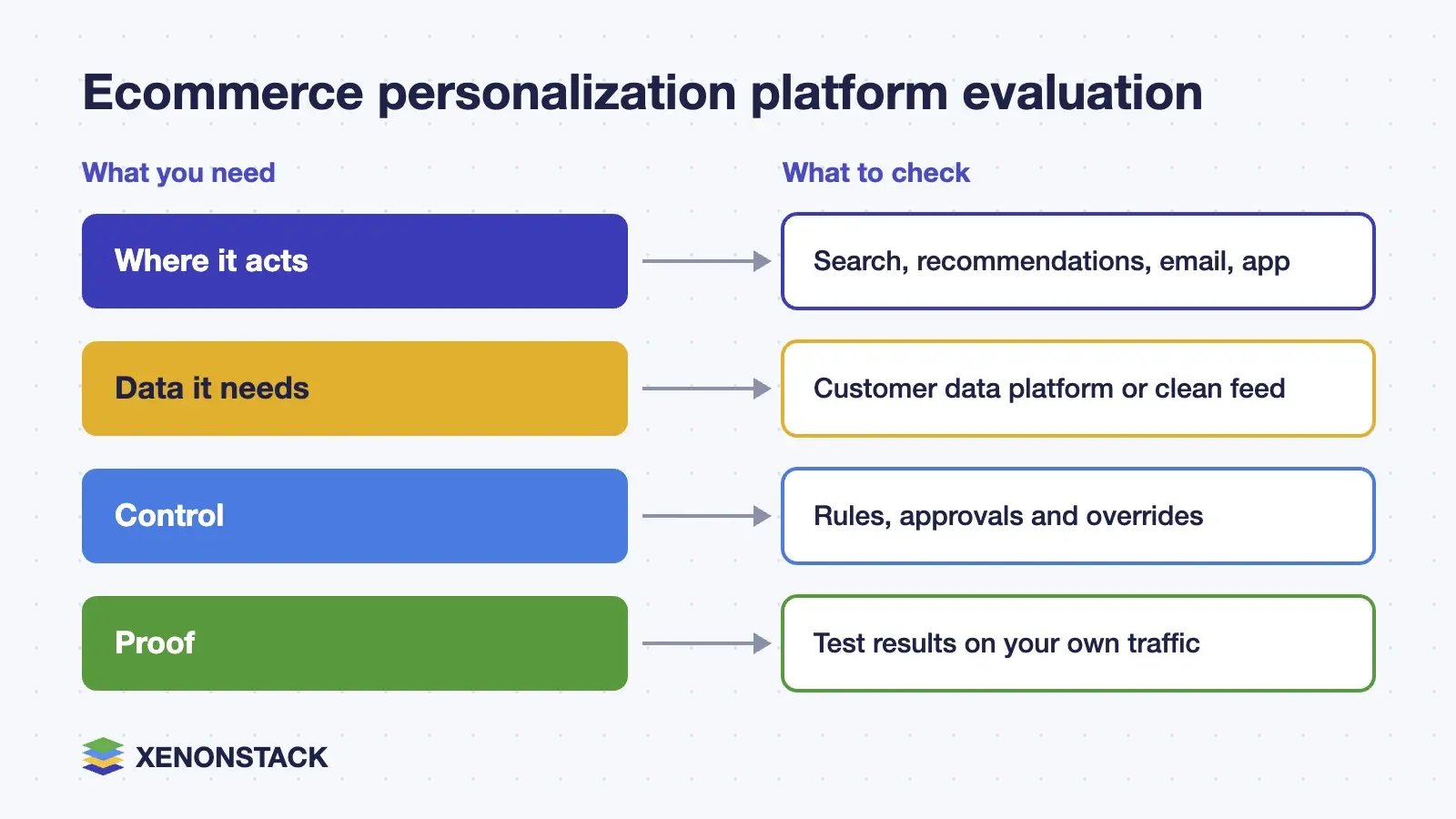
- Where it acts: search, recommendations, on-site content, email, app or all of them.
- Data it needs: does it need a customer data platform, a clean product feed, or only a script on the site?
- Control: can merchandisers see why a product ranks where it does and override it?
- Proof method: does it include holdout groups and testing so uplift is measured, not assumed?
- Cost and effort: quote-based or public pricing, and how many months to implement.
Which platforms are compared here?
| Platform | Main strength | Best fit | What to check |
|---|---|---|---|
| Dynamic Yield (Mastercard) | On-site personalization, recommendations, experimentation | High-traffic retailers with a testing programme | Team needed to run tests; pricing, confirm with the vendor |
| Bloomreach (Loomi AI) | Search, discovery, engagement and a unified data layer | Enterprise catalogues wanting search and campaigns together | Scope and cost across modules |
| Algolia | Fast, developer-first search with AI ranking | Technical teams building their own experience | Which AI features your contract tier includes |
| Constructor | Search and discovery ranked for business outcomes | Large catalogues with engineering resources | How rankings can be explained and overridden |
| Nosto | Recommendations and discovery for mid-market | Shopify and mid-market retailers | Release status of AI search features |
| Adobe Target / Experience Cloud | Personalization inside the Adobe stack | Enterprises already on Adobe | Total cost including implementation |
What does Dynamic Yield offer?
According to Mastercard, Dynamic Yield's Experience OS covers product recommendations, personalized content, audience segmentation, A/B testing and experimentation across web, app, email and other channels, and Mastercard says it has been named a Leader in Gartner's Magic Quadrant for Personalization Engines eight times. Mastercard also says targeting can use consumer spend insights from its own models.
Choose it when you want one place to personalise and test on-site experiences at scale. It suits teams that can run a structured testing programme. Ask the vendor for pricing, since we did not find it published.
What does Bloomreach offer?
According to Bloomreach, Loomi AI is an agentic platform that brings customer, content and product data together and acts on it in real time across search, email, web and other channels. It has launched a conversational shopping agent and a marketing agent that builds campaign workflows from a prompt, and says the shopping assistant raised shopper engagement on Black Friday 2025. That is a vendor claim. It also offers Loomi Connect to extend search intelligence into agentic AI ecosystems such as the OpenAI marketplace.
Choose it when you want search, merchandising and campaigns on one data layer. Ask for the full cost as modules are added.
What does Algolia offer?
According to Algolia, it is known for speed and developer-friendly APIs, with NeuralSearch blending keyword and vector search and AI ranking and personalization layered on top. Features differ by contract tier, so confirm with Algolia which AI features your tier includes.
Choose it when your engineers want to build the experience themselves and search speed is the priority.
What does Constructor offer?
Constructor describes itself as an AI-native search and product discovery platform for enterprise ecommerce, and says it ranks results by business outcomes such as revenue.
Choose it when you run a large catalogue with plenty of traffic and engineering support. Ask how a merchandiser can see why a product ranked where it did, how to pin or exclude products, and how the model performs on categories with little traffic.
What does Nosto offer?
According to a trade report, Nosto's Huginn AI and Large Intent Model power recommendations and discovery, and it connects to Klaviyo and Shopify's Sidekick. It is aimed at Shopify and mid-market retailers. Confirm the release status of any AI search feature on the vendor page before you buy for that feature.
What does Adobe Target offer?
Adobe Target belongs to Adobe Experience Cloud and uses machine learning to choose experiences per visitor, with links to Adobe Analytics and Experience Manager.
Choose it when Adobe is already your content and analytics stack. Ask for the total cost including implementation and integration work.
How do the options compare on control and measurement?
| Platform | Testing and holdouts | Visibility into ranking | Typical cost model |
|---|---|---|---|
| Dynamic Yield | A/B testing and experimentation per Mastercard | Confirm with the vendor | Quote-based |
| Bloomreach | Confirm with the vendor | Merchandiser controls per vendor | Modular, not published |
| Algolia | Confirm with the vendor | Configurable relevance, confirm with the vendor | Tiered |
| Constructor | Confirm with the vendor | Ask for per-ranking explanation | Custom enterprise |
| Nosto | Confirm with the vendor | Confirm with the vendor | Quote-based |
| Adobe Target | Part of Adobe testing tools | Confirm with the vendor | Part of Adobe licensing |
Ask any vendor to show how uplift is measured against a holdout group, not against last month.
Which platform fits your situation?
- Search is the problem: shortlist Algolia, Constructor or Bloomreach.
- You have traffic and a testing team: Dynamic Yield.
- Shopify or mid-market, small team: Nosto first.
- Adobe or Salesforce is your core stack: start with that vendor's personalization before adding another.
- You want AI shopping assistants and campaign agents with guardrails: pilot the vendor agent on one category and review what it recommended and why.
When should you not buy a personalization platform?
- Your product data is incomplete or inconsistent. Models inherit the mess.
- Traffic is low, so tests cannot reach a clear result.
- You have no consent and data policy for using behaviour and purchase data.
- No one owns merchandising rules and testing after launch.
How can you test a platform before committing?
Run a six-week pilot on one category or page type with a fixed holdout group. Record revenue per visitor, conversion, average order value and returns for both groups. Check that a merchandiser can pin or exclude a product and see the reason a product was recommended.
To agree what an AI agent may recommend on its own and what evidence each change must leave, book a Context Workshop or see what happens in the workshop. Need help shortlisting or designing a pilot? Book a strategy call.
Frequently asked questions
What is ecommerce personalization software?
Software that changes what each shopper sees, such as search results, recommendations, banners and emails, based on behaviour and product data.
Which platform is best for Shopify stores?
Nosto is aimed at Shopify and mid-market retailers, and Bloomreach and Algolia also offer Shopify integrations. Confirm fit for your catalogue size.
Do I need a customer data platform first?
Not always. Recommendation tools can start from on-site behaviour and a product feed. Cross-channel work usually needs unified customer data.
How do AI shopping agents change personalization?
They let shoppers ask questions in the search bar and get guided results. Test them on one category and review the answers for accuracy.
How do I prove personalization works?
Use a holdout group that does not see the personalised experience and compare revenue per visitor over the same period.
How much does it cost?
Most enterprise vendors quote privately. Expect module-based pricing, and ask for the full cost including implementation.
Follow XenonStack on LinkedIn: XenonStack on LinkedIn for new guides on agentic AI, data and platform engineering.
Ready to put AI agents to work? Explore ElixirClaw, the agentic OS platform to build, orchestrate and govern AI agents.
Explore the XenonStack platform family: ElixirData · ElixirClaw · ElixirHub · NexaStack · MetaSecure · Neural AI · AgentGRC · AgentSRE · AgentAnalyst · AgentInstruct · AgentRAI · AgentScrum · AgentSearch · AgentForce · AI Aviator · SAIF Aviator · CohortIQ · XenonStack AI · XenonStack UAE


