

Key takeaway
- Learn what audit ready AI fraud detection means for banks: the decision record, human review limits, replay and change control, plus a 90 day plan.
Audit ready AI fraud detection means a bank can explain, reproduce and defend any fraud decision months later from a stored record, without asking engineers to reconstruct it. The record shows what data the system saw, which model and policy versions applied, who or what had authority to act, and what happened next, including any human override. A bank can test this by picking one declined payment from last quarter and asking for the full story in under an hour.
Why does audit readiness matter for fraud decisions?
Fraud models are judged twice. First on whether they catch fraud, then on whether the bank can account for what they did. The second test arrives late, often during an internal audit, a regulatory review or a customer dispute, and it asks for evidence the model alone does not produce.
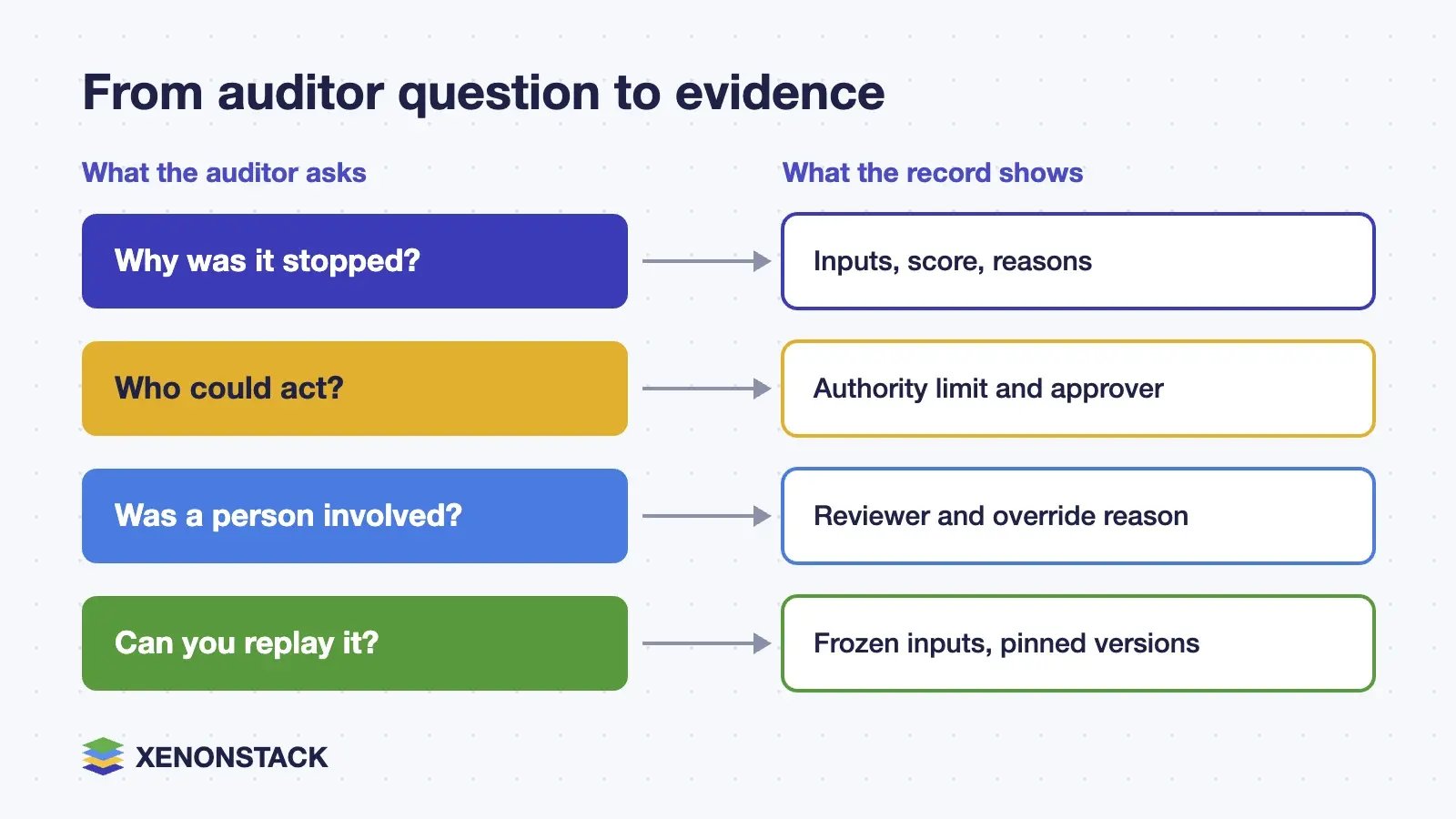
A score is not a decision. A decision is a score plus context, a policy, an authority and an outcome. If only the score is stored, the bank can say the model flagged a transaction but not why the action was allowed, who approved it, or whether the same inputs would give the same answer today. That gap is where audit findings come from.
This article explains the concept and the evidence. If you are comparing vendors, our guide to AI fraud detection platforms for banks covers the selection criteria. Here we focus on what the evidence must contain and how to build it.
What do regulators and internal auditors actually ask for?
Questions differ by institution, but they cluster around the same themes: what the model is for, how it was validated, how it is monitored, and who is accountable. The table translates those themes into requests a fraud team should be able to answer from records, not memory.
| What the auditor asks | What the record must show | Where it usually comes from |
|---|---|---|
| Why was this transaction stopped? | Inputs, score, reason codes and the rule or policy that triggered action | Fraud engine plus the decision trace |
| Who was allowed to act? | The authority level, the approver and the time of approval | Policy engine and approval log |
| Was a person involved? | Reviewer identity, notes, and any override with a reason | Case management system |
| Which version made the call? | Model version, rule set, thresholds and data feed at that moment | Model inventory and release records |
| Can you reproduce it? | A stored snapshot that replays to the same outcome | Decision trace store |
| What changed since? | Approved change, validation result and rollback path | Change control log |
Notice that no row asks for a better model. Audit readiness is mostly an evidence and control problem that sits around the model.
What does US guidance say about models and evidence?
In April 2026 the Federal Reserve, the OCC and the FDIC issued revised model risk management guidance as SR 26-2. It supersedes SR 11-7 and the 2021 interagency statement on model risk management for BSA and AML systems. The letter describes a risk-based approach tailored to each institution's model risk profile, and says it is expected to be most relevant to banking organisations with more than $30 billion in total assets.
The guidance covers themes a fraud team will recognise: a model inventory with enough detail to understand risk, validation, ongoing monitoring against changes in products, clients and data, documentation, and effective challenge from independent, expert reviewers. It states that the principles still apply to vendor models, even where the bank cannot see the vendor's code.
One point matters for anyone planning agents. The guidance footnotes that generative and agentic AI are novel and rapidly evolving, and it leaves them outside its scope, pointing banks to their own risk management practices. A bank deploying AI agents around fraud decisions therefore cannot rely on the guidance alone. It needs its own written rules for what an agent may do, which is the subject of the next sections. This is a summary, so read the primary text with your compliance team.
The NIST AI Risk Management Framework, released in January 2023, is a voluntary resource organised around four functions: Govern, Map, Measure and Manage. Many banks use it as a common vocabulary for AI oversight alongside their supervisory guidance.
What must a fraud decision record contain?
Think of the record as a case file that could be handed to someone who was not in the room. A useful minimum has nine parts.
- Identity of the decision: a unique reference, timestamp and the customer, account or transaction it concerns.
- Inputs as seen: the data values and feeds used, captured at decision time, not looked up again later.
- Model and rule versions: the exact versions, thresholds and feature definitions in force.
- Score and reasons: the output and the main factors behind it, in plain words.
- Policy applied: the written rule that mapped the score to an action.
- Authority: whether the agent or system was permitted to act, and under which limit.
- Human involvement: who reviewed, what they saw, and whether they agreed or overrode.
- Outcome: what was done, and any later correction, such as a released payment or a confirmed loss.
- Integrity proof: a way to show the record has not been altered since it was written.
Most banks hold parts of this today, scattered across the fraud engine, the case system and email. The work is joining them under one reference so an auditor follows a single thread.
Where should humans stay in the loop?
Audit readiness does not mean a person approves everything. It means the bank has decided, in writing, which decisions an agent may take alone and which need a named person. A workable split uses three tiers.
- Act and record: low-impact, reversible steps such as adding a step-up check to a payment. The agent acts, and the decision record is written.
- Prepare and approve: steps with customer impact, such as holding funds. The agent assembles the evidence and a reviewer approves.
- Human only: irreversible or regulated steps, such as closing an account or filing a suspicious activity report. The agent may summarise, but a person decides.
Review the boundaries on a schedule, and log every exception. A boundary that nobody can see is not a control.
How can a bank reproduce a decision months later?
Reproduction is the hardest test. Rerunning a model today with today's data rarely matches the past, because features, thresholds and even customer records have moved on. To replay a decision, the bank needs a frozen snapshot of the inputs, pinned versions of the model and policy, and a way to run them in a controlled environment.
Plan this on day one, because it is expensive to retrofit. Decide what is snapshotted, how long it is kept, and who may run a replay. Then rehearse: pick ten past decisions at random and replay them. Any that do not match tell you where evidence is missing.
How should model and policy changes be controlled?
Most surprises in fraud come from change: a new threshold, a retrained model, a revised data feed, or a tweak to an agent's instructions. Treat each as a controlled change with an owner, a reason, a test result and an approval, and keep a rollback path ready.
- Register every model, rule set and agent policy in one inventory.
- Run changes in shadow mode first, comparing old and new decisions side by side.
- Require independent challenge before a change reaches production.
- Tie each decision record to the version live at that moment.
What is a practical audit readiness checklist?
Use this list to find gaps before an auditor does. A "no" on any line is a work item.
- Can we retrieve one end-to-end record for any decision from the last quarter?
- Does each record name the model, rule and policy versions in force?
- Are inputs stored as seen at decision time?
- Is the agent's authority limit written down and enforced by the system?
- Do human overrides carry a reviewer name and a reason?
- Can we replay a past decision to the same outcome?
- Is every change approved, tested and reversible?
- Can we show the record has not been altered?
- Have we agreed retention periods with compliance and legal?
- Have we rehearsed an audit request using real cases?
How does XenonStack approach audit ready fraud decisions?
XenonStack does not ask banks to replace their fraud engine. The engine keeps scoring. Around it, governed AI agents on ElixirClaw handle the work that follows a flag: gathering evidence, preparing the case, and taking only the actions that policy allows. Each action is policy-driven, higher-impact steps wait for a human approval, and every decision is auditable.
ElixirData acts as the context and decision-trace layer. It captures the context an agent used, the policy it applied and the outcome, and keeps them linked so a reviewer can follow one thread from alert to action. The aim is a record that answers the auditor's questions in the table above without a manual hunt across systems.
For wider oversight of enterprise agents, see our work on AI governance, risk and compliance for agents, and for sector context, our banking industry solutions. Every deployment starts by agreeing the boundaries in writing, because tooling cannot fix an unclear policy.
What does a first 90 days plan look like?
Start narrow. One fraud scenario, one set of decisions, one audit rehearsal.
- Days 1 to 30, scope and map: choose one use case, inventory the models and rules involved, write the decision record fields, and agree the three autonomy tiers with risk, compliance and audit.
- Days 31 to 60, build and shadow: capture decision traces alongside the live engine, run agents in shadow mode, and compare their recommendations with analyst decisions.
- Days 61 to 90, rehearse and decide: replay a sample of past decisions, run a mock audit request, fix the gaps, and agree with sponsors whether to widen the scope.
Judge the pilot on evidence quality and reviewer confidence as well as detection. If the record cannot answer the auditor's questions, widen nothing yet.
To agree what an agent may decide on its own and where the audit record lives, book a Context Workshop. Want a second opinion on your approach? Book a strategy call.
Frequently asked questions
What does audit ready mean for AI fraud detection?
It means every fraud decision can be explained, reproduced and defended later from a stored record. The record shows the inputs, the model or rule version, the policy applied, who or what held authority, and the outcome, including any human override.
Does an audit ready record replace the bank's fraud engine?
No. The fraud engine keeps scoring transactions. The audit layer sits beside it, captures the context and the decision, and records what happened, so the engine does not have to double as an evidence store.
Which US guidance should a bank read first?
Start with SR 26-2, the revised model risk management guidance issued in April 2026 by the Federal Reserve, the OCC and the FDIC. It supersedes SR 11-7. Its scope excludes generative and agentic AI, so a bank still needs its own governance for those tools. Check the primary text with compliance counsel.
How long should decision records be kept?
Retention is set by the bank's own policy and the rules that apply in each jurisdiction, so agree it with compliance and legal teams before build. Design storage so that records stay readable and linked to the right model and policy versions for the whole retention period.
Where should an AI agent never decide alone?
Anywhere the consequence is hard to reverse or the evidence is thin. Typical examples are closing an account, filing a suspicious activity report, and any action outside written policy. In those cases the agent prepares the case and a named person decides.
Follow XenonStack on LinkedIn: XenonStack on LinkedIn for new guides on agentic AI, data and platform engineering.
Ready to put AI agents to work? Explore ElixirClaw, the agentic OS platform to build, orchestrate and govern AI agents.
Explore the XenonStack platform family: ElixirData · ElixirClaw · ElixirHub · NexaStack · MetaSecure · Neural AI · AgentGRC · AgentSRE · AgentAnalyst · AgentInstruct · AgentRAI · AgentScrum · AgentSearch · AgentForce · AI Aviator · SAIF Aviator · CohortIQ · XenonStack AI · XenonStack UAE


