Key takeaway
- How a supervisor, RAG and SQL agent design on AWS EKS and Qdrant searches structured and unstructured data, with controls, trade-offs and adoption steps.
Agent search in an enterprise is rarely a single-database problem. Answers sit in documents, policies and relational records, and a search box that only matches keywords misses most of them. The DeepQuery Navigator pattern described here puts a supervisor agent in front of a retrieval-augmented generation (RAG) agent and a SQL agent, so one question can reach both unstructured and structured data. It was built by our team for an insurance technology client (anonymised) on AWS cloud infrastructure.
This guide is written for CTOs, CIOs and solution architects who need to decide whether agentic search fits their estate. It covers the architecture, which query goes to which agent, the controls to put around it, the trade-offs, and an adoption sequence. For the wider design context, see our guides to agentic workflows and a closely related agentic RAG engagement platform.
What is agentic search and why does it replace keyword search?
According to AWS, retrieval-augmented generation augments a large language model with external data, such as internal documents, so the model has the context it needs for a specific use case. Content is turned into embeddings, which are numeric representations of meaning, and stored in a vector database. At query time an orchestrator runs a similarity search, adds the retrieved context to the prompt and asks the model to answer from it (AWS Prescriptive Guidance, read 13 Nov 2026).
Agentic search adds a decision step on top. Instead of one fixed retrieval path, a supervisor agent decides whether a question needs documents, a database query or both, and combines the results. That matters when an agent search covers licensing records, customer profiles and policy text at the same time.
What problem did the legacy agent search have?
The insurance technology client had an agent search that users found slow, incomplete and short on filtering options. The legacy system was built on a rigid architecture that was hard to adapt, and its databases were difficult to scale and did not support real-time indexing. Integration with customer profiles, licensing data and third-party verification services was fragile. Data privacy obligations and high availability requirements added further constraints, and the client needed search that worked for agents, support staff and customers across regions.
The programme goals were therefore architectural rather than cosmetic: modular services, real-time indexing, one entry point for structured and unstructured questions, and a traceable history of what was asked and answered.
How does the DeepQuery Navigator architecture work?
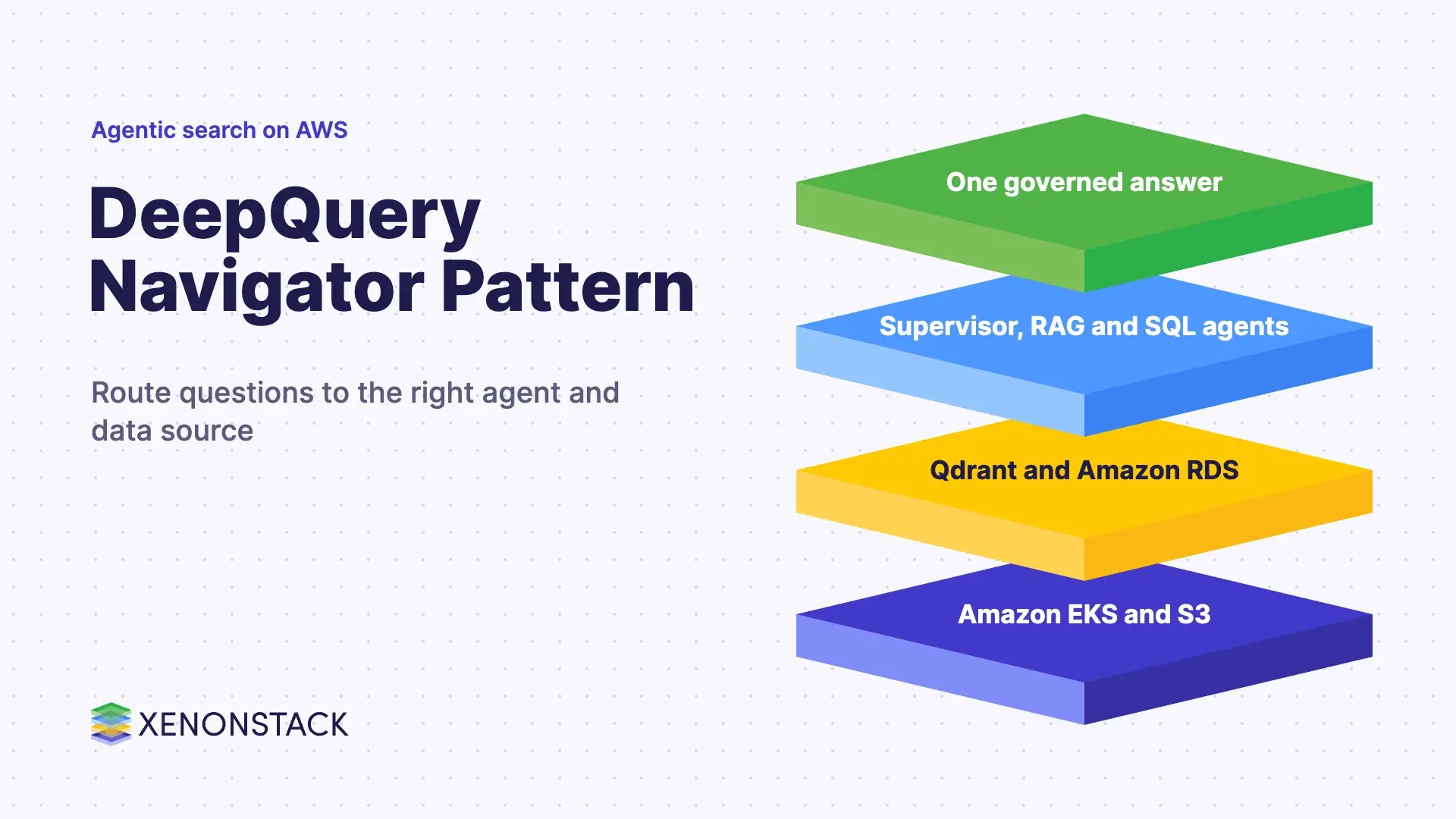
The solution is a microservices-based multi-agent framework running on Amazon EKS. Three agents carry the logic: a Supervisor Agent (a ReAct-style agent) that plans and routes, a RAG Agent for unstructured content, and a SQL Agent for structured records. An embedding pipeline fills a Qdrant vector database from files held in Amazon S3, and a frontend provides agent chat and a data configuration interface.
| Component | Role in the pattern | Source for the capability |
|---|---|---|
| Supervisor Agent | Reads the question, picks the RAG Agent, the SQL Agent or both, and merges the answer | Our design |
| RAG Agent | Retrieves passages from the vector store and grounds the answer in them | RAG steps per AWS Prescriptive Guidance |
| SQL Agent | Runs structured queries against Amazon RDS | Our design |
| Qdrant | Vector search with payload filtering and hybrid (semantic plus lexical) retrieval | Qdrant documentation |
| Amazon EKS | Runs the agent services and frontend; AWS manages the Kubernetes control plane | Amazon EKS user guide |
Which AWS services does it use?
- Amazon EKS: hosts the multi-agent services and the frontend.
- Amazon S3: holds unstructured data.
- Amazon RDS: holds structured data.
- Qdrant: vector database for semantic search.
- AWS CodePipeline: embedding and deployment pipeline.
- Amazon CloudWatch: monitoring and observability.
- AWS IAM: access control.
How was it built and run?
- Agile delivery with two-week sprints.
- Microservices on EKS, deployed through CodePipeline.
- The embedding pipeline populates Qdrant from S3, and real-time data sync keeps the index current.
- The Supervisor Agent orchestrates the RAG Agent and the SQL Agent.
- Checkpoints and history are stored securely for traceability.
- Infrastructure as code gives reproducible deployments, and business-user dashboards handle configuration.
Which query should go to which agent?
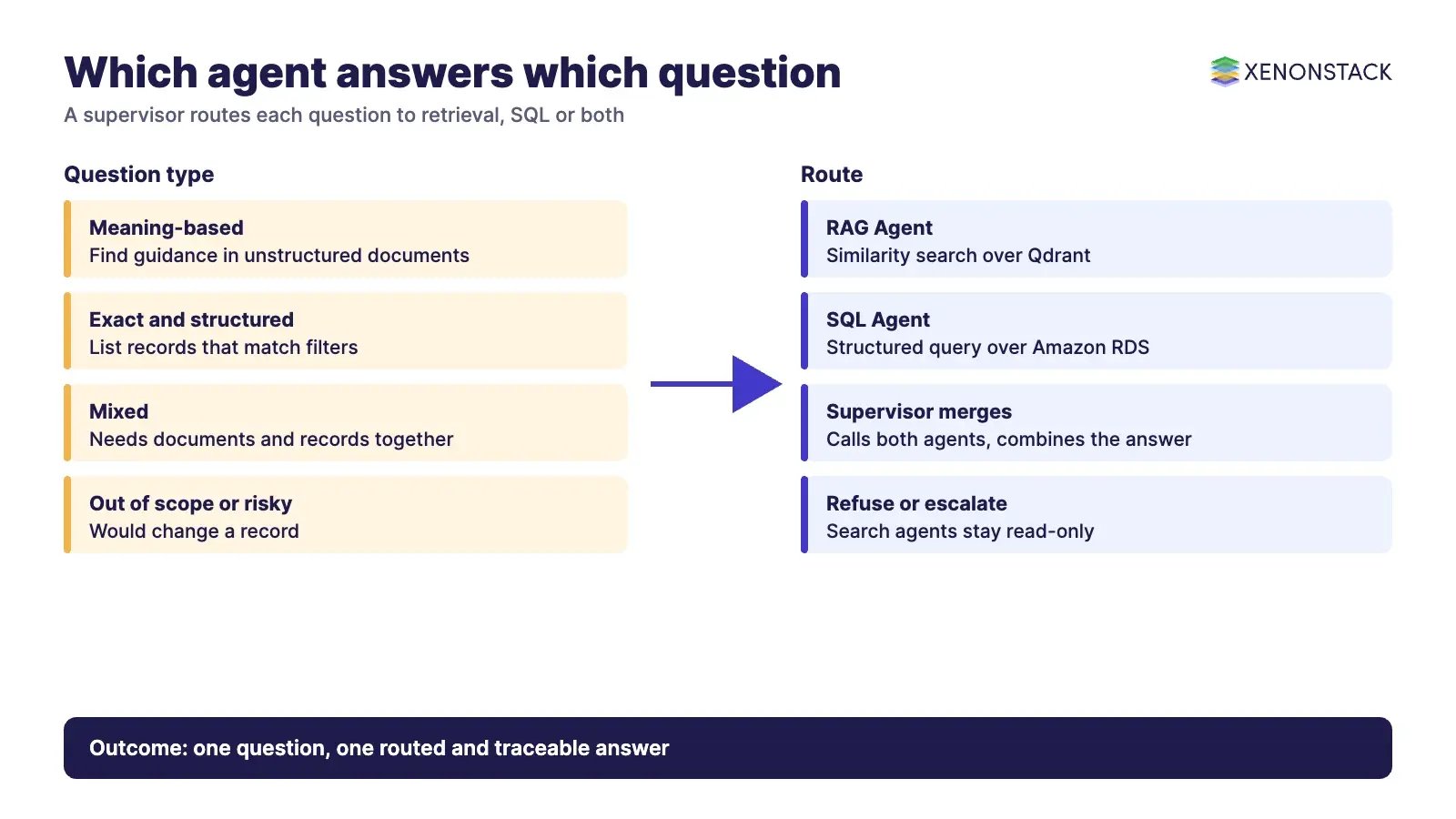
| Question type | Example | Route | Why |
|---|---|---|---|
| Meaning-based, unstructured | Find guidance on a product or procedure | RAG Agent over Qdrant | Similarity search matches meaning, not exact words |
| Exact, structured | List agents licensed in a given state | SQL Agent over RDS | Records and filters are exact; retrieval by similarity would guess |
| Mixed | Summarise an agent's licensing status and the related guidance | Supervisor calls both and merges | One answer needs both sources |
| Out of scope or risky | A request that would change a record | Refuse or escalate to a person | Search agents should be read-only unless a policy says otherwise |
Qdrant states that its payload indexes let filtering happen during the semantic search phase, and that it supports hybrid retrieval with semantic and lexical search (Qdrant documentation, read 13 Nov 2026). In practice that lets metadata such as region or role narrow results without a second pass.
How should an enterprise govern and secure agent search?
A search agent touches personal and commercial data, so controls matter as much as relevance. The OWASP Top 10 for LLM Applications (2025 edition) names risks that apply directly: prompt injection, sensitive information disclosure, excessive agency and vector and embedding weaknesses (OWASP GenAI Security Project, read 13 Nov 2026). Our guides to agentic AI risk management and agentic AI governance and compliance cover the control framework in more depth.
| Risk | Control to apply |
|---|---|
| Users see data they should not | Enforce permissions at retrieval time; use IAM and Kubernetes RBAC, which Amazon EKS supports together |
| Prompt injection through retrieved content | Treat retrieved text as untrusted input; keep the agents read-only |
| Agent does more than intended | Limit tools per agent; require approval for any write action |
| Stale or wrong answers | Monitor index freshness and sample answers against source records |
| No audit trail | Store queries, retrieved sources and agent steps for review |
Compliance obligations such as SOC 2 or HIPAA depend on the organisation, the data and the contracts involved. Confirm the scope with your own compliance team and the framework owners; this post does not make compliance claims for any deployment.
What are the trade-offs, and when is this pattern not the right choice?
- More moving parts. A supervisor, two agents, a vector store and an embedding pipeline need more operations effort than a single search index.
- Routing errors. The supervisor can pick the wrong source, so route decisions need logging and review.
- Index freshness. Real-time indexing needs an owner and a failure alert, because a stale index gives confident but outdated answers.
- Cost. Amazon EKS charges per cluster and separately for the underlying resources, so size the cluster to the workload (Amazon EKS user guide).
- When not to use it. If your data sits in one well-modelled database and users ask fixed questions, a conventional search or report is simpler and easier to audit.
How should a team adopt it in sequence?
| Stage | What to do | Exit check |
|---|---|---|
| 1. Scope | List the data sources, user groups and the questions that matter most | Agreed question set with owners |
| 2. Prepare data | Clean, chunk and embed unstructured content; model the structured tables the SQL Agent may read | Schema audit passes |
| 3. Build retrieval | Stand up the vector store and RAG Agent; test with the agreed questions | Answers cite the right sources |
| 4. Add routing | Introduce the supervisor and the SQL Agent | Routing logged and reviewed |
| 5. Secure and observe | Apply access control, logging and monitoring | Risk review signed off |
| 6. Roll out in increments | Release to one group, collect feedback, then widen | Feedback loop in place |
What implementation hurdles should teams plan for?
The client reported two main hurdles: integrating fragmented legacy systems and keeping data in sync in real time. Midway through delivery, unexpected schema inconsistencies caused indexing failures. The team responded with a validation layer and automated schema audits. Regular demos and feedback loops kept stakeholders aligned. Clear documentation, early stakeholder engagement and incremental rollouts helped, and infrastructure as code with CI/CD pipelines made deployments repeatable. Teams running this pattern in production may also want a support model, covered in AI managed services.
What is on the roadmap for DeepQuery?
The client plans multilingual support and voice search, followed by chatbot interfaces and predictive agent recommendations using machine learning. It is also evaluating further AWS services, including Amazon SageMaker and Amazon Comprehend. These are plans, not delivered features, and each would go through the same governance review as the original build.
For teams that want search built on governed context, AgentSearch is, according to its site, an agentic search layer for unstructured and semi-structured enterprise knowledge, with retrieval that follows the access permissions of ElixirData Context OS, which keeps governed context, versioned policy and decision traces in one decision layer above AI agents. ElixirClaw is an agentic OS platform to build, orchestrate and govern AI agents and automation workflows while keeping humans in control.
To map one search decision your agents should make, and the context and policy it depends on, book a Context Workshop. See what happens in the workshop.
FAQ
What is DeepQuery Navigator?
It is our multi-agent search pattern: a Supervisor Agent routes each question to a RAG Agent, a SQL Agent or both, using Qdrant for vector search and Amazon RDS for structured data, hosted on Amazon EKS.
Why use a supervisor agent instead of one search index?
Questions differ. Meaning-based questions suit vector retrieval, while exact questions suit SQL. A supervisor chooses the route and merges the answer.
What does RAG add to search?
According to AWS, RAG gives a language model external data, such as internal documents, so answers are grounded in your own content rather than only the model's training data.
Which security risks apply to an agent search system?
The OWASP Top 10 for LLM Applications (2025) lists prompt injection, sensitive information disclosure, excessive agency and vector and embedding weaknesses, all of which apply to search agents.
Does it need real-time indexing?
Only if users need new records to be searchable quickly. It adds operational work, so assign an owner and alert on indexing failures.
When should we not build this?
When your data sits in one well-modelled database and users ask fixed questions, conventional search or reporting is simpler to run and audit.
Explore the XenonStack platform family: ElixirData · ElixirClaw · ElixirHub · NexaStack · MetaSecure · Neural AI · AgentGRC · AgentSRE · AgentAnalyst · AgentInstruct · AgentRAI · AgentScrum · AgentSearch · AgentForce · AI Aviator · SAIF Aviator · CohortIQ · XenonStack AI · XenonStack UAE