Key takeaway
- How XenonStack helped XtendLabs build an on-demand platform for Hadoop, NoSQL, AI, IoT and blockchain workloads on Kubernetes and AWS at low running cost.
Platform-as-a-Service gives teams on-demand access to compute, storage and tools without building or administering the underlying infrastructure. XenonStack helped XtendLabs build an emerging technology platform on Kubernetes and AWS, so individuals, enterprises and academic institutions can work with Hadoop, NoSQL, AI, IoT and blockchain applications immediately.
What is Platform-as-a-Service and why does it matter?
A Platform-as-a-Service lets users deploy and run applications while the provider manages servers, storage, scaling and availability. For decision makers, it converts large upfront infrastructure investment into pay-for-what-you-use capacity and shortens the path from idea to a working proof of concept.
XtendLabs set out to offer exactly that for emerging technologies, where installing and configuring complex software stacks is often the slowest and most expensive part of getting started.
What challenges did XtendLabs face?
Building a shared platform for demanding workloads raised several connected problems. Each had to be solved without letting infrastructure cost grow beyond what customers would pay.
- Choosing a provider that keeps infrastructure cost minimal.
- Storing customer data safely and reliably.
- Keeping services available around the clock.
- Selecting technologies for developing and deploying the software.
- Providing enough compute and storage for big data and virtualisation tools.
- Offering an interactive front end through which deployed tools can be reached.
How did XenonStack build the platform?
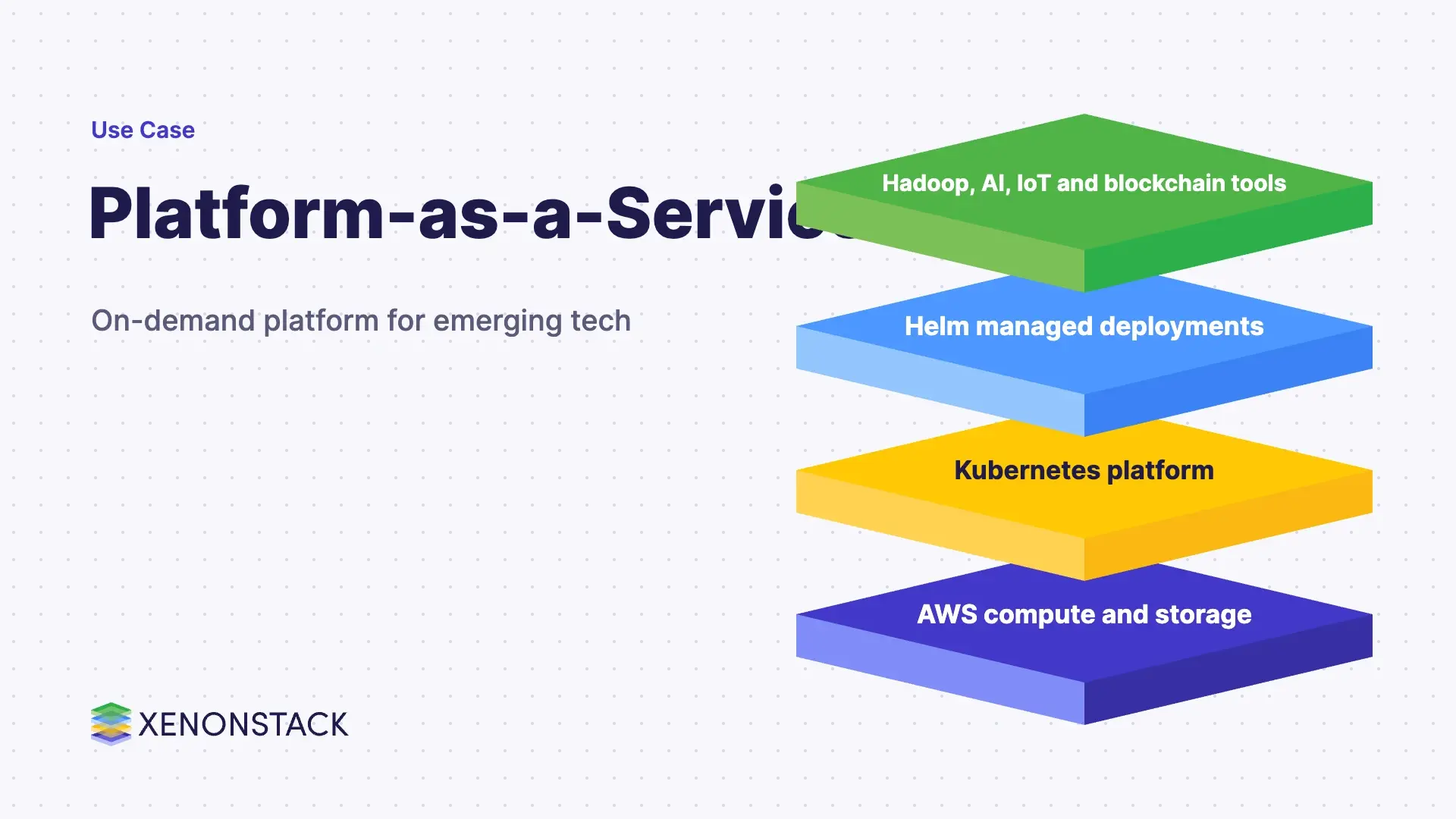
XenonStack delivered a Platform-as-a-Service that deploys software on Kubernetes with high availability and low running cost, using AWS services for compute and storage. Helm manages the software deployments, while Amazon EC2 provides virtual servers and Amazon S3 holds customer data.
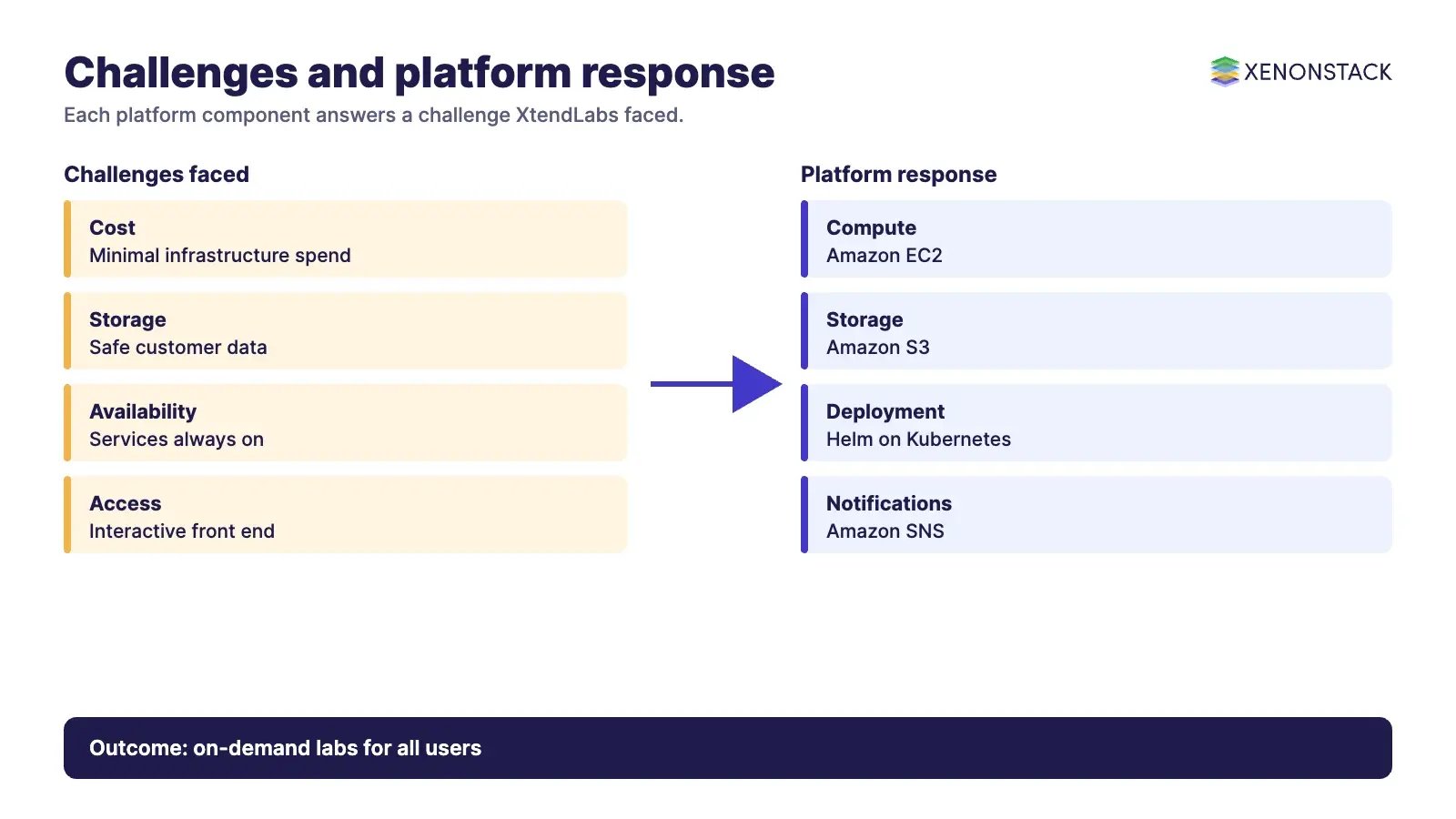
| Component | Role in the platform |
|---|---|
| Kubernetes | Automates application deployment, scaling and management |
| Helm | Packages and manages Kubernetes applications |
| Amazon EC2 | Provides virtual servers for compute |
| Amazon S3 | Stores customer data |
| Amazon SNS | Sends email notifications |
Who benefits from the platform?
The platform serves three audiences, each with a different need but the same underlying promise: immediate access without installation or setup.
| Audience | What they gain |
|---|---|
| Individuals | Affordable, instant access to online software platforms to gain hands-on experience with new technologies |
| Enterprises | Faster, lower-cost proofs of concept, reduced project risk and quicker time to market |
| Academic institutions | On-demand lab environments that students can reach from any location at any time |
How does it help enterprises specifically?
Enterprises can develop and evaluate software through proofs of concept faster and at much lower cost. Teams focus on business needs rather than technology infrastructure and administration, and they pay only for the resources they use, without large upfront IT investment to support big data and other emerging platforms.
That shift reduces the risk of speculative software projects and accelerates time to market.
When is a Platform-as-a-Service the right choice?
It fits when many users need the same complex environments, when setup time blocks learning or experimentation, or when cost control matters more than owning infrastructure. It is less suitable where workloads need highly specialised hardware that a shared platform cannot provide.
For organisations extending platform operations with governed automation, CloudOps Reimagined shows how AI agents can support cloud and platform operations.
Organisations weighing a similar platform can begin with a Context Workshop, a short working session that clarifies users, workloads and governance needs before any build starts.
Frequently asked questions
What is Platform-as-a-Service?
Platform-as-a-Service is a cloud model in which a provider manages the infrastructure and runtime so users can deploy and run applications without installing or administering servers themselves.
Which technologies does the XtendLabs platform support?
It gives on-demand access to compute and storage for Hadoop, NoSQL, artificial intelligence, machine learning, IoT and blockchain applications.
Why were Kubernetes and Helm used?
Kubernetes automates deployment, scaling and management of applications, while Helm packages and manages Kubernetes applications, which keeps software deployments consistent and highly available.
How does the platform keep infrastructure cost low?
It uses AWS services such as Amazon EC2 and Amazon S3 for compute and storage, so users pay only for the resources they need instead of funding large upfront IT investment.
Who can use the platform?
Individual developers, enterprises running proofs of concept and academic institutions that need hands-on lab environments can all use it without installation or setup.
Ready to put AI agents to work? See an ElixirClaw demo: the agentic OS to build, orchestrate and govern AI agents across your enterprise systems.
Explore the XenonStack platform family: ElixirData · ElixirClaw · ElixirHub · NexaStack · MetaSecure · Neural AI · AgentGRC · AgentSRE · AgentAnalyst · AgentInstruct · AgentRAI · AgentScrum · AgentSearch · AgentForce · AI Aviator · SAIF Aviator · CohortIQ · XenonStack AI · XenonStack UAE