Key takeaway
- How a blockchain coupon platform lets brands issue offers, retailers redeem them and shoppers save them in mobile wallets, and what to check first.
A blockchain digital coupon platform is a shared ledger on which brands issue coupons, retailers redeem them and consumers hold them in mobile wallets, with each issue and redemption recorded in a way that is hard to alter. It replaces paper and one-off promotion codes with offers that can be created, distributed and redeemed on one platform.
This page is for retail, brand and platform leaders. It covers the problem, what each party gains, how a ledger compares with paper coupons, where AI agents fit and what to check before you build.
What is a blockchain digital coupon platform?
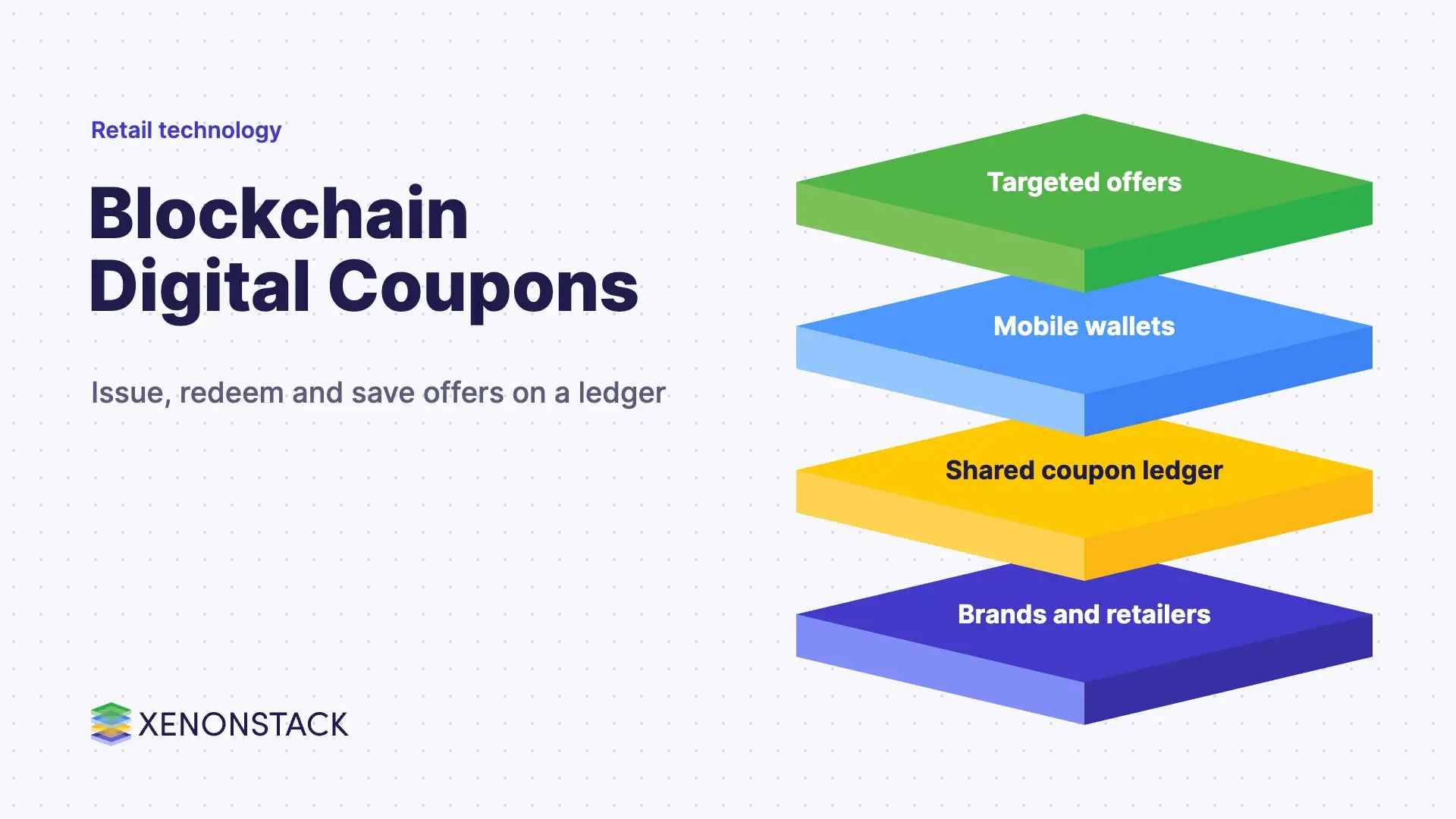
The platform gives a retailer a way to create, distribute and redeem coupons and to run marketing campaigns with them, mainly by self-service and with little technical help. Digital coupons and incentives are held on a secure, scalable distributed ledger that uses blockchain technology and works with Apple Pay and Android Pay. The ledger stores coupons in a cryptographically secure and highly controllable manner, while mobile wallets give consumers an easy way to save and present offers.
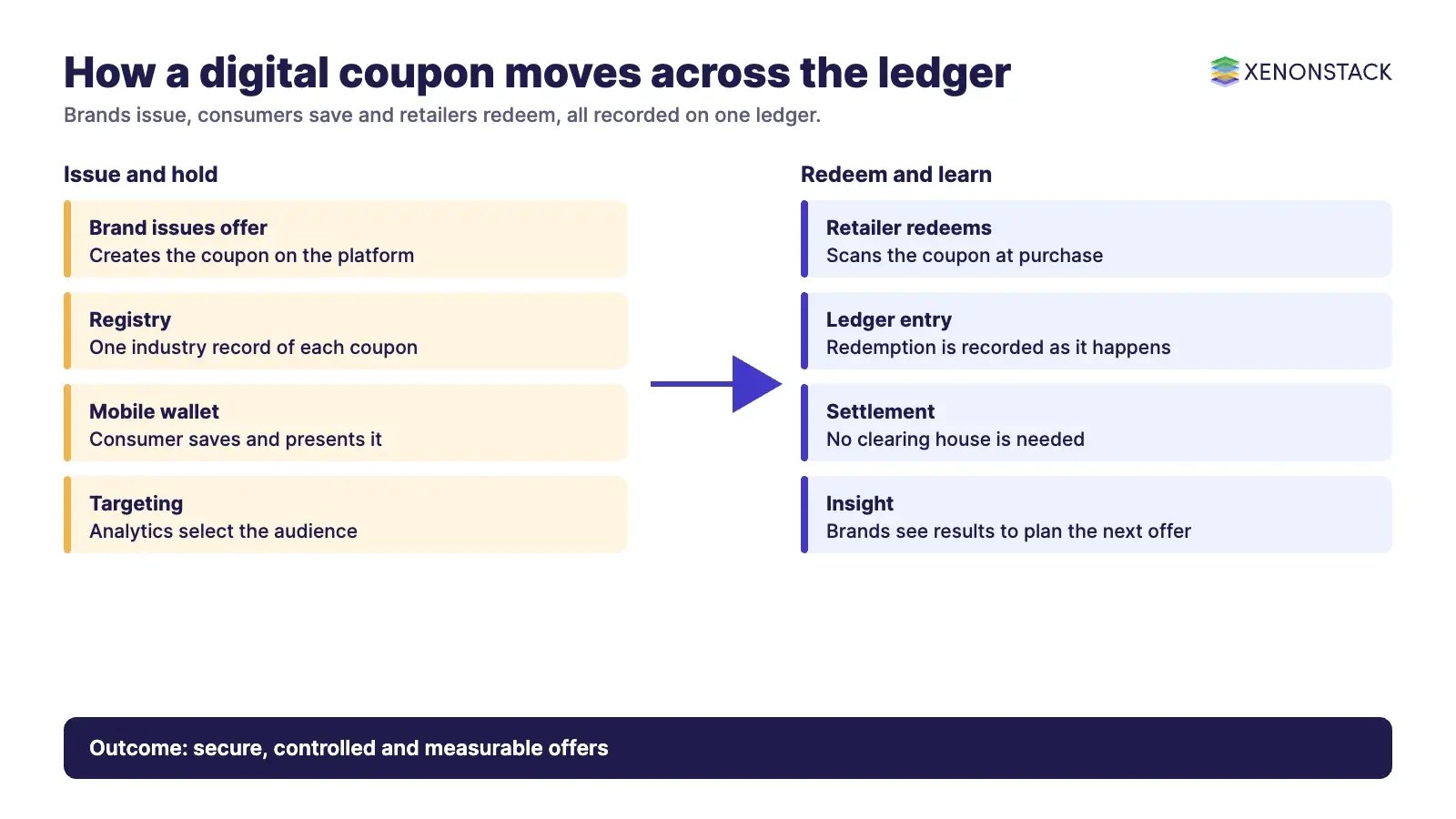
Coupons suit short campaigns because they can be created quickly to fit a promotion need and managed easily afterwards.
What problem does it solve?
- One registry. Design a central industry registry for digital coupons with precise control over distribution and redemption.
- Settlement. Settle redemptions in real time on the ledger, which removes the need for clearing houses.
- Trust. Give issuers the security and trust they need to distribute high-value offers.
- Targeting. Reach a specific audience with personalised offers, using real-time analytics.
What does each party gain?
The solution serves every stakeholder in the ecosystem. Brands issue offers, retailers redeem them and consumers use them.
| Party | Role | What the platform gives them |
|---|---|---|
| Consumer | Finds and uses offers | A way to find high-value offers from different brands and keep them in a wallet |
| Retailer | Redeems offers | Moves from paper to digital coupons to increase traffic, and supports better inventory management |
| Brand | Issues offers | Targeted, personalised promotion using real-time analytics on a flexible business model |
Retailers are not alone in moving this way. The Gartner post on digital shopping tools describes digital price-savings tools as central to how consumers now shop, and says brands should not ignore them.
How does a ledger compare with paper coupons?
| Question | Paper coupons | Blockchain digital coupons |
|---|---|---|
| Creation | Printed and distributed in batches | Created on the platform as needed for a campaign |
| Redemption | Handled at the till and settled later | Recorded on the ledger as it happens |
| Duplication | Copies are hard to detect | Each coupon is a unique entry on the ledger |
| Control | Limited once printed | Issuers control distribution and redemption |
| Targeting | Broad | Personalised using analytics |
| Consumer experience | Clip, carry and hand over | Save in a mobile wallet and present |
What does blockchain actually add?
The NIST blockchain technology overview defines blockchains as tamper-evident, tamper-resistant digital ledgers distributed across many machines, usually with no central authority. It distinguishes permissionless networks, where anyone can read and write, from permissioned networks that limit participation to specific people or organisations. A coupon platform that needs approved issuers and retailers sits closer to the permissioned model, where someone must govern who is allowed in.
In retail, blockchain is applied to decentralised platforms, better payment approaches, transparency and integrity of databases, and fraud prevention with duplicate removal. For supply chains, it is applied to tracking and automating transactions in real time, self-executing contracts and smart IoT applications. Read more in our guide to blockchain in supply chain.
Where do AI agents fit?
The ledger records what happened. AI agents can help decide what to offer and when. An agent can read campaign results, propose a new offer for a segment, check it against the brand's rules and send it to a marketer for approval before it is issued. It should work only within limits the issuer sets, and each action should leave a record. ElixirClaw is the AI agents computing platform from XenonStack, and is the page to read for agent and automation use cases.
What should you check before you build?
The NIST overview is direct that blockchain is not a cure-all and should be used in appropriate situations. Start with the problem, then test whether a ledger is the right tool.
- Need. Confirm that several parties who do not fully trust each other need a shared record.
- Governance. Decide who may issue, who may redeem and who runs the network.
- Wallets. Test the coupon flow with the mobile wallets your customers use.
- Privacy. Keep personal data off the ledger and use it only for approved targeting.
- Fraud rules. Define limits on use and how disputes are handled.
To map one decision your offer agents make, and the data and policy it depends on, book a Context Workshop. See what happens in the workshop.
Frequently asked questions
What is a digital coupon platform?
It is a platform on which brands issue coupons, retailers redeem them and consumers save them in mobile wallets, so campaigns can be created and managed digitally.
Why use blockchain for coupons?
A ledger records each issue and redemption in a tamper-evident way and can settle redemptions as they happen, which supports trust between brands, retailers and consumers.
Does blockchain remove clearing houses?
The design aims to settle redemptions in real time on the ledger so that clearing houses are not needed.
Is blockchain always the right choice?
No. NIST describes it as not a cure-all and advises using it in appropriate situations, so confirm that a shared ledger solves a real problem first.
How can AI agents support coupon campaigns?
An agent can analyse campaign results, propose offers for a segment and route them to a marketer for approval within limits the issuer sets.
Ready to put AI agents to work? See an ElixirClaw demo: the agentic OS to build, orchestrate and govern AI agents across your enterprise systems.
Explore the XenonStack platform family: ElixirData · ElixirClaw · ElixirHub · NexaStack · MetaSecure · Neural AI · AgentGRC · AgentSRE · AgentAnalyst · AgentInstruct · AgentRAI · AgentScrum · AgentSearch · AgentForce · AI Aviator · SAIF Aviator · CohortIQ · XenonStack AI · XenonStack UAE