
.webp?width=1921&height=622&name=usecase-banner%20(1).webp)
Introduction
This is the documentation for the groundbreaking project aimed at revolutionizing the user experience of a news platform through the strategic integration of machine learning (ML) techniques. This document serves as a comprehensive guide to the design, implementation, and functionalities of the project, providing insights into the system architecture, modules, workflows, and much more.
Project Overview
In an era where information is abundant and diverse, tailoring news consumption to individual preferences is imperative. This project focuses on enhancing the front-page experience, article submission process, and personalized newsletters on a news platform. Leveraging ML models, the platform aims to deliver breaking news, personalized content recommendations, and curated newsletters, ensuring that users receive news that aligns with their interests.
The project is structured into three main modules: the Front-Page module, which handles breaking news and personalized news carousels; the New Article module, responsible for processing and displaying user-submitted articles; and the Personalized Newsletter module, which facilitates the creation and distribution of customized newsletters. Each module utilizes machine learning algorithms to optimize content delivery, providing users with a more engaging and tailored news experience.
ROI methodology
The Return on Investment (ROI) for this project is measured through improved user engagement, increased user satisfaction, and potentially higher user retention. By leveraging ML algorithms to provide personalized content, the platform aims to keep users engaged, attract new users, and increase the overall time spent on the platform. The Diversity Slider, breaking news features, and personalized newsletters contribute to a more tailored and engaging user experience, potentially resulting in increased ad revenue and user subscriptions.
Purpose and Objectives
The primary purpose of this project is to create a user-centric news platform that goes beyond generic content delivery. The key objectives include:
-
Enhanced User Experience: Implement ML-driven personalization to deliver breaking news and article recommendations tailored to individual user preferences, thereby enhancing overall user satisfaction.
-
Improved User Engagement: Foster increased user engagement by providing a front-page experience that dynamically adapts to user interactions, offering a more relevant and captivating news feed.
-
Efficient Article Submission: Streamline the process of submitting new articles by implementing text processing mechanisms, interested reader lists, and personalized notifications, making it seamless for users to contribute to the platform.
-
Personalized Newsletters: Introduce a personalized newsletter feature that allows users to receive curated content based on their preferences, with optional 1-1 outreach for a more personalized communication channel.
How does ML add value to business?
Machine Learning adds significant value to the business by enabling a more personalized and engaging user experience.
-
The Breaking News for You feature uses an article cluster approach, enhancing the relevancy of breaking news for each user.
-
The News for You carousel and News Genre carousel leverage a user personalization model, ensuring that users receive news articles tailored to their interests.
-
The ML-driven approach not only keeps users more engaged but also opens up avenues for monetization through targeted advertising.
-
Moreover, the system's ability to process new articles, create lists of interested readers, and send personalized notifications enhances user interaction and satisfaction.
-
The personalized newsletter feature, with the option for 1-1 outreach, allows the platform to connect with users on a deeper level.
-
ML models facilitate the selection and presentation of articles in the newsletter, contributing to a more engaging and relevant communication channel with the user base.
The integration of ML techniques optimizes content delivery, increases user engagement, and potentially leads to improved business metrics such as ad revenue and user retention. The project aligns with the evolving landscape of personalized digital experiences, providing a competitive edge in the news and media industry.
System Architecture
Business flow
Frontpage
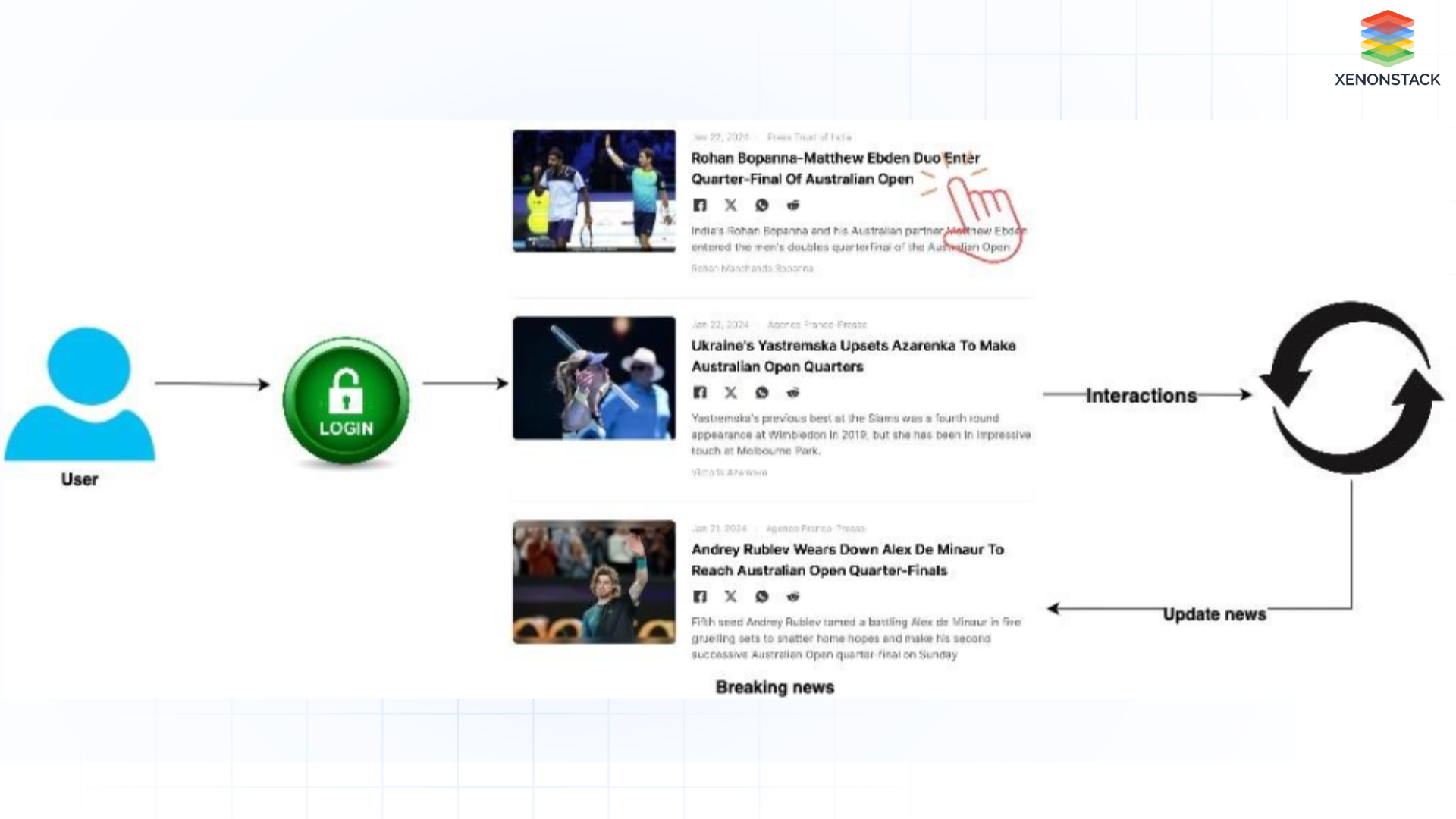
The Frontpage, which is also the first tab, named Home, provides the user with three carousels, namely: breaking news, news for you, and genre of news.
The first carousel provides the user with numerous card components which, when clicked, open popups providing a detailed article which has the following sections: the title of the article, a brief about the article, and the detailed article summary. The article has a scrollbar, which enables scrolling through the article and accessing further content. The cards generated in the Breaking News carousel can also be adjusted based on the diversity slider provided along with it.
The second carousel, which is named News for you, provides the user with news articles similar to the breaking news section, but this section is curated specially based on user interests.
The third carousel, named genre of news, provides the user with news articles, but based on various genres such as Tech, AI, Cloud provider news, etc. The user is supposed to select any genre of choice from the drop-down menu provided it which updates the genres of news accordingly.
New article
The second tab, which is the new article tab, allows the user to create and submit new articles. The tab provides the user with a text area that allows the user to create an article whose length must be above 200 words. Once the user provides a legitimate article and clicks on the submit button, he is provided with another carousel that comprises of sample list of interested users who relate to the article the user submitted. When the user selects any user from the sample list, another menu opens, providing the user with the list of the most recent articles viewed by the selected user.
.png?width=1920&height=1080&name=Xenon%20Daily%20Work-36%20(1).png)
Personalized newsletter
The third tab, which is the personalized newsletter tab, provides the user with the ability to create personalized newsletters based on the selection of the Gen Ai-enabled checkbox. Generally, the user is supposed to create a prompt for the AI model as input which in response provides the user with a newsletter. The page is divided into two major sections. The first section contains a prompt for gen ai and the sections following it (initially empty) provide the user with a personalized newsletter. It is to be noted that only the users having an @amazon user can manipulate the by default disabled prompt in the first section. The user is provided with a checkbox which enables or disables gen ai for the creation of the newsletter. If the user creates a personalized newsletter without gen ai enabled, he is provided with a newsletter which comprises of sections of news containing links which upon clicking opens news articles, with gen ai disabled creation the user is not provided with any links in the newsletter.
.png?width=1920&height=1080&name=Xenon%20Daily%20Work-36%20(2).png)
Front-End Architecture
The Project is built upon React Framework, which is a front-end JavaScript library. The Architecture comprises of the user-onboarding flow (Sign up page), Login page, upon login the user is provided with three basic tabs which are Home tab, New article tab and Personalized newsletter tab.
Home page provides the user with three sections namely: Breaking news, News for you, and Genre of news which provides user with news based on the selected genre, The new article tab allows the user to create and submit a new article, upon successful submission of an article the user is also provided with a sample list of interested users and the latest articles viewed by them. The personalized newsletter tab provides the user with a gen AI based newsletter.
The project uses native html components as well as UI components derived from MUI such as Sliders, Tabs, Checkboxes, Radio buttons, buttons, Drop down menus etc.. These UI components are further styled to match the project design.
Back-End Architecture
Frontpage
.png?width=1920&height=1080&name=Xenon%20Daily%20Work-36%20(3).png)
New Article
.png?width=1920&height=1080&name=Xenon%20Daily%20Work-36%20(4).png)
Personalized newsletter
.png?width=1920&height=1080&name=Xenon%20Daily%20Work-36%20(5).png)
Machine Learning Models Used
ML Model setup document to be added here
For more UI designs one can go through this link here.
Testing
Integration Testing
User Acceptance Testing
Deployment
Deployment Pipeline
Deployment Environment Configuration
User Guides
Front Page User Guide
New Article Submission Guide
Personalized Newsletter Guide
Future Enhancements
Planned Features
Potential Improvements
Benefits of the application
-
Enhanced User Engagement and User Retention: The personalized news features, breaking news, and customized newsletters contribute to increased user engagement. Users are more likely to spend additional time on the platform when presented with content tailored to their interests. Personalized content and breaking news tailored to individual preferences increase the likelihood of users returning to the platform regularly. This can result in improved user retention rates and reduced churn.
-
Monetization Opportunities: The application creates opportunities for targeted advertising, as the platform has a deeper understanding of user preferences. Advertisers can benefit from reaching a more receptive audience, potentially increasing ad revenue for the business.
-
Competitive Edge: By adopting ML-driven personalization, the platform gains a competitive edge in the news and media industry. Providing a tailored and relevant news experience sets the platform apart from competitors, attracting and retaining users.
-
Data-Driven Decision Making: The application generates valuable user interaction data. Leveraging this data for analytics and reporting allows the business to make informed decisions about content strategy, user experience improvements, and overall platform optimization.
-
Increased User Satisfaction: Users are more likely to be satisfied when presented with news content that aligns with their interests. Personalized newsletters and breaking news features contribute to an overall positive user experience, fostering satisfaction and loyalty.
-
Scalability: The ML-driven approach allows the platform to scale efficiently as user numbers grow. The algorithms can adapt to a larger user base, ensuring that personalization remains effective even with increased content and user interactions.