Key takeaway
- Spinnaker is an open-source, multi-cloud continuous delivery platform. See how pipelines, canary checks and strategies work, and what changed in 2026.3.
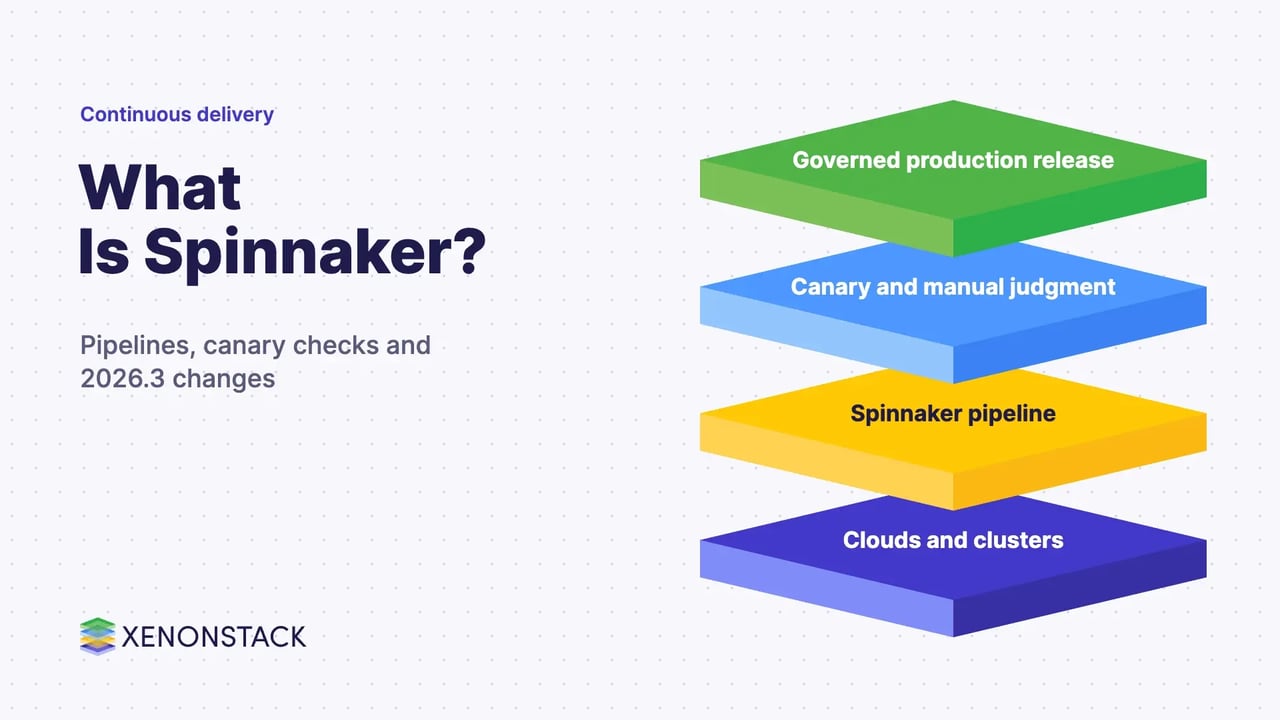
Spinnaker is an open-source, multi-cloud continuous delivery platform. It takes a built artefact, such as a container image, and moves it through test, approval and production stages using pipelines, deployment strategies and rollbacks. According to its site, it was created at Netflix.
The short decision for enterprise leaders: Spinnaker earns its place when many teams release to several clusters or clouds and you want one governed release path. For a single cluster, Helm with a GitOps tool is often enough. If you run Kubernetes, our guide to Spinnaker with Kubernetes covers manifests, canary analysis and the 2026.3 changes in more detail.
What is Spinnaker and where does it fit?
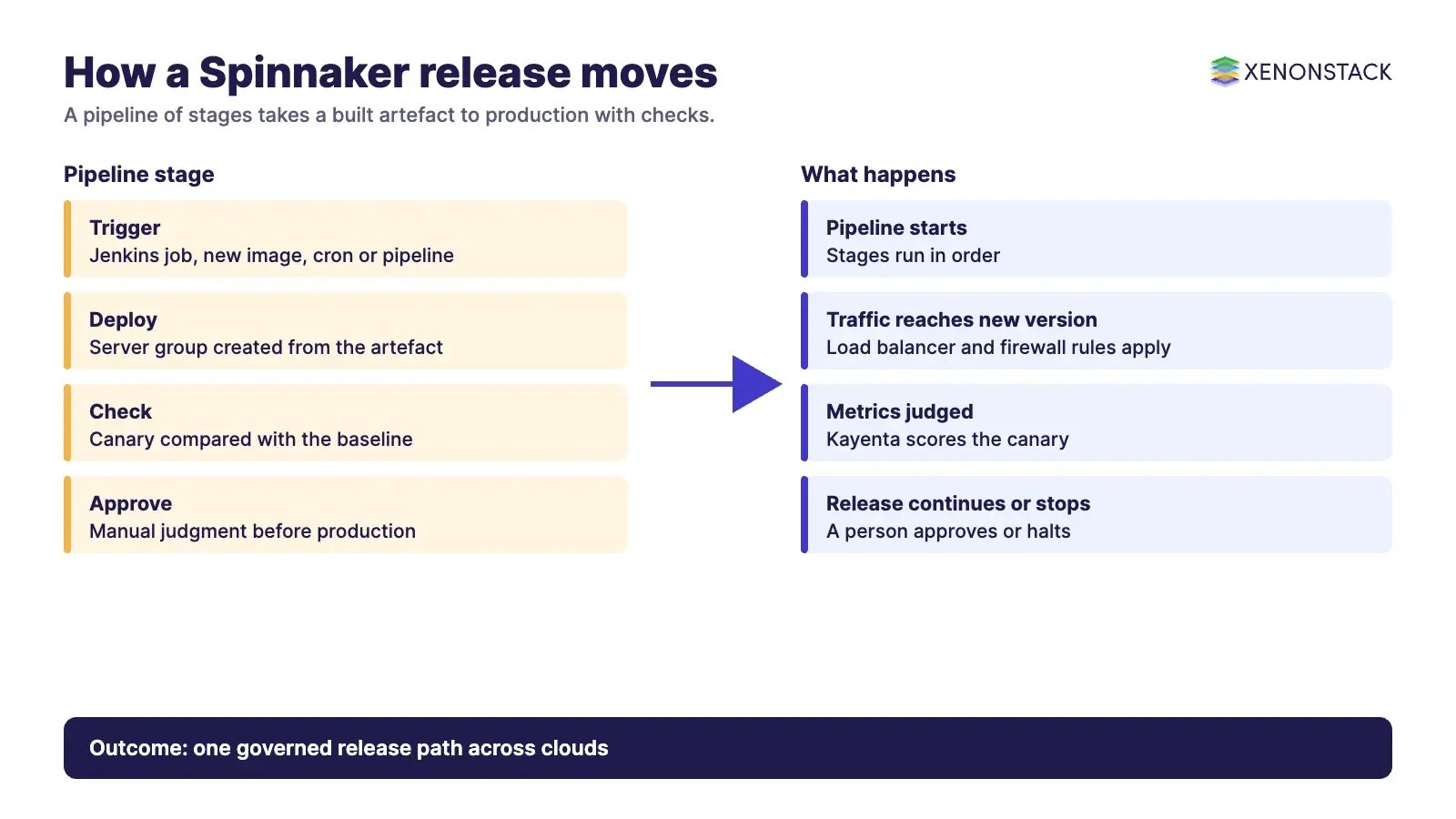
Spinnaker is a delivery tool, not a build tool. Continuous integration builds and tests code; Spinnaker deploys the result and checks it before more traffic arrives. Pipelines can be started manually or by triggers such as a Jenkins job, a new image, a cron schedule or another pipeline. It is listed as a current open-source project of the Continuous Delivery Foundation. For the wider picture, see our guides to continuous delivery and continuous testing in continuous delivery.
How does Spinnaker work?
Spinnaker's core concepts fall into two groups: application management, which shows what is running, and application deployment, which builds the workflow that releases new versions.
| Concept | What it means (per Spinnaker docs) | Why it matters |
|---|---|---|
| Application | A collection of clusters, plus the firewalls and load balancers that expose them | The unit a team owns and views |
| Cluster | A logical grouping of server groups. It is not a Kubernetes cluster | Avoids confusion on the dashboard |
| Server group | The base deployable resource: an artefact such as a VM image or Docker image, with settings such as instance count and autoscaling | What a release actually creates |
| Load balancer | Tied to an ingress protocol and port range; spreads traffic across server group instances, with optional health checks | Controls how traffic reaches a version |
| Firewall | A set of network access rules defined by an IP range, protocol and port range | Limits who can reach a service |
| Pipeline | The key deployment construct: an ordered sequence of stages | Your repeatable release path |
| Stage | A higher-level action in a pipeline, such as Deploy, Resize, Disable or Manual Judgment | Where approvals and checks sit |
The docs also describe managed delivery, a higher-level layer where teams declare the desired state in terms of environments and artefacts and Spinnaker works to reconcile the current state with it.
Which deployment strategies does Spinnaker support?
The concepts page says cloud-native deployment strategies are first-class constructs and that blue/green is supported. Its canary guide describes a different approach: a canary partially rolls out a change and compares it with the current deployment, the baseline, using metrics you choose.
| Strategy | How it works | When it fits | Trade-off |
|---|---|---|---|
| Blue/green | Two environments; traffic moves to the new one once it passes checks | Releases where a quick switch back matters | Needs capacity for two versions at once |
| Canary | Compares a partial rollout with the baseline using chosen metrics, with a canary configuration and canary stages in a pipeline | High-traffic services where you want evidence before full rollout | Needs good metrics; Spinnaker says it is not a substitute for other testing |
| Manual judgment | A stage that waits for a person to approve or stop the release | Production gates and regulated changes | Adds waiting time; needs a named approver |
The canary overview lists Stackdriver, Datadog, Prometheus, Signalfx and New Relic as supported metric sources and names Kayenta as the component that makes the judgment.
Which clouds and platforms does Spinnaker support?
The provider setup page lists the platforms below, and none is marked deprecated there. The 2026.3.0 changelog separately marks Titus as deprecated because of a lack of contributions. Confirm the status of your provider on the official page before you plan around it.
| Provider | Listed by Spinnaker | Note |
|---|---|---|
| AWS (EC2 and ECS) | Yes | 2026.3.0 moved caching agents to AWS SDK v2; plugins using v1 stop working |
| Kubernetes | Yes | Manifest-based provider; see our Spinnaker with Kubernetes guide |
| Azure | Yes | Confirm feature coverage on the provider page |
| Cloud Foundry | Yes | Confirm feature coverage on the provider page |
| Google Compute Engine, App Engine | Yes | 2026.3.0 moved the Google provider to the stable Compute v1 API; saved deploy stages may need changes |
| Oracle | Yes | Confirm feature coverage on the provider page |
| Docker Registry | Yes | Used as an artefact source |
What has changed in Spinnaker recently?
The Spinnaker 2026.3.0 changelog (published 7 September 2026) warns of major breaking changes, so validate it carefully before upgrading.
| Change | Status per the changelog | Action |
|---|---|---|
| Installer | Halyard removed from the codebase; BOM publishing stops in 2027.0.0 | Move to Kustomize-based installs |
| UI | Angular removed; plugins and forks must migrate to React | Plugin owners plan a migration |
| Kubernetes API types | extensions/v1beta1 and networking.k8s.io/v1beta1 removed | Update manifests |
| Pipeline storage | From 2027.0.0, Redis execution storage and Front50 blob storage are removed; SQL only | Plan a SQL migration |
| Kustomize | Kustomize 3 removed in 2027.0.0 | Move pipelines to Kustomize 4 or 5 |
The install guide says to give the cluster at least 18GB of memory and 6 cores, and that usage varies with configuration and the number of registered accounts. Plan capacity before a pilot.
What are the benefits and best practices?
The benefits below come from the docs summarised above. The practices are general continuous delivery habits that suit Spinnaker pipelines.
- One release path: the same pipeline model across clusters and clouds.
- Controlled promotion: manual judgment stages and canary checks before full rollout.
- CI integration: a stage can call a Jenkins job, and a CI job can trigger a pipeline.
- Declarative direction: managed delivery reconciles desired state across environments.
- Keep one pipeline per service and release it often.
- Store application and pipeline configuration as code, as in Kubernetes deployment practice, and review changes like any other code.
- Test early, and stage in a test environment before production.
- Watch user-facing metrics after each release, and agree who can approve production.
When should you not use Spinnaker?
Spinnaker is a heavy system to run, so weigh the cost. If you deploy to one cluster with a handful of services, Helm with a GitOps tool or a native Kubernetes Deployment is usually simpler. Start Spinnaker with one or two services, prove the canary and approval stages, then widen. If you also compare platforms, read what continuous delivery tools do and our multi-cloud strategy guide.
What is the adoption sequence?
- Choose the provider and confirm its status on the official page.
- Install with Kustomize, not Halyard, and size the cluster.
- Connect CI and a registry, then build one pipeline for one service.
- Add a manual judgment stage, then a canary stage with chosen metrics.
- Roll out to more teams and record approvals and outcomes.
Watch the overview
A short overview of Spinnaker as a multi-cloud continuous delivery platform.
When automated agents start proposing or triggering releases, the approval and evidence trail matters as much as the pipeline. ElixirData Context OS keeps governed context, versioned policy and decision traces in one decision layer above AI agents, and AgentGRC keeps autonomous agent actions inside policy, with the audit trail risk teams need.
To map one release decision your agents should make, and the context and policy it depends on, book a Context Workshop. See what happens in the workshop.
What should you plan for in 2027?
The Spinnaker 2026.3.0 changelog, published 7 September 2026, names several removals that arrive with release 2027.0.0. The page gives no release date for it, so treat it as a 2027 planning item.
- Installer: as of 2027.0.0, Halyard BOMs are no longer published, so move installs to Kustomize first.
- Storage: Redis based pipeline execution storage and Front50 blob storage are removed in 2027.0.0, so plan a SQL migration.
- Kustomize: Kustomize 3 is removed in 2027.0.0, so move pipelines to Kustomize 4 or 5.
- Metrics: Spectator is removed in 2027.0.0 as the project moves to Micrometer.
Read the full 2026.3.0 changelog before you schedule the upgrade.
Frequently asked questions
What is Spinnaker used for?
Spinnaker is an open-source, multi-cloud continuous delivery platform. It takes a built artefact, such as a container image, and moves it through pipeline stages to production, with deployment strategies and rollbacks.
Who created Spinnaker?
According to its site, Spinnaker was created at Netflix. It is now listed as a current open-source project of the Continuous Delivery Foundation.
Is Halyard still the way to install Spinnaker?
No. The install guide says Halyard is deprecated in favour of native installation with Kustomize. The 2026.3.0 changelog says Halyard was removed from the codebase and that Halyard BOM publishing stops in 2027.0.0.
What is the difference between Spinnaker and Jenkins?
Jenkins is typically used for continuous integration, such as building and testing code. Spinnaker focuses on delivery: deploying, verifying and promoting a built artefact across environments. A Spinnaker stage can start a Jenkins job, or a Jenkins job can trigger a Spinnaker pipeline.
Which clouds does Spinnaker support?
Its provider page lists AWS and ECS, Kubernetes, Azure, Cloud Foundry, Docker Registry, Google App Engine, Google Compute Engine and Oracle. Google Cloud Run also appears in the concepts page. Confirm current support on the official page before you commit.
When is Spinnaker not the right choice?
For one cluster or a small number of services, Helm with a GitOps tool or a native Kubernetes Deployment is usually simpler to run. Spinnaker adds the most value when many teams release to several clusters or clouds and need one governed path.
Ready to put AI agents to work? See an ElixirClaw demo: the agentic OS to build, orchestrate and govern AI agents across your enterprise systems.
Explore the XenonStack platform family: ElixirData · ElixirClaw · ElixirHub · NexaStack · MetaSecure · Neural AI · AgentGRC · AgentSRE · AgentAnalyst · AgentInstruct · AgentRAI · AgentScrum · AgentSearch · AgentForce · AI Aviator · SAIF Aviator · CohortIQ · XenonStack AI · XenonStack UAE