Key takeaway
- Agentic automation lets AI agents plan and run workflow steps beyond fixed RPA rules. See how it differs, where it fits, the risks and how to start safely.
Agentic automation is the use of AI agents, models that direct their own steps and tool use, to carry out business workflows that fixed rules cannot cover. It builds on agentic process automation and sits beside, not instead of, rule-based bots.
This guide is for operations, IT and transformation leaders deciding where agents belong in their processes. It covers how agentic automation differs from robotic process automation (RPA), what an automation centre of excellence does, where it applies, the risks, and what to do first.
What is agentic automation?
Anthropic's Building effective agents draws the line clearly. Workflows are systems where models and tools are orchestrated through predefined code paths. Agents are systems where models dynamically direct their own processes and tool usage. Agentic automation uses the second kind where a task is open-ended and the number of steps cannot be predicted or hardcoded, often combining generative AI with business tools. Our overview of AI agents covers the building blocks, and agentic workflows the way they chain together.
How does agentic automation differ from RPA?
IBM describes RPA as rule-based software that follows processes an end user defines, whereas AI is data-driven. RPA stays valuable for stable, repetitive steps. Its limits appear with unstructured data and workflows that change.
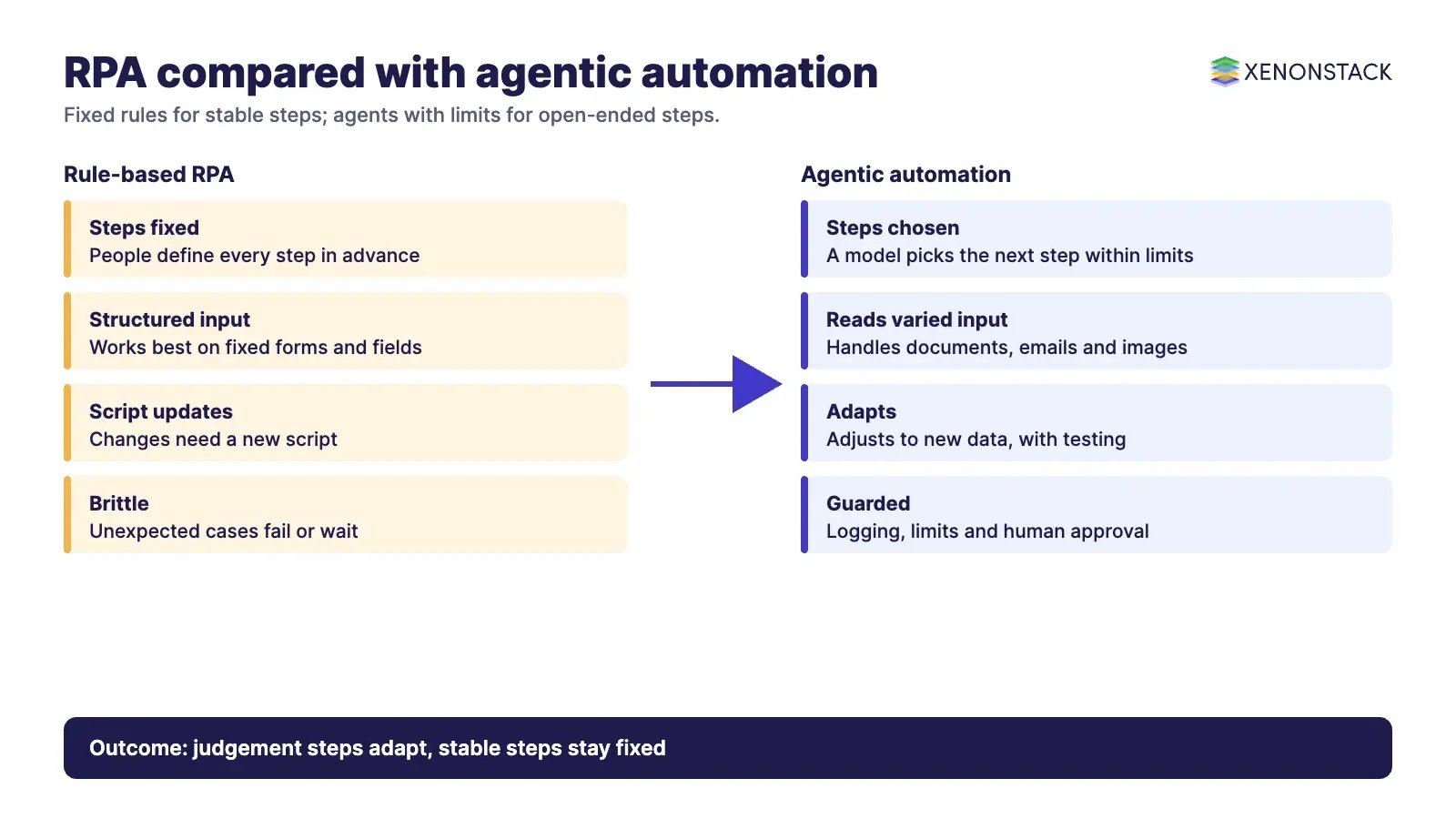
| Question | RPA | Agentic automation |
|---|---|---|
| How are steps decided? | Defined in advance by people | Chosen by a model at run time, within limits |
| Unstructured data | Poorly suited | Models can read and classify it |
| Changing workflows | Scripts need updating | Can adapt, but needs testing and guardrails |
| Main risk | Brittle scripts | Compounding errors, cost and unpredictability |
| Best suited to | Stable, high-volume tasks | Open-ended tasks that need judgement |
What does an agentic automation centre of excellence do?
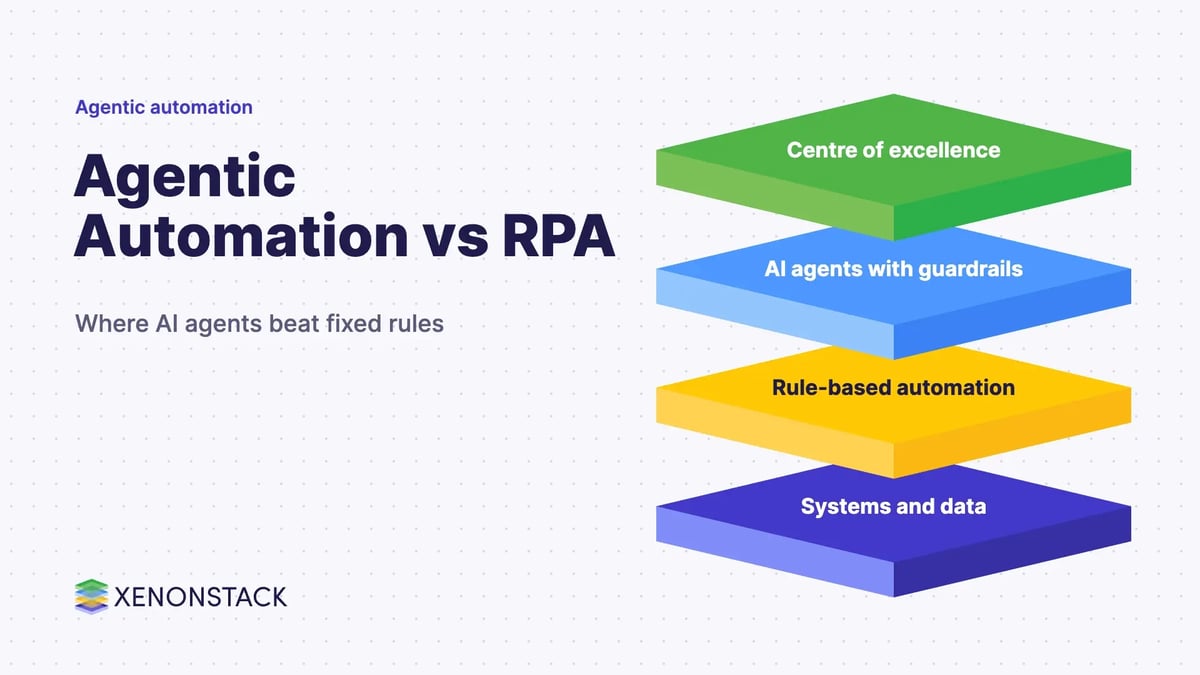
A centre of excellence (CoE) is a central team that integrates, governs and scales automation across departments. For agentic work it usually covers three things.
- Strategy. Link automation to business goals, choose high-value processes, pick technologies and set metrics.
- Governance. Standardise how agents are built and released, with rules on data privacy, ethics and regulation.
- Knowledge sharing. Share patterns across business units and train staff to work with automated systems.
How does generative AI change the workflow?
Three capabilities matter. A model can adapt to varied inputs without a new script. It can read unstructured material such as emails, documents or images. And it can propose the sequence of steps instead of following a fixed definition. Each also adds risk: Anthropic notes that agentic systems trade latency and cost for task performance, bring the potential for compounding errors, and recommends extensive testing in sandboxed environments with guardrails.
Where is agentic automation applied?
The table shows design patterns, not measured results. In each case a person should approve consequential actions until the agent has earned trust on your own data.
| Sector | Workflow | What an agent can do | Human check |
|---|---|---|---|
| Healthcare | Patient registration and scheduling | Adjust scheduling steps from live patient data | Clinical decisions stay with clinicians |
| Insurance | Claims processing | Extract data, check consistency, flag possible fraud | Approval of declined or high-value claims |
| Banking and financial services | Market trend analysis | Combine market and portfolio data into recommendations | Limits and sign-off on any trade |
| Manufacturing | Predictive maintenance | Use sensor data to propose a maintenance window and alert staff | Safety-critical stops |
For a deeper look at one sector, read about insurance with agentic AI. Agents that improve from experience rely on methods such as self-supervised learning.
What are the benefits and challenges?
Potential benefits are fewer manual hand-offs, handling of unstructured inputs, and workflows that respond to new data. We do not quote percentage savings here, because they depend on the process, the data and how success is measured; measure your own baseline. Challenges are practical:
- Integration. Connecting agents to legacy systems is often the longest part.
- Security and privacy. Agents act on data, so access, logging and compliance with relevant standards matter.
- Skills. Teams need training to supervise agents and to manage changed roles.
- Testing. See effective APA testing and strategies for scaling APA.
How do AI agents fit into your automation estate?
Keep fixed automation for steps that must never vary, and give an agent a narrow task with limits, logs and an approval route. Anthropic advises finding the simplest solution possible and adding complexity only when needed. The AI agents computing platform, ElixirClaw, is where XenonStack builds and runs agents. For the cloud view, see cloud agentic process automation with generative AI.
What should you do first?
- Inventory current RPA and workflow automations and where they fail or wait for people.
- Pick one open-ended process with a clear owner and a measurable baseline.
- Run an agent in shadow mode beside the existing process and compare outputs.
- Add limits, logging and human approval for consequential actions.
- Form a small centre of excellence to set standards before scaling.
To map one decision an agent makes in your workflow, and the data and policy it depends on, book a Context Workshop. See what happens in the workshop.
Frequently asked questions
What is agentic automation?
It is the use of AI agents, which direct their own steps and tool use, to run business workflows that fixed rules cannot cover.
How is agentic automation different from RPA?
RPA follows steps defined in advance by people. Agentic automation lets a model choose steps at run time within limits, which suits open-ended work but needs more testing and guardrails.
Does agentic automation replace RPA?
Not necessarily. RPA remains suited to stable, repetitive tasks, and many organisations keep it for those steps while agents handle judgement steps.
What are the risks of agentic automation?
Anthropic notes agentic systems trade latency and cost for performance and bring the potential for compounding errors, so extensive sandbox testing and guardrails are advised.
What does an automation centre of excellence do?
It sets strategy, governance and shared practice for automation across departments, including data privacy, compliance and staff training.
Explore the XenonStack platform family: ElixirData · ElixirClaw · ElixirHub · NexaStack · MetaSecure · Neural AI · AgentGRC · AgentSRE · AgentAnalyst · AgentInstruct · AgentRAI · AgentScrum · AgentSearch · AgentForce · AI Aviator · SAIF Aviator · CohortIQ · XenonStack AI · XenonStack UAE