Key takeaway
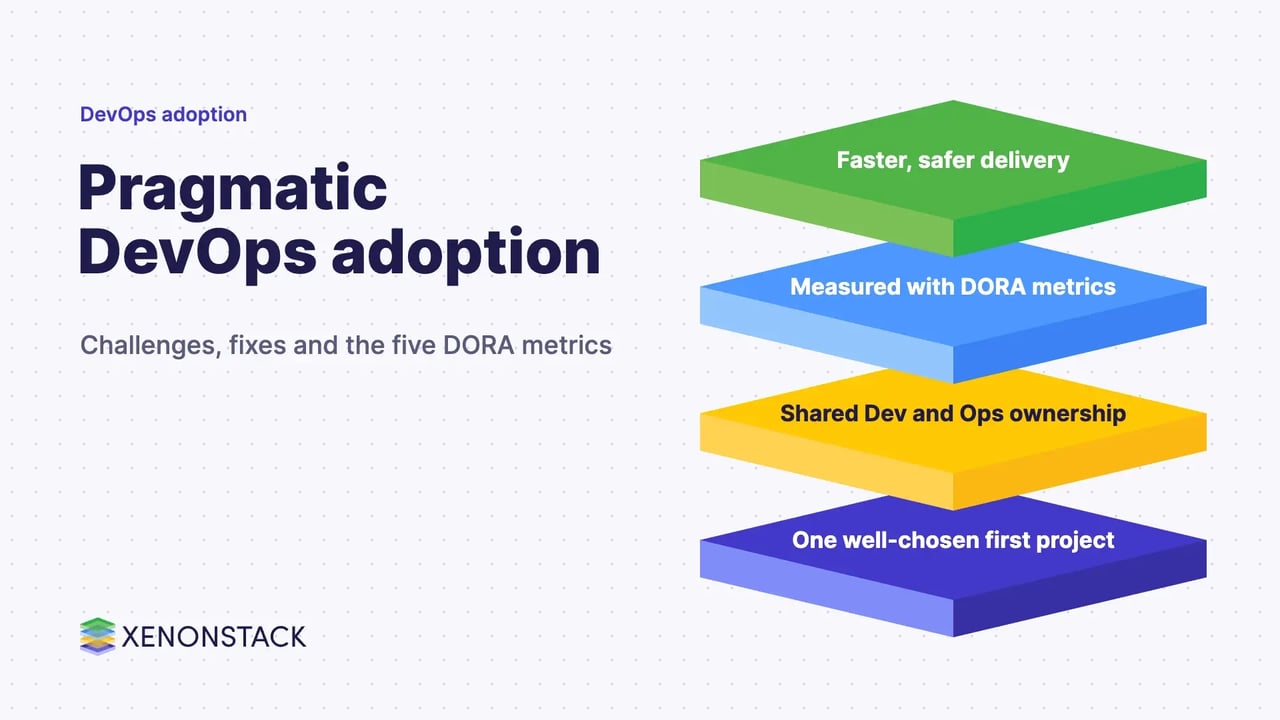
- Pragmatic DevOps means adopting DevOps in steps that fit your context. See seven adoption challenges, practical fixes and the five DORA metrics to track.
What is pragmatic DevOps?
Pragmatic DevOps is a sensible, step-by-step way of adopting DevOps. Instead of installing a full toolchain at once, a team picks the practices that suit its systems and risk, applies them to one project, measures the effect and removes waste from the delivery process. The aim is to deliver value to customers faster and more safely.
Adoption is hard because the people, the legacy systems and the budget are different in every company. This guide lists seven common challenges, the practical fix for each, and the five DORA metrics that show whether the change is working. For wider context, see our guide to DevOps challenges.
What are the common challenges in pragmatic DevOps adoption?
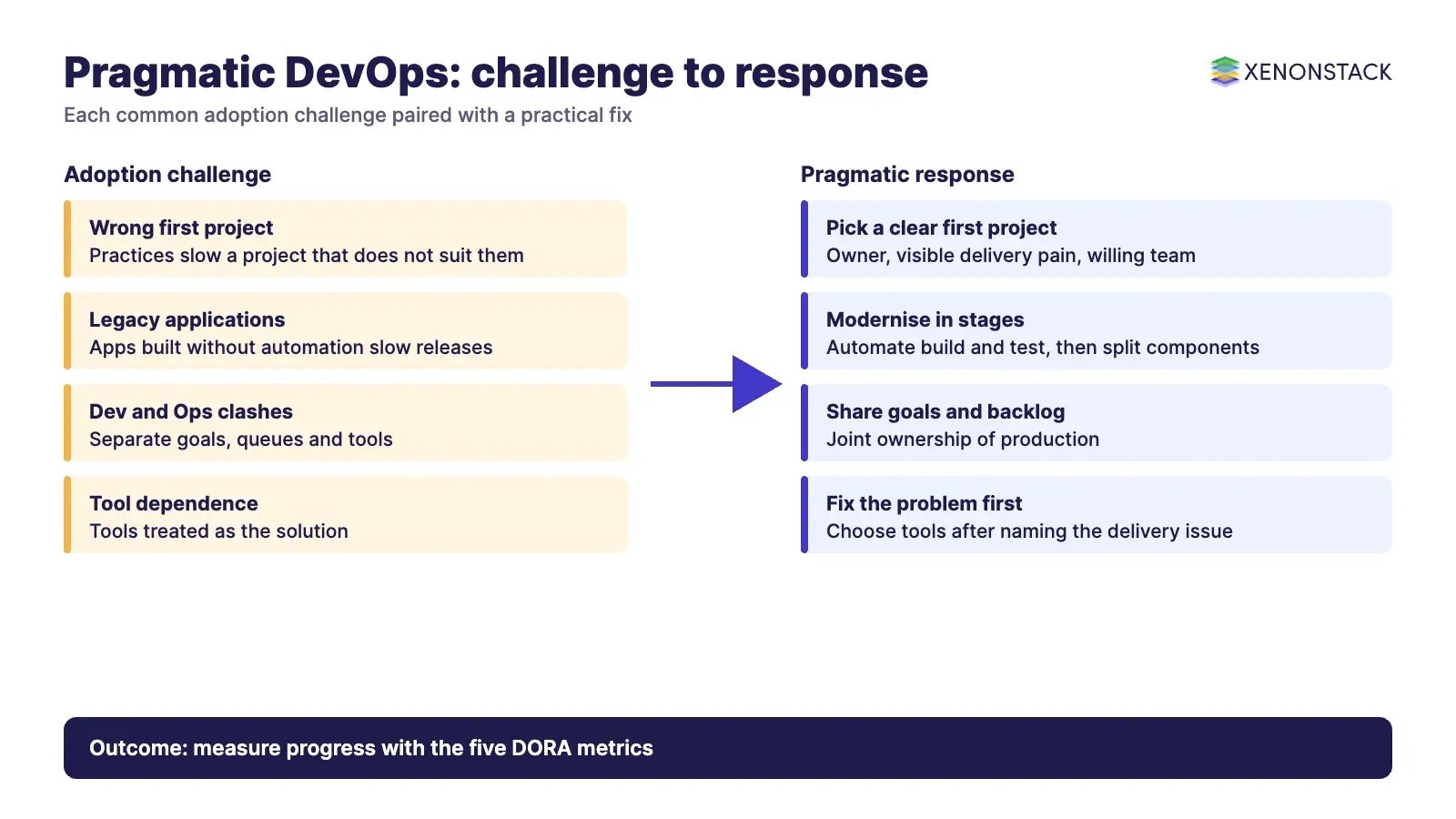
The table below summarises the seven challenges and the pragmatic response to each. The sections that follow explain them.
| Challenge | What goes wrong | Pragmatic response |
|---|---|---|
| Wrong first project | The practices slow a project that does not suit them | Pick a project with a clear owner and visible delivery pain |
| Lack of experience | Teams and managers create friction without knowing the practices | Train in short cycles and bring in coaching early |
| Legacy apps and systems | Applications built without automation slow every release | Modernise in stages, starting with the parts that change most |
| Dev and Ops clashes | Teams keep separate goals, queues and tools | Share goals, a backlog and on-call ownership |
| Budget | Open-source tools still need cloud, storage and monitoring spend | Budget for infrastructure and review cost regularly |
| Tool dependence | Tools are treated as the solution | Fix the delivery problem first, then pick tools |
| Resistance to change | People stay inside existing roles | Show small wins and involve teams in the design |
Choosing the right project
Not every project is a good first candidate. If the project is unsuited to the practices, delivery can slow down and the whole approach gets the blame. Be selective: begin where release pain is real and the team is willing to change.
Lack of experience
Teams that adopt DevOps without prior experience often reproduce old habits under new names. Short training cycles, a coach and a clear definition of done help avoid this.
Legacy applications and systems
Many applications were built long before automated delivery was common, so they resist frequent releases. Modernise in stages, for example by automating build and test first, and then separating components that change often. The DevOps automation tools guide covers options for each stage.
Development and operations clashes
DevOps depends on developers and operations working together. When the two teams keep separate goals and queues, the practices fail. Shared goals, a joint backlog and shared responsibility for production are the usual remedy.
Budget
Many DevOps tools are open source, but running them still needs cloud compute, storage, networking and monitoring. Plan for these costs from the start, and review them as usage grows.
Tool dependence
Tools can automate delivery, but collaboration and team habits matter more. Companies that focus on tools first can end up dependent on them without improving how work flows.
Resistance to change
People may prefer familiar roles and avoid working across teams. Small, visible wins and involving the teams in the design of the new workflow reduce resistance more than mandates do.
How do you overcome these challenges?
Move quickly, but do not rush
Train people at a steady pace and adopt practices in stages. Culture takes months to embed, so set expectations accordingly.
Build collaboration into the work
Put developers and operations people on the same backlog, the same incident reviews and the same delivery goals. This avoids the rift behind many DevOps challenges.
Replace legacy in steps
Where a legacy application blocks delivery, move components to cloud infrastructure and microservices gradually, choosing the parts that change most often first.
Build security into the pipeline
Attacks target both products and the delivery pipeline, so security belongs early in the software life cycle. This approach is usually called DevSecOps. Automate checks where you can, and build up the skills of the security team.
How do you know pragmatic DevOps is working?
Measure delivery, not activity. According to dora.dev, DORA defines five software delivery metrics, three for throughput and two for instability.
| Metric | Group | Definition (according to dora.dev) |
|---|---|---|
| Change lead time | Throughput | Time for a change to go from committed to version control to deployed in production |
| Deployment frequency | Throughput | Number of deployments over a given period, or the time between deployments |
| Failed deployment recovery time | Throughput | Time to recover from a deployment that fails and needs immediate intervention |
| Change fail rate | Instability | Ratio of deployments that need immediate intervention after deployment |
| Deployment rework rate | Instability | Ratio of deployments that are unplanned but happen because of a production incident |
Track these per service, review them with both development and operations, and use them to choose the next improvement. Our DevOps metrics guide goes deeper on the five metrics and what to add.
What is a practical adoption sequence?
- Pick one project with clear delivery pain and a willing team.
- Baseline the five DORA metrics before changing anything.
- Automate build, test and deployment for that project.
- Add security checks to the pipeline.
- Review the metrics, adjust, then extend to the next project.
When is DevOps not the right next step?
If a system is near end of life, changes rarely or is about to be replaced, a heavy adoption effort may cost more than it returns. In those cases, apply light practices such as version control and basic automated tests, and put the effort into the systems that change often.
Where do governed AI agents fit in delivery?
As teams add AI agents to build, test and release work, the same pragmatic rules apply: start with one workflow, keep a human in control and record decisions. ElixirClaw is an agentic OS platform to build, orchestrate and govern AI agents and automation workflows while keeping humans in control. ElixirData Context OS keeps governed context, versioned policy and decision traces in one decision layer above AI agents.
To map one delivery decision your agents should make, and the context and policy it depends on, book a Context Workshop. See what happens in the workshop.
Frequently asked questions
What is pragmatic DevOps?
Pragmatic DevOps is a practical way of adopting DevOps: you pick the practices that fit your teams, systems and risk, start small, measure the result and remove waste, instead of copying a full toolchain or framework.
What are the most common challenges in adopting DevOps?
The most common ones are choosing the wrong first project, lack of experience, legacy applications, clashes between development and operations, cloud and tooling cost, over-reliance on tools, resistance to change and security added too late.
Which metrics show whether DevOps is working?
DORA describes five software delivery metrics: change lead time, deployment frequency and failed deployment recovery time for throughput, and change fail rate and deployment rework rate for instability.
Should every project adopt DevOps at the same pace?
No. Start with a project that has a clear owner, a manageable codebase and visible delivery pain, prove the approach there, and then extend it. A legacy system may need incremental change rather than a full rebuild.
Do tools make a DevOps adoption succeed?
Tools help with automation, but they do not replace shared ownership, a common backlog and agreed practices. Choose tools after you have named the delivery problem you want to fix.
Conclusion
Pragmatic DevOps works when it is treated as a series of small, measured changes. Choose the right first project, share ownership between development and operations, budget for infrastructure, and use the DORA metrics to decide what to improve next.
Explore the XenonStack platform family: ElixirData · ElixirClaw · ElixirHub · NexaStack · MetaSecure · Neural AI · AgentGRC · AgentSRE · AgentAnalyst · AgentInstruct · AgentRAI · AgentScrum · AgentSearch · AgentForce · AI Aviator · SAIF Aviator · CohortIQ · XenonStack AI · XenonStack UAE