Key takeaway
- Learn how synthetic data and generative AI support medical imaging, how AWS HealthLake and HealthImaging differ, and what privacy review to complete first.
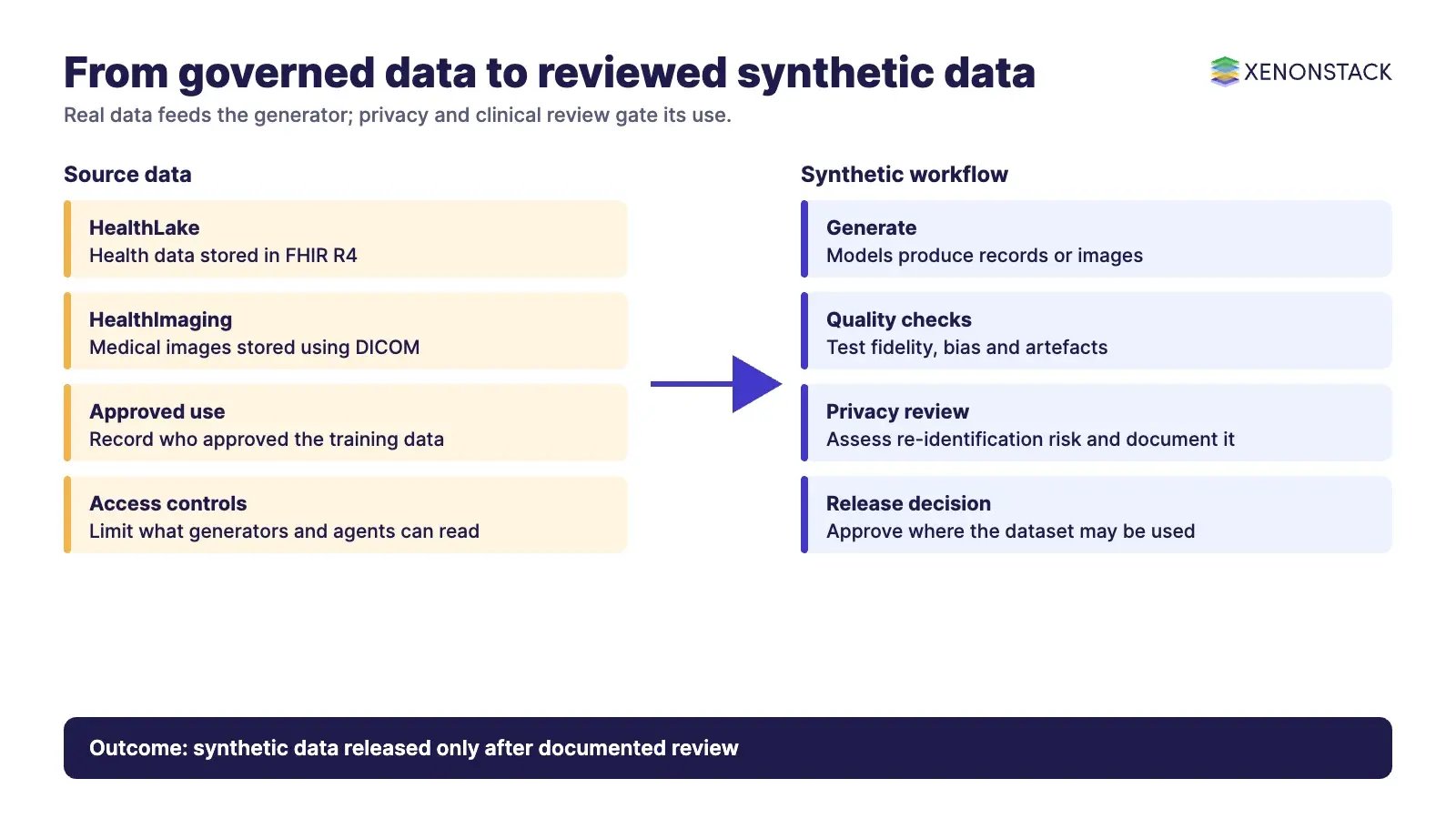
Synthetic data for healthcare is artificially generated data that mimics the structure and statistical patterns of real patient records or medical images, so teams can build and test AI without using the real records directly. Amazon HealthLake and AWS HealthImaging supply the governed, standards-based real data that generative models are trained and checked against, and where synthetic output is validated.
This guide is for healthcare data leaders, clinical informatics teams and AI engineers. It explains how synthetic data and generative AI apply to medical imaging, what the AWS services provide, how privacy rules affect the work, and what to do first.
What is Amazon HealthLake?
The AWS HealthLake documentation describes it as "a HIPAA eligible service for storing, analyzing, and sharing health data in the cloud using the Fast Healthcare Interoperability Resources (FHIR) R4 specification." It can transform legacy C-CDA and CSV data into FHIR R4, indexes data into a view of each patient's history, and includes natural language processing that extracts medical entities from unstructured text and stores them as FHIR resources. The documentation also warns that it should only be used in patient care or clinical scenarios after review by trained medical professionals.
How is AWS HealthImaging different from HealthLake?
They are separate services that work together. The AWS HealthImaging documentation says it lets providers, life science organisations and their software partners "store, analyze, and share medical images in the cloud at petabyte scale", and it lists HealthLake as a related service for combining imaging with health data for precision medicine. It is the imaging service, so check the AWS documentation for its current name and features before you design around either.
| Question | Amazon HealthLake | AWS HealthImaging |
|---|---|---|
| Main data | Health data in FHIR R4 | Medical images such as X-ray, CT, MRI and ultrasound |
| Standard | FHIR R4 APIs, bulk data access, SMART on FHIR | DICOM, with DICOMweb conformant APIs |
| Typical use | Interoperability, transformation, natural language extraction | Enterprise imaging, long-term archive, AI and machine learning on images |
| Together | Combine clinical imaging with health data for multimodal analysis | Combine with HealthLake and omics data for precision medicine |
How does synthetic data generation work in healthcare?
Generative models learn the patterns in a training set and produce new records or images that resemble it. In healthcare, the common targets are structured records, such as encounters and lab results, and medical images. Typical uses include testing software without live patient data, balancing rare conditions in a training set, and sharing development data across teams. Quality is not automatic: synthetic data can copy the biases and gaps of the data it learned from, and it can leak information if a model memorises individual records.
| Technique | Best for | Main caution |
|---|---|---|
| Rule-based or statistical generation | Test data for software and pipelines | May not reflect real clinical complexity |
| Generative adversarial networks and diffusion models | Synthetic medical images | Needs checking for artefacts and for memorised real images |
| Language models | Synthetic clinical notes and structured records | Needs checking for factual errors and leaked identifiers |
Where does generative AI help in medical imaging?
Imaging teams use generative models to augment training sets, to produce examples of uncommon findings, to enhance or reconstruct images and to draft reports for review. Each use needs clinical validation: a model that produces plausible images is not the same as a model that is clinically safe. HealthImaging's archive and its DICOMweb access give teams one governed place to read images from while they train and evaluate. The documentation also states that the service is for clinical use only after review by trained medical professionals.
What privacy and regulatory points apply?
Synthetic data does not remove the need for privacy review. The US HHS page on de-identification of protected health information sets out two HIPAA methods: Expert Determination, where a qualified expert concludes that the risk of identifying an individual is very small and documents the reasoning, and Safe Harbor, which removes a list of 18 specified identifiers. Whether a synthetic dataset meets either test depends on how it was generated and what it could reveal, so ask your privacy and legal teams. Outside the US, other laws apply, and you should confirm the rules for each region you operate in.
How do AI agents change this work?
Agents can run the repetitive parts of a synthetic data programme: pulling a governed sample, generating records, running quality and privacy checks, logging the result and routing exceptions to a human reviewer. The decision that matters is what each agent may read and write, and who approves a dataset before it is used. XenonStack's ElixirData is XenonStack's Context OS, which supports mapping the data and policy behind such decisions.
What should you do first?
- Name one use case, such as testing a pipeline or augmenting one imaging task.
- Confirm what real data feeds the generator and who approved its use.
- Define quality checks for fidelity, bias and re-identification risk before generating anything.
- Get privacy and clinical review of the first dataset and record the decision.
- Document where synthetic data may and may not be used.
To map one decision your healthcare agents make, and the data and policy it depends on, book a Context Workshop. See what happens in the workshop.
Frequently asked questions
What is synthetic data in healthcare?
It is artificially generated data that mimics the structure and patterns of real patient records or images. Teams use it to build and test systems without handling the real records directly, though it still needs privacy and quality checks.
Is synthetic data automatically HIPAA compliant?
No. The HHS guidance describes two de-identification methods, Expert Determination and Safe Harbor. Whether a synthetic dataset qualifies depends on how it was made and what it could reveal, so it needs a documented review.
What is the difference between HealthLake and HealthImaging?
HealthLake stores and analyses health data in FHIR R4, while HealthImaging stores and serves medical images using DICOM. AWS documents them as related services that can be combined for multimodal analysis.
Can generative AI replace real medical images for training?
It can supplement them, for example by adding examples of rare findings, but it cannot be assumed to replace them. Validate any model trained on synthetic images against real, clinically reviewed data.
Can these services be used for clinical decisions?
AWS states that HealthLake and HealthImaging should only be used in patient care or clinical scenarios after review by trained medical professionals applying sound medical judgment.
Follow XenonStack on LinkedIn: XenonStack on LinkedIn for new guides on agentic AI, data and platform engineering.
Ready to put AI agents to work? Explore ElixirClaw, the agentic OS platform to build, orchestrate and govern AI agents.
Explore the XenonStack platform family: ElixirData · ElixirClaw · ElixirHub · NexaStack · MetaSecure · Neural AI · AgentGRC · AgentSRE · AgentAnalyst · AgentInstruct · AgentRAI · AgentScrum · AgentSearch · AgentForce · AI Aviator · SAIF Aviator · CohortIQ · XenonStack AI · XenonStack UAE