Key takeaway
- FinDevOps adds cost visibility to DevOps. See five core capabilities, DORA metrics, adoption steps and when to wait, for banks and fintechs.
What is FinDevOps and why does it matter in financial services?
FinDevOps means bringing cost and financial accountability into the DevOps delivery loop, so the engineers who ship a change can see what it costs and the finance team can see why spend moved. It applies the practice the FinOps Foundation describes, "an operational framework and cultural practice which maximizes the business value of technology", to teams that build and run software.
For banks, insurers and fintechs the question is sharper: heavy regulation, always-on services and cloud bills that scale with usage. This guide covers what FinDevOps adds to DevOps, its five core capabilities, how to adopt it in a regulated firm and when it is not the right investment. For the cost view of data platforms, see DataFinOps.
How does FinDevOps differ from DevOps and FinOps?
DevOps shortens the path from code to production and measures it with delivery metrics. FinOps manages technology spend through collaboration between engineering, finance and the business. FinDevOps is the working overlap: cost signals appear in the same pipelines, dashboards and reviews that engineers already use.
| Practice | Main question | Typical owner | Where it falls short on its own |
|---|---|---|---|
| DevOps | How fast and safely do we ship? | Engineering and platform teams | Cost is rarely a delivery metric, so a change that doubles spend can pass every test |
| FinOps | Is technology spend delivering business value? | FinOps practitioner with finance and engineering | Reviews can lag deployments, so the link to a specific change is lost |
| FinDevOps | What did this change cost, and was it worth it? | Delivery teams with finance as a partner | Needs tagging, allocation and ownership discipline before it works |
The FinOps Foundation lists six principles, including "Teams need to collaborate", "Everyone takes ownership for their technology usage" and "FinOps data should be accessible, timely, and accurate". Each maps directly to a FinDevOps habit: shared dashboards, team-level ownership and cost data fresh enough to explain a release.
What are the five core capabilities of FinDevOps?
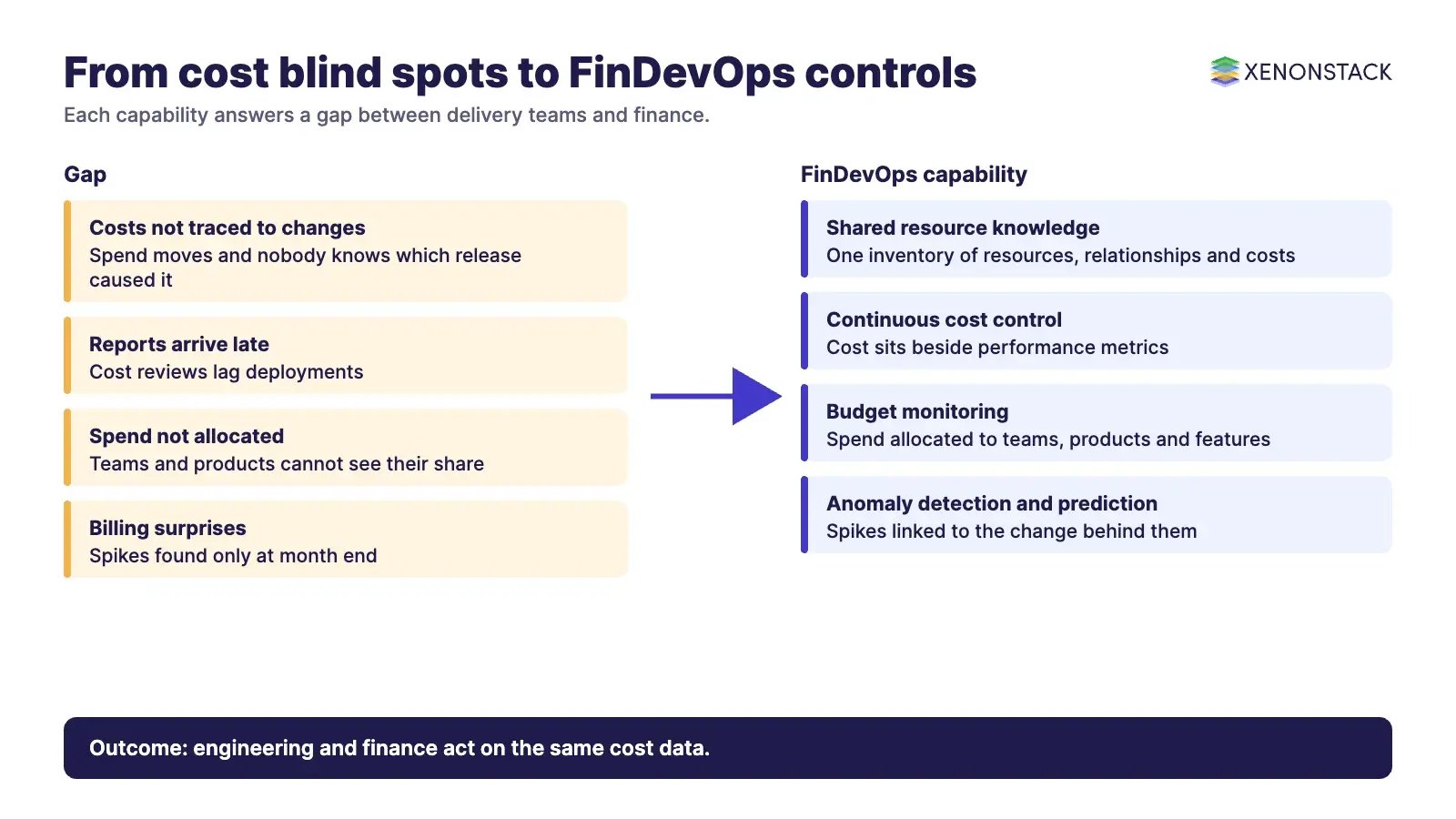
The FinOps Framework groups practice into the phases Inform, Optimize and Operate, and its Understand Usage and Cost domain includes data ingestion, allocation, reporting and analytics, and anomaly management. The five capabilities below are how a delivery team applies that in practice.
| Capability | What it does | What it needs |
|---|---|---|
| Shared resource knowledge | One inventory of cloud resources, their relationships and costs, so a change can be traced to its cost effect | Consistent tagging and ownership data |
| Continuous cost control | Costs sit beside performance metrics, so teams act on cost the way they act on errors or CPU load | Cost data per service or environment, updated often |
| Budget monitoring | Spend is allocated to business units, teams, products and features, including in multi-account set-ups | Allocation rules agreed with finance |
| Cost prediction | Longer-term cost trends are analysed to forecast spend and avoid billing surprises | Enough billing history and a forecasting method |
| Anomaly detection | Unusual spikes are separated from recurring patterns and linked to the release or change behind them | Billing data joined to deployment events |
Anomaly detection and forecasting are where automation earns its place, because billing data is too large to scan by eye. Keep a human owner for each alert: an unexplained spike should reach a named team, not a shared mailbox.
Why do regulated financial firms adopt DevOps, and where does cost fit?
Financial services firms modernise legacy back-end systems while meeting governance, risk, security and compliance rules, which makes software delivery slow and complex. DevOps practices such as continuous integration, continuous delivery and small iterative changes reduce the size of each release and make testing and audit easier. FinDevOps adds the missing measure: the cost of each change and each environment.
| Driver | What DevOps changes | What FinDevOps adds |
|---|---|---|
| Speed of delivery | Smaller, more frequent releases | Cost per release and per environment is visible before it compounds |
| Resilience and downtime | Faster recovery from failed deployments | The cost of over-provisioned redundancy is weighed against recovery targets |
| Compliance and risk | Automated testing and repeatable pipelines leave an evidence trail | Spend, ownership and approvals can be audited alongside change records |
Track delivery with the DORA metrics: change lead time, deployment frequency, failed deployment recovery time, change fail rate and deployment rework rate. DORA groups the first three as throughput and the last two as instability. Pairing them with a cost-per-service view shows whether faster delivery is also affordable delivery. See DevOps metrics for how to read them, and building a DevOps pipeline on AWS for where cost data can be captured in the pipeline.
How should a financial services firm adopt FinDevOps?
- Pick the business driver. Decide whether the goal is lower cloud cost, faster delivery at the same cost or better audit evidence, and set one measure for it.
- Start with one product. Prove the approach on a single service, then extend it once leaders and teams trust the data.
- Fix tagging and ownership. Every resource needs an owner, a team and a business line, or allocation will fail.
- Put cost beside delivery data. Show cost and DORA metrics on the same dashboard, reviewed by engineering and finance together.
- Automate where it is safe. Use anomaly alerts and budget thresholds, and keep human approval for spend-changing actions.
- Organise by business line. Retail banking, lending and investment each need their own cost owner, with shared platform standards.
- Use cloud environments on demand. Test environments that match production can be created and removed, so they do not run idle.
- Avoid blame. Treat a cost spike as a system signal to learn from, as in an incident review.
What does governed FinDevOps look like with AI agents?
As agents start to propose or take actions in cloud estates, cost and policy control must cover them too. ElixirData Context OS keeps governed context, versioned policy and decision traces in one decision layer above AI agents, and AgentGRC keeps autonomous agent actions inside policy, with the audit trail risk teams need. For delivery trends that shape this, read DevOps trends for 2026.
When is FinDevOps not the right step yet?
- Cloud spend is small and stable, so the effort outweighs the saving.
- Resources are not tagged and nobody owns them. Fix that first.
- Delivery is unstable. Stabilise deployments before optimising their cost.
- Finance and engineering do not meet. A tool will not replace the working relationship.
Cost cutting that harms resilience or security controls in a regulated firm is a poor trade, so set cost targets next to recovery and compliance targets, not instead of them.
To map one FinDevOps decision your agents and teams should make, and the context and policy it depends on, book a Context Workshop. See what happens in the workshop.
FinDevOps FAQ
What is FinDevOps?
FinDevOps brings cost visibility and financial accountability into the DevOps loop, so engineers and finance can see what each change costs. It applies FinOps Foundation principles to software delivery teams.
How is FinDevOps different from FinOps?
FinOps is the wider practice of managing technology spend through collaboration between engineering, finance and the business. FinDevOps focuses on the delivery pipeline, linking cost to specific releases and environments.
Which metrics should a FinDevOps team track?
Track the DORA delivery metrics (change lead time, deployment frequency, failed deployment recovery time, change fail rate, deployment rework rate) beside cost per service, budget against actual spend and cost anomalies.
What are the main FinDevOps capabilities?
Shared resource knowledge, continuous cost control, budget monitoring, cost prediction and anomaly detection.
When should a firm not start with FinDevOps?
Hold back when cloud spend is small, resources are untagged, deployments are unstable or finance and engineering do not work together. Fix those first.
Follow XenonStack on LinkedIn: XenonStack on LinkedIn for new guides on agentic AI, data and platform engineering.
Ready to put AI agents to work? Explore ElixirClaw, the agentic OS platform to build, orchestrate and govern AI agents.
Explore the XenonStack platform family: ElixirData · ElixirClaw · ElixirHub · NexaStack · MetaSecure · Neural AI · AgentGRC · AgentSRE · AgentAnalyst · AgentInstruct · AgentRAI · AgentScrum · AgentSearch · AgentForce · AI Aviator · SAIF Aviator · CohortIQ · XenonStack AI · XenonStack UAE