

Key takeaway
- Compare six airline AI operations platforms for disruption recovery, crew and fleet planning, with decision tables, governance checks and when not to buy.
The best airline AI operations platform depends on which decision you are trying to improve. Lufthansa Systems NetLine/Ops ++ and SITA OCCam target the operations control room, Amadeus Passenger Recovery and Sabre with Plan3 target passenger rebooking, Jeppesen targets crew planning and tracking, and a governance layer such as ElixirData Context OS decides what an AI agent is allowed to do on any of them. No single product covers all of it, and most airlines will combine two or three.
This guide compares six options on the criteria an enterprise architect or operations leader needs: operational scope, how decisions are governed, evidence of production use, and integration effort. Disclosure: XenonStack sells one of the options below (ElixirData Context OS). Every competitor claim is taken from the vendor's own page or a named trade report, worded "according to its site", and anything we could not confirm is marked "confirm on the official page".
How should you evaluate an airline AI operations platform?
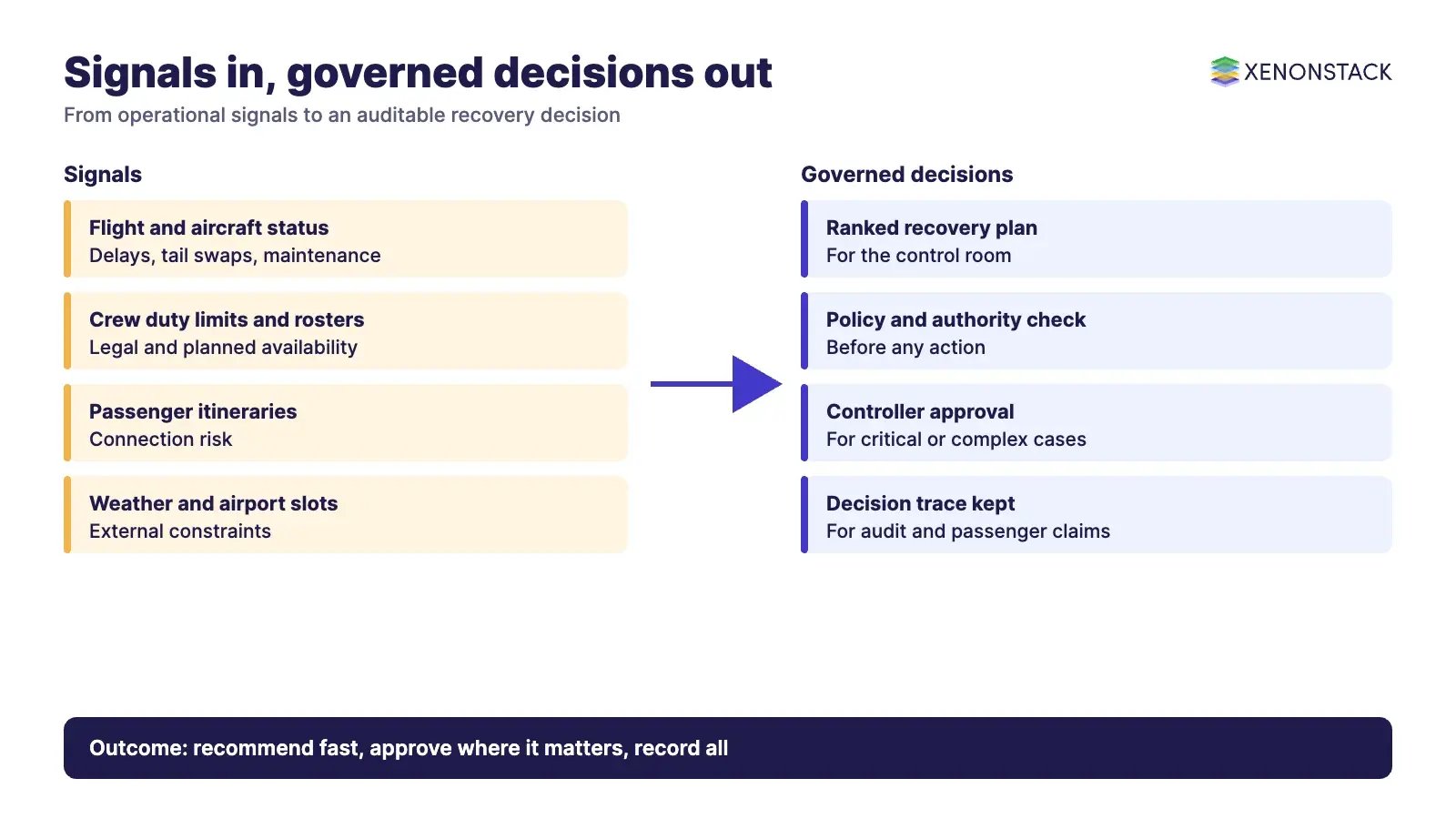
Airline disruption is a chain of linked decisions: a late inbound aircraft breaks a rotation, which breaks a crew duty limit, which strands connecting passengers. A platform that optimises one link and ignores the rest can make the total outcome worse. We used five criteria.
- Scope: does it cover aircraft, crew, passengers and maintenance together, or one of them?
- Decision governance: who may approve what, and is the reason recorded?
- Production evidence: named airlines and measured results, not demos.
- Integration: which passenger service system (PSS) or operations stack must you already run?
- Human control: where does a controller stay in the loop?
The governance criterion matters more each year. Our guide to bounded autonomy explains why agent failures usually come from unchecked authority, not from weak models.
Which platforms are compared here?
| Platform | Main job | Best fit | Evidence to check |
|---|---|---|---|
| Lufthansa Systems NetLine/Ops ++ | Operations control and disruption decisions | Carriers wanting one control-room view | Over 50 carriers cited on its site |
| SITA OCCam (Big Blue Analytics) | Joint aircraft, crew, passenger recovery plans | Airlines already working with SITA | Up to 30% lower disruption cost, claimed by SITA |
| Amadeus Passenger Recovery | Mass passenger re-accommodation | Altéa airlines | Air Canada rebooking case study |
| Sabre with Plan3 | Passenger disruption options and bundles | Sabre-stack or PSS-agnostic airlines | 2023 partnership announcement |
| Jeppesen Crew Management System | Crew pairing, rostering, tracking | Crew planning and day-of-operation control | Product page, no quantified results |
| ElixirData Context OS | Governance and decision traceability for AI agents | Airlines adding agents on top of existing systems | Vendor claims, no airline deployment stated |
What does Lufthansa Systems NetLine/Ops ++ offer?
According to its site, NetLine/Ops ++ is an AI-driven operations control system that monitors flight events in real time. It merges weather, passenger connection risk, maintenance and crew data into one view and compares recovery options against financial KPIs. Its CrewConnex module shows crew constraints and legal duty limits in the control view and warns about infeasible decisions before they are executed. A "critical telex control" feature pauses automatic interpretation of certain telexes until a person validates them, which is a useful example of a human checkpoint built into the product.
The site cites over 50 carriers, including Cathay Pacific and THAI. A separate product, NetLine/Ops ++ aiOCC, is described as an AI operations control assistant for delay risk mitigation; confirm on the official page how it differs from the core product.
Choose it when you want one control-room system with crew limits visible at decision time. Watch for the integration effort of replacing or wrapping an existing OCC tool.
What does SITA OCCam offer?
In June 2026 SITA announced that it had acquired Big Blue Analytics, the developer of the OCC Assistant Manager (OCCam). Trade reports relaying the announcement say OCCam weighs aircraft, crew, passenger itinerary and maintenance constraints together, produces a ranked recovery plan within minutes, and ranks scenarios by cost, on-time performance, passenger impact and compliance. It logs decisions so airlines can measure savings. SITA claims airlines using it have cut disruption costs by up to 30 percent. We could not open SITA's own page, so confirm the figure and the integration plan with SITA before relying on them.
Choose it when joint recovery across aircraft, crew and passengers is your priority. Watch for how it will sit inside SITA's Intelligent Operations Control Center after the acquisition, and ask for named references.
What does Amadeus Passenger Recovery offer?
According to Amadeus, Passenger Recovery is a web-based tool that analyses multiple flight disruptions at once, uses real-time data to re-accommodate passengers, balances high-yield seat sales against rebooking obligations, can rebook onto other carriers, and offers KPI dashboards and optimisation templates to compare scenarios before a plan is triggered. It integrates with Altéa modules including reservations, inventory and notifications.
The strongest public evidence is an Amadeus blog written by an Air Canada director in October 2024. It says most passengers are rebooked about 10 minutes after a cancellation notice, against about 12 hours before, and that the tool proposes solutions for about 90 percent of disrupted passengers in a typical month, with the remaining 10 percent handled manually. Treat that as a vendor-hosted customer claim.
Choose it when you run Altéa and your pain is passenger rebooking volume. Watch for its scope: it addresses passengers, not crew or aircraft routing.
What does Sabre with Plan3 offer?
In March 2023 Sabre and Plan3 announced a disruption management partnership. Trade reports say Plan3 connects to the passenger service system through APIs, flags affected travellers on an issues dashboard, and bundles rebooking options such as flights, hotels and meal vouchers for passengers to choose from on their devices. It is described as PSS agnostic and able to handle thousands of disruptions at once. The announcement is several years old, so confirm current availability and customers on sabre.com.
Choose it when you want whole-journey passenger options, including ground services, and need a tool that is not tied to one PSS. Watch for the same passenger-only scope.
What does Jeppesen offer for crew and fleet planning?
According to its site, the Jeppesen Crew Management System spans crew pairing, rostering, manpower planning, crew tracking and fatigue risk management, with the aim of keeping operations stable on the day. The page does not mention AI or machine learning and gives no quantified results, so this is a mature planning backbone rather than an AI recovery engine. Its value in this comparison is that crew rules are the hardest constraint in any recovery plan, and any AI layer has to respect the data held here.
Choose it when crew planning and tracking is the bottleneck. Watch for how recovery recommendations from other tools feed back into the crew system.
Where does ElixirData Context OS fit?
XenonStack sells this option, so read it with that in mind. According to its site, ElixirData Context OS sits between enterprise systems and AI agents. It compiles business context, checks policy and authority before an agent acts, and records a decision trace for each outcome. It can be deployed as managed SaaS, in a customer VPC or on premises, and the site cites a four-week deployment, SOC 2 and ISO 27001.
It is not a crew optimiser or a rebooking engine, and the pages we reviewed do not claim an airline deployment. Its relevance is the layer above the engines: when an AI agent proposes a tail swap or a mass rebooking, who is allowed to approve it, on what evidence, and where is the record? The Exception Handling Agent routes cases that need human judgement to an approver by authority and SLA, and the Approval Agent approves routine items within set limits. Both are described on the vendor pages with generic enterprise examples, not airline ones. Related reading: who controls what agents can do and decision memory.
Choose it when you already have optimisation engines and want governed agents on top. Watch for the lack of public airline references; run a pilot on one decision type first.
How do the options compare on governance and human control?
| Platform | Human control stated by the vendor | Decision record |
|---|---|---|
| NetLine/Ops ++ | Critical telex validation, infeasible-decision warnings | Confirm on the official page |
| SITA OCCam | Ranked plans for controllers (per trade reports) | Decision logging for ROI, per reports |
| Amadeus Passenger Recovery | Scenario comparison before triggering; complex cases manual | KPI dashboards |
| Sabre with Plan3 | Passenger chooses from options | Confirm on the official page |
| Jeppesen Crew Management | Planner-driven workflows | Confirm on the official page |
| ElixirData Context OS | Policy and authority checks, escalation to approvers | Decision traces |
The regulatory backdrop makes the record important. In the EU, Regulation (EC) No 261/2004 sets compensation and assistance rules for cancellations and long delays, so an automated rebooking or care decision may later need to be explained to a passenger or a regulator.
Which platform should you pick for your situation?
| If your main problem is | Start with |
|---|---|
| Control-room visibility and recovery decisions | NetLine/Ops ++ or OCCam |
| Passenger rebooking volume on Altéa | Amadeus Passenger Recovery |
| Whole-journey options on a mixed or Sabre stack | Sabre with Plan3 |
| Crew rules and rosters | Jeppesen |
| Proving that AI agents act within authority | A governance layer such as Context OS |
Moving from pilot to production is usually a governance problem, not a modelling one. See why pilots stall and the decision rules that get them to production, and multi-agent coordination for how several agents (crew, passenger, maintenance) should hand work to each other. The same signal-to-decision delay appears in other sectors, as in supply chain decision gaps.
When should you not buy an AI operations platform?
- Your data feeds are unreliable. If schedule, crew and aircraft status are not available in near real time, no optimiser will help. Fix integration first.
- You have a small fleet and few disruptions. A trained controller team with existing tools may be cheaper and safer.
- You expect to remove people from safety-relevant decisions. Every product reviewed keeps humans on complex or critical cases.
- You cannot name the decision you want to improve. Buying a platform before choosing one decision type leads to a stalled pilot. The rollback era shows what happens when governance is added after launch.
- You only need analytics. A reporting layer, as described in agentic analytics, may be enough.
What about contact-centre AI such as HappyRobot?
Voice and chat agents handle the surge of passenger calls during disruption, which is a different job from recovery planning. One vendor comparison we reviewed, published by HappyRobot itself and ranking itself first, claims about 64 percent of calls resolved without a human in a supply chain deployment. That is a self-published figure from a non-airline setting, so confirm on the official page before using it. We left contact-centre tools out of the table because they sit downstream of the decisions compared here.
How can you test decision readiness before choosing?
Pick one recurring operational decision, for example approving a tail swap that breaks a crew duty limit, and map who decides, on what data, and what evidence is kept. ElixirData runs a free half-day Context Workshop that traces one recurring AI decision and ends with a decision map and a clear yes or no. You can book a Context OS demo or join a Context Workshop. The exercise is useful whichever platform you choose.
Frequently asked questions
What is an airline AI operations platform?
It is software that watches flight, crew, aircraft, maintenance and passenger data in real time and recommends or executes recovery decisions when the schedule breaks. The better ones rank options by cost, on-time performance, passenger impact and rule compliance, and keep a record of why a decision was made.
Which platform is best for airline disruption recovery?
There is no single winner. Airlines on Amadeus Altéa often start with Amadeus Passenger Recovery, Lufthansa Systems NetLine/Ops ++ and SITA OCCam target the operations control room, and Jeppesen covers crew planning and tracking. Choose by the decision you need to improve and the systems you already run.
Can AI replace the operations control centre team?
No. In the products reviewed, people still validate critical inputs or handle complex cases. Air Canada, for example, says about 10% of disrupted passengers are handled manually. AI shortens the time to a good option; accountable controllers still approve decisions that carry safety or legal consequences.
How should airlines govern AI decisions in operations control?
Define which decisions an agent may take alone, which need approval, and which are never delegated. Check authority before every action, and store the context and policy version for each decision so that it can be audited later.
What should a buyer ask a vendor before a pilot?
Ask which data feeds are required, what the claimed results were measured against, which airlines run it live, how crew duty limits and maintenance constraints are enforced, and what evidence the system keeps for each decision.
Where does ElixirData fit among these platforms?
ElixirData Context OS is a governance and decision layer for AI agents, not a replacement for a crew optimiser or a passenger recovery engine. According to its site, it checks policy and authority before an agent acts and records a decision trace. It does not claim an airline deployment on the pages reviewed.
Ready to put AI agents to work? Explore ElixirClaw, the agentic OS platform to build, orchestrate and govern AI agents.
Explore the XenonStack platform family: ElixirData · ElixirClaw · ElixirHub · NexaStack · MetaSecure · Neural AI · AgentGRC · AgentSRE · AgentAnalyst · AgentInstruct · AgentRAI · AgentScrum · AgentSearch · AgentForce · AI Aviator · SAIF Aviator · CohortIQ · XenonStack AI · XenonStack UAE


