Key takeaway
- Apache Solr in 2027: architecture, SolrCloud, vector and hybrid search, security and Solr 10.1 changes, with when to choose Solr and how to deploy it.
Apache Solr is an open source search platform built on Apache Lucene that provides full-text, vector and geospatial search over large document collections. It indexes documents made of fields, answers queries over HTTP, and scales out through SolrCloud, which adds distributed indexing, replication, load-balanced querying, automated failover and centralised configuration.
Solr 10.1.0, released on 27 October 2026, is the current release. The 10.x line needs Java 21, runs on Lucene 10.4, removes several legacy modules and adds hybrid search that blends keyword and vector results. This guide covers how Solr works, what changed in Solr 10, how to secure and deploy it, and when another engine is the better fit.
What is Apache Solr?
The Solr project describes Solr as an open source, multi-modal search platform that draws on Lucene's full-text, vector and geospatial search capabilities. Its feature areas include faceting, statistics and aggregations, spatial search, rich content handling, plugins and scaling with SolrCloud.
Everything Solr searches is a document: a set of named fields, usually with a unique ID that acts like a primary key. When a field is defined in the schema, Solr applies that field's analysis steps when the content is tokenised. According to the indexing guide, content usually arrives through Solr Cell with Apache Tika for binary files, through HTTP uploads of XML files, or through Java applications using the client API.
How does the Apache Solr architecture work?
A request to Solr passes through a small set of pluggable components. Knowing them helps architects decide where custom logic belongs.
| Component | What it does | Typical use |
|---|---|---|
| Request handler | Receives an HTTP request and decides how to process it | Separate endpoints for search, updates and administration |
| Query parser | Turns query text into a Lucene query and checks its syntax | Keyword, structured or knn vector queries |
| Search components | Add features to a search request | Faceting, highlighting, spell checking |
| Analysers and tokenisers | Break field text into tokens and normalise them | Language handling, stemming, synonyms |
| Update request processors | Change documents as they are indexed | Adding, removing or transforming fields |
| Response writers | Format results for the caller | JSON or XML responses to applications |
SolrCloud or user-managed mode?
Solr runs in one of two cluster modes. Most enterprise deployments choose SolrCloud.
| Question | SolrCloud | User-managed |
|---|---|---|
| Who coordinates the cluster? | ZooKeeper tracks nodes and core state and stores configuration | You, manually or with local scripts |
| How is data split? | Collections are sharded automatically on creation | You create shards and route documents yourself |
| What happens if a leader fails? | Another replica is elected automatically | No built-in failover; you edit solrconfig.xml and reload cores |
| When it fits | Production clusters that need resilience and scale | Small, single-node or legacy leader and follower setups |
What has changed in Solr 10?
Solr 10.0.0 was released on 3 March 2026 and Solr 10.1.0 on 27 October 2026, according to the Solr news page. The changes below matter most when upgrading from older guides, which often still show Solr 7 or 8 on Java 8.
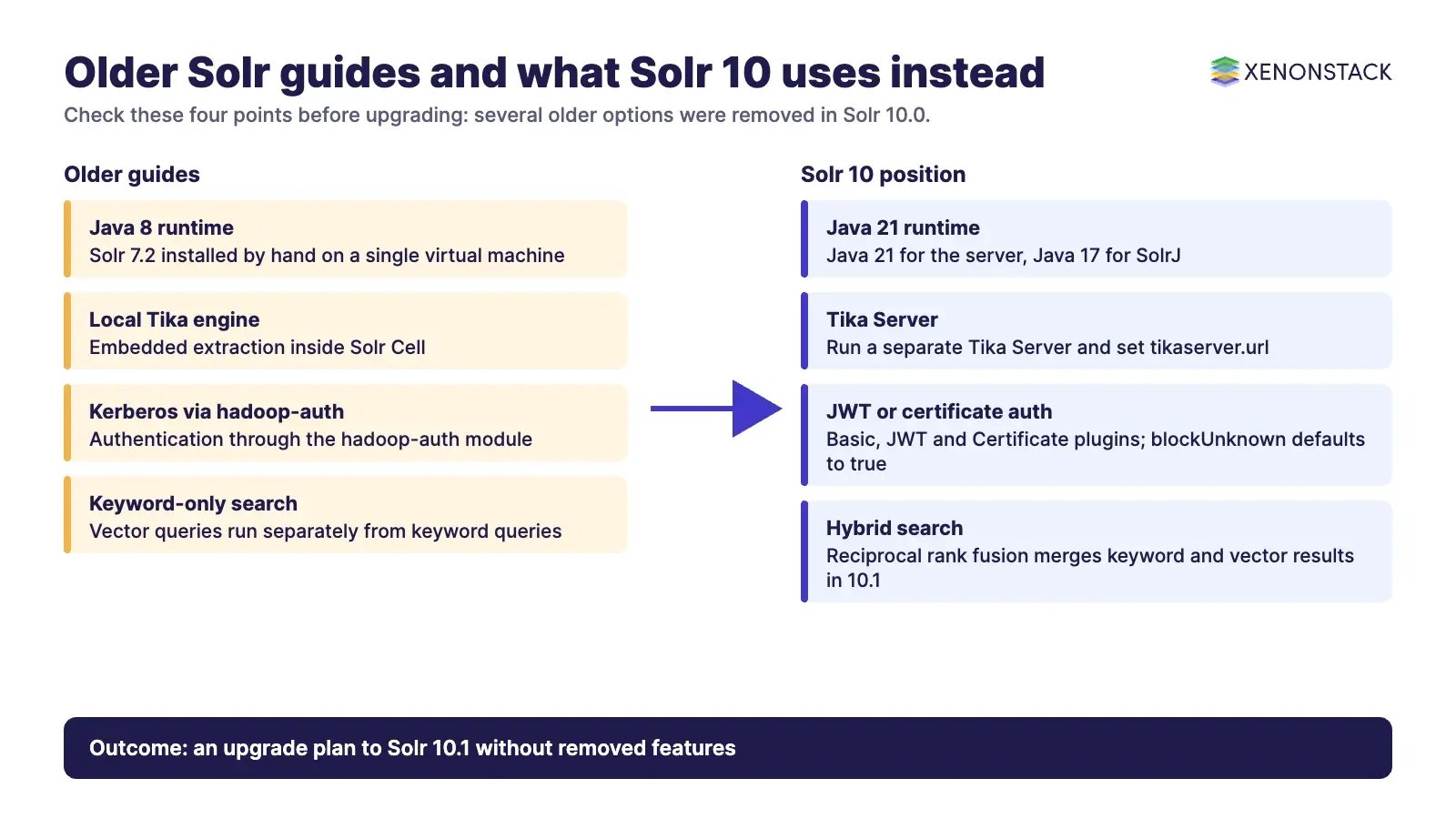
| Area | Earlier position | Solr 10 position |
|---|---|---|
| Java | Java 8 in older guides, including the Solr 7.2 install steps this post used to show | Java 21 for the server, Java 17 for SolrJ |
| Lucene and web stack | Older Lucene and Jetty releases | Lucene 10.4, Jetty 12 and Jakarta EE 10 in Solr 10.1 |
| Rich document extraction | Embedded local Tika engine | Removed; run a Tika Server and set tikaserver.url |
| Modules | analytics, hadoop-auth and jaegertracer-configurator modules | All three removed in Solr 10.0 |
| Field types | ExternalFileField, CurrencyField and EnumField | Removed in Solr 10.0 |
| JWT authentication | blockUnknown defaulted to false in code | Defaults to true in Solr 9.11 and 10.1, blocking unauthenticated requests |
| Search | Keyword search with separate vector queries | Hybrid search through reciprocal rank fusion and nested vector search in 10.1 |
| Admin UI | Classic Admin UI only | Experimental new Admin UI at /solr/ui alongside the classic one |
Solr 9.11.0, released on 4 October 2026, is the last 9.x release. The downloads page says the previous major version may receive critical bug fixes only, so new projects should start on 10.x.
How does Solr handle vector and hybrid search?
Solr stores embeddings in a DenseVectorField and searches them with the knn query parser. The dense vector search guide sets HNSW, the approximate nearest neighbour graph implemented in Lucene, as the default algorithm, with euclidean, cosine and dot product similarity. A knn query returns 10 neighbours unless you set topK.
Three further options affect cost and design. Scalar and binary quantised vector fields reduce memory use by storing smaller values per dimension. The experimental knn_text_to_vector parser, which uses LangChain4j, encodes query text with a model registered in Solr. Solr 10.0 added a cuVS-Lucene codec for GPU acceleration, though the 10.1 guide notes that GPU vector indexing does not work in that release. Solr 10.1 then adds hybrid search through reciprocal rank fusion, which merges keyword and vector rankings.
For retrieval behind AI agents, the search index is only one layer. ElixirData AgentSearch provides context-aware enterprise search across unstructured knowledge bases, with access controls and governance applied from ElixirData Context OS, which keeps governed context, versioned policy and decision traces in one decision layer above AI agents.
How should you secure Apache Solr?
Solr security is configured in a security.json file. In SolrCloud it lives at the ZooKeeper chroot and is uploaded with bin/solr zk cp; in standalone mode it sits in $SOLR_HOME. The authentication and authorisation guide lists these plugins:
| Control | Current options | What to check |
|---|---|---|
| Authentication | Basic, JWT and Certificate authentication plugins | Set JWT blockUnknown to true explicitly on releases before 9.11 and 10.1 |
| Authorisation | Rule-based and external role rule-based authorisation plugins | Patch for CVE-2026-22022, a RuleBasedAuthorizationPlugin bypass affecting 5.3.0 to 9.10.0 |
| Core creation | File-access checks in standalone core creation | Patch for CVE-2026-22444, affecting 8.6 to 9.10.0 |
| Audit | Audit logging section in security.json | Send audit events to your security monitoring |
| Network | TLS between clients and nodes, ZooKeeper access control | Keep Solr and ZooKeeper off the public internet |
Kerberos is not in the current plugin list, and Solr 10.0 removed the hadoop-auth module. If your clusters still use Kerberos, as described in our deep dive into Apache Solr security, plan the move to JWT or certificate authentication before upgrading.
How should enterprises deploy Solr going into 2027?
Older guides install Solr by hand on a single virtual machine with Java 8. For current releases, follow this sequence.
- Define the search problem. Keyword, faceted, vector or hybrid; document volume; freshness needed; who may see which results.
- Start on Solr 10.1 with Java 21. Do not start new work on 9.x, which is in critical-fix-only mode.
- Choose SolrCloud. Run a dedicated ZooKeeper ensemble for production clusters and keep it under the same change control as Solr.
- Run on Kubernetes with the Solr Operator. The Apache Solr Operator is built to manage Solr on Kubernetes and deploy SolrCloud; v0.9.1 was announced on 25 March 2025.
- Secure before loading data. Enable authentication, rule-based authorisation, TLS and audit logging in security.json.
- Plan extraction. If you index PDFs or Office files, run a separate Tika Server, because the local Tika engine is gone.
- Test relevance and capacity. Measure query latency, index size with and without vector quantisation, and recovery after node loss.
If you would rather not run the cluster yourself, see Managed Apache Solr Services. Teams pairing Solr with a wide-column store for source data can read our guide to implementing Apache Cassandra on AWS.
When should you choose Solr, and when not?
| Situation | Fit | Reason |
|---|---|---|
| You need an Apache Software Foundation project with community governance | Solr | Solr is developed at the ASF; Elasticsearch is offered under SSPL 1.0, AGPLv3 and the Elastic License 2.0, with default distributions under the Elastic License 2.0 |
| Faceted catalogue or site search over structured fields | Solr | Faceting, statistics and schema-driven analysis are core features |
| Hybrid keyword and vector retrieval for AI applications | Solr 10.1 or a dedicated vector store | Solr 10.1 adds reciprocal rank fusion; test recall and latency against your embeddings |
| Log analytics and observability dashboards | Usually another tool | Teams often choose a stack built around log ingestion and dashboards |
| A small app with a few thousand records | Database full-text search | A separate search cluster adds operational cost |
Elastic added AGPLv3 as a licence option in September 2024, according to its licensing FAQ. Check the licence of the exact distribution you deploy, not only the source code.
To map one search-driven decision your agents should make, and the context and policy it depends on, book a Context Workshop. See what happens in the workshop.
What should you plan for in 2027?
Solr 10.1 is the release to build on, so plan around it rather than around older guides. Three points from this guide shape the year.
- Start new work on Solr 10.1 with Java 21. Version 9.x is in critical fix only mode, so new projects gain nothing by starting there.
- Settle security before upgrading. If clusters still use Kerberos, plan the move to JWT or certificate authentication, set JWT blockUnknown explicitly on older releases and patch the authorisation and core creation issues listed above.
- Plan extraction and retrieval. Run a separate Tika Server for PDFs and Office files, and test relevance, latency and recall before you rely on hybrid keyword and vector search.
Measure query latency, index size and recovery after node loss before each rollout.
Frequently asked questions about Apache Solr
What is the latest version of Apache Solr?
Solr 10.1.0, released on 27 October 2026, is the current release. Solr 9.11.0, released on 4 October 2026, is the last release in the 9.x series and may receive only critical bug fixes.
Which Java version does Solr 10 need?
Solr 10 needs Java 21 for the Solr server and Java 17 for the SolrJ client library.
Does Apache Solr support vector search?
Yes. Solr stores embeddings in DenseVectorField, searches them with the knn query parser using an HNSW graph by default, and supports euclidean, cosine and dot product similarity. Solr 10.1 adds hybrid search through reciprocal rank fusion and nested vector search.
What is the difference between SolrCloud and user-managed Solr?
SolrCloud uses ZooKeeper to track nodes, store configuration, route requests and elect a new leader when one fails. In user-managed mode, sharding, routing, load balancing and failover are left to you.
Is Kerberos authentication still available in Solr?
The current Solr Reference Guide lists Basic, JWT and Certificate authentication plugins, and Kerberos is not among them. Solr 10.0 also removed the hadoop-auth module, so plan JWT or certificate authentication for new clusters.
Follow XenonStack on LinkedIn: XenonStack on LinkedIn for new guides on agentic AI, data and platform engineering.
Ready to put AI agents to work? Explore ElixirClaw, the agentic OS platform to build, orchestrate and govern AI agents.
Explore the XenonStack platform family: ElixirData · ElixirClaw · ElixirHub · NexaStack · MetaSecure · Neural AI · AgentGRC · AgentSRE · AgentAnalyst · AgentInstruct · AgentRAI · AgentScrum · AgentSearch · AgentForce · AI Aviator · SAIF Aviator · CohortIQ · XenonStack AI · XenonStack UAE