

Key takeaway
- Evaluate AI agent platforms for legacy modernisation with a weighted scorecard, 60 day pilot plan and governance checklist for CIOs and architects.
To evaluate an AI agent platform for legacy modernisation, score it on six things: governance enforced by the platform itself, integration with the systems you are replacing, auditability of every agent decision, production readiness, security of tools and connectors, and the cost and exit terms. Then prove the scores in a time-boxed pilot on one real workflow, with agents in read-only mode first. A demo shows what a platform can do. A pilot shows what it does when your oldest system returns a malformed record at 2am.
This guide gives CIOs, CTOs and architects the criteria, a weighted scorecard you can adapt, a 60 day pilot plan and a governance model for the agents that survive the pilot. It is written for governed environments such as banking, insurance, healthcare and the public sector, where an agent that cannot explain an action is an agent you cannot deploy. XenonStack sells one of the options discussed in this field, so we say where our view is shaped by that.
What should a CIO evaluate in an AI agent platform?
Most evaluations start with model quality and end with a price. For legacy modernisation that order is wrong. Legacy estates are where the risk sits: undocumented business rules, brittle integrations and batch jobs nobody dares touch. A platform is only useful if agents can act safely inside that environment.
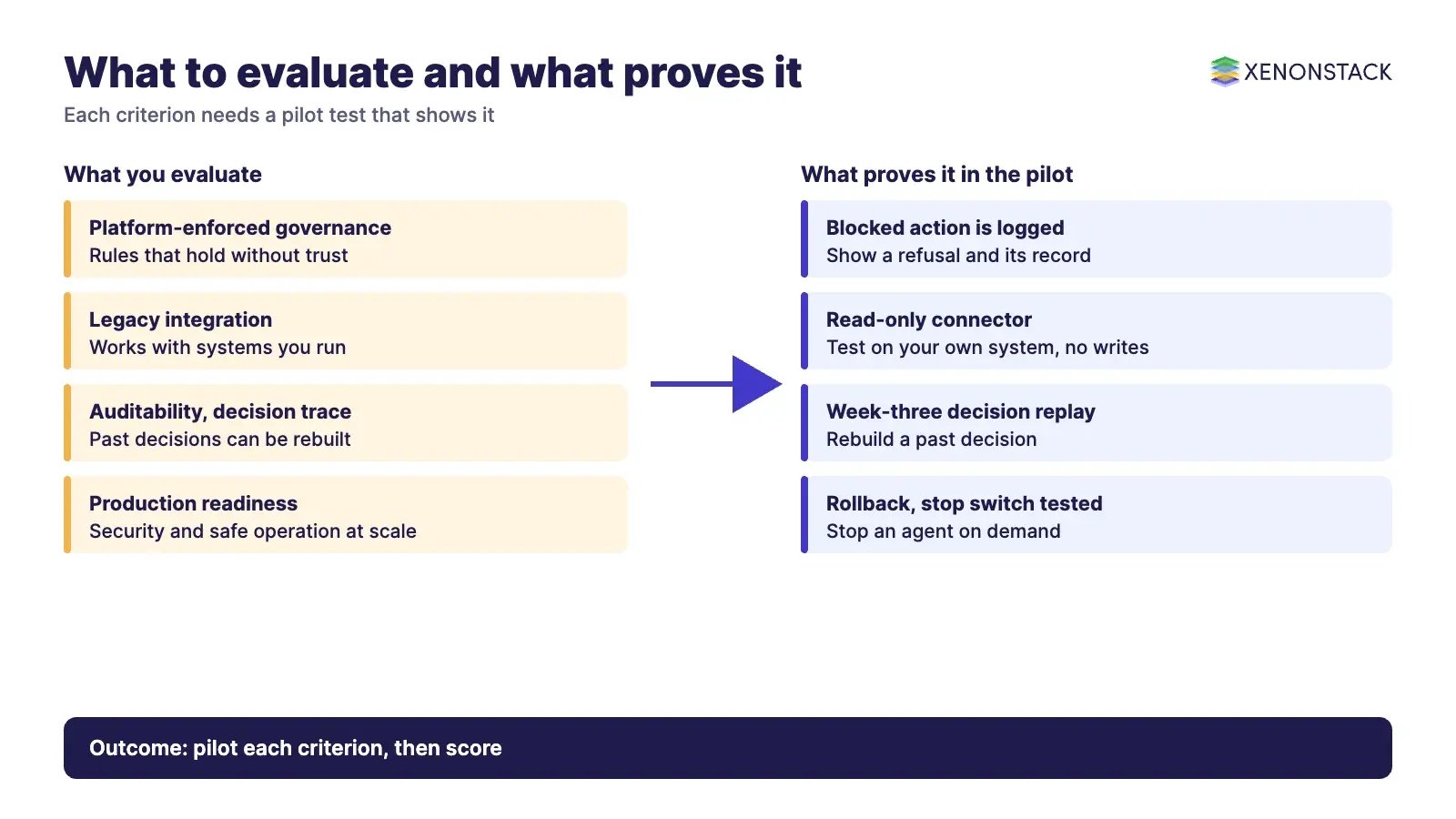
Six criteria cover most of what matters.
- Governance that is enforced, not requested. Policy should be checked by the platform before an agent acts, outside the prompt. Our post on who controls what agents can do explains why prompt-level rules fail: models are probabilistic, so a rule written in natural language is a hope, not a control.
- Integration with legacy systems. Ask how the platform reaches mainframes, old databases, file drops and SOAP services without rewriting them. Look for API wrapping, change data capture and read-only connectors.
- Auditability. You should be able to replay why an action was taken: the context the agent saw, the policy checks it passed, the approver and the outcome.
- Production readiness. Observability, rollback, versioning, evaluation harnesses, identity per agent and sensible failure behaviour.
- Security of tools and connectors. Agents install skills and call tools. Each is a supply chain risk and a route for excessive permissions.
- Commercial and exit terms. Deployment control, data residency, pricing model and how you leave.
Two public sources are worth anchoring on. The NIST AI Risk Management Framework, released as AI RMF 1.0 on 26 January 2023, organises risk work around four functions: Govern, Map, Measure and Manage. NIST also published a Generative AI Profile (NIST-AI-600-1) on 26 July 2024. Its page notes that AI RMF 1.0 is being revised, so check the current version before you cite it in a policy. The OWASP Top 10 for LLM Applications (2025 edition) lists Prompt Injection (LLM01), Supply Chain (LLM03) and Excessive Agency (LLM06) among its risks, and all three bear directly on agent platforms.
Why does legacy modernisation change the evaluation?
Because the hardest problems are not model problems. According to its site, Ascendion advises ranking an estate by business consequence and annual cost rather than technical age, and it describes risk as sitting in the cutover and in code no one fully understands. According to its site, Mobisoft Infotech proposes four readiness gates for each AI use case: data accessibility, data quality, real-time availability and integration surface, with failure at any gate blocking production for that use case.
Read together, they point to a practical rule. Evaluate the platform against the specific systems it will touch, not against a generic benchmark. A platform that shines on a modern SaaS stack may stall on a thirty year old core system with batch-only updates. Pick two or three representative legacy systems before you shortlist anything, and make every vendor show their approach on those.
How do you score platforms? A weighted scorecard
The weights below are our suggested starting point, not an industry standard. Change them to reflect your risk appetite. A regulated bank might lift governance to 30 percent. A team modernising an internal reporting stack might lower it.
| Criterion | Suggested weight | What a strong answer looks like | Evidence to ask for |
|---|---|---|---|
| Governance enforced by the platform | 25% | Policy checks before every action; approval thresholds; authority matrix per agent | Live demo of a blocked action; policy-as-code samples |
| Legacy integration | 20% | Read-only connectors first; API wrapping; change data capture; no rewrite of source systems | Proof on your own system, not a reference slide |
| Auditability and decision trace | 20% | Replayable record of context, policy result, approver and outcome | An exported trace you can hand to an auditor |
| Production readiness | 15% | Per-agent identity, observability, rollback, versioned evaluation | Runbook; incident history; rollback test |
| Security of tools and connectors | 10% | Allow-lists, scoped credentials, review of installed skills | Threat model mapped to OWASP LLM risks |
| Commercial and exit | 10% | Deployment in your cloud or data centre; export of traces and policies; clear pricing | Contract terms; data residency statement |
Score each criterion from 0 to 5 during the pilot, not before it. Multiply by the weight and add up. Anything scoring 1 or below on governance or auditability should be an automatic stop, whatever the total says.
What does governance look like in practice?
Governance has three surfaces: what an agent can retrieve, which tools it can call and what it can commit to. Ask each vendor to show the control for each one. Our buyer's checklist for agentic AI platforms adds governed context, limits and approvals, decision trace, reversibility, observability, deployment control and supply-chain checks to the list.
The question that separates serious platforms from weak ones is simple: can the agent do this even if it wants to? If the answer depends on the prompt, the control is soft. If the platform refuses the action at the policy layer and logs the refusal, the control is hard.
For identity, each agent should have an owner, a scope, a risk rating and a lifecycle, just like a human user or service account. ElixirData's Agent Registry page describes this approach, covering identity, authority and scope, monitoring, shadow agent discovery and lifecycle management. Whatever platform you pick, insist on an equivalent inventory.
How do you design a 60 day pilot?
Choose one workflow where the legacy system is real, the stakes are moderate and success can be measured. Examples include code and schema analysis for a migration, reconciliation of records between old and new systems, or exception triage on a batch process. Our post on why pilots stall and the decision rules that get them to production argues that most stalls come from undefined decisions, not weak models, and proposes a seven-question gate covering decision scope, limits, exceptions, evidence, reversibility, value and exit.
| Phase | Days | Agent mode | Exit test |
|---|---|---|---|
| 1. Define | 1 to 10 | None | Decisions, limits, approvers and evidence written down; legacy systems connected read-only |
| 2. Observe | 11 to 30 | Read-only | Agent outputs match human results on a sample you chose; traces are complete |
| 3. Recommend | 31 to 45 | Recommend, human approves | Approval rate, override reasons and error types recorded |
| 4. Limited action | 46 to 60 | Act within tight limits, reversible only | Rollback tested; no policy breach; scorecard completed |
Keep the scope narrow. One workflow, one or two legacy systems, one accountable business owner. Agree the success and stop rules on day one. A pilot without a stop rule tends to become a permanent experiment.
Run the same pilot with two or three platforms if you can afford it, and the scorecard will do real work. If you cannot, run one pilot and apply the scorecard to the evidence.
What should you test that demos never show?
- Refusal. Ask the agent to do something outside its authority. Check it is blocked and the refusal is logged.
- Bad data. Feed it a malformed or stale record from the legacy system. Does it flag it, guess or fail silently?
- Replay. Pick a decision from week three and reconstruct exactly why it was made.
- Rollback. Reverse an action in a system of record and confirm the state is clean.
- Prompt injection. Place hostile instructions in a document the agent reads. See whether tool calls change.
- Observability. Check you can see reasoning traces, policy results and escalation rates, not just uptime. Our post on agentic observability sets out a three-layer model: system health, the agent's cognitive process and governance.
How should you govern agents after the pilot?
Treat the move from pilot to production as a change of control, not a change of environment. Four elements are enough to start.
- An agent inventory with an owner, scope, risk rating and review date for every agent, including any found running outside official channels.
- An authority matrix stating what each agent may read, call and commit to, and which actions need a human.
- Continuous evidence. Decision records generated as a by-product of operation, not assembled before an audit. Our post on GRC for agentic AI systems lists six artifacts to have ready: agent inventory, risk assessment, decision evidence, governance documentation, incident history and regulatory mapping.
- A stop switch. A tested way to pause an agent or a class of agents without a code release.
On regulation, the EU AI Act is Regulation (EU) 2024/1689, adopted on 13 June 2024. Obligations are phased in, and the application dates for particular requirements have been under active discussion, so confirm the current dates and your risk classification on the official EUR-Lex page and with counsel. Map your evidence to NIST AI RMF functions as well, as they give a common vocabulary for internal audit.
Build, buy or combine?
| Option | Choose it when | Watch out for |
|---|---|---|
| Build on open frameworks | You have a strong platform team and unusual requirements | You own governance, audit and security work indefinitely |
| Buy a platform | You need governed agents quickly and standard patterns fit | Lock-in; legacy connectors that exist only on slides |
| Combine | You want your own agents on a governed control layer | Clear ownership between layers; integration effort |
Disclosure: XenonStack sells one of the options in this market, through its Akira AI and ElixirData products. We have tried to keep the criteria vendor-neutral, and you should hold us to the same scorecard as everyone else. For a broader comparison, see our post on top agentic AI platforms and how to evaluate them. ElixirData describes its Context OS as a system that "compiles enterprise context, enforces governance structurally, and produces evidence at every decision", organised into Context, Control and Decision layers. Read that on its Context OS page and test it against the same pilot.
When should you not buy an agent platform yet?
- The legacy data is not accessible. If you cannot read the system reliably, fix that first. An agent on bad data only produces confident errors faster.
- No one owns the decision. If no business owner will sign off the limits and the evidence, a platform will not supply one.
- The task is deterministic. If a rule or a script solves it, use the script. It is cheaper and easier to audit.
- You cannot reverse the action. Where an error cannot be undone, keep a human in the loop until reversibility exists.
- The goal is a headline. A pilot chosen for the press release rarely survives contact with production.
In those cases, spend the quarter on data access, decision definitions and a read-only agent. It is a smaller step, and it makes the later platform choice better informed.
Where do you start?
If you want a structured way to pick the first workflow, ElixirData runs a Context Workshop. According to its site, it is a free half-day session where your team maps one AI decision with ElixirData architects, and you leave with a one-page decision map, a ranked list of other decisions worth fixing and a written go or no-go. It needs no data access. You can see the Context OS demo or book a Context Workshop. Our related post on agentic analytics architecture, controls and rollout covers a read-only first rollout in more detail.
Frequently asked questions
What is the most important criterion when evaluating an AI agent platform?
Governance enforced by the platform itself. If policy checks happen before an agent acts and every decision is recorded, other gaps can be managed. If they do not, no other strength compensates.
How long should an AI agent platform pilot last?
About 60 days for one workflow is a workable default: 10 days to define, 20 read-only, 15 recommend-only and 15 for limited, reversible action. Shorten it for low-risk internal work and lengthen it in regulated settings.
Should agents act on legacy systems directly during a pilot?
No. Start read-only, move to recommendations with human approval, and allow action only where it can be reversed. Wrap or stream data from legacy systems instead of modifying them.
How do we compare vendors fairly?
Use one weighted scorecard, one workflow and the same legacy systems for each vendor. Score from pilot evidence rather than slides, and set automatic stops for governance and auditability.
Which frameworks should we map our evaluation to?
The NIST AI Risk Management Framework (Govern, Map, Measure, Manage) and its Generative AI Profile, the OWASP Top 10 for LLM Applications for security testing and, where relevant, the EU AI Act. Confirm current versions and dates on the official pages.
When is it better not to use an agent platform?
When the task is deterministic, the data is not accessible, no one owns the decision or the action cannot be reversed. Fix those first.
Ready to put AI agents to work? Explore ElixirClaw, the agentic OS platform to build, orchestrate and govern AI agents.
Explore the XenonStack platform family: ElixirData · ElixirClaw · ElixirHub · NexaStack · MetaSecure · Neural AI · AgentGRC · AgentSRE · AgentAnalyst · AgentInstruct · AgentRAI · AgentScrum · AgentSearch · AgentForce · AI Aviator · SAIF Aviator · CohortIQ · XenonStack AI · XenonStack UAE


