Key takeaway
- Agentic AI in HR explained: where agents fit in recruiting, onboarding and service, what the EU AI Act and NYC rules require, and a safe rollout plan.
Agentic AI in HR means software agents that take a goal, such as shortlisting candidates, answering an employee query or preparing a new hire's first week, and carry out the steps with HR tools and data, while a named person keeps the decisions that affect someone's job. It differs from agentic AI in general only in its risk: HR decisions touch hiring, pay, promotion and exit, so the controls matter as much as the capability.
For a CHRO, CIO or enterprise architect, the practical answer is to start with high-volume, low-judgement work (scheduling, document checks, HR queries, onboarding tasks), keep humans on every decision about a person, and log what each agent did and why. This guide covers where agents fit, what the EU AI Act and New York City's Local Law 144 require, and a rollout sequence.
What is agentic AI in HR, and how is it different from HR automation?
Traditional HR automation follows fixed rules: send this email when this field changes. Generative AI drafts text or summarises a document when asked. An agent works towards a goal across several steps and systems, decides which step comes next, and hands over to a person when its rules say so.
| Approach | What it does in HR | Who decides | Typical limit |
|---|---|---|---|
| Rule-based automation | Sends reminders, routes forms, updates records on a trigger | The rule, set in advance | Breaks when a case does not match the rule |
| Generative AI assistant | Drafts job descriptions, summarises feedback, answers a prompt | The user, prompt by prompt | Does not act across systems on its own |
| Agentic AI | Plans and performs multi-step work, such as screening, scheduling and ticket resolution | The agent within set limits; a person for decisions about people | Needs access control, policy and an audit trail |
Which HR processes suit AI agents?
Fit depends on how much judgement about a person the step needs. The table separates work an agent can run from work where it should only prepare evidence for a person.
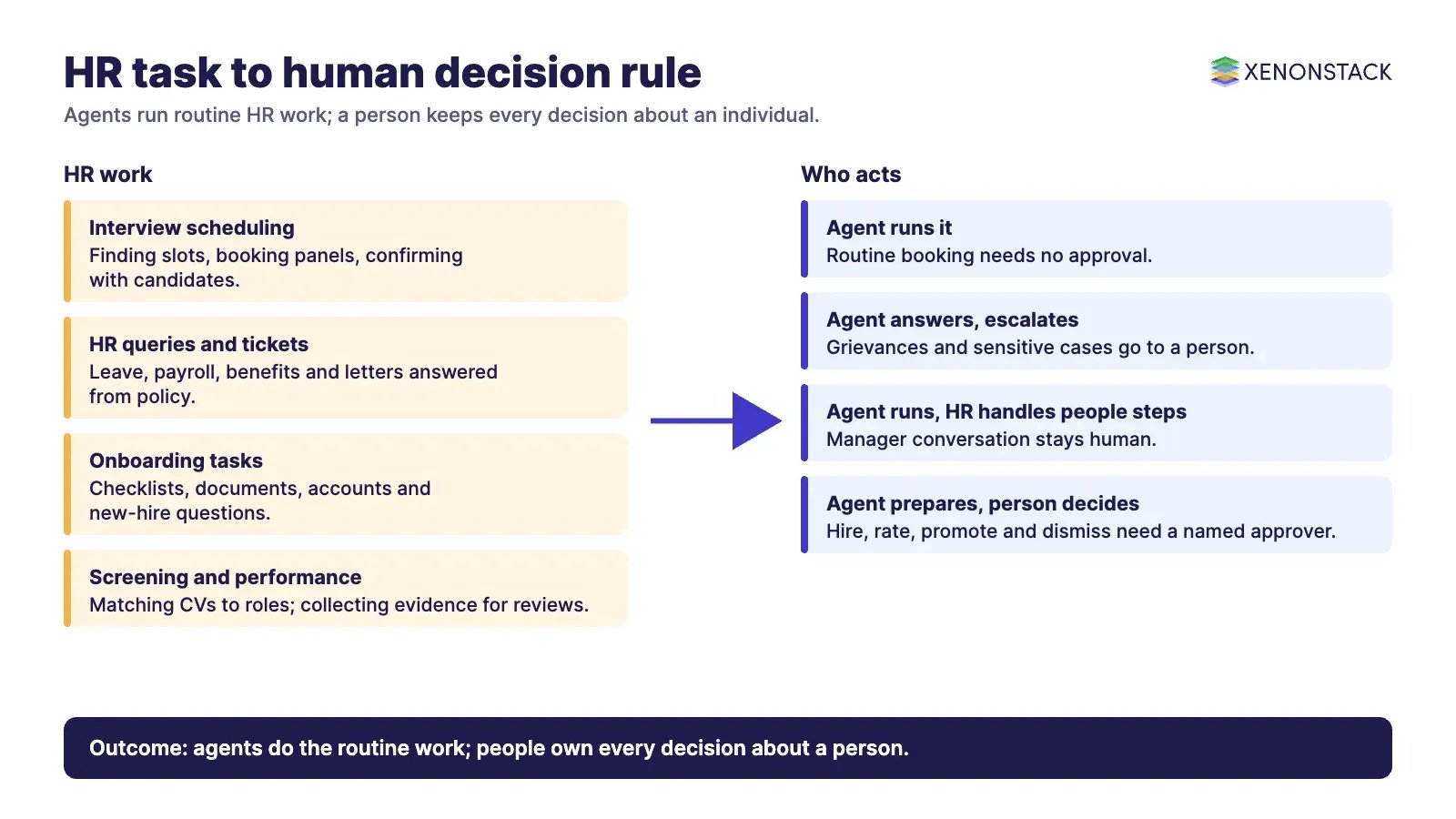
| HR process | What the agent does | Decision kept by a person | Fit |
|---|---|---|---|
| Interview scheduling and candidate communication | Finds slots, books panels, sends confirmations | None needed for routine booking | Strong |
| Employee HR queries and ticket handling | Categorises requests, answers from policy, escalates exceptions | Exceptions and sensitive cases | Strong |
| Onboarding | Builds a role-based checklist, chases documents and accounts, answers new-hire questions | Offer terms and policy exceptions | Strong |
| CV screening and shortlisting | Matches CVs to role requirements and explains the match | Who is shortlisted and hired | Medium, high-risk under the EU AI Act |
| Learning and development | Suggests learning paths from skills and role needs | Career and promotion decisions | Medium |
| Performance and engagement analysis | Collects evidence and flags trends for managers | Ratings, promotion, pay, termination | Cautious, high-risk under the EU AI Act |
In our work with HR teams, the common starting point is not replacing the existing HR system. Teams usually keep it and add agents where it is weakest, most often recruitment coordination and interview set-up. ElixirClaw is an agentic OS platform to build, orchestrate and govern AI agents and automation workflows while keeping humans in control.
How do agents handle recruitment without making the hiring decision?
Recruitment is where agents save the most routine effort and where regulation is tightest. An agent can parse CVs against the requirements, schedule interviews and keep candidates informed. The shortlist and the offer stay with recruiters and hiring managers.
- Screening: the agent should state which requirements each CV met, so a recruiter can check the reasoning rather than accept a score.
- Interviews: use agents for logistics and structured question packs. Do not infer emotion from faces or voices. The EU AI Act prohibits emotion recognition in the workplace, and it has applied since February 2025.
- Bias: a well-designed agent can focus on skills rather than irrelevant traits, but this has to be tested on your own data. Test outcomes by group before and after go-live.
How does an agent run the HR service desk?
HR service requests (leave, payroll, benefits, letters) follow a repeatable path: log and categorise, assign or escalate, answer from the knowledge base, resolve, record for audit, and review the metrics. Agents fit well here because each stage has a clear owner and the policy sits in documents the agent can cite. The same pattern is used in customer service, and the access controls are covered in our guide to cybersecurity challenges in agentic AI.
Keep every answer tied to a policy source, escalate anything that involves a grievance, health, immigration or disciplinary matter, and keep the record of who asked, what the agent answered and which policy it used. The Audit Agent from ElixirData is aimed at audit trails and compliance evidence of this kind.
What does an agent-led onboarding look like?
An onboarding agent builds the checklist for the role, requests documents, raises account and equipment requests, and answers the new hire's questions from the handbook. The people-side steps, such as the manager conversation and buddy introduction, remain human.
Video: Employee Onboarding Automation, from ElixirClaw.
What do regulators expect when AI is used on people?
Two sources matter most for enterprise HR. Both are read from the regulators' own pages.
| Rule | What it says for HR | Current status |
|---|---|---|
| EU AI Act, Annex III point 4 | AI systems used to recruit or select people (placing targeted job adverts, analysing and filtering applications, evaluating candidates), or to make decisions on promotion or termination, allocate tasks from individual behaviour or traits, or monitor and evaluate performance, are high-risk | The European Commission's page (updated 19 October 2026) gives 2 December 2027 for Annex III high-risk rules, following the AI Omnibus |
| EU AI Act, prohibited practices | Emotion recognition in the workplace and in education is prohibited | Applies since February 2025 |
| New York City Local Law 144 | An employer may not use an automated employment decision tool unless it has had a bias audit within one year of use; a summary of the audit must be public, and candidates and employees must receive notice | Enforced by the Department of Consumer and Worker Protection from 5 July 2023 |
Dates and scope change, so confirm with legal counsel for each country where you hire. The design consequence is stable: keep a person accountable for each decision, record what the agent used, and be able to explain a result to a candidate or employee.
What controls should an HR agent have?
- Decision rights: a written list of what the agent may do alone, what needs approval and what it must never do (hire, reject, rate, promote, dismiss).
- Least-privilege data access: HR data includes pay, health and personal records. Give each agent only the fields its task needs.
- Policy as data: the agent should read the current policy version and cite it, so answers change when policy changes.
- Audit trail: log the request, data used, policy applied, action taken and the person who approved.
- Bias and quality testing: measure outcomes by group and error rates on a sample before launch and on a schedule after it.
- Escalation: route grievances, medical, legal and disciplinary matters to people.
The Compliance Agent monitors operations against regulatory requirements and internal policies and generates a decision lineage for each finding and action, which is the kind of evidence an HR risk review asks for.
When should you not use an agent in HR?
- When the output would be the decision itself, such as who is hired, rated, promoted or dismissed.
- When you cannot explain to the person affected how the result was reached.
- When the data is thin or unrepresentative, for example for a small team or a new role.
- When the proposal is to infer emotion, personality or intent from faces or voices of staff.
- When HR records are too poor to support the task. Fix the data first.
What is a sensible adoption sequence?
- Map the processes: list repetitive, rules-bound tasks and the volume of each.
- Set objectives: choose measures such as time to schedule, time to resolve a query and employee satisfaction.
- Classify risk: mark which steps touch hiring, pay, promotion or exit and apply the regulations above.
- Pilot one process: start with scheduling or HR queries in one department, with approvals switched on.
- Train the HR team: explain what the agent does, how to override it and how to report problems.
- Measure and widen: review the audit trail and outcome tests, then extend to the next process.
What will change for HR teams in the next few years?
This is our view, not a sourced forecast. Routine administration will move to agents, and HR roles will shift towards policy design, employee advocacy and oversight of agents. Organisations will be asked to show how automated tools reach conclusions about people, so explainability and audit trails will become part of normal HR operations rather than a project.
To map one HR decision your agents should help with, and the data and policy it depends on, book a Context Workshop. See what happens in the workshop.
Related on XenonStack
- ElixirClaw: run governed AI agents with decision boundaries and human approvals.
- Agentic AI vs AI agents vs automation: the key differences.
- AgentGRC AI governance: inventory, risk ratings and running controls for AI.
FAQ: Agentic AI in HR
What is agentic AI in HR?
It is software that works towards an HR goal across several steps and systems, such as scheduling interviews or resolving an employee query, within limits set by HR, with a person keeping decisions about individuals.
Is AI used in hiring regulated?
Yes. The EU AI Act classes AI for recruitment, selection, promotion, termination and worker monitoring as high-risk, with Annex III rules applying from 2 December 2027 according to the European Commission. New York City's Local Law 144 requires a bias audit within a year of use, a public summary and notice to candidates.
Can an AI agent decide who to hire or dismiss?
It should not. Those decisions fall in the EU high-risk category, and we recommend a named person approves every hiring, rating, promotion and termination decision, with the agent supplying evidence.
Where should an HR team start?
Start with interview scheduling, HR queries or onboarding tasks, where volume is high and judgement about a person is low. Pilot in one department and review the audit trail before widening.
Do we need to replace our existing HR system?
Not necessarily. In our experience HR teams often keep their HR system and add agents for the gaps, such as recruitment coordination.
Can agents analyse facial expressions in video interviews?
We advise against it. The EU AI Act prohibits emotion recognition in the workplace, and it has applied since February 2025.
Follow XenonStack on LinkedIn: XenonStack on LinkedIn for new guides on agentic AI, data and platform engineering.
Explore the XenonStack platform family: ElixirData · ElixirClaw · ElixirHub · NexaStack · MetaSecure · Neural AI · AgentGRC · AgentSRE · AgentAnalyst · AgentInstruct · AgentRAI · AgentScrum · AgentSearch · AgentForce · AI Aviator · SAIF Aviator · CohortIQ · XenonStack AI · XenonStack UAE