Key takeaway
- Xtendlabs improved company search speed and security by moving source files from Google Drive to Amazon S3 and running loading jobs on Amazon EC2.
Xtendlabs, a PaaS company offering data science and big data engineering, made company search faster, more reliable and secure by moving its source files from Google Drive to Amazon S3 and running the loading jobs on Amazon EC2. The result was lower latency, fewer job timeouts and keyword search that users can trust.
What business problem was Xtendlabs trying to solve?
Xtendlabs serves clients from a variety of domains, and its users needed to find and filter companies quickly by keyword. XenonStack delivered the search capability through Elastic AppSearch, with the focus on speed, reliability and scale.
The source data arrived as large Excel files, each holding detailed company records such as name, location, domain, number of employees and revenue. The weak point was not the search engine itself but the path the data took to reach it.
What challenges did the customer face?
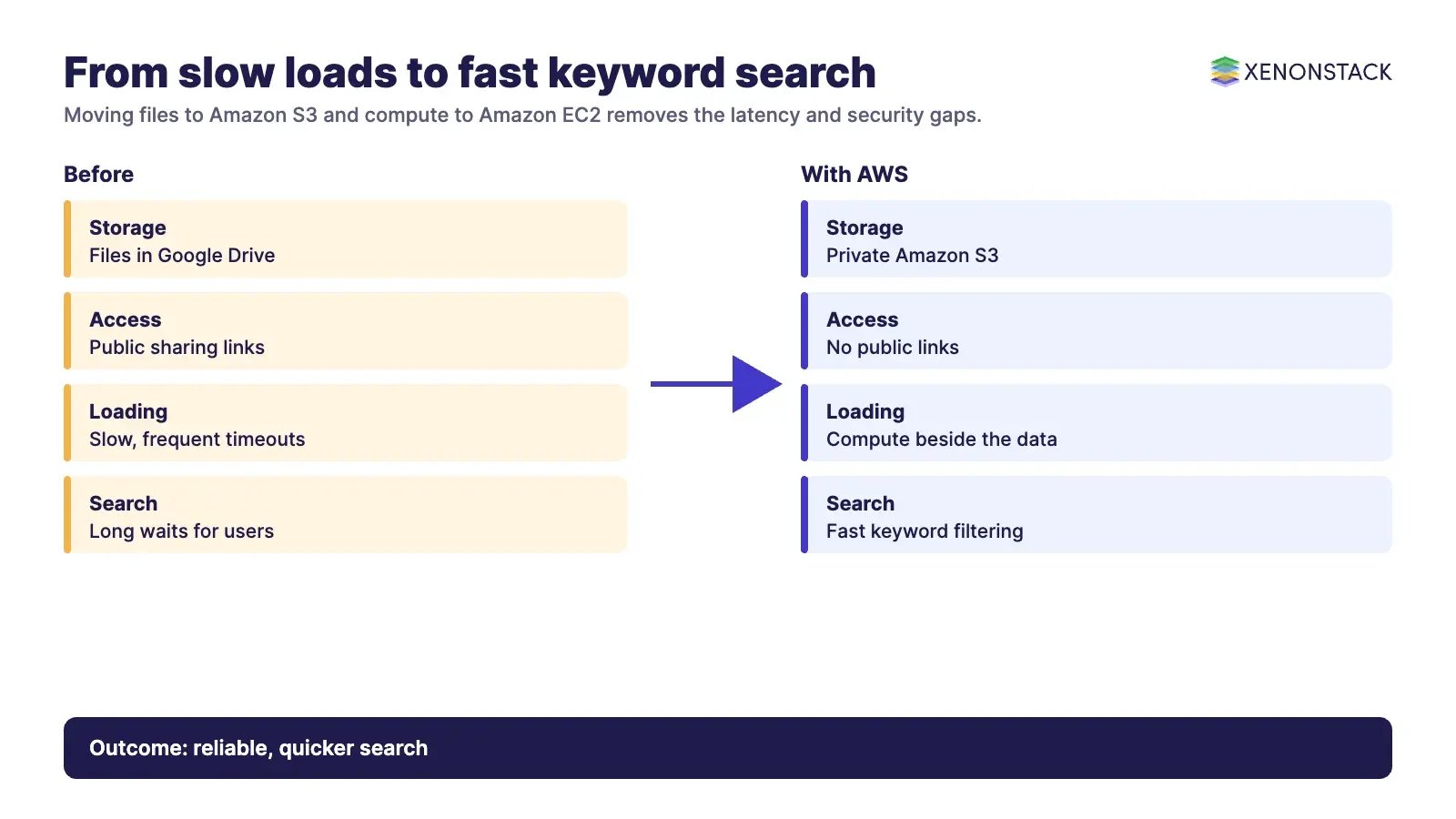
The files were stored in Google Drive and loaded into Elastic AppSearch from there. That arrangement created three linked problems for the business.
| Challenge | What happened | Business impact |
|---|---|---|
| Long waiting time | Writing the data into Elastic AppSearch was slow | Users waited before they could search |
| Frequent job timeouts | High latency caused the loading jobs on cloud infrastructure to time out | Incomplete or repeated loads and unreliable data |
| Security exposure | Drive links needed public access so the job could read the files | Data could be misused if a link reached the wrong hands |
How does the solution scale search capability on AWS?
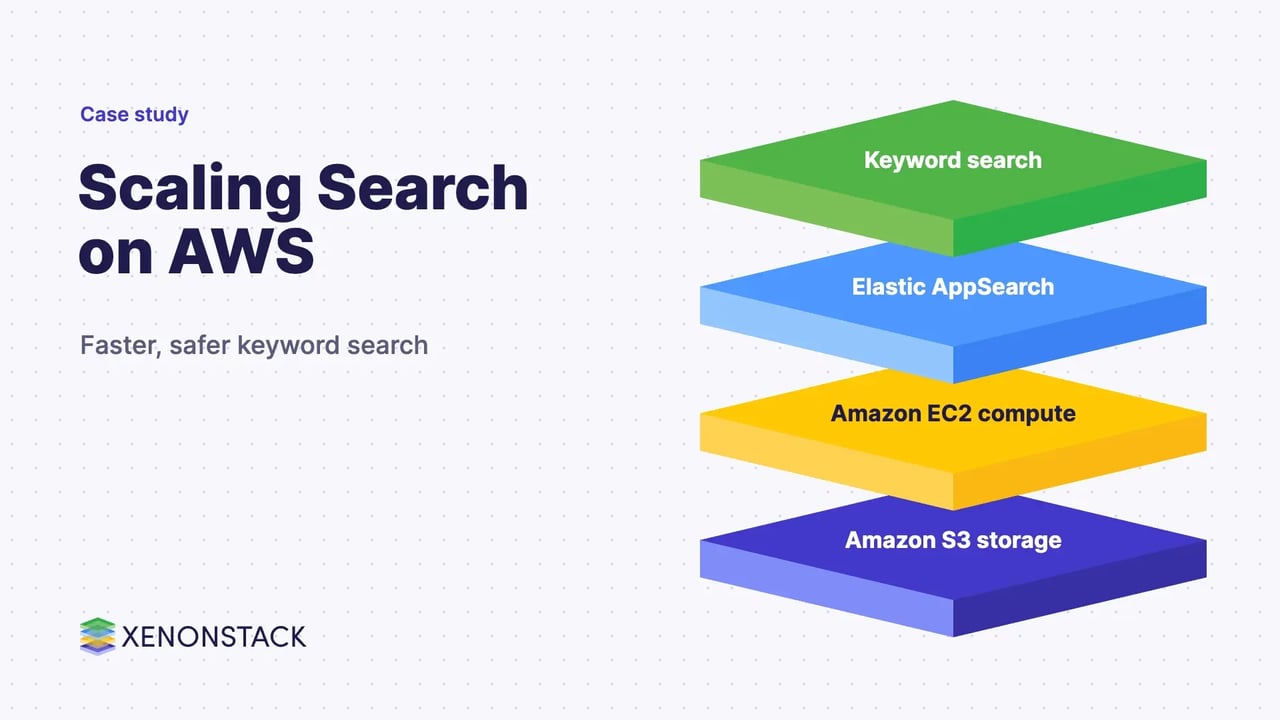
The design moves storage and compute next to each other on AWS, so the loading job no longer depends on a public file link. It had three goals: reduce latency in accessing the data, minimise timeouts and deliver faster search results.
| Component | Role in the solution |
|---|---|
| Amazon S3 | Distributed storage that keeps the files highly available, secure and easy to maintain |
| Amazon EC2 | Cloud compute that runs the loading job close to the stored data |
| Elastic AppSearch | Keyword search and filtering for company records |
When should an organisation rethink its search pipeline?
Consider a redesign when search results feel slow, loading jobs fail intermittently, or source files are shared through links that anyone can open. These are signs that the data path, not the search tool, is the constraint. Teams building semantic or retrieval-based search will meet the same issue, and our RAG and LLM services address it with governed data pipelines. Solid foundations also depend on a sound big data platform.
What was the outcome?
Data is now highly available, writing jobs complete in less time, and users can find and filter companies by keyword with confidence. Storing the files privately in Amazon S3 also removed the need for public links, which closed the security gap.
What should leaders take from this?
Fast search is usually a data logistics problem first. Fix where the data lives, how it is secured and where the loading job runs, and the search experience improves without changing the search product. If you want to frame data and context decisions before you build, join our Context Workshop.
FAQ
What problem did Xtendlabs have with search?
Company data stored in Google Drive loaded slowly into Elastic AppSearch, so users waited, jobs timed out and files had to be shared through public links.
How did Amazon S3 and Amazon EC2 help?
Amazon S3 stored the files securely with high availability, while Amazon EC2 ran the loading jobs on cloud compute close to that data, cutting latency and timeouts.
Why does public file access matter for security?
A public link lets anyone who holds it read the data. Moving the files into private cloud storage removes that exposure.
What can users do with the improved search?
Users can find and filter companies by keyword and get results faster, supported by highly available data and shorter loading jobs.
Ready to put AI agents to work? See an ElixirClaw demo: the agentic OS to build, orchestrate and govern AI agents across your enterprise systems.
Explore the XenonStack platform family: ElixirData · ElixirClaw · ElixirHub · NexaStack · MetaSecure · Neural AI · AgentGRC · AgentSRE · AgentAnalyst · AgentInstruct · AgentRAI · AgentScrum · AgentSearch · AgentForce · AI Aviator · SAIF Aviator · CohortIQ · XenonStack AI · XenonStack UAE