Key takeaway
- How AI and video surveillance detect stopped vehicles, oversized trucks and dangerous driving, and what road authorities should check before adopting it.
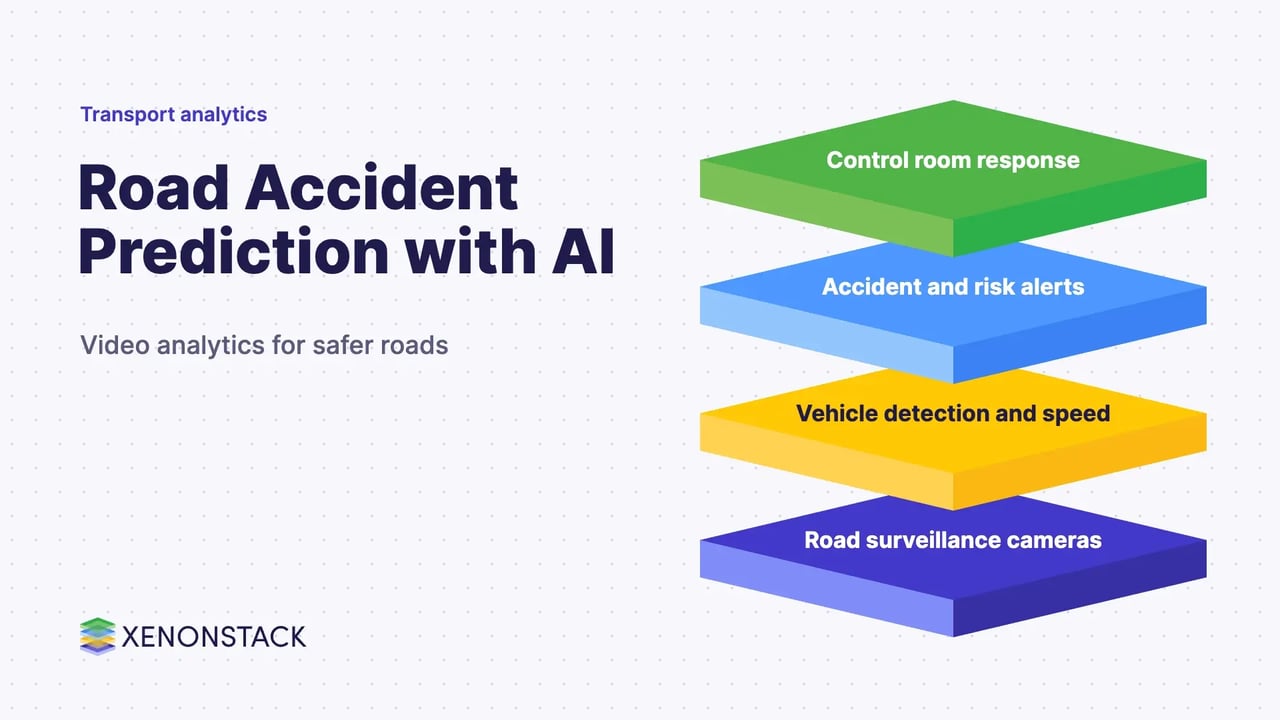
Road accident prediction with AI video analytics uses cameras and computer vision models to track every vehicle, measure its speed and flag patterns that point to an accident or a risk of one. It lets a road authority see more of the network than a control room can watch by eye.
This page is for transport authorities, highway operators and smart city teams. It covers the monitoring problem, how detection and speed tracking work, what the dashboards show, where AI agents fit and what to check before you deploy. For the technology behind it, see artificial intelligence.
What is road accident prediction with video analytics?
Government and road management authorities have started to use artificial intelligence and video surveillance to reduce road incidents and make roads safer. A surveillance system that only records is not enough. It must track moving objects, interpret their patterns of behaviour, recognise the preconditions of a mishap and alert the system so that people can act.
What problem does it solve?
As population and vehicle numbers grow, roads face more congestion, more suspicious activity and more accidents. It has become difficult for the monitoring authority to keep track of everything. The WHO road traffic injuries fact sheet notes that an increase in average speed is directly related to both the likelihood of a crash and its severity, and it lists speed management among its main recommendations. Knowing how fast vehicles move on each road is therefore useful safety data.
How does AI detect and predict road accidents?
The IBM computer vision overview explains that object detection pinpoints where objects are in an image by locating them and classifying them, and that object tracking follows an object across a sequence of video frames. Road video analytics builds on both.
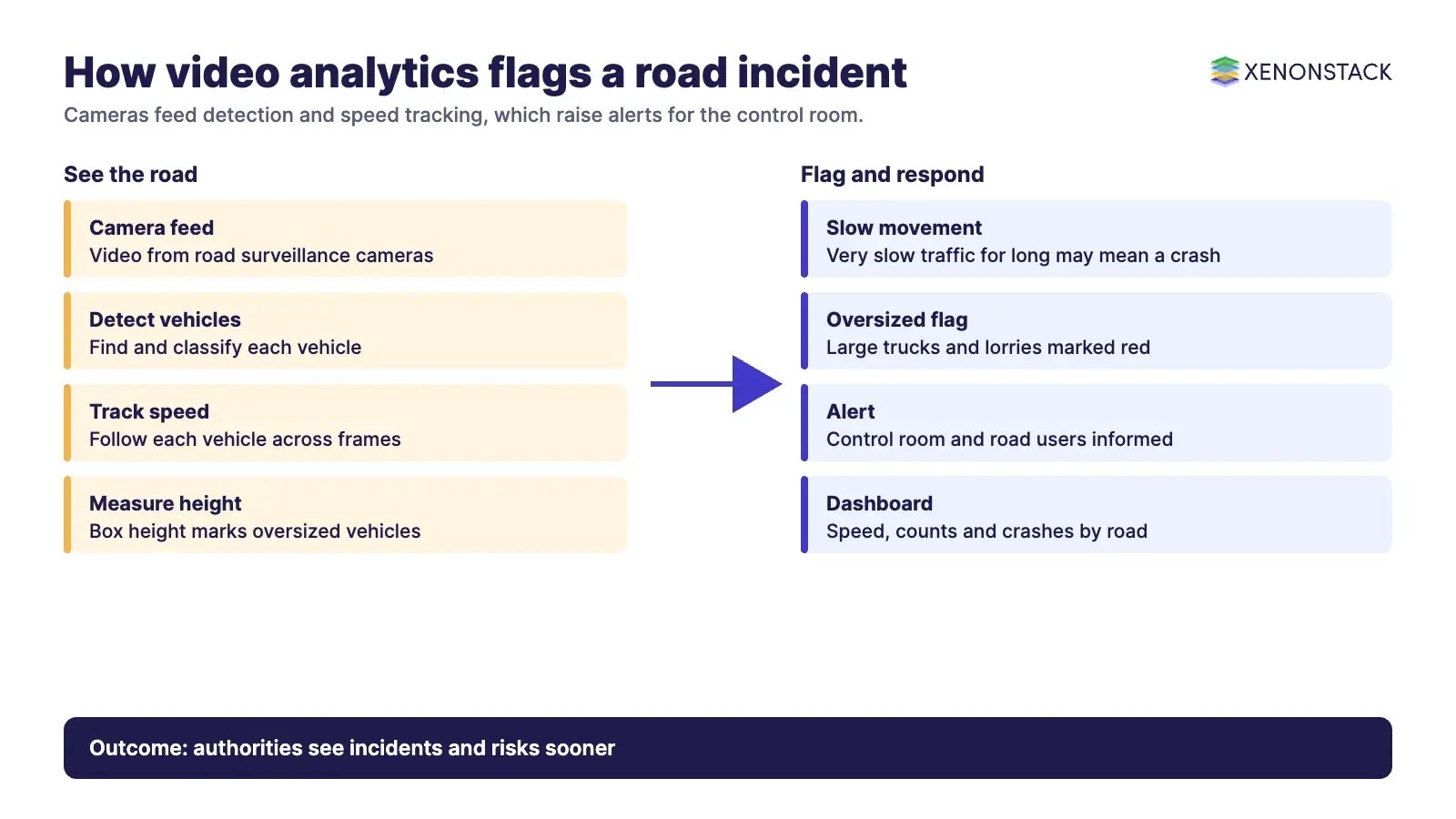
- Detect and classify. The model finds each vehicle in the camera frame and labels its type, such as car, truck, trailer or lorry.
- Track and measure. The system follows each vehicle across frames and calculates its speed.
- Spot anomalies. If vehicles on a stretch of road move very slowly for a long time, an accident has probably occurred, and the camera can indicate it.
- Flag oversized vehicles. The system calculates the height of each detected box and marks large container trucks, trailers and lorries, so people can be told about them.
- Alert. The result goes to the control room and to road users so the authority can respond.
Beyond accidents, the same pipeline supports vehicle classification, parking status, oversized vehicle detection, dangerous driving detection and pedestrian and cyclist monitoring.
What do the analytics dashboards show?
- Average and maximum vehicle speed for different roads
- Injury type for pedestrians, and speed against crashes by vehicle and road type
- Number and type of vehicles each month, and the peak count for a vehicle type
- Stationary against moving vehicles, and the congestion of accidents at a given speed
How does AI video analytics compare with manual monitoring?
| Question | Manual monitoring | AI video analytics |
|---|---|---|
| Coverage | Operators watch a few screens | Every camera analysed continuously |
| Speed data | Spot checks and reports | Speed calculated for each tracked vehicle |
| Stopped vehicles | Noticed when someone reports them | Flagged when movement stays very slow for long |
| Oversized vehicles | Seen by chance | Marked automatically by box height |
| Records | Notes and clips | Counts, types and speeds by road and month |
The system supports control room staff; it does not replace their judgement or the emergency response.
Where do AI agents fit?
Detection models see the road. An AI agent can act on what they see: confirm an incident by checking neighbouring cameras, find the nearest response team, draft the alert for variable message signs and log the event for review. A person approves any action that changes traffic control or dispatches responders. ElixirClaw is the AI agents computing platform from XenonStack. For a demo of the analytics approach, see the XenonStack demo request.
What should you check before you deploy?
- Camera placement. Check angle, lighting and weather coverage, since speed and height estimates depend on them.
- Calibration. Calibrate each camera so that measured speed and height match real values.
- False alarms. Test how often slow traffic in a jam is mistaken for an accident.
- Privacy and law. Decide what footage is stored, for how long and who can view it.
- Response process. Agree who acts on an alert and how fast, because detection alone does not make a road safer.
To map one road safety decision your agents make, and the data and policy it depends on, book a Context Workshop. See what happens in the workshop.
Frequently asked questions
How does AI detect road accidents from video?
Models detect and track each vehicle, calculate its speed and flag unusual patterns. If vehicles move very slowly for a long time, an accident has probably occurred.
How does the system find oversized vehicles?
It calculates the box height of each detected vehicle and marks large container trucks, trailers and lorries so that people can be told about them.
Why is vehicle speed important for road safety?
The WHO says an increase in average speed is directly related to both the likelihood of a crash and its severity, so speed data helps authorities manage risk.
What does a road accident analytics dashboard show?
It shows average and maximum speed by road, injury type for pedestrians, speed against crashes, vehicle counts and types by month, and stationary against moving vehicles.
How do AI agents help road authorities?
They can confirm an incident across cameras, draft alerts and log events, while a person approves any change to traffic control or dispatch.
Ready to put AI agents to work? See an ElixirClaw demo: the agentic OS to build, orchestrate and govern AI agents across your enterprise systems.
Explore the XenonStack platform family: ElixirData · ElixirClaw · ElixirHub · NexaStack · MetaSecure · Neural AI · AgentGRC · AgentSRE · AgentAnalyst · AgentInstruct · AgentRAI · AgentScrum · AgentSearch · AgentForce · AI Aviator · SAIF Aviator · CohortIQ · XenonStack AI · XenonStack UAE