
Key takeaway
- See how ServiceNow Now Assist for ITOM maps services, cuts alert noise and explains alerts in plain language, and what to check before you adopt it.
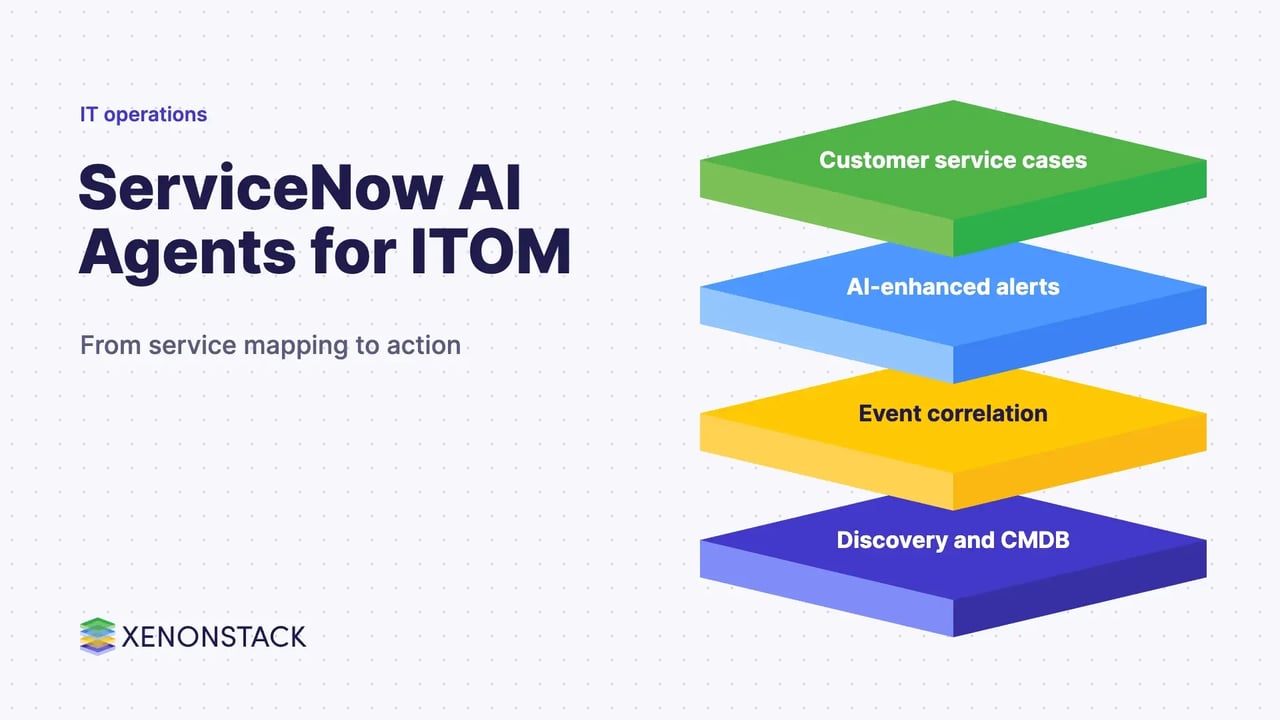
ServiceNow AI agents for IT operations management use Now Assist in IT Operations Management (ITOM) to map infrastructure and services, cut alert noise, explain alerts in plain language and help teams act on service issues. The aim is to keep services available as IT estates spread across on-premises, cloud and hybrid environments.
This page is for IT operations, service management and platform leaders. It covers the problems ITOM addresses, how the solution works, where AI agents fit, a before and after comparison, and what to check before you adopt it. It builds on ServiceNow solutions from XenonStack.
What is the ITOM use case?
IT operations management covers administering the processes and services of an IT department, including hardware and software support and client services. The aim is availability, performance and efficiency, through standard methods for service delivery, support and deployment. ITOM typically includes management teams that set and enforce policies and procedures to meet organisational objectives and service level agreements.
The use case here is Now Assist for ITOM, which the page describes as using generative AI and data-driven insights for visibility, alert management and automation. The ServiceNow ITOM page describes the underlying product as discovering and mapping end-to-end service dependencies, keeping the CMDB accurate and correlating alerts across monitoring tools.
What problems does it address?
- Complexity and visibility: as environments grow, fragmented data makes a complete view of infrastructure and services hard to build.
- Alert management and incident response: a high volume of cryptic alerts slows triage and lengthens mean time to repair.
- Outages and disruption: finding a root cause in real time is hard, and legacy systems struggle with dynamic, virtualised environments.
- Cloud resource optimisation: managing the lifecycle and use of cloud resources is complex without one platform for visibility and control.
- Integration and coordination: siloed systems limit collaboration between IT operations and customer service teams.
How does Now Assist ITOM work?
The solution moves from knowing what you have, to understanding what is happening, to acting on it. The steps below follow the page's description, with the ServiceNow product page as the source for the discovery and event capabilities.
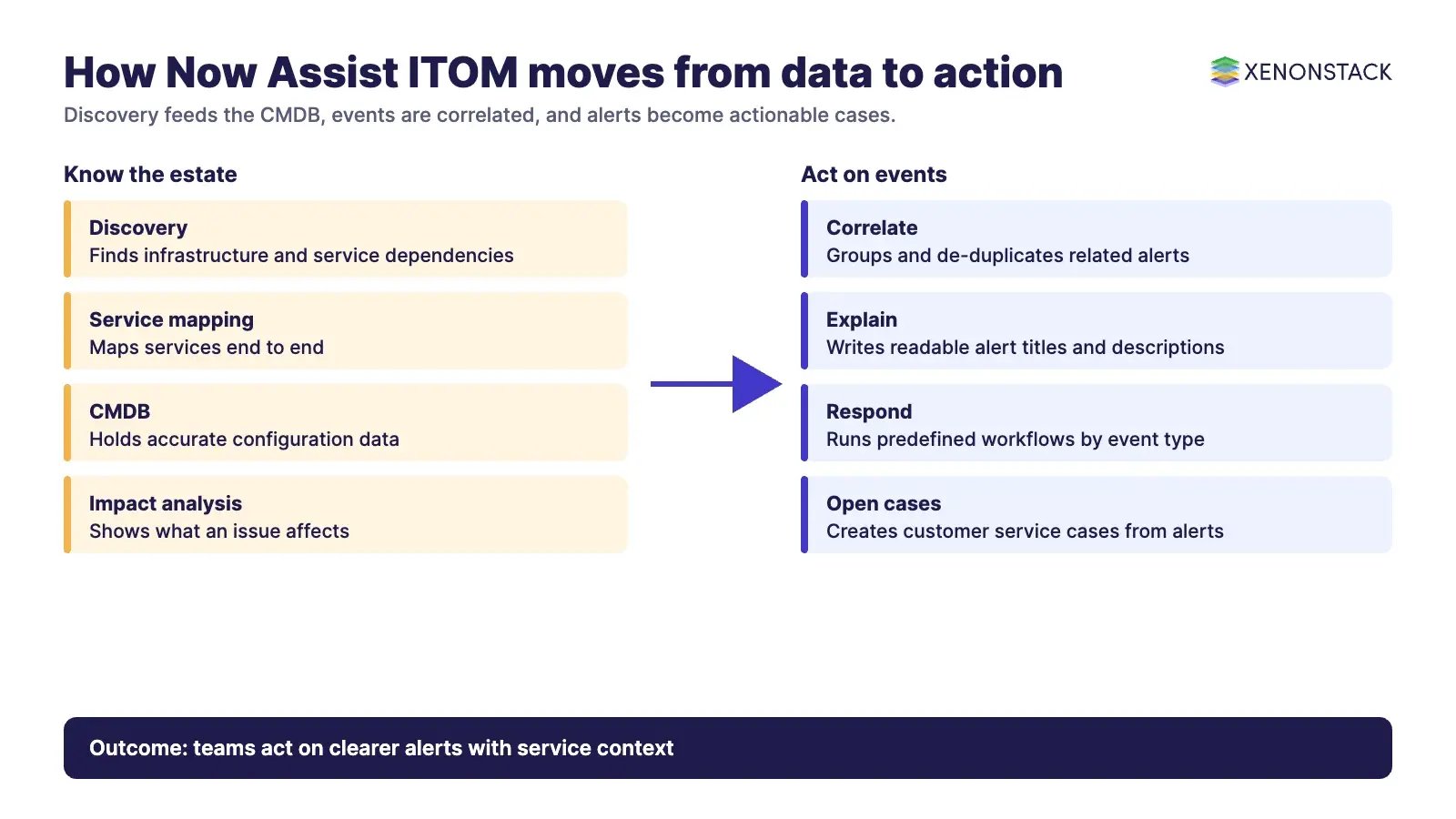
- Discover and map. End-to-end discovery and service mapping build a reliable configuration management database (CMDB), which supports impact analysis and faster root-cause analysis.
- Correlate events. The ServiceNow ITOM page says the product correlates and de-duplicates alerts across disparate monitoring tools. IBM's AIOps overview describes the same goal as separating significant alerts from noise.
- Explain alerts. Generative AI writes human-readable alert titles and descriptions, so teams can interpret and act on them more easily.
- Analyse and act. Machine learning and analytics turn raw event data into insight, and predefined workflows respond to different event types in a consistent way.
- Plan capacity and manage cloud. Historical data and forecasting help teams avoid over-provisioning and under-provisioning, and cloud resources are managed from discovery and provisioning through change management to deprovisioning.
- Connect to customer service. Integration with Customer Service Management lets ITOM alerts create cases so customer issues are dealt with promptly.
How does it compare with managing IT operations without it?
| Area | Without a unified approach | With Now Assist ITOM, as the page describes it |
|---|---|---|
| Visibility | Fragmented data and an incomplete view of services | Discovery and service mapping feed a reliable CMDB |
| Alerts | Cryptic, high-volume alerts that are hard to triage | Correlated events with human-readable titles and descriptions |
| Root cause | Slow, manual diagnosis across tools | Analytics and impact analysis speed root-cause analysis |
| Cloud resources | Hard to see and control across the lifecycle | Unified management from provisioning to deprovisioning |
| Customer link | IT operations and customer service work in silos | Alerts can open customer service cases |
Where do AI agents fit?
In this use case, generative AI is used for alert wording and the analytics layer for event handling, while people keep ownership of service decisions. Agents are most useful where a task is repeatable: triaging an alert, gathering context from the CMDB, or preparing a case. ElixirClaw is XenonStack's AI agents computing platform for agent and automation use cases. You can also explore ServiceNow AI Platform for business transformation or ServiceNow AI agents for HR service delivery.
What should you check before adopting it?
- CMDB quality: service mapping is only as useful as the data and ownership behind it.
- Monitoring coverage: list the tools that send events, and decide which alerts should be correlated first.
- Approvals: decide which responses may run automatically and which need a person.
- History: capacity forecasting depends on usable historical data.
- Customer service scope: agree which alerts may create cases and who handles them.
To map one IT operations decision your agents make, and the data and policy it depends on, book a Context Workshop. See what happens in the workshop.
Frequently asked questions
What is Now Assist for ITOM?
It is the use of generative AI and data-driven insights within ServiceNow IT Operations Management to improve visibility, alert management and automation, as this page describes it.
How does ITOM reduce alert noise?
ServiceNow describes correlating and de-duplicating alerts across disparate monitoring tools, so related events are grouped instead of reaching teams one by one.
What is a CMDB and why does ITOM need it?
A configuration management database records the infrastructure and services in an estate. ITOM discovery and service mapping keep it accurate, which supports impact analysis and root-cause analysis.
Can ITOM connect to customer service?
Yes. Integration with Customer Service Management lets alerts that affect customers create cases, so IT operations and customer service work from the same information.
Where do AI agents add value in IT operations?
They help with repeatable work such as triage, context gathering and case preparation, while people keep control of decisions that carry risk.
Ready to put AI agents to work? See an ElixirClaw demo: the agentic OS to build, orchestrate and govern AI agents across your enterprise systems.
Explore the XenonStack platform family: ElixirData · ElixirClaw · ElixirHub · NexaStack · MetaSecure · Neural AI · AgentGRC · AgentSRE · AgentAnalyst · AgentInstruct · AgentRAI · AgentScrum · AgentSearch · AgentForce · AI Aviator · SAIF Aviator · CohortIQ · XenonStack AI · XenonStack UAE


