Key takeaway
- See how AI analytics measure employee performance, forecast hiring and review recruitment channels, and what to check on bias and notice before adopting.
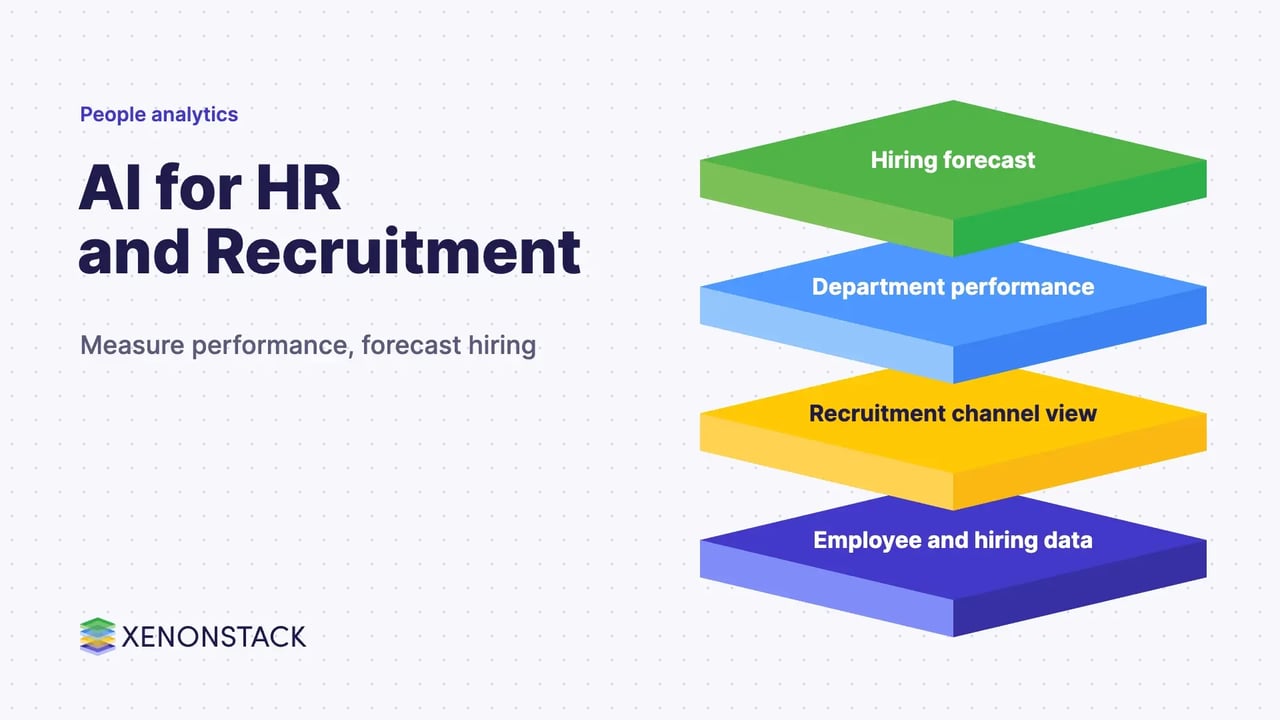
AI for HR and recruitment uses analytics and predictive models to measure employee performance, forecast hiring needs and show where recruitment effort pays off. It gives HR leaders one view of performance by department, experience and role instead of separate spreadsheets.
This page is for HR, talent acquisition and people analytics leaders. It covers the problem, how a predictive model and dashboard work, where AI agents fit, how the approach compares with manual HR reporting, and what to check before using AI in hiring decisions. To see an example, you can request a demo of the AI predictive model.
What is AI for HR and recruitment?
It is the use of machine learning on employee and hiring data to answer practical questions: how is each department performing, how many people will the business hire this year, and which recruitment channels bring in the right candidates. A dashboard presents the answers by department, age group, position and years of experience.
What problem does it solve?
Measuring employee performance is an essential part of HR management, but companies hold large volumes of employee data, which makes performance hard to manage and calculate. Hiring plays a vital role in placing the right person in the right job. Even when employees are given good facilities they can still be dissatisfied, so the organisation needs employee experience data to see what to improve, maintain or develop, and then act on it.
How does a predictive HR model work?
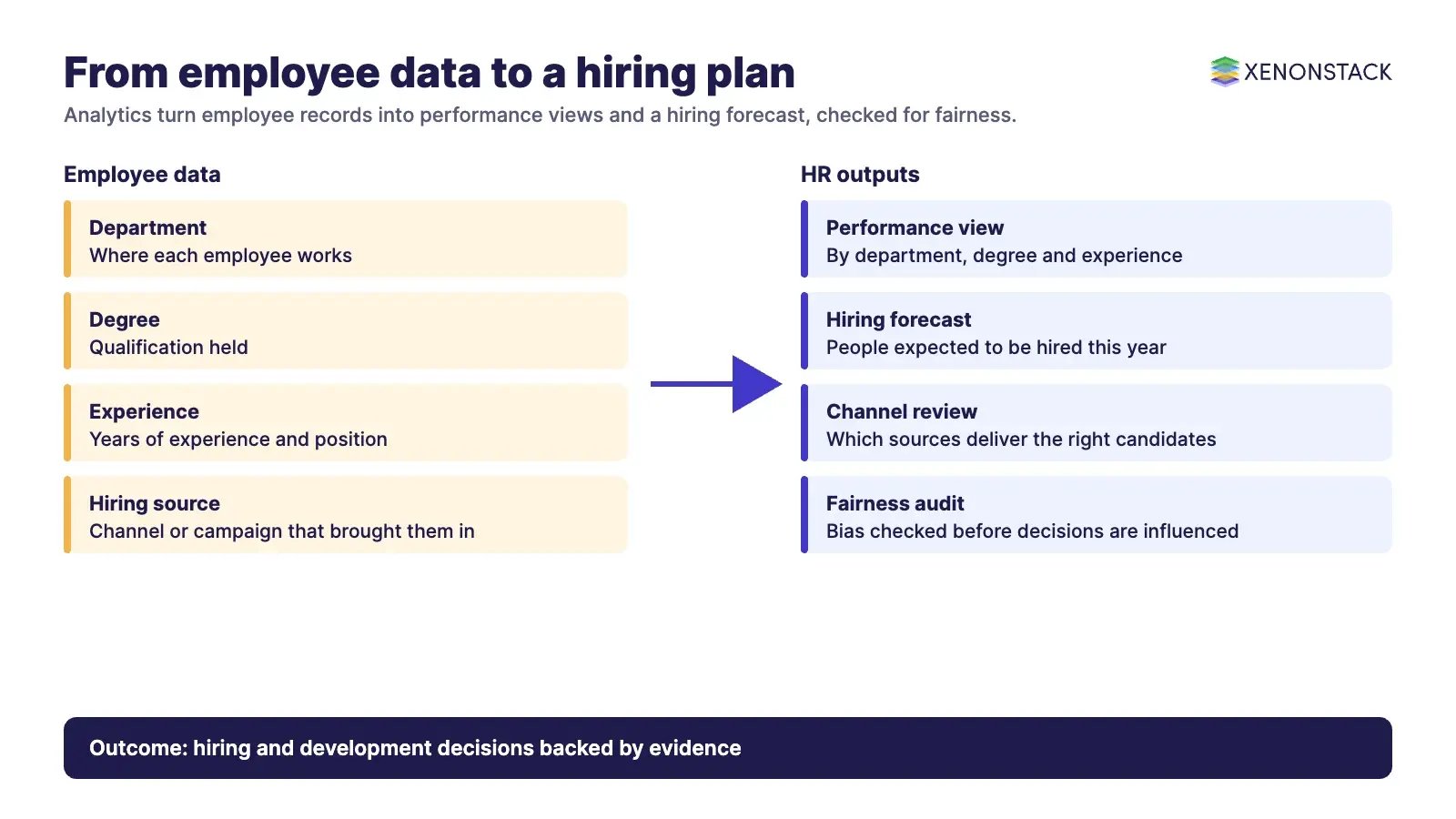
- Collect employee data. Gather records on department, degree, experience, position and hiring source.
- Measure performance. Calculate performance by department and by degree, and compare experience bands.
- Forecast hiring. Train a model that predicts how many people the organisation will hire this year.
- Build the dashboard. Show performance by department, employees by age group and position, hiring by channel and hiring by month.
- Act and review. Use the findings to adjust recruitment channels and development plans, then refresh as new data arrives.
A well-built dashboard can show, for instance, that the best-performing experience band differs between teams, or that most hiring in a period came from one channel or campus programme. These are questions to investigate, not conclusions to apply blindly.
Where do AI agents fit?
An agent can keep the analysis current and prepare it for people. On ElixirClaw, XenonStack's AI agents computing platform, an agent can refresh the hiring forecast, summarise department performance, flag a recruitment channel that is under-delivering and send the pack to the HR business partner. Decisions about people stay with people.
How does it compare with manual HR reporting?
| Question | Manual reporting | With AI analytics and agents |
|---|---|---|
| Data | Spread across HR files and tools | Brought together for analysis |
| Performance view | One report per team, built by hand | By department, degree and experience on one dashboard |
| Hiring plan | Based on last year and judgement | Forecast from employee and hiring data |
| Channel review | Occasional, after the campaign | Ongoing, by source and month |
| Fairness check | Rarely tested | Needs a deliberate audit |
What should you check before using AI in hiring?
Hiring is a regulated area. The New York City Department of Consumer and Worker Protection states that employers and employment agencies may not use an automated employment decision tool unless it has been subject to a bias audit within one year of use and information about the audit is publicly available. Its revised slides also say the notice must be provided ten business days before use of the tool. If you operate in other jurisdictions, check the rules that apply there.
- Bias. Test outcomes across groups before a tool influences who is hired or promoted.
- Notice. Tell candidates and employees when an automated tool is used.
- Data protection. Employee records are personal data, so limit access and purpose.
- Human decision. Use predictions to inform managers, not to decide alone.
- Data quality. Check that experience, degree and department fields are consistent before training.
To map one decision your agents make, and the data and policy it depends on, book a Context Workshop. See what happens in the workshop.
Frequently asked questions
What is AI for HR and recruitment?
It is the use of analytics and predictive models on employee and hiring data to measure performance, forecast hiring and review recruitment channels.
What can a predictive HR model forecast?
It can forecast how many people the organisation will hire this year, using data collected from its employees and hiring history.
Which views does an HR dashboard show?
Typical views are performance by department and degree, employees by age group and position, hiring by channel and hiring by month.
Is AI allowed to screen candidates?
It depends on the jurisdiction. New York City, for example, requires a bias audit within one year of use and public information about it, plus advance notice to candidates.
Does AI replace HR teams?
No. Models and agents prepare analysis and keep it current, while people make decisions about hiring, pay and development.
Ready to put AI agents to work? See an ElixirClaw demo: the agentic OS to build, orchestrate and govern AI agents across your enterprise systems.
Explore the XenonStack platform family: ElixirData · ElixirClaw · ElixirHub · NexaStack · MetaSecure · Neural AI · AgentGRC · AgentSRE · AgentAnalyst · AgentInstruct · AgentRAI · AgentScrum · AgentSearch · AgentForce · AI Aviator · SAIF Aviator · CohortIQ · XenonStack AI · XenonStack UAE