Key takeaway
- The SMACK stack combines Spark, Mesos, Akka, Cassandra and Kafka for real-time analytics. See how it works, what has changed and what to check first.
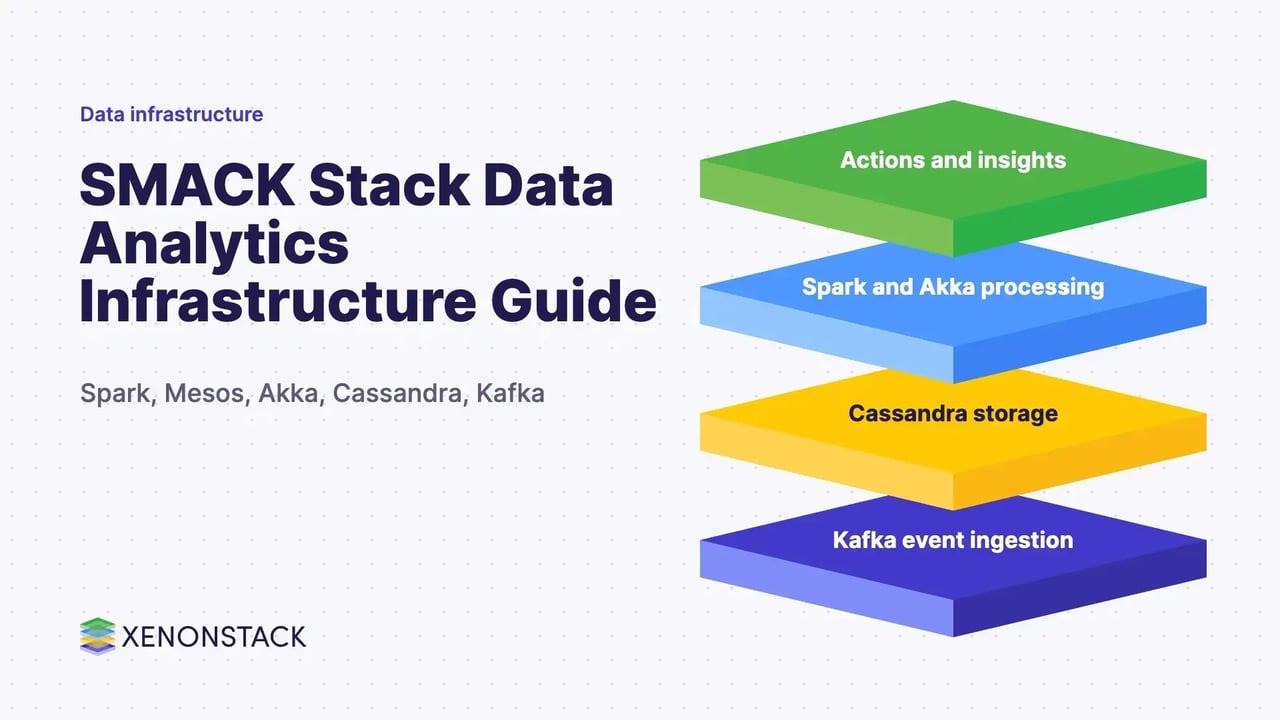
A SMACK stack is a big data analytics infrastructure built from five open-source technologies: Apache Spark, Apache Mesos, Akka, Apache Cassandra and Apache Kafka. Together they ingest data at scale, process it in batch or as a stream, trigger actions and store the results.
This page is for data architects and engineering leaders who need a real-time analytics platform. It covers the problem, how the stack works, where AI agents fit, how it compares with a traditional batch warehouse, and what to check, including the status of some components, before you adopt it.
What problem does a SMACK stack solve?
Teams building scalable, data-driven applications need a system of real-time insight that creates new opportunities and delivers new value. The platform has to ingest data at scale without loss, trigger actions based on the analysed data, and store the data at cloud scale. The SMACK stack meets these objectives with a loosely coupled toolchain of open-source technologies, each doing one job.
How does the SMACK stack work?
Each letter stands for one component with a distinct role in the pipeline.
| Letter | Component | Role in the stack |
|---|---|---|
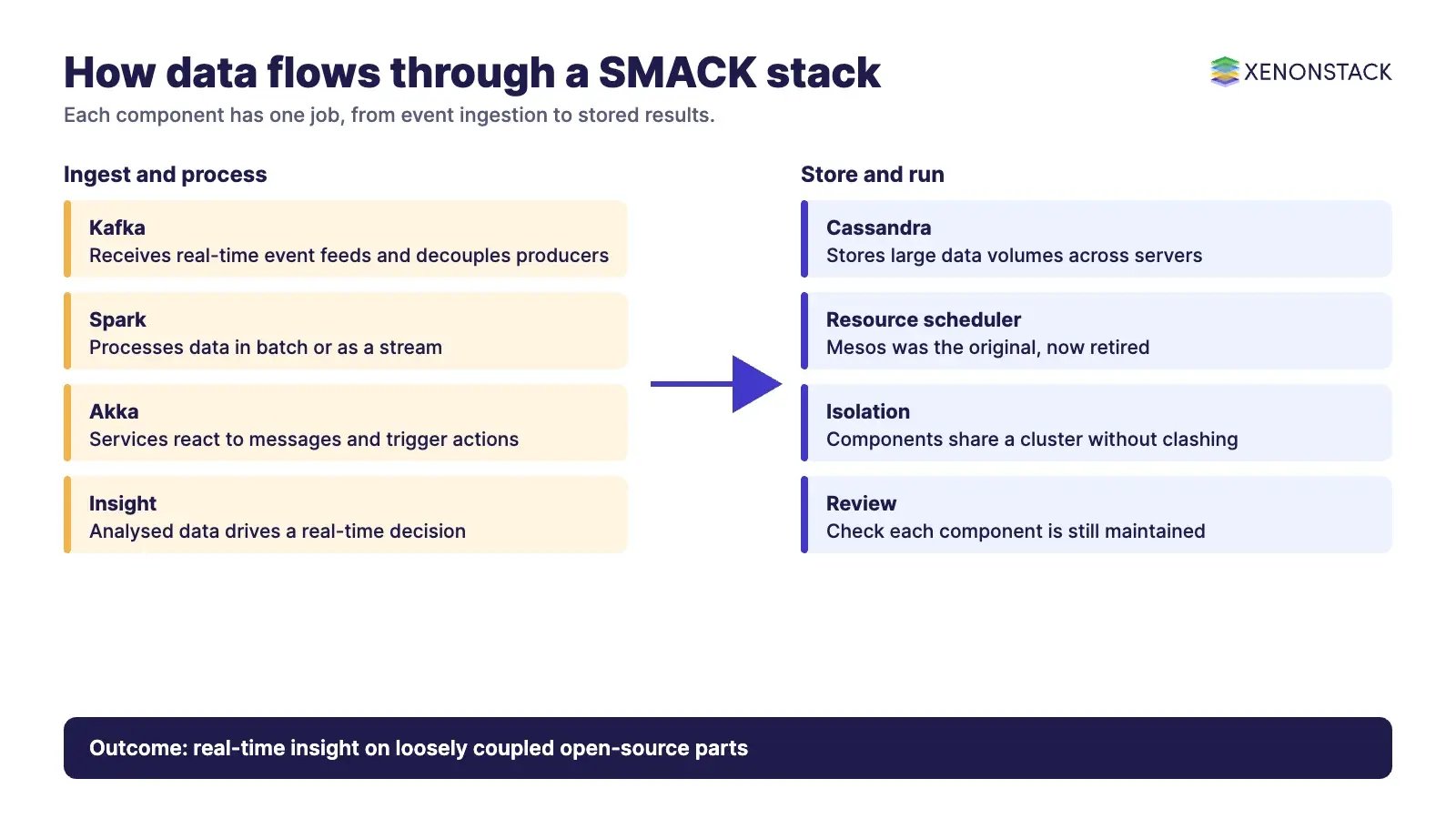
| S | Apache Spark | General engine for large-scale data processing, from SQL queries to machine learning, graph analytics and stream processing |
| M | Apache Mesos | Distributed systems kernel that provides resourcing and isolation across the other components |
| A | Akka | Toolkit and runtime for concurrent, distributed applications that respond to messages |
| C | Apache Cassandra | Distributed database management system for large data volumes across servers with high availability |
| K | Apache Kafka | High-throughput, low-latency platform for real-time data feeds, which decouples producers from consumers |
The Apache Kafka introduction says Kafka can "publish (write) and subscribe to (read) streams of events", "store streams of events durably and reliably for as long as you want", and "process streams of events as they occur or retrospectively". The Cassandra basics page calls Cassandra "a NoSQL distributed database" with "a masterless architecture", where "any node in the database can provide the exact same functionality as any other node".
A typical flow is: events enter through Kafka, Spark processes them, Akka services react to messages, Cassandra stores the results, and Mesos schedules the work across the cluster.
What has changed since the SMACK stack was introduced?
Two points matter for new builds. The Apache Mesos site now states "This project has retired", so new clusters often use another scheduler, such as Kubernetes, in the M position. And the Spark documentation describes Spark Streaming as "the previous generation of Spark's streaming engine" and says "You should use Spark Structured Streaming for your streaming applications and pipelines." Check each component's current status before you commit to a design.
How does it differ from a traditional batch warehouse?
| Question | Batch warehouse | SMACK-style stack |
|---|---|---|
| Data arrival | Loaded on a schedule | Ingested continuously as events |
| Actions | Reports reviewed later | Actions triggered from analysed data |
| Scaling | Scaled as one system | Each component scales on its own |
| Coupling | Tightly tied to one vendor | Loosely coupled open-source parts |
| Operations | One platform to run | Several components to integrate and run |
The trade-off is operational: more parts mean more to integrate, secure and monitor.
Where do AI agents fit in a real-time analytics stack?
An AI agent can consume the event stream, spot a pattern, and propose an action for a person or a service to approve, using the stored history for context. The data it reads should be governed, with clear definitions and access rules. For governed context above an analytics layer, see ElixirData, XenonStack's Context OS.
What should you check before building one?
- Which real-time decision justifies streaming, rather than a nightly batch.
- Which components are still maintained, and what replaces any that are retired.
- How data loss is prevented from ingestion to storage, and how you will test it.
- Who operates the cluster, and how its access and security are managed.
- How the data is governed before AI agents or models read it.
To map one decision your agents make, and the data and policy it depends on, book a Context Workshop. See what happens in the workshop.
Frequently asked questions
What does SMACK stand for?
Spark, Mesos, Akka, Cassandra and Kafka: five open-source technologies for ingesting, processing, acting on and storing data.
What is the SMACK stack used for?
It is used to build scalable, real-time, data-driven applications that ingest data at scale without loss and trigger actions from analysed data.
Is Apache Mesos still maintained?
The Apache Mesos site states that the project has retired, so new builds usually choose another cluster scheduler.
What does Kafka do in the stack?
It publishes and subscribes to streams of events, stores them durably, and lets them be processed as they occur or retrospectively.
Should new projects use Spark Streaming?
The Spark documentation calls Spark Streaming a legacy project and recommends Structured Streaming for new streaming applications and pipelines.
Ready to put AI agents to work? See an ElixirClaw demo: the agentic OS to build, orchestrate and govern AI agents across your enterprise systems.
Explore the XenonStack platform family: ElixirData · ElixirClaw · ElixirHub · NexaStack · MetaSecure · Neural AI · AgentGRC · AgentSRE · AgentAnalyst · AgentInstruct · AgentRAI · AgentScrum · AgentSearch · AgentForce · AI Aviator · SAIF Aviator · CohortIQ · XenonStack AI · XenonStack UAE