Key takeaway
- How to evaluate a property investment with cap rate, NOI, IRR, cash on cash return and gross rent multiplier, and how a dashboard and AI agents help.
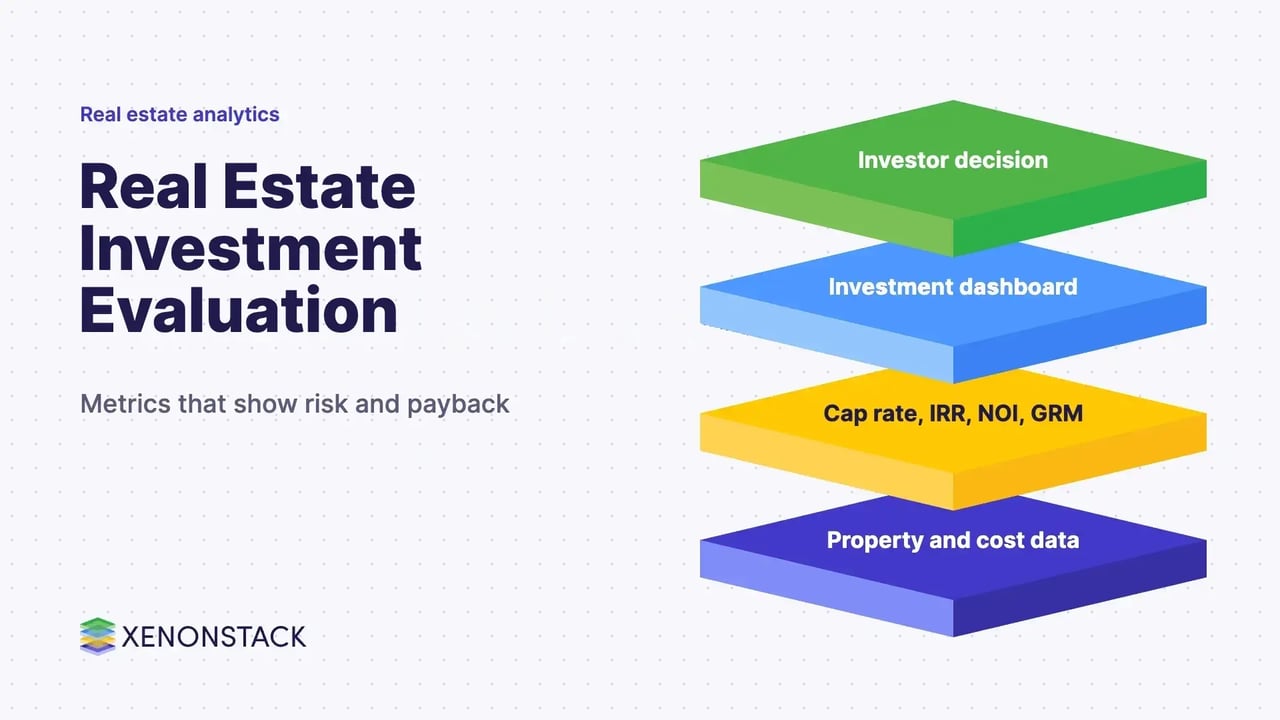
Real estate investment evaluation is the process of estimating how much a property will earn, what it costs to run and how quickly it pays back, using a consistent set of metrics. The usual set is net operating income, cap rate, internal rate of return, cash on cash return and gross rent multiplier.
This page is for property investors and the analytics teams that support them. It covers why evaluation is hard, what each metric tells you, how a dashboard brings them together, where AI agents fit and what to check before relying on the numbers.
What is real estate investment evaluation?
Investors often struggle with industry acronyms, and the right metrics change with the property and the investment goal. Evaluation answers practical questions: what return can the investor expect, how much capital does the property need, what does it cost to operate, what will it earn after operating expenses, and how many years will it take to pay back the initial investment. The same questions apply to a property already owned and to one under consideration.
What problem do investors face?
Monitoring the wrong metric, or reading one metric alone, hides risk. A property can look attractive on rent and still return little once costs, financing and time are counted. Investors who compare several properties need the same measures calculated the same way for each, otherwise the comparison is not fair. Doing this by hand across a portfolio is slow, and it is hard to spot a weak property early enough to act.
Which metrics should you use to evaluate a property?
Each metric answers one question and has a known blind spot, so use them together. The Corporate Finance Institute NOI guide describes NOI as a standardised proxy for cash flow on income-producing property, and says it is not the same as accounting net profit.
| Metric | What it tells you | What to remember |
|---|---|---|
| Net operating income (NOI) | Income left after operating costs | A proxy for cash flow, not accounting profit |
| Cap rate | Return based on NOI relative to market value | The Corporate Finance Institute cap rate guide says never to base a purchase on cap rate alone |
| Internal rate of return (IRR) | Time-adjusted return across all cash flows | The LoopNet IRR explainer notes it does not show total dollar profit |
| Cash on cash return | Annual pre-tax cash flow against cash invested | The Corporate Finance Institute cash on cash guide notes it ignores taxes and appreciation |
| Gross rent multiplier (GRM) | Price relative to annual gross rent | The Corporate Finance Institute gross rent multiplier guide notes it ignores operating expenses and vacancy |
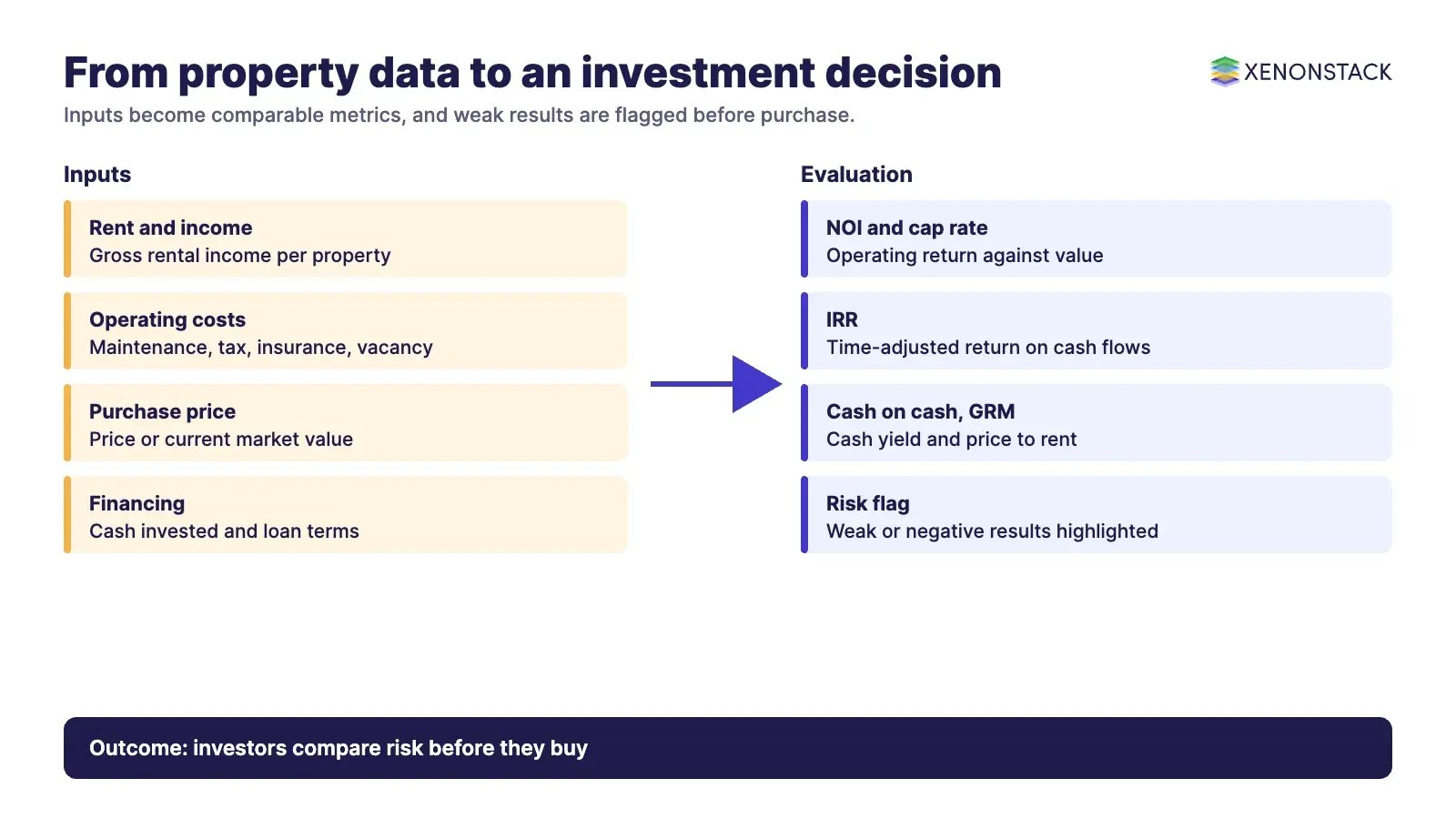
A worked example shows how they combine. Suppose a property has a very low cap rate, a negative IRR, and a low gross rent multiplier and cash on cash return. Read together, those signals say the property returns capital slowly or not at all, so it is a high-risk purchase. No single figure would make that case as clearly.
How does an investment evaluation dashboard work?
- Bring in the data. Collect rent, operating expenses, financing terms, purchase price and valuation for every property.
- Calculate the metrics. Compute NOI, cap rate, IRR, cash on cash return and gross rent multiplier on one agreed definition.
- Compare properties. Show them side by side so the least risky options stand out.
- Flag weak results. Highlight a property whose return is low or negative so the investor can act.
- Track over time. Refresh as rents, costs and values change, to see how well each investment has performed.
The output gives the investor each property's cap rate, return rate, income, profit and expense rate, and shows how much the investment is paying back. For related analytics work, see a demo with XenonStack.
Where do AI agents fit?
The dashboard reports; an AI agent can do the legwork around it. An agent can gather rent rolls and expense records, check that inputs are complete, recalculate the metrics when an assumption changes and draft a short note on why one property ranks below another. A person still makes the investment decision, and the agent works only from the sources the team approves. ElixirClaw is the AI agents computing platform from XenonStack, and ElixirData describes the data and governance layer.
How do manual and dashboard evaluation compare?
| Question | Manual spreadsheets | Metrics dashboard |
|---|---|---|
| Consistency | Each analyst may define metrics differently | One definition shared across properties |
| Comparing properties | Slow and error prone | Side by side in one view |
| Spotting risk | Often after the purchase | Flagged before the decision |
| Updating | Rebuilt by hand | Refreshed as inputs change |
| Audit trail | Hard to trace an assumption | Inputs and formulas are recorded |
What should you check before relying on the numbers?
- Inputs. Confirm rent, vacancy and expense figures come from records, not estimates.
- Definitions. Agree how NOI, cap rate and IRR are calculated, and apply them to every property.
- Blind spots. Pair each metric with one that covers what it ignores, such as taxes, vacancy or total profit.
- Market context. A cap rate means little without comparable properties in the same area.
- Decision rights. Decide who can change an assumption and who signs off the investment.
To map one investment decision your agents support, and the data and policy it depends on, book a Context Workshop. See what happens in the workshop.
Frequently asked questions
What is real estate investment evaluation?
It is the process of estimating what a property will earn, what it costs to run and how quickly it pays back, using metrics such as NOI, cap rate, IRR, cash on cash return and gross rent multiplier.
What is a cap rate?
The cap rate is the rate of return on a property based on the net operating income it generates, found by dividing NOI by the current market value. It should be used with other measures, not alone.
What does a negative IRR mean?
It means the cash flows, adjusted for time, produce a loss rather than a return. IRR should be read with the dollar profit and the cost of capital.
Why use several metrics together?
Each metric has a blind spot. Gross rent multiplier ignores operating costs and vacancy, cash on cash return ignores taxes, and IRR hides total profit, so combined use gives a fairer picture of risk.
How do AI agents help with property evaluation?
They can gather records, check inputs, recalculate metrics and draft comparisons, while a person makes the final investment decision.
Ready to put AI agents to work? See an ElixirClaw demo: the agentic OS to build, orchestrate and govern AI agents across your enterprise systems.
Explore the XenonStack platform family: ElixirData · ElixirClaw · ElixirHub · NexaStack · MetaSecure · Neural AI · AgentGRC · AgentSRE · AgentAnalyst · AgentInstruct · AgentRAI · AgentScrum · AgentSearch · AgentForce · AI Aviator · SAIF Aviator · CohortIQ · XenonStack AI · XenonStack UAE