Key takeaway
- How machine learning helps airlines, hotels and tour operators forecast route revenue, understand flight cancellations and track customer satisfaction.
AI in travel and hospitality is the use of machine learning on booking, flight, revenue and customer review data to forecast demand, explain cancellations and track customer satisfaction. It brings data from many sources into one pool that can be queried to find patterns and predict outcomes.
This page is for airline, hotel and tour operator leaders. It covers the problem, the data flow, how cancellations are classified, how to read a travel dashboard, where AI agents fit and what to check before you start.
What is AI in travel and hospitality?
Travel and hospitality data comes from many places and in many forms: bookings, flight schedules, cancellations, revenue by route and customer reviews. Hotel and airline organisations can use a system that handles this data quickly and gives them answers. Collecting the data into one pool means it can be queried to find problems, spot patterns and predict new outcomes.
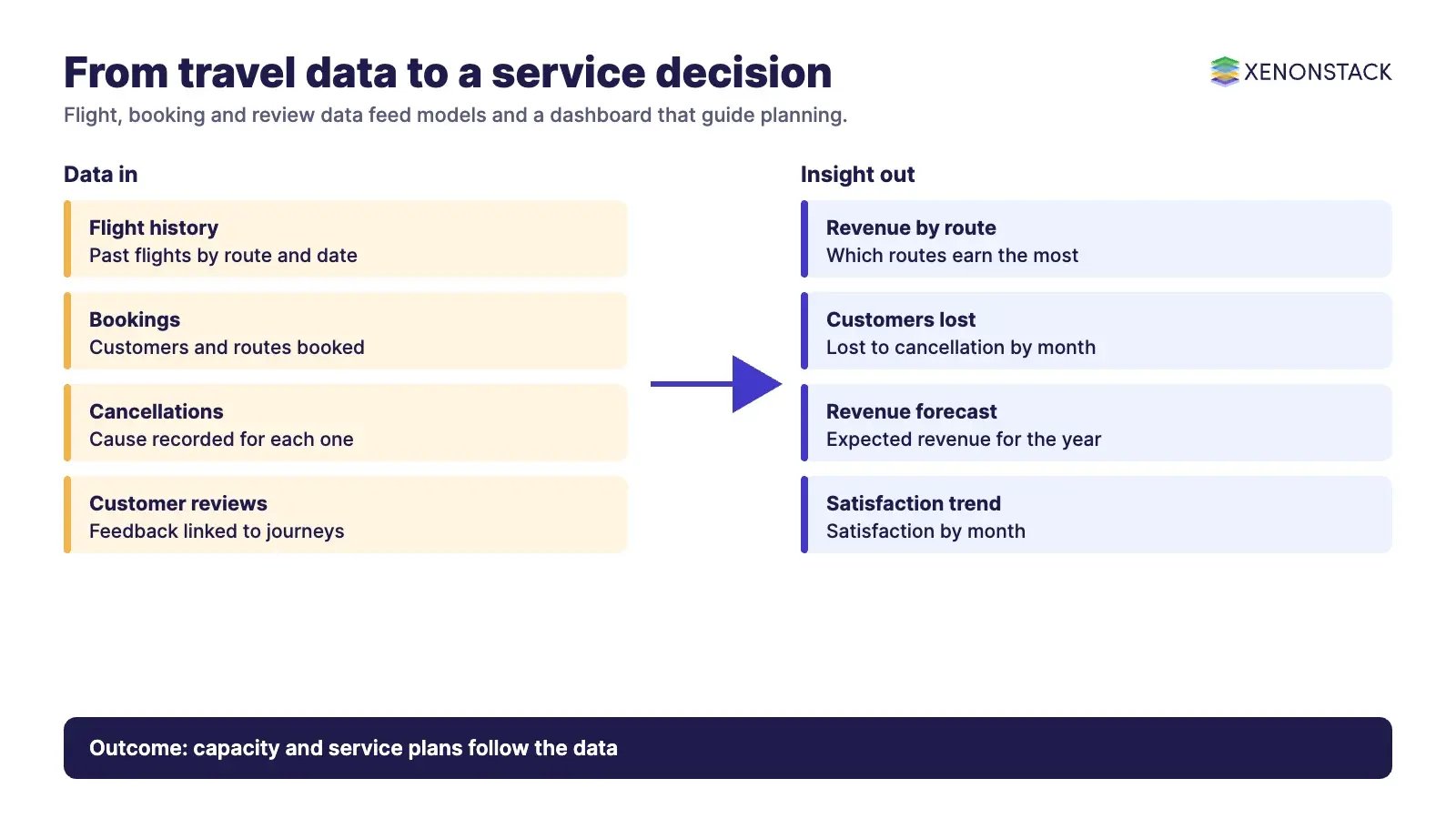
A predictive model built on that pool can help explain why flights are cancelled and how many customers are affected. It can also forecast revenue and the share of customers who are satisfied after a change in service.
What problem does it solve?
Without a shared view, teams answer questions late. Which routes earn the most? Why were flights cancelled, and how many customers were lost? Is revenue on track for the year? Are customers more satisfied after a service change? Each question needs data from a different system, so planning stays reactive.
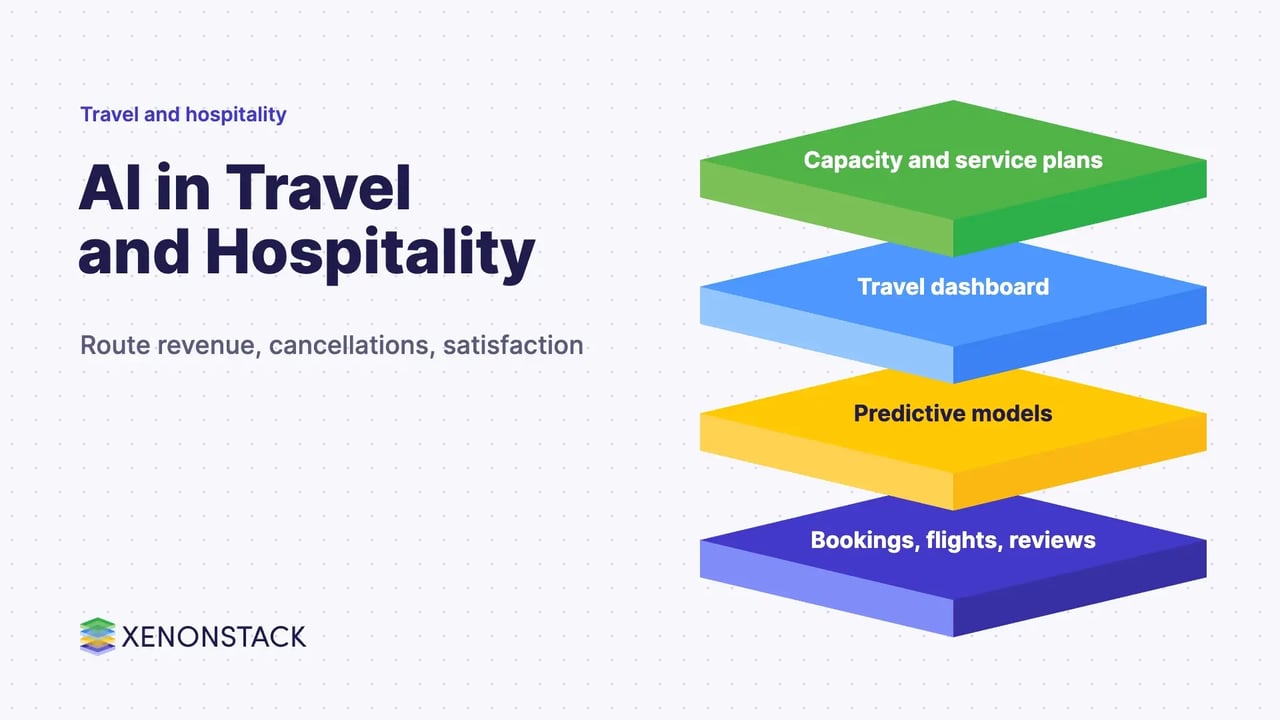
How does the data flow from source to decision?
- Collect. Gather historical flight data, bookings, cancellations and customer reviews.
- Combine. Bring the records into one pool with common route, date and customer fields.
- Model. Train predictive models on the combined data, for example for revenue by route and for satisfaction.
- Present. Show routes by revenue, customers lost to cancellation, revenue by month and satisfaction by month on a dashboard.
- Act. Adjust capacity, service and customer messages based on what the data shows.
How are flight cancellations classified?
A model that explains cancellations needs a clear cause for each one. The Bureau of Transportation Statistics uses a set of cause categories for delays and cancellations: air carrier, extreme weather, national aviation system, late-arriving aircraft and security. Cancellations use the same categories except late-arriving aircraft. Air carrier covers matters within the airline's control, such as maintenance, crew and fuelling.
| Cause category | Typical examples | What a travel team can do |
|---|---|---|
| Air carrier | Maintenance, crew, fuelling | Improve planning and spare capacity |
| Extreme weather | Storms and blizzards | Rebook early and tell customers quickly |
| National aviation system | Airport operations, traffic control, non-extreme weather | Plan around known congestion |
| Security | Terminal evacuations, screening problems | Prepare customer communication |
| Late-arriving aircraft (delays only) | An earlier flight on the same aircraft arrived late | Build buffers into aircraft rotations |
How do you read a travel and hospitality dashboard?
A dashboard for this use case answers the planning questions on one screen.
| Dashboard view | What it shows | Decision it supports |
|---|---|---|
| Revenue by route | Which routes generate the most revenue | Capacity and pricing |
| Customers lost to cancellation | How many customers were lost, by month and cause | Reliability work and customer care |
| Revenue by month | Revenue against the plan for the year | Forecast and budget |
| Satisfaction by month | Customer satisfaction over time | Service changes |
Where do AI agents fit?
A dashboard shows what happened. An AI agent can act on the signal: when a cancellation cause points to a recurring issue, it can pull the affected bookings, draft customer messages, propose rebooking options and ask a duty manager to approve. The agent works inside limits set by the business, and a person approves anything that changes a customer's booking. ElixirClaw is the AI agents computing platform from XenonStack and is the product page to read for agent and automation use cases. You can also request a predictive model demo.
What should you check before you start?
- Cause coding. Agree how each cancellation is classified so the data can be compared over time.
- Data quality. Check route, date and customer fields match across systems.
- Review data. Decide how reviews are collected, cleaned and linked to journeys.
- Customer data. Confirm consent and retention rules before using personal data in models.
- Forecast review. Compare forecasts with actual revenue and retrain when they drift.
- Approval. Decide which customer-facing actions an agent may take alone.
To map one travel decision your agents make, and the data and policy it depends on, book a Context Workshop. See what happens in the workshop.
Frequently asked questions
What is AI in travel and hospitality?
It is the use of machine learning on booking, flight, revenue and review data to forecast demand, explain cancellations and track customer satisfaction.
What causes flight cancellations?
The Bureau of Transportation Statistics groups causes into air carrier, extreme weather, national aviation system and security. Delays also have a late-arriving aircraft category.
What data does a travel prediction model use?
It uses historical flight data, bookings, cancellations, revenue by route and customer reviews, brought together in one pool.
What should a travel dashboard show?
Common views are revenue by route, customers lost to cancellation, revenue by month and customer satisfaction by month.
How can an AI agent help after a cancellation?
It can pull the affected bookings, draft customer messages and propose rebooking options, while a duty manager approves any change to a booking.
Ready to put AI agents to work? See an ElixirClaw demo: the agentic OS to build, orchestrate and govern AI agents across your enterprise systems.
Explore the XenonStack platform family: ElixirData · ElixirClaw · ElixirHub · NexaStack · MetaSecure · Neural AI · AgentGRC · AgentSRE · AgentAnalyst · AgentInstruct · AgentRAI · AgentScrum · AgentSearch · AgentForce · AI Aviator · SAIF Aviator · CohortIQ · XenonStack AI · XenonStack UAE