Key takeaway
- Master data management in insurance gives policyholder, product and agent data one governed record. See how it works, why it matters and where to start.
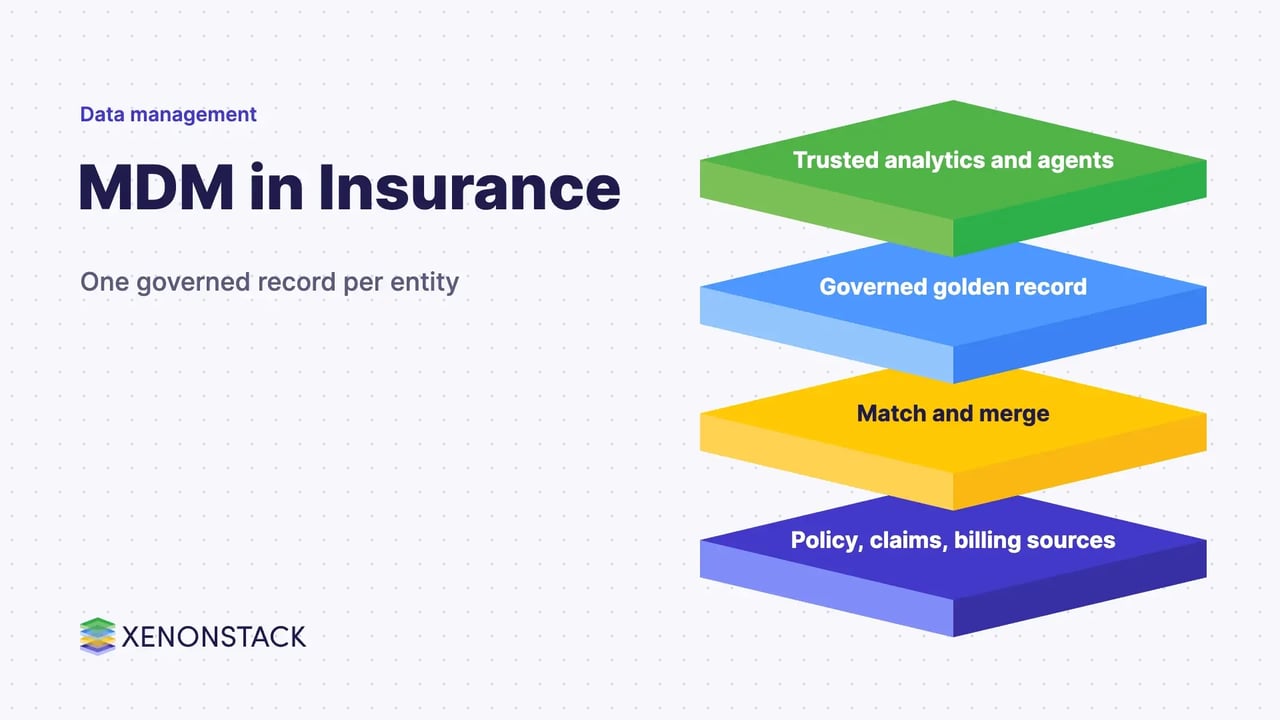
MDM in insurance is master data management applied to the records an insurer depends on, such as policyholders, products, agents and brokers, and locations, so that every system works from one trusted version of each. It replaces duplicated and conflicting records with a single governed reference that underwriting, claims, service and reporting can share.
This guide is for insurance data leaders, architects and compliance owners deciding where to start. It explains what MDM is, why insurers need it, how it works, how it differs from neighbouring disciplines, and how AI agents change the picture. For the banking view, read our guide to master data management in banking.
What is master data management?
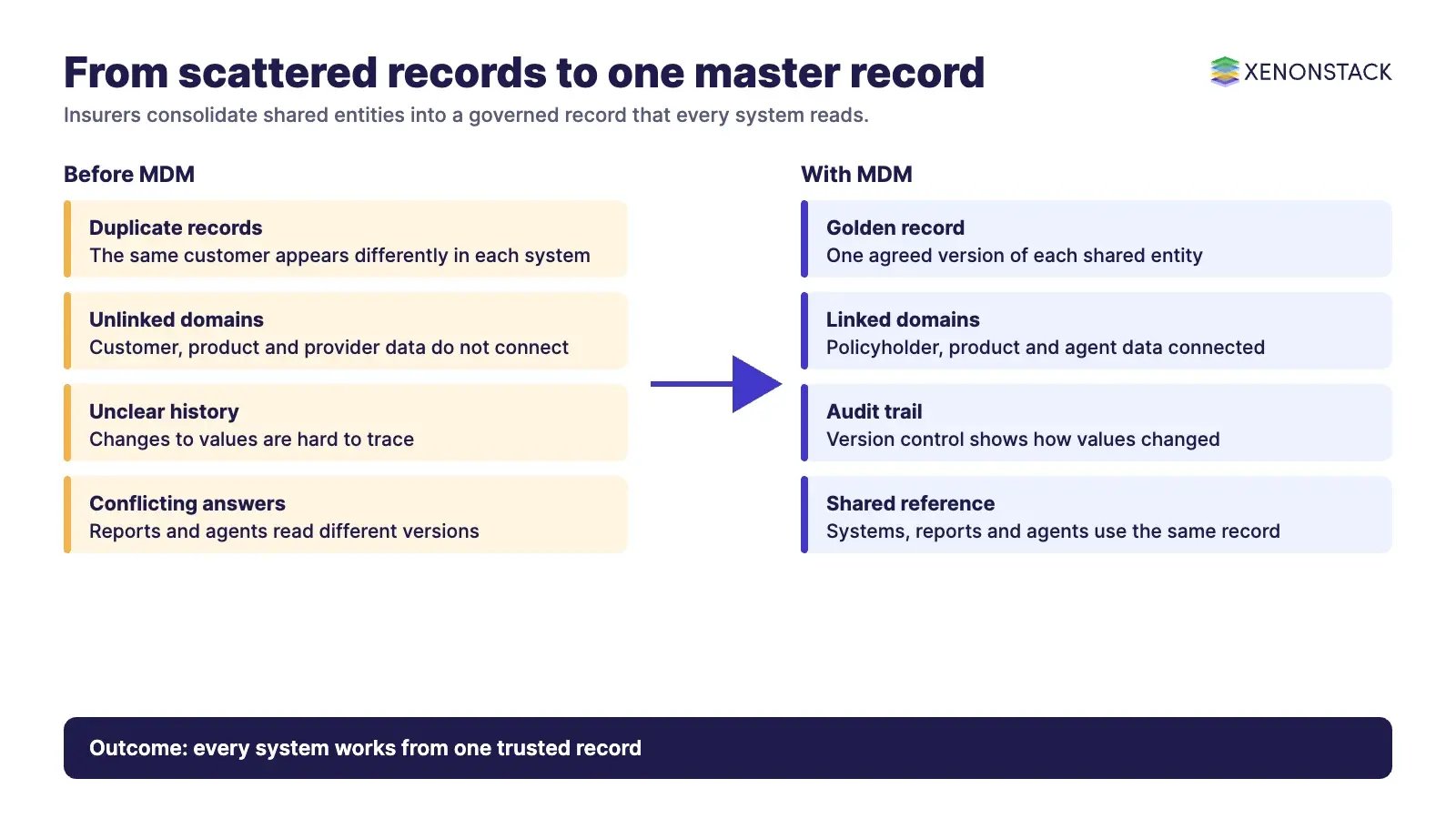
IBM describes master data management as an enterprise-wide approach that uses technology, tools and processes to consolidate key shared data, such as customer, product and location information, into a unified master data service. The goal, in IBM's words, is to reduce fragmentation, silos, duplication and inaccuracies. The result is often called a golden record: a single source of truth that integrates data from various systems so everyone works with the same information.
IBM lists five common master data domains: customer, product, supplier, location, and other items such as contracts, warranties and licences. For an insurer, the same idea maps naturally onto policyholders and claimants, insurance products and coverages, agents, brokers and service providers, and risk locations. For a broader view of the architecture, see master data management architecture.
Why do insurers need master data management?
Insurers hold the same entities in many places: policy administration, claims, billing, agent portals and analytics. When those copies disagree, three problems follow.
- Inconsistent records. The same customer appears with different spellings, addresses or identifiers, so no one can confirm a single view of that customer or their portfolio.
- Weak links between domains. Customer, product and provider records rarely connect, which makes it hard to see which coverage gaps a customer has or which providers touch which claims.
- Unclear history. If earlier versions of a record are not tracked, it is hard to show how a value changed, which matters when you must document your own compliance.
IBM notes that audit trails and version control support accountability and regulatory compliance, and that inaccuracy, inconsistency and incompleteness can undermine an organisation. Specific insurance rules differ by jurisdiction and line of business, so confirm requirements with your regulator and compliance team and not from a general guide.
How does MDM work in an insurance organisation?
IBM outlines the strategy steps in plain terms: decide which data counts as master data, based on factors such as behaviour, volatility and reuse; define governance policies; establish lifecycle processes; and select tools. Building the master record involves deduplicating records, reconciling discrepancies and enriching data, and data quality management adds cleansing, validation and continuous monitoring of quality metrics.
- Identify. List the entities every line of business shares, such as policyholder, product and agent.
- Match and merge. Deduplicate records across policy, claims and billing systems into one master record.
- Govern. Assign owners, define who may change a value, and keep an audit trail.
- Distribute. Publish the master record to the systems and reports that consume it.
- Monitor. Track quality metrics and fix the sources of error, not only the symptoms.
How is MDM different from related disciplines?
| Discipline | Main question it answers | Typical insurance example |
|---|---|---|
| Master data management | Which record is the agreed version of this shared entity? | One policyholder record used by every system |
| Data quality management | Is this data accurate, complete and valid? | Validating addresses and identifiers before merging |
| Data governance | Who owns the data and who may change it? | Owner and approval rules for product codes |
| Data analytics | What does the data tell us? | Spotting coverage gaps across a customer portfolio |
Analytics is only as good as the records beneath it. Our overview of the latest trends in big data analytics covers the layer that sits on top of a clean master record, and data management best practices with DataOps covers the operating habits that keep it clean.
What does a trusted master record make possible?
With one agreed view of each customer and policy, agents and brokers can see an entire portfolio in one place and spot a coverage gap, and recommendations at the moment of a new purchase or policy change can draw on consistent data. These are uses of analytics that rely on MDM, not benefits MDM delivers by itself. See our digital insurance technology solutions for the wider programme.
How do AI agents change MDM in insurance?
AI agents that answer policy questions, triage claims or draft broker replies read master data as an input to a decision. If two systems disagree about a policyholder, an agent can act on the wrong one. Agents also create new work for MDM: matching candidate duplicates, proposing corrections and routing exceptions to a data steward. The master record, its ownership rules and the decision trace should be governed in one place. ElixirData is XenonStack's Context OS for governed data and decision context.
What should you do first?
- Choose one domain, usually the policyholder, and one business outcome to improve.
- Map every system that holds that entity and note where values conflict.
- Agree ownership and change rules before buying or configuring a tool.
- Match and merge a single line of business, and measure data quality before and after.
- Decide which agents and reports will consume the master record, and test them against it.
To map one decision your agents make from policy data, and the data and policy it depends on, book a Context Workshop. See what happens in the workshop.
Frequently asked questions
What does MDM stand for in insurance?
MDM stands for master data management. In insurance it means keeping one governed record for shared entities such as policyholders, products, agents and locations.
What is a golden record?
IBM describes a golden record as a single source of truth that integrates data from various systems so everyone works with the same information.
Which data domains does MDM cover?
IBM lists customer, product, supplier and location domains, plus other items such as contracts, warranties and licences.
Is MDM the same as data quality management?
No. MDM creates and maintains the agreed record, while data quality management cleanses, validates and monitors the data. They work closely together.
Where should an insurer start with MDM?
Start with one domain and one business outcome, agree ownership and change rules, then match and merge a single line of business before expanding.
Ready to put AI agents to work? See an ElixirClaw demo: the agentic OS to build, orchestrate and govern AI agents across your enterprise systems.
Explore the XenonStack platform family: ElixirData · ElixirClaw · ElixirHub · NexaStack · MetaSecure · Neural AI · AgentGRC · AgentSRE · AgentAnalyst · AgentInstruct · AgentRAI · AgentScrum · AgentSearch · AgentForce · AI Aviator · SAIF Aviator · CohortIQ · XenonStack AI · XenonStack UAE