Key takeaway
- BizDevOps explained: how it differs from DevOps and SRE, benefits and trade-offs, DORA metrics, tools and a small first step for enterprise teams.
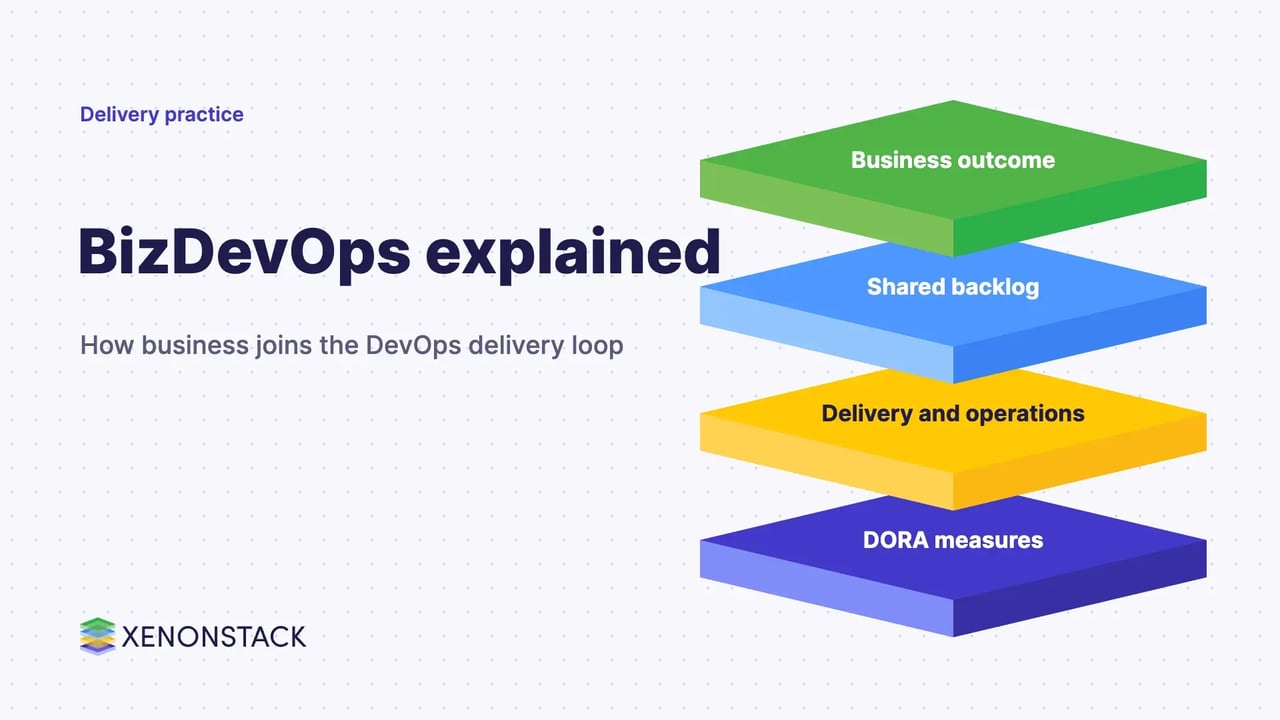
BizDevOps is a way of working in which business owners, developers and operations teams share one backlog, one set of outcomes and one feedback loop, so that software is judged by the business result it produces and not only by whether it deployed. It extends DevOps by putting the business side inside the delivery team from the first planning conversation.
For an enterprise, the practical question is not the name but the habit: who decides what gets built, who sees the effect in production, and how that evidence changes the next release. This guide defines BizDevOps carefully, shows how it differs from DevOps and SRE, and sets out a small first step. To measure the delivery side, start with the DORA metrics.
What is BizDevOps?
BizDevOps (Business, Development and Operations) is a practice term, not a formal standard. Its common meaning is that business people take part in the whole delivery cycle: planning, design, build, release and the review of results in operation. The aim is that every release can be traced back to a business goal and its effect checked afterwards.
| Group | Main question | Typical activities |
|---|---|---|
| Business | Which outcome are we paying for? | Value case, priorities, acceptance, feedback on results |
| Development | What is the smallest change that delivers it? | Backlog, design, code, test, delivery |
| Operations | Is it running well and safely? | Deploy, operate, monitor, optimise |
How is BizDevOps different from DevOps and SRE?
DevOps joins development and operations around fast, reliable delivery. BizDevOps adds the business as a standing member of that loop. Site reliability engineering (SRE) focuses on service reliability using targets and error budgets; see SRE vs DevOps for that comparison. The three work together rather than compete.
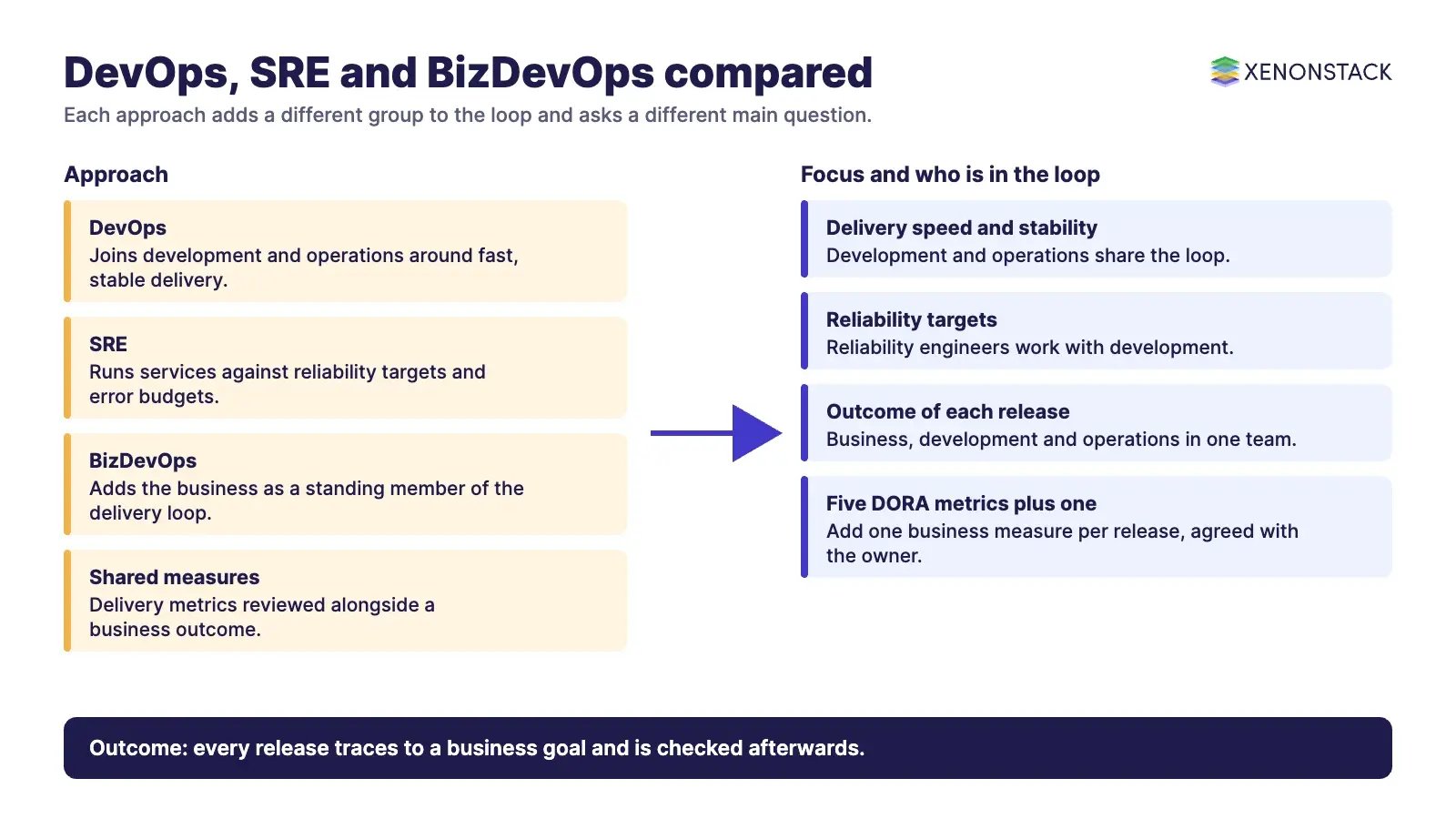
| Approach | Focus | Who is in the loop |
|---|---|---|
| DevOps | Delivery speed and stability | Development, operations |
| SRE | Reliability targets and error budgets | Reliability engineers, development |
| BizDevOps | Business outcome of each release | Business, development, operations |
Why do enterprises need it?
A single application can be judged by whether it works as expected. An enterprise runs hundreds of applications, many of them hosted by suppliers who change them on their own schedule. What matters then is whether business processes still work end to end after each change. DevOps pipelines do not answer that on their own, because they measure delivery, not process outcomes. Putting business owners in the loop gives teams a way to agree what "working" means across applications, along with the compliance and risk limits that apply.
What are the benefits and the trade-offs?
| Benefit | Why it can happen | Trade-off to watch |
|---|---|---|
| Aligned goals | Business KPIs and delivery measures are reviewed together | Needs a shared, agreed set of measures |
| Less rework | Requirements are clarified earlier and changed less late | Business time is needed every sprint |
| Shared ownership | Developers see the business reason behind their work | Unclear decision rights cause delay |
| Better governance | Compliance and security limits are agreed up front | Can slow small changes if over-applied |
These are expected effects, not guaranteed results. Measure them in your own teams before claiming them. BizDevOps is a poor fit for a small product with one owner who already works inside the team.
How do you implement BizDevOps in an enterprise?
1. Form one cross-functional team
Bring a business owner, developers, operations and, where relevant, security, data and compliance into one team around a single business process or product. Give it one backlog and one owner for priorities.
2. Start small
Pick one process or product. Learn what the business side needs to see, then extend to more processes in steps.
3. Define the business problem and the evidence
Write the problem, the technical and economic fit and the outcome that will show success before coding starts. Then follow the normal path: build, test, deploy, monitor, and review the result with the business owner.
4. Measure delivery and outcome together
According to dora.dev, DORA describes five software delivery metrics in two groups. Throughput covers change lead time, deployment frequency and failed deployment recovery time. Instability covers change fail rate and deployment rework rate (DORA metrics guide, read 13 November 2026). Pair these with one business measure per release, such as the process outcome the owner named. See also DevOps trends for where delivery practice is heading.
Which tools support BizDevOps?
No single product makes a team BizDevOps. Choose by the job each tool does and check current status on the vendor's own page.
| Need | Tool category | What to check |
|---|---|---|
| See application behaviour | Application performance monitoring and observability | Business-level metrics, not only latency and errors |
| Let business people change workflows | Low-code and process platforms | Governance, versioning and approval of changes |
| Keep a shared record of decisions | Backlog and decision tracking | Link from each release to its business goal |
As AI agents begin to take part in delivery, the same loop needs rules for what they may do. ElixirData Context OS keeps governed context, versioned policy and decision traces in one decision layer above AI agents, and AgentGRC keeps autonomous agent actions inside policy, with the audit trail risk teams need. ElixirClaw is an agentic OS platform to build, orchestrate and govern AI agents and automation workflows while keeping humans in control.
To map one delivery decision your agents should make, and the context and policy it depends on, book a Context Workshop. See what happens in the workshop.
Frequently asked questions
What does BizDevOps stand for?
Business, Development and Operations. It is a practice term in which business owners work in the same delivery loop as developers and operations.
Is BizDevOps a replacement for DevOps?
No. It builds on DevOps by adding the business side to the loop. DevOps practices such as automated delivery and monitoring still apply.
How is BizDevOps different from SRE?
SRE centres on service reliability and error budgets. BizDevOps centres on the business outcome of each release. Teams often use both.
Which metrics should a BizDevOps team track?
Start with the five DORA delivery metrics from dora.dev and add one business outcome measure per release, agreed with the business owner.
How should an enterprise start?
Pick one business process or product, form one cross-functional team with one backlog, and review delivery and outcome measures together.
Explore the XenonStack platform family: ElixirData · ElixirClaw · ElixirHub · NexaStack · MetaSecure · Neural AI · AgentGRC · AgentSRE · AgentAnalyst · AgentInstruct · AgentRAI · AgentScrum · AgentSearch · AgentForce · AI Aviator · SAIF Aviator · CohortIQ · XenonStack AI · XenonStack UAE