Key takeaway
- Build a multimodal chatbot on AWS: Amazon Lex for conversation, Polly for speech and Rekognition for images, with architecture steps and design checks.
A multimodal chatbot on AWS is a conversational assistant that accepts text, speech and images, typically built with Amazon Lex for the conversation, Amazon Polly for spoken replies and Amazon Rekognition for image analysis. The user can type, talk or send a photo, and the bot answers in the form that suits the channel.
This guide is for product owners and engineers planning a customer-facing assistant, such as a shop or support bot. It explains what each service does, how the parts connect, an e-commerce example, the checks to make, and how AI agents extend the design. See also our notes on multimodal embeddings with Amazon SageMaker and AWS Inferentia for multimodal inference.
What is a multimodal chatbot?
A text-only chatbot reads typed messages. A multimodal chatbot adds other input and output types: voice in, voice out, and pictures the user uploads. The benefit is practical: a customer can photograph a product instead of describing it, or listen to an answer while their hands are busy.
What do Lex, Polly and Rekognition each do?
According to the Amazon Lex page, Lex lets users interact with applications through natural language voice or chat, and it lists an automated chatbot designer, a Visual Conversation Builder and streaming APIs to manage interruptions. It names channels including Facebook Messenger, Slack, Kik and Twilio SMS, plus native integration with Amazon Connect. Usage is metered and billed per API request.
The Amazon Polly page describes a managed service that turns written text into speech through an API. It supports SSML tags to adjust emphasis, intonation, phrasing and style, offers 100+ voices in 40+ languages and language variants, and produces formats such as MP3 and OGG. The Amazon Rekognition page lists labels, text detection, face analysis, content moderation and custom labels for images and video.
| Service | Role in the bot | Input | Output |
|---|---|---|---|
| Amazon Lex | Understands the request and manages the conversation | Typed or spoken language | Interpreted request and bot reply text |
| Amazon Polly | Speaks the reply | Reply text, optionally with SSML | Audio such as MP3 or OGG |
| Amazon Rekognition | Analyses uploaded images | Image files | Labels, detected text, moderation flags |
How do you build a multimodal chatbot on AWS?
The steps below are a design path, not a fixed recipe. Check each service's current documentation for limits, regions and pricing before you build.
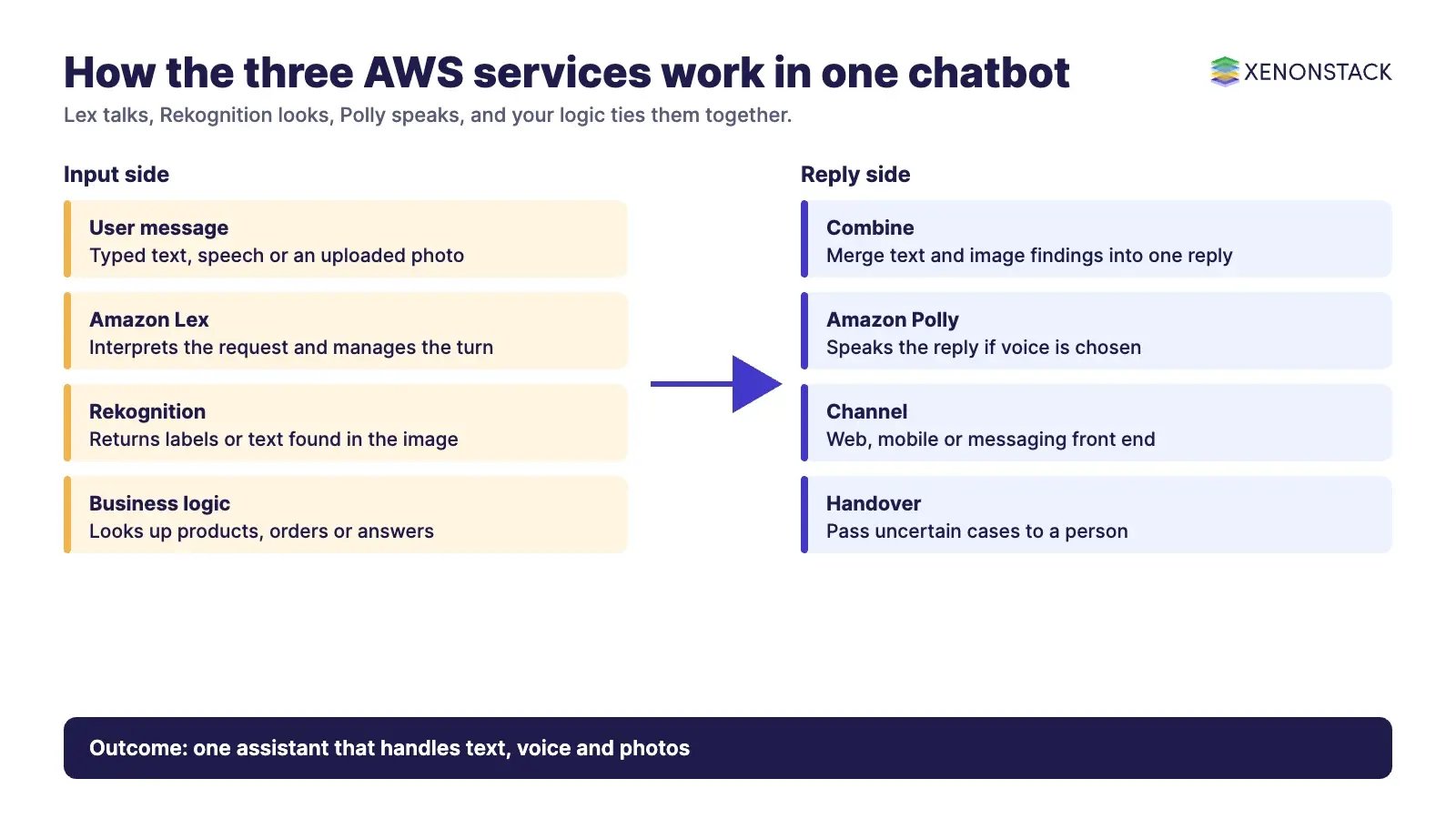
- Define the use case. Name the user, the channel and the three or four requests the bot must handle.
- Design the conversation in Lex. Capture the requests the bot must understand, the details it must collect, and what happens when it does not understand.
- Connect business logic. Call your own services, such as AWS Lambda functions, to look up orders or products.
- Add voice with Polly. Send reply text to Polly and use SSML where pacing or emphasis matters.
- Add image analysis with Rekognition. Accept uploads, check them, call Rekognition and pass the findings back into the conversation.
- Combine and deploy. Merge text, speech and image findings into one reply, then expose the bot through a web or mobile front end or a messaging channel.
What does an e-commerce assistant look like?
A shopper uploads a photo of a lamp and asks, "Do you have something similar under my budget?" Rekognition returns labels for the image, Lex handles the budget request and collects any missing details, your product service searches the catalogue, and Polly reads the shortlist aloud if the shopper chose voice. Rekognition output is a set of labels, so matching them to a catalogue is your own logic. Test it with real photos before launch.
What should you check before launch?
| Area | Check | Why it matters |
|---|---|---|
| Privacy | Photos and voice are personal data: set consent, retention and access rules | Users upload things you did not plan for |
| Safety | Use Rekognition content moderation on uploads | Public channels attract unsafe images |
| Accuracy | Keep confidence values and set a threshold for handover to a person | Labels can be wrong |
| Fallback | Offer a text path and a human handover | Voice and images fail in noisy or poor conditions |
| Cost | Review per-request pricing for each service | Three services bill separately |
Our guide to multimodal chatbots with Amazon Lex, Polly and Rekognition goes deeper on the architecture, and multimodal AI agents with Rekognition and Comprehend covers adding text analysis.
How do AI agents change chatbot design?
A scripted bot follows the paths you designed. An agent can decide which tool to use for each message: answer directly, ask for a photo, search the catalogue, or hand over to a person. It can also carry context across turns and explain what it did. That needs clear limits on what it may do for the customer and a record of each decision. ElixirClaw is the AI agents computing platform XenonStack builds for this kind of work. Lex still provides the conversational layer, with agent logic behind it.
What should you do first?
- Pick one channel and one customer journey.
- Write the five requests the bot must handle and the cases it must hand over.
- Prototype text first in Lex, then add Polly and Rekognition one at a time.
- Test with real photos, accents and noisy audio.
- Set consent, moderation and handover rules before opening the bot to customers.
To map one decision your chatbot agents make, and the data and policy it depends on, book a Context Workshop. See what happens in the workshop.
Frequently asked questions
What is a multimodal chatbot?
A chatbot that works with more than one kind of input and output, such as typed text, speech and images, instead of text alone.
What does Amazon Lex do in a multimodal chatbot?
Lex handles the conversation. The AWS page describes it as letting users interact with applications through natural language voice or chat.
What does Amazon Polly add?
Polly turns reply text into speech, with SSML tags to adjust emphasis, intonation, phrasing and style.
How does Rekognition fit in?
Rekognition analyses uploaded images, for example returning labels, detecting text and flagging unsafe content, and your bot uses those findings in its reply.
Do I need an AI agent for this?
No. A Lex bot works on its own. An agent becomes useful when the bot must choose between tools, carry context and hand over to a person under clear rules.
Follow XenonStack on LinkedIn: XenonStack on LinkedIn for new guides on agentic AI, data and platform engineering.
Ready to put AI agents to work? Explore ElixirClaw, the agentic OS platform to build, orchestrate and govern AI agents.
Explore the XenonStack platform family: ElixirData · ElixirClaw · ElixirHub · NexaStack · MetaSecure · Neural AI · AgentGRC · AgentSRE · AgentAnalyst · AgentInstruct · AgentRAI · AgentScrum · AgentSearch · AgentForce · AI Aviator · SAIF Aviator · CohortIQ · XenonStack AI · XenonStack UAE