Key takeaway
- A smart FAQ system answers customer questions in plain language from your own content. See the flow, where AI agents fit and what to check first.
A smart FAQ system is a chatbot that answers customer questions in plain language by searching an organisation's own questions, answers and documents, instead of sending the visitor through pages of content. The version described here was built for the ElixirClaw website so that visitors can ask about products and services and get an answer on the spot.
This page is for teams that run a website or support portal and want fewer repeat enquiries. It covers the problem, the build flow, how the pieces fit, where AI agents come in, and what to check before you adopt it.
What problem does a smart FAQ system solve?
Customers and prospects have little time. They do not want to read several web pages or posts to learn who you are, what you provide and what it costs. They want to know straight away whether you are the right fit.
When the answer is hard to find, the visitor either contacts the organisation or leaves. Both outcomes cost something: the organisation spends staff time replying to questions that are already answered somewhere, and the website loses visits. A smart FAQ system aims to shorten the path from question to answer.
How does a smart FAQ system work?
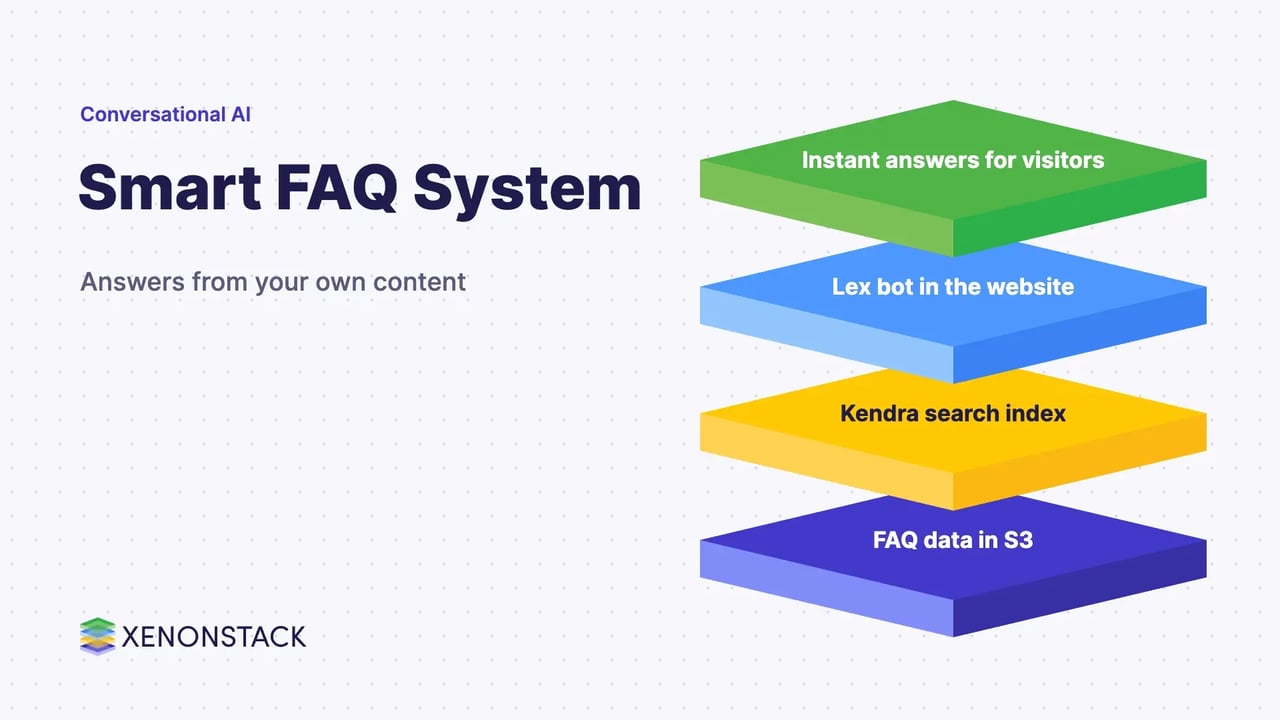
The flow has four steps, and each one maps to a managed AWS service.
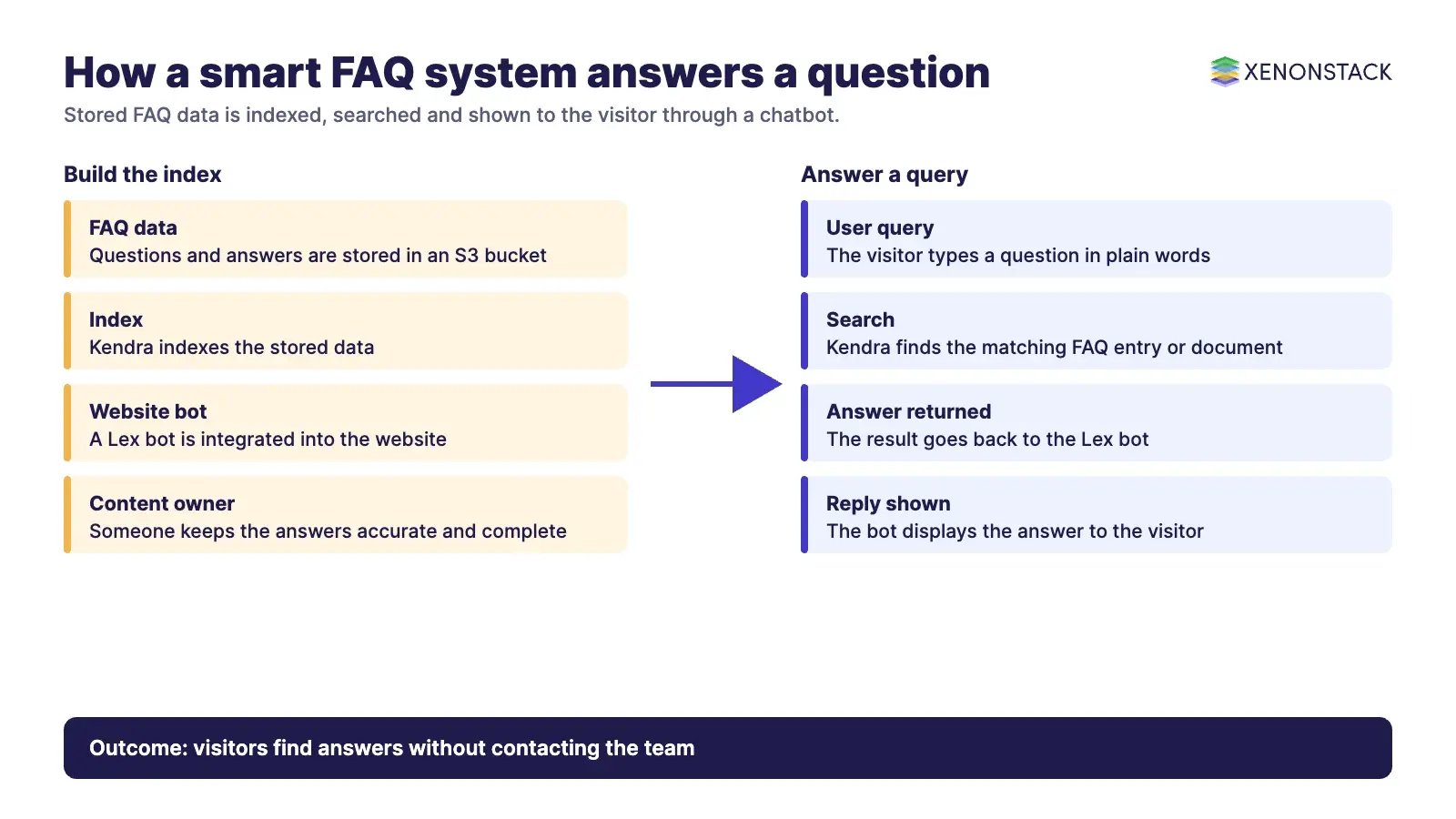
- The FAQ data, meaning questions and answers, is stored in an Amazon S3 bucket.
- The stored data is indexed with Amazon Kendra.
- When a user sends a query, Kendra searches the index for the document or FAQ entry that answers it and returns the answer to the Lex bot.
- The Amazon Lex V2 bot displays the answer to the user.
The chatbot is integrated into the website, so visitors ask their question in the same place where they would otherwise browse.
Why use a search service behind the chatbot?
AWS describes Kendra as a managed information retrieval service that, unlike keyword search, uses semantic and contextual similarity and ranking to decide whether content is relevant to a query. It also says Kendra can return answers to simple factoid questions, such as who, what, when or where, from an FAQ or from indexed documents. That suits a website where the same questions arrive in many different wordings.
The Lex documentation for AMAZON.KendraSearchIntent explains how the two connect. Lex calls the search intent whenever it cannot match the user's words to one of the bot's own intents. Kendra's response comes back through the intent's closing response, and up to five FAQ answers and five document answers can be returned. FAQ answers need an FAQ in the index, and document answers need a data source.
How does it compare with a static FAQ page?
| Question | Static FAQ page or site search | Smart FAQ system |
|---|---|---|
| How does the visitor ask? | Browses a list or types matching keywords | Types a question in their own words |
| What is searched? | One page or one site section | An index built from FAQ entries and documents |
| What does the visitor get? | A list of pages to read | A direct answer, with the source where one is configured |
| What happens when nothing matches? | An empty results page | The bot re-prompts, then ends or hands over, depending on how it is configured |
| Upkeep | Edit pages by hand | Update the stored questions and answers, then refresh the index |
Where do AI agents fit in a smart FAQ system?
A FAQ chatbot answers from content that already exists. An AI agent can go a step further, for example by looking up a record or starting a request on the customer's behalf. That extra reach is useful, but it needs clear limits on which data the agent may read and which actions it may take.
ElixirClaw is XenonStack's AI agents computing platform. Teams that start with a question-and-answer bot can use it as the place where later agent workflows are built and run.
What should you check before adopting one?
- Content quality. The system can only answer from what you give it. Review the questions and answers for accuracy and gaps first.
- Service availability. AWS states that Amazon Kendra is no longer open to new customers and recommends Amazon Bedrock Knowledge Bases for similar capabilities. Check which retrieval service your account can use.
- Language and region. AWS says AMAZON.KendraSearchIntent is available only in the English (US) locale and in the US East (N. Virginia), US West (Oregon) and Europe (Ireland) Regions.
- Fallback behaviour. Decide what the bot does when it finds no answer, including how a person takes over.
- Ownership. Name who updates the content and who reviews the questions the bot could not answer.
To map one decision your agents make, and the data and policy it depends on, book a Context Workshop. See what happens in the workshop.
Frequently asked questions
What is a smart FAQ system?
It is a chatbot that answers customer questions in plain language by searching an organisation's own questions, answers and documents.
Which services does this build use?
FAQ data is stored in Amazon S3, indexed with Amazon Kendra, and shown to the user through an Amazon Lex bot.
What happens if the bot cannot match a question?
In Lex, the Kendra search intent is called whenever the bot cannot match the user's words to an intent. If no answer comes back, the bot re-prompts and then falls back, as you configure it.
Can a smart FAQ system replace human support?
It handles questions that already have answers in your content. Questions that need judgement or account access still need a person or a governed agent.
Is Amazon Kendra still available?
AWS states that Amazon Kendra is no longer open to new customers and recommends Amazon Bedrock Knowledge Bases for similar capabilities, so check your account before you plan around it.
Ready to put AI agents to work? See an ElixirClaw demo: the agentic OS to build, orchestrate and govern AI agents across your enterprise systems.
Explore the XenonStack platform family: ElixirData · ElixirClaw · ElixirHub · NexaStack · MetaSecure · Neural AI · AgentGRC · AgentSRE · AgentAnalyst · AgentInstruct · AgentRAI · AgentScrum · AgentSearch · AgentForce · AI Aviator · SAIF Aviator · CohortIQ · XenonStack AI · XenonStack UAE