Key takeaway
- How to build a batch and ad hoc query platform with Presto and Apache Hive on AWS, with automated cluster scaling and Spot Instances. Read the steps.
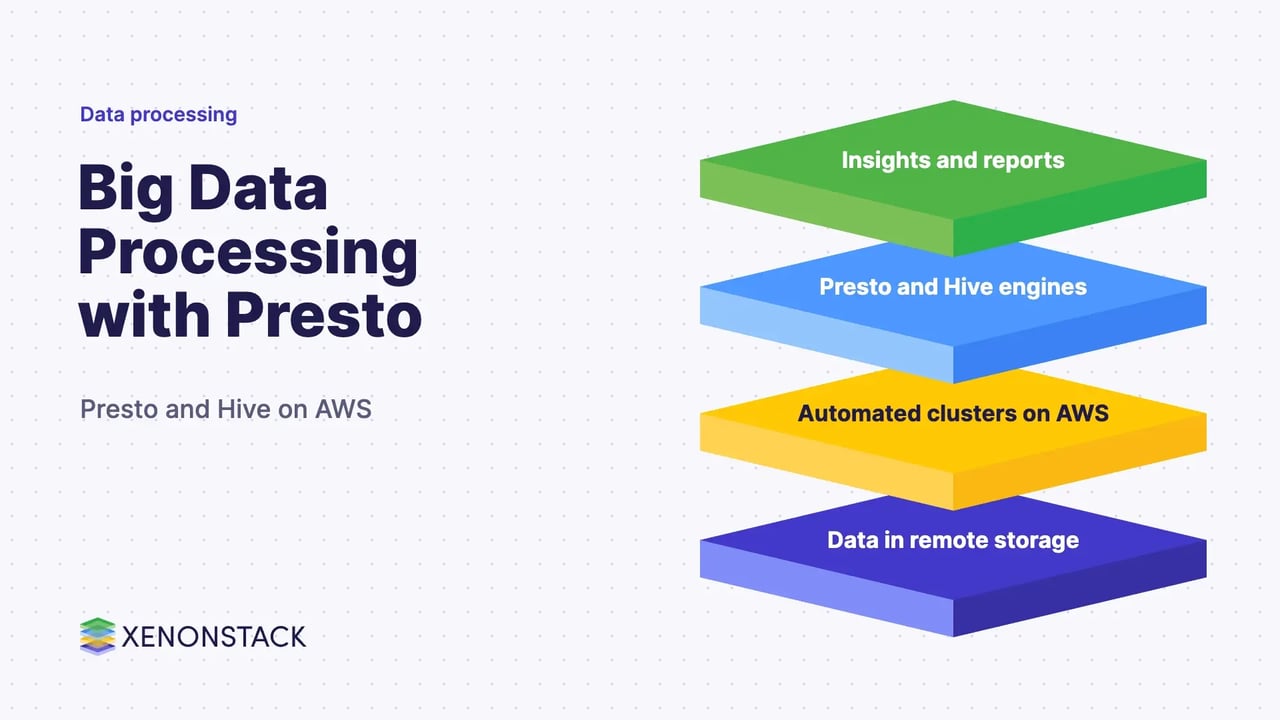
A big data processing platform with Presto and Apache Hive pairs a distributed SQL query engine for ad hoc analysis with a batch engine for large ETL jobs, both running on automatically managed clusters. On AWS, infrastructure automation launches, scales and heals those clusters so teams do not manage them by hand.
This page is for data platform and analytics engineering teams. It covers the problem, how Presto and Hive differ, how infrastructure automation works, where AI agents help, and what to check first.
What is a Presto and Hive query platform?
Presto is described in its documentation as "a distributed SQL query engine designed to query large data sets" across heterogeneous data sources. Apache Hive is described as a distributed, fault-tolerant data warehouse system that lets you read, write and manage petabytes of data in distributed storage using SQL.
Used together, Presto serves data discovery and interactive questions, and Hive with Tez runs the heavy ETL and reporting jobs over data held in remote storage.
What problem does it solve?
Teams with large datasets in remote storage need two things at once: a fast way to explore data, and a dependable way to transform it on a schedule. They also need the clusters behind both to be created, resized and repaired without manual effort.
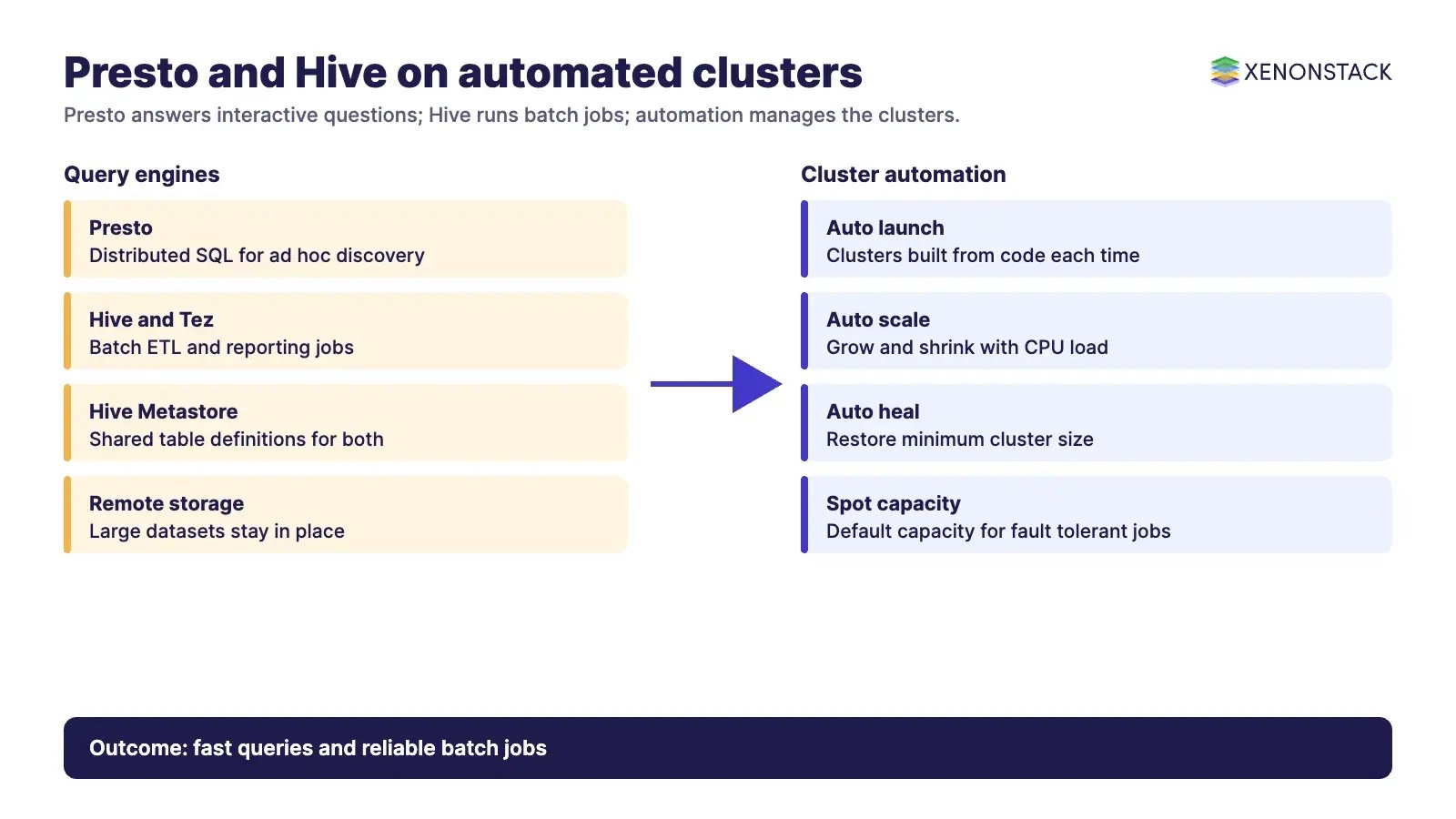
- Build a data processing and query platform with managed clusters.
- Use Presto for data discovery and Hive with Tez for ETL jobs.
- Automate cluster management and deployment, using AWS Spot Instances where suitable.
How do Presto and Hive differ?
| Area | Presto | Apache Hive |
|---|---|---|
| Main use | Ad hoc and interactive queries | Batch processing and ETL |
| Optimised for | Query latency | Query throughput |
| Data | Queries data through the Hive Metastore and other sources | Processes data from gigabytes to petabytes |
| Processing model | Push model, like a traditional database | Pull model |
| Memory | Memory limits apply to query tasks, so large daily or weekly reports need a lot of memory | Suited to large batch runs |
Choose by workload. Use Presto when an analyst needs an answer quickly, and Hive when a large job must finish reliably.
How does infrastructure automation work on AWS?
Cluster management is automated with tools such as Ansible and Terraform, which handle auto launch, auto scaling and auto healing for the Presto and Hive clusters.
- Launch the cluster from code, so every environment is built the same way.
- Use AWS Spot Instances as the default capacity, with On-Demand instances for the parts that must not be interrupted.
- Scale the cluster up and down according to CPU load.
- Heal the cluster automatically if it falls below its minimum size.
- Monitor workloads and review cost on a regular schedule.
The AWS Spot Instances page says they let you use unused EC2 capacity and suggests them for stateless, fault-tolerant or flexible applications such as big data. Because that capacity can be reclaimed, design jobs to be retried. For help running Hive and HBase as a managed service, see Apache HBase and Apache Hive managed services.
What are the typical uses of Presto and Hive on AWS?
Presto is used for SQL across many sources, cost-based query optimisation, autoscaling with workload monitoring, and exploring results in tools such as Apache Superset. Hive is used for structured and semi-structured data processing, as a data warehouse on Hadoop, for ETL, and for SQL-style queries with HiveQL, including custom map and reduce scripts for specific needs.
Where do AI agents fit in a data processing platform?
Agents can review failed jobs, suggest a fix, flag a query that exceeds its memory limit, and summarise cost and scaling events for an engineer to approve. Keep a record of each change an agent proposes. ElixirData is XenonStack's Context OS, a place to keep the data and policy those decisions depend on.
What should you check before adopting it?
- Which queries are interactive and which are batch?
- Can your jobs tolerate Spot interruptions, and are they safe to retry?
- What minimum cluster size must always be available?
- Who owns the Hive Metastore and its schemas?
- How will you track cost per team or workload?
To map one decision your agents make, and the data and policy it depends on, book a Context Workshop. See what happens in the workshop.
Frequently asked questions
What is the difference between Presto and Hive?
Presto is a distributed SQL engine optimised for low-latency, ad hoc queries. Hive is a data warehouse system suited to large batch jobs and ETL that favours throughput.
Why use Spot Instances for big data clusters?
Spot Instances use unused EC2 capacity and are suggested for fault-tolerant workloads such as big data. Jobs must be able to retry if capacity is reclaimed.
What do Ansible and Terraform do here?
They define and launch the clusters as code, so scaling and healing are repeatable rather than manual.
Where do AI agents help?
Agents can review failed jobs, flag heavy queries and summarise scaling and cost events for an engineer to approve.
What should we set up first?
Start with one Presto cluster for ad hoc queries and one Hive job for a daily report, launched from code, then add autoscaling.
Ready to put AI agents to work? See an ElixirClaw demo: the agentic OS to build, orchestrate and govern AI agents across your enterprise systems.
Explore the XenonStack platform family: ElixirData · ElixirClaw · ElixirHub · NexaStack · MetaSecure · Neural AI · AgentGRC · AgentSRE · AgentAnalyst · AgentInstruct · AgentRAI · AgentScrum · AgentSearch · AgentForce · AI Aviator · SAIF Aviator · CohortIQ · XenonStack AI · XenonStack UAE