Key takeaway
- How to build a real-time streaming data pipeline with Apache NiFi, Kafka, Spark and Cassandra, and where AI agents help monitor and govern the flow.
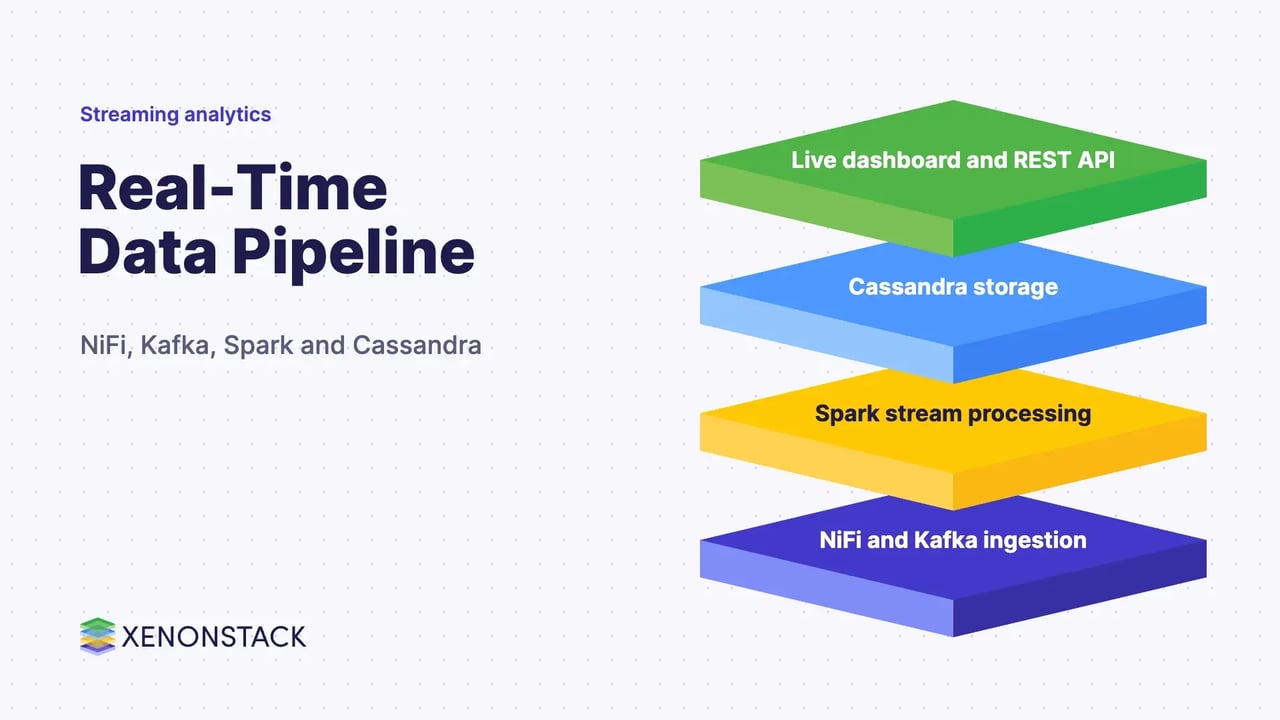
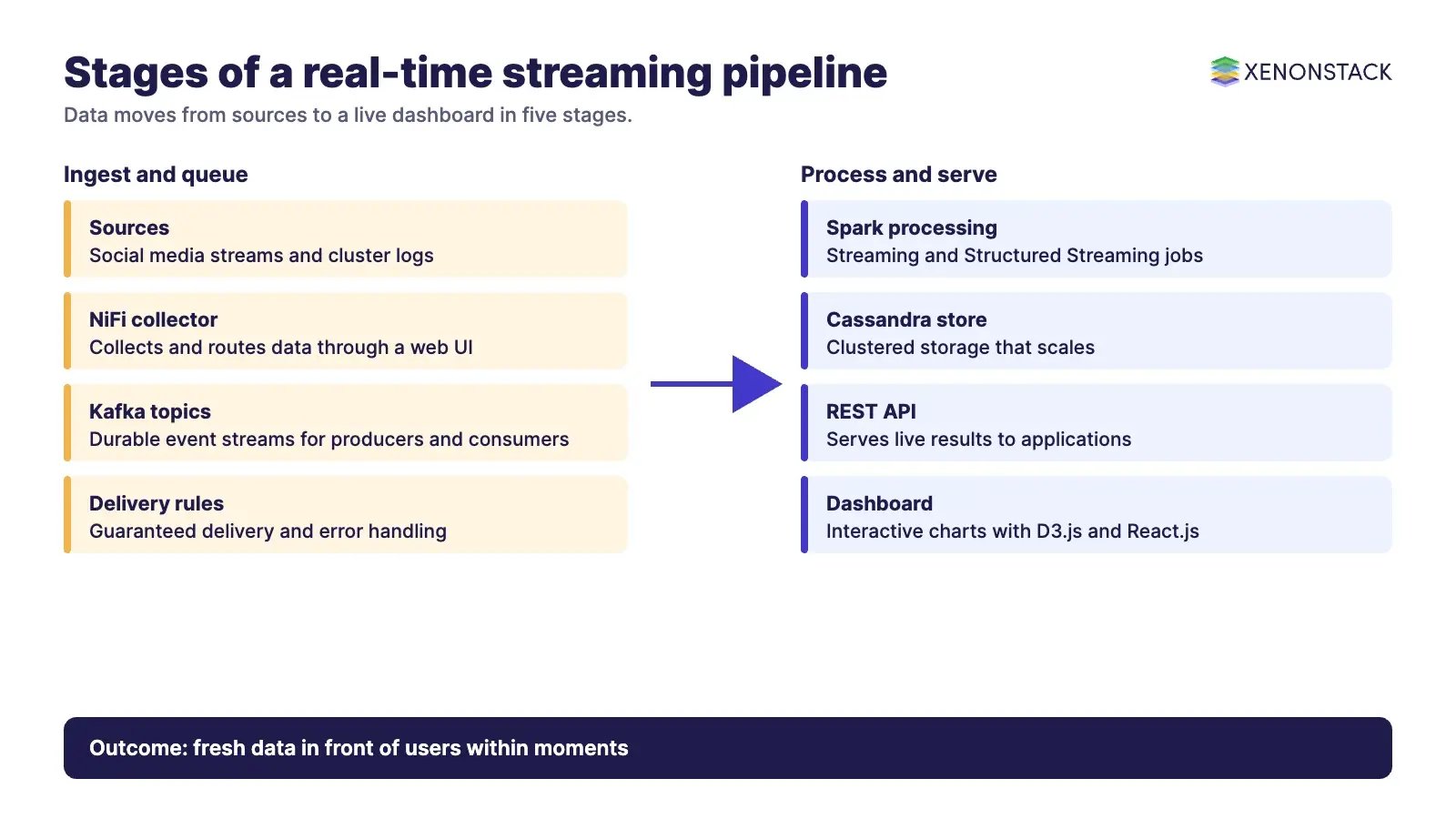
A real-time streaming data pipeline collects events from many sources, moves them through a message queue, processes them as they arrive and stores the results so dashboards and applications can use them within moments. A common open-source stack uses Apache NiFi, Apache Kafka, Apache Spark and Apache Cassandra.
This page is for data engineers and architects building a streaming analytics platform. It covers the problem, the architecture, how the stages work, where AI agents fit and what to check before you build.
What problem does a real-time streaming pipeline solve?
Batch jobs deliver answers hours after events happen. A streaming pipeline closes that gap, but it must also handle memory management, scalability and concurrency, and it must guarantee that data is delivered from the source to the processing engine with sensible error handling. The scenario here ingests a social media stream such as the Twitter Stream API, plus Apache Hadoop cluster logs as test data, and shows live results in an interactive dashboard. The team must also benchmark the pipeline against message size and duration.
How does the pipeline work?
Each stage has one job.
| Stage | Tool | Role |
|---|---|---|
| Collect and automate | Apache NiFi | Collects and produces data for ingestion and automates the workflow through a web interface |
| Message queue | Apache Kafka | Captures event streams and stores them durably so they can be processed as they occur or later |
| Stream processing | Spark Streaming and Structured Streaming | Processes the stream in near real time |
| Storage | Apache Cassandra | Stores results for scale and reliable delivery |
| Serving | REST API and dashboard | Exposes live results, for example in D3.js charts and React.js |
Apache NiFi offers a browser-based interface for designing, controlling and monitoring data flows, with data provenance that records the lineage of information from start to finish. Apache Kafka is an event streaming platform that writes and reads event streams, stores them durably and lets you process them as they occur or afterwards. Spark Structured Streaming treats a live stream as a table that keeps growing, so you write a streaming query as you would a batch query, and Spark documents end-to-end exactly-once semantics when sources are replayable and sinks are idempotent.
How do you build and deploy it?
- Define the sources and the events that matter, and set delivery and error-handling rules.
- Build the NiFi flow that collects the data and hands it to Kafka.
- Create Kafka topics and size them for the expected message volume.
- Write the Spark streaming jobs that transform and aggregate events.
- Deploy Cassandra as a cluster, as microservices on Kubernetes or on EC2 instances, to scale and protect delivery of data across the pipeline.
- Expose the results through a REST API and build the dashboard.
- Benchmark with realistic message sizes and durations, then tune.
Where do AI agents fit in a streaming pipeline?
Agents sit around the pipeline and watch it. An agent can read consumer lag, failed deliveries and processing delays, find the stage that is falling behind, and open an incident with the evidence for an engineer. Agents can also check schemas, flag unusual input and draft runbook steps. For data, analytics and governance work, see ElixirData, XenonStack's Context OS. Each agent action should record the data and policy behind it so a person can review it.
How does streaming compare with batch processing?
| Factor | Batch pipeline | Real-time streaming pipeline |
|---|---|---|
| Freshness of results | After each scheduled run | Within moments of the event |
| Typical tools | Scheduled jobs and a warehouse | NiFi, Kafka, Spark Streaming |
| Failure handling | Rerun the job | Replay from stored offsets and checkpoints |
| Operational effort | Lower | Higher, needs monitoring around the clock |
| Best for | Periodic reporting | Live dashboards and fast reaction |
What should you check before adopting it?
- Confirm that you need results in moments rather than hours.
- Decide the delivery guarantee you need and test it by forcing failures.
- Plan memory use and concurrency for peak message rates.
- Choose how long Kafka keeps events and how Cassandra data is replicated.
- Name an owner for monitoring and for approving agent actions.
To map one decision your agents make on streaming data, and the data and policy it depends on, book a Context Workshop. See what happens in the workshop.
Frequently asked questions
What is a real-time streaming data pipeline?
It is a set of components that collect events, queue them, process them as they arrive and store the results so applications can use fresh data.
What does Apache NiFi do in a pipeline?
NiFi collects data from sources and routes it to the next stage, with a web interface to design and monitor flows and data provenance that records lineage.
Why use Kafka between NiFi and Spark?
Kafka stores event streams durably and decouples producers from consumers, so Spark can process events as they occur or later.
What is Spark Structured Streaming?
It is Spark's stream processing engine that treats a live stream as a continuously growing table, so you write streaming queries like batch queries.
How can AI agents help run a streaming pipeline?
Agents can watch lag, failures and delays, locate the slow stage and raise an incident with evidence for an engineer to act on.
Ready to put AI agents to work? See an ElixirClaw demo: the agentic OS to build, orchestrate and govern AI agents across your enterprise systems.
Explore the XenonStack platform family: ElixirData · ElixirClaw · ElixirHub · NexaStack · MetaSecure · Neural AI · AgentGRC · AgentSRE · AgentAnalyst · AgentInstruct · AgentRAI · AgentScrum · AgentSearch · AgentForce · AI Aviator · SAIF Aviator · CohortIQ · XenonStack AI · XenonStack UAE