Key takeaway
- Continuous delivery for Drupal on AWS automates build, test and release. See the approval-gated flow, how it compares with manual deploys, and checks.
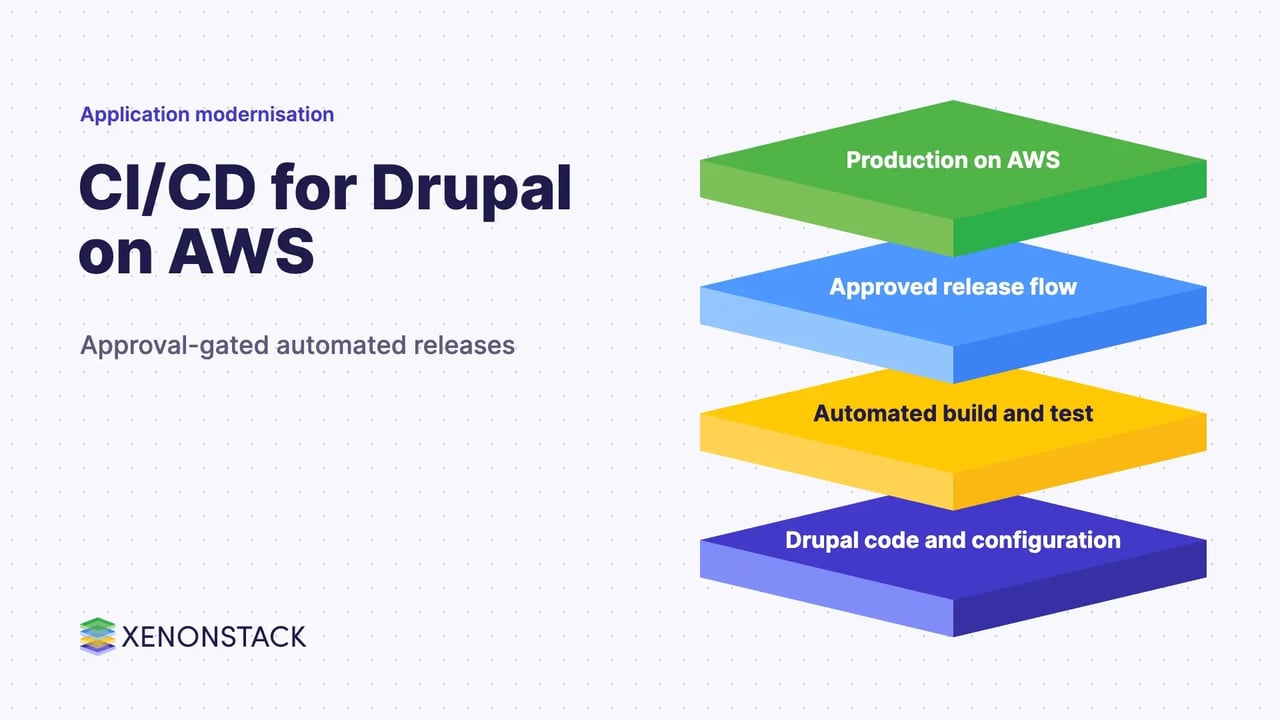
Continuous delivery for Drupal on AWS is a practice where every code change to a Drupal site is automatically built, tested and prepared for release to production, with a controlled approval step before it goes live. It replaces manual, server-by-server updates with a repeatable release process.
This page is for teams that run Drupal for enterprise or government web content and are moving from traditional physical servers to AWS. It covers the problem, a release flow, how it compares with manual deployment, where AI agents fit and what to check first.
What is continuous delivery for Drupal?
Drupal describes itself on drupal.org as "content management software". Enterprises and governments use it for web content because it is flexible, scalable and supports advanced configuration management.
The AWS continuous delivery overview defines continuous delivery as "a software development practice where code changes are automatically prepared for a release to production". It expands on continuous integration by deploying all code changes to a testing or production environment after the build stage.
What problem does it solve?
- The software release process stays manual, so each release depends on the person doing it.
- Teams moving Drupal from traditional physical servers to the cloud need a release path that fits cloud infrastructure and ends in an automated deployment to AWS production.
How does the release flow work?
A production release follows these steps:
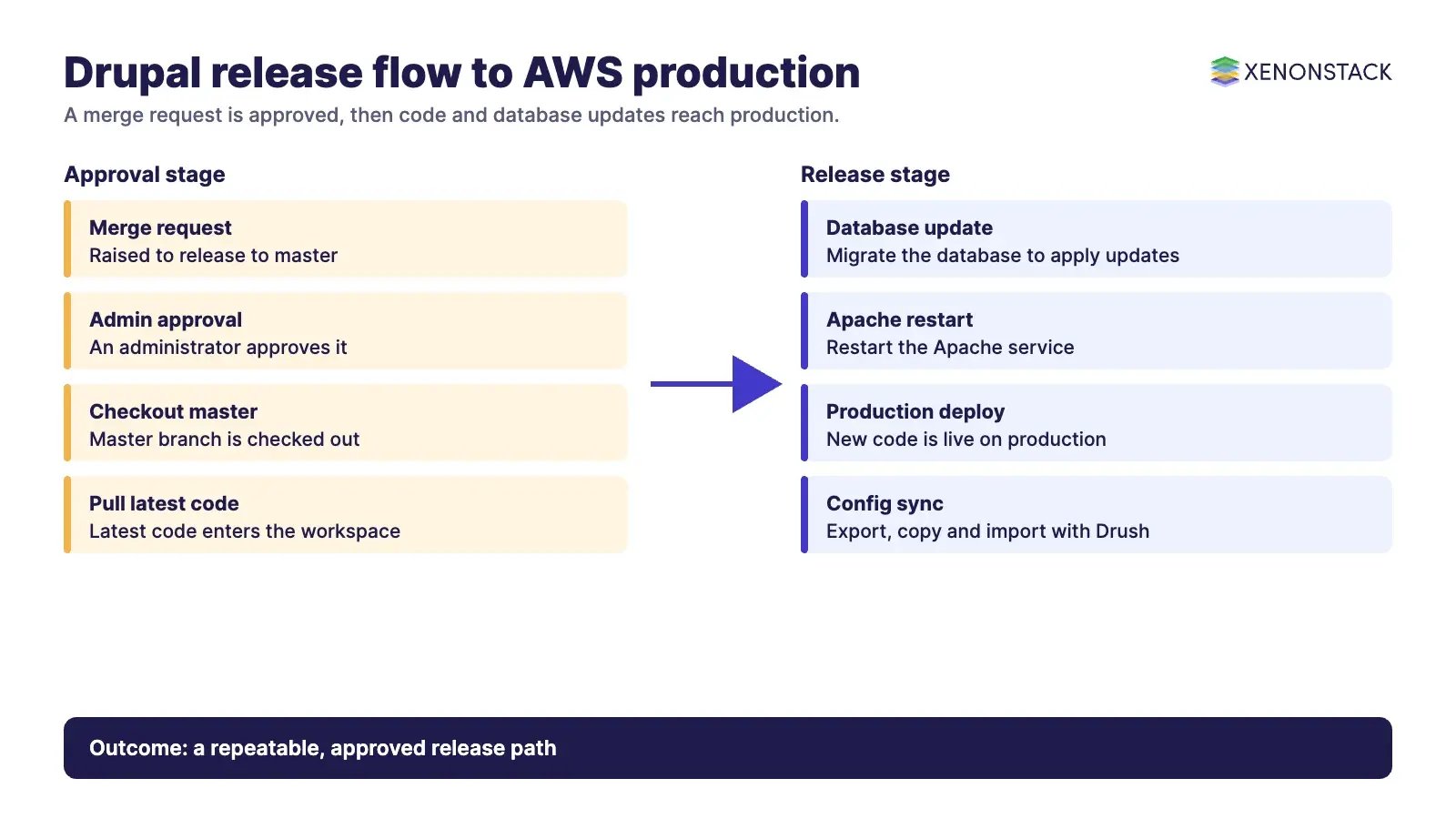
- A merge request is raised to release changes to the master branch.
- An administrator approves the merge request.
- The master branch is checked out.
- The latest code is pulled into the workspace.
- The database is migrated to apply updates.
- The Apache service is restarted.
- The new code is live on the production environment.
Configuration moves between environments in a similar controlled way. The Drupal.org guide to the Drush configuration workflow exports configuration from development to a sync directory, copies that folder to the live site with a tool such as rsync, Git, FTP or SCP, and then imports it. Drush shows the available changes and asks for confirmation before importing.
How does automated delivery compare with manual deployment?
The AWS overview lists the benefits of automating the release path: less manual work for developers, earlier bug detection through frequent testing, and a build that is always ready to deploy because it has passed a standard test process.
| Question | Manual deployment | Automated continuous delivery |
|---|---|---|
| Who runs the steps | A person, on each server | A pipeline, from the same definition each time |
| Approval | Informal | Merge request and administrator approval before release |
| Testing | Run when someone remembers | Run on every change after the build stage |
| Repeatability | Varies by person and server | Same steps for each release |
| Source | General practice | aws.amazon.com/devops/continuous-delivery |
The AWS overview also distinguishes continuous delivery from continuous deployment. Delivery includes a manual approval before production, while deployment sends changes to production automatically with no explicit approval. Choose based on how much risk your site can accept.
Where do AI agents fit in a Drupal release pipeline?
An agent can summarise a merge request, check that the change has tests, read the build and test output and flag a release that looks risky, leaving the approval to an administrator. After release it can watch logs for errors and open a ticket when something fails. The pipeline stays the control point, and the agent supports the people who operate it.
ElixirClaw is XenonStack's AI agents computing platform, the place to look for running agents like these.
What should you check before adopting it?
- Choose where configuration lives and how it moves between environments.
- Decide who approves a release and what evidence they see.
- Plan database updates so they can be applied safely and rolled back.
- Agree what happens if a step fails midway, including the restart of the web service.
- Keep test environments close to production so tests mean something.
To map one decision your agents make, and the data and policy it depends on, book a Context Workshop. See what happens in the workshop.
Frequently asked questions
What is continuous delivery?
It is a software development practice where code changes are automatically prepared for a release to production, according to AWS.
What is the difference between continuous delivery and continuous deployment?
Continuous delivery includes a manual approval before production. Continuous deployment releases to production automatically with no explicit approval.
How does Drupal configuration move between environments?
With Drush you export configuration to a sync directory, copy it to the live site with a tool such as rsync, Git, FTP or SCP, and import it after reviewing the changes.
Why move Drupal to AWS?
Teams use cloud infrastructure instead of traditional physical servers so that releases can be automated and the platform can scale with demand.
How can AI agents help with Drupal releases?
They can summarise changes, check test results and watch logs after release, while an administrator keeps approval of the release.
Ready to put AI agents to work? See an ElixirClaw demo: the agentic OS to build, orchestrate and govern AI agents across your enterprise systems.
Explore the XenonStack platform family: ElixirData · ElixirClaw · ElixirHub · NexaStack · MetaSecure · Neural AI · AgentGRC · AgentSRE · AgentAnalyst · AgentInstruct · AgentRAI · AgentScrum · AgentSearch · AgentForce · AI Aviator · SAIF Aviator · CohortIQ · XenonStack AI · XenonStack UAE