What are your key focus areas? *
AI Workflow and Operations
Data Management and Operations
AI Governance
Analytics and Insights
Observability
Security Operations
Risk and Compliance
Procurement and Supply Chain
Private Cloud AI
Vision AI


Download as PDF

Share


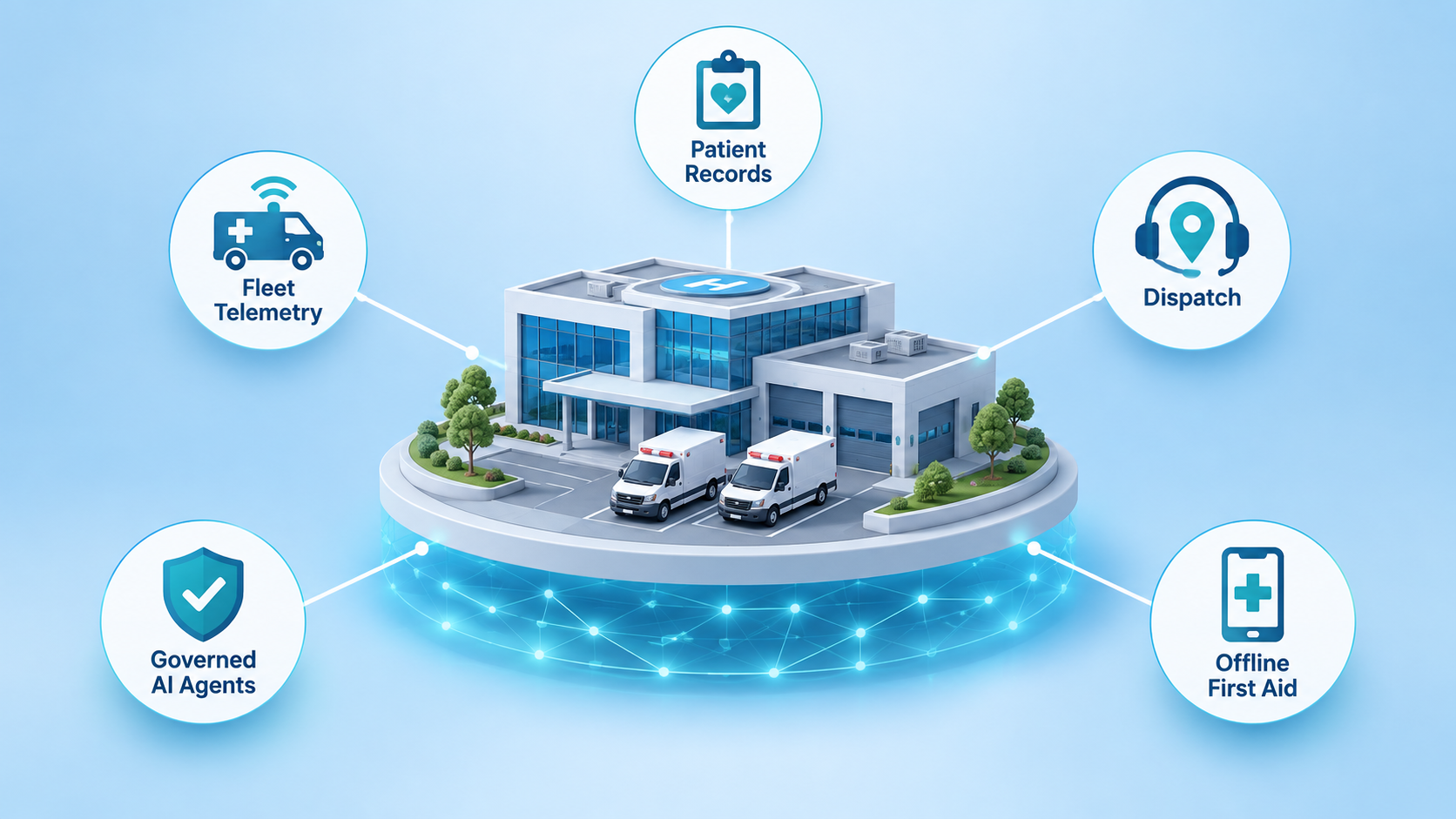
An emergency medical service makes time-critical decisions every minute, with data spread across fleet telemetry, electronic patient care records and the systems that dispatch and track crews. AI agents can only help if they work from one trusted view of what is happening, with clear limits on what each agent may see and do. This case study shows how XenonStack is building that foundation for a government emergency medical service in the UAE: a governed context layer with ElixirData, agents with layered governance on ElixirClaw, and offline first-aid guidance for citizens in Arabic and English.
Explore the XenonStack platform family: ElixirData · ElixirClaw · ElixirHub · NexaStack · MetaSecure · Neural AI · AgentGRC · AgentSRE · AgentAnalyst · AgentInstruct · AgentRAI · AgentScrum · AgentSearch · AgentForce · AI Aviator · SAIF Aviator · CohortIQ · XenonStack AI · XenonStack UAE

Tell us about you and your priorities so we can prepare the right conversation. It takes about 2 minutes.
AI continuously monitors systems for risks before they escalate. It correlates signals across logs, metrics, and traces. This ensures faster detection, fewer incidents, and stronger reliability
 Proactive detection of performance and availability issues
 Root-cause analysis across microservices and environments
 Automated remediation playbooks to reduce MTTR

AI converts camera feeds into instant situational awareness. It detects unusual motion and unsafe behavior in real time. Long hours of video become searchable and summarized instantly
 Real-time detection of suspicious motion or intrusion
 Natural language video search and instant playback
 Smart summaries for audits, investigations, and compliance

Your data stack becomes intelligent and conversational. Agents surface insights, detect anomalies, and explain trends. Move from dashboards to autonomous, always-on analytics
 Connects to warehouses, lakes, and streaming sources
 Question-answering in natural language
 Continuous monitoring for anomalies and KPI deviations

Agents identify recurring failures and performance issues. They trigger workflows that resolve common problems automatically. Your infrastructure evolves into a self-healing environment
 Automated diagnostics for recurring errors
 Playbook execution: restart services, scale pods, clear queues
 Feedback loop for improving remediation strategies

AI continuously checks controls and compliance posture. It detects misconfigurations and risks before they escalate. Evidence collection becomes automatic and audit-ready
 Continuous control checks across infrastructure and SaaS
 Automated evidence collection for audits
 Risk scoring and prioritized remediation recommendations

Financial and procurement workflows become proactive and insight-driven. Agents monitor spend, vendors, and contracts in real time. Approvals and sourcing decisions become faster and smarter
 Real-time visibility into spend and commitments
 Anomaly detection on invoices and vendor performance
 Intelligent workflows for approvals and sourcing decisions


