Key takeaway
- Sustainable marketing with agentic AI: where agents help, which green claims rules apply in the EU, UK and US, and the controls to set before launch.
Sustainable marketing with agentic AI means software agents that plan, run and adjust campaigns while keeping each environmental claim, data use and spend decision inside rules a person has approved. The value is less wasted spend and fewer repeated assets. The risk is that an agent can publish a green claim faster than anyone can check it, and from 27 September 2026 the EU rules on such claims apply.
This guide is for CMOs, CTOs and heads of digital and sustainability who need to know where agents help, what the claims rules require and which controls to set first. For agents that run personalised campaigns in general, see agentic marketing for personalised campaigns; for the email channel, see agentic AI for email marketing. This post covers the sustainability angle only.
What is agentic AI in sustainable marketing?
Agentic AI is autonomous AI that pursues a goal across several steps: it reads data, chooses an action, uses tools and checks the result. In marketing it can draft content, test variants, shift budget between channels and report on results. In sustainable marketing the goal also includes limits: do not repeat assets that already work, do not spend on placements that do not perform, and do not state an environmental benefit that the company cannot evidence.
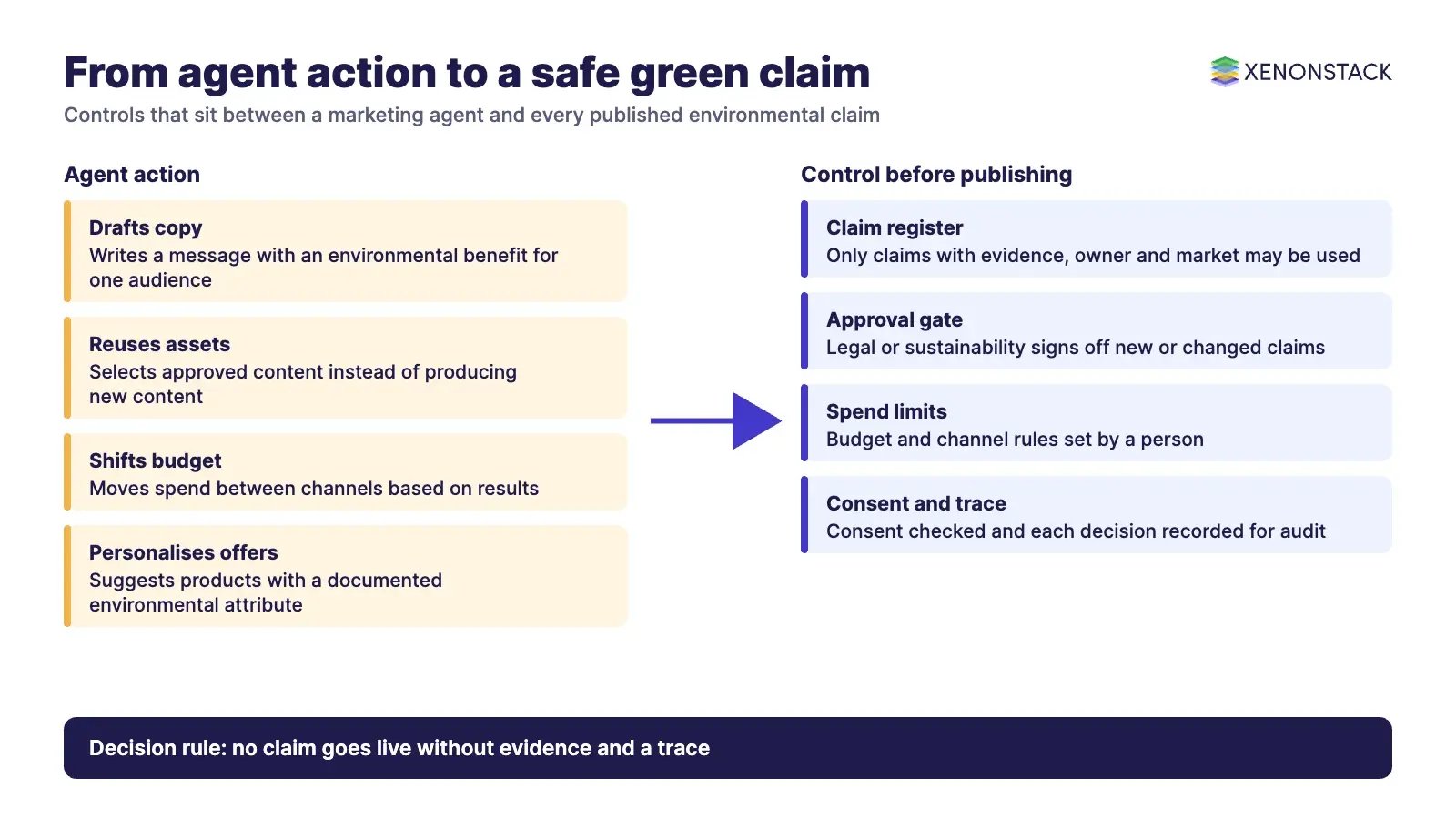
That last limit matters most. A claim such as "sustainable" or "carbon neutral" is a legal statement, not a style choice, so the agent needs a list of approved claims and the evidence behind each one.
Where does agentic AI fit in a sustainable marketing programme?
| Use case | What the agent does | What a person decides | When it fits |
|---|---|---|---|
| Content reuse and personalisation | Selects and adapts existing approved assets for each audience instead of producing new ones each time | Which claims and tone are approved | Large content libraries and many segments |
| Media planning | Tests variants and moves budget away from placements that do not perform | Budget limits and channel rules | Several paid channels with enough data to learn from |
| Supply chain storytelling | Pulls supplier and product evidence into draft copy and flags claims with no evidence | Whether the evidence is good enough to publish | Products with traceable sourcing data |
| Loyalty and engagement | Suggests offers that favour products with a documented environmental attribute | Which attribute counts and how it is described | Programmes with purchase history and consent |
| Claims monitoring | Checks live pages, ads and posts against the approved claim register and raises differences | Whether to correct, withdraw or document | Any company that makes environmental claims in more than one market |
Any figure for emissions saved depends on your own data and method. Treat vendor claims of savings as unproven until you have measured them against a baseline.
What do green claims rules require before an agent publishes?
Three regimes cover most enterprise marketing. All of them judge the claim as published, whoever or whatever wrote it.
| Regime | What it says | Status |
|---|---|---|
| EU Directive (EU) 2024/825 (EmpCo) | Bans generic environmental claims such as "green", "environmentally friendly" or "sustainable" without recognised excellent environmental performance, product-level climate-neutral claims that rely on offsetting, and sustainability labels not based on a public authority or an approved certification scheme. Future environmental performance claims need a verified, time-bound plan. | Rules apply across the EU from 27 September 2026; member states had to transpose by 27 March 2026, and implementation is uneven (Freshfields, read 12 Nov 2026) |
| UK Green Claims Code (CMA) | Guidance to help businesses meet consumer protection law when making environmental claims. It is not legal advice. | Published by the CMA on 20 September 2021 |
| US FTC Green Guides | Help marketers avoid misleading environmental claims, with guidance added on carbon offsets in 2012. | Revised in 1996, 1998 and 2012; the FTC has a review under way |
Sources: Freshfields on EmpCo, GOV.UK Green Claims Code, FTC Green Guides. Check the legal text with counsel for each market you sell in.
What governance controls should the agents have?
- Approved claim register. The agent may only use claims that are in the register, each with its evidence, owner and market. Anything else goes to a person.
- Approval gates. New claims, new labels and any use of "net zero", "carbon neutral" or similar terms need sign-off from legal or sustainability before publication.
- Decision trace. Keep a record of which data, rule and prompt led to each published claim, so that a regulator or auditor can see why it appeared. ElixirData Context OS keeps governed context, versioned policy and decision traces in one decision layer above AI agents.
- Policy enforcement. AgentGRC keeps autonomous agent actions inside policy, with the audit trail risk teams need.
- Data and consent limits. Personalisation must respect consent and purpose limits in each market, including the GDPR rules on objecting to direct marketing and on solely automated decisions.
- Stop switch. One owner can pause an agent or withdraw a claim across channels.
To build and govern the agents themselves, ElixirClaw is an agentic OS platform to build, orchestrate and govern AI agents and automation workflows while keeping humans in control. For the marketing solution view, see XenonStack Agentic AI for Marketing.
What does it cost to run the agents, and how do you measure it?
Agents use compute, and a sustainability story that ignores that is weak. Record the model calls, the volume of assets generated and the channels used per campaign, and compare them with the number of assets and sends the agent avoided. Use one method across campaigns so that results can be compared. Where a media platform or publisher provides emissions data, include it in the agent's inputs; where it does not, say so rather than estimate. No industry-wide saving figure is quoted here because none was verified for this post.
When should you not use agents for sustainable marketing?
- Claims that need legal judgement, such as first use of a new label or a future target.
- Markets where you have no claim evidence or consent record yet.
- Small programmes where a person can review every asset faster than you can set up the controls.
- Any case where the data on products or suppliers is incomplete. The agent will fill the gap with plausible text.
How should enterprises adopt it?
| Step | What to do | Exit check |
|---|---|---|
| 1. Audit claims | List every environmental claim in use, with evidence and market | Each claim has an owner and a source |
| 2. Build the register | Turn approved claims into a register the agent reads | Agent cannot publish outside it in a test |
| 3. Pilot one channel | Run the agent on one channel with human approval on every asset | No unapproved claim reached an audience |
| 4. Add monitoring | Check live pages and ads against the register | Differences are raised within your agreed time |
| 5. Widen autonomy | Let low-risk actions run without approval; keep claim changes gated | Decision trace is complete for all actions |
What will change next?
Two things are known. The EU rules on green claims apply from 27 September 2026, so campaigns aimed at EU consumers need evidence-backed wording now. The FTC has a review of its Green Guides under way, so US guidance may change. Plan for stricter evidence requirements rather than looser ones.
To map one claim or campaign decision your agents should make, and the context and policy it depends on, book a Context Workshop. See what happens in the workshop.
Frequently asked questions
What is agentic AI in sustainable marketing?
It is autonomous AI that plans, runs and adjusts marketing campaigns within approved rules, including limits on what environmental claims it may make and what evidence each claim needs.
Can an AI agent write green claims on its own?
Only from an approved claim register. Generic terms such as "green" or "sustainable" are restricted under the EU rules that apply from 27 September 2026, so new or changed claims should go to a person for approval.
Which rules cover environmental marketing claims?
In the EU, Directive (EU) 2024/825 applies from 27 September 2026. In the UK, the CMA published its Green Claims Code on 20 September 2021. In the US, the FTC Green Guides were last revised in 2012 and are under review.
How is this different from agentic marketing for campaigns?
Campaign agents optimise reach and conversion. Sustainable marketing adds claim evidence, approval gates and a record of why each claim was published.
What should we set up first?
A register of approved environmental claims with evidence, owner and market, and an approval gate on any change to it.
Explore the XenonStack platform family: ElixirData · ElixirClaw · ElixirHub · NexaStack · MetaSecure · Neural AI · AgentGRC · AgentSRE · AgentAnalyst · AgentInstruct · AgentRAI · AgentScrum · AgentSearch · AgentForce · AI Aviator · SAIF Aviator · CohortIQ · XenonStack AI · XenonStack UAE