
Key takeaway
- Agentic AI for email marketing for enterprise leaders: which decisions agents can own, Gmail and Yahoo sender rules, consent law and how to govern sending.
Agentic AI for email marketing means software agents that decide who to email, what to say, when to send and when to stop, within limits that your team sets. The difference from conventional automation is the decision: a rule-based workflow follows a fixed path, while an agent chooses between actions using live engagement data and can be checked against policy before anything is sent. For an enterprise, the value is fewer manual test cycles and tighter targeting. The risk is that an agent that can send can also send the wrong thing at scale, so the controls matter as much as the model.
This guide is for marketing, data and platform leaders who need to decide which email decisions to hand to agents, what the sender rules from Gmail and Yahoo and the consent rules in the US and UK require, and how to keep an audit trail. For the wider picture, see our guide to agentic AI in marketing; this post stays on the email channel.
What is agentic AI for email marketing, and how does it differ from automation?
Marketing automation runs rules you wrote: if a subscriber clicks, send step two after three days. An agentic system holds a goal, such as a renewal or a webinar registration, observes behaviour, picks the next action from a defined set, and records why. Tools, data access and approval points are set by your team. Our guide to the agentic AI infrastructure stack covers the layers underneath, and the agentic AI for marketing page sets out the wider use cases.
| Aspect | Rule-based automation | Agentic email marketing |
|---|---|---|
| Who decides the next step | A fixed workflow written in advance | An agent choosing from allowed actions, with reasons logged |
| Segmentation | Static lists and rules | Segments that change with behaviour |
| Testing | Manual A/B cycles | Continuous variant testing inside set limits |
| Control point | Workflow approval | Policy checks before send, plus human approval for new audiences or claims |
| Main risk | Stale rules | Wrong action taken at scale without review |
Which email decisions can agents own, and which need a person?
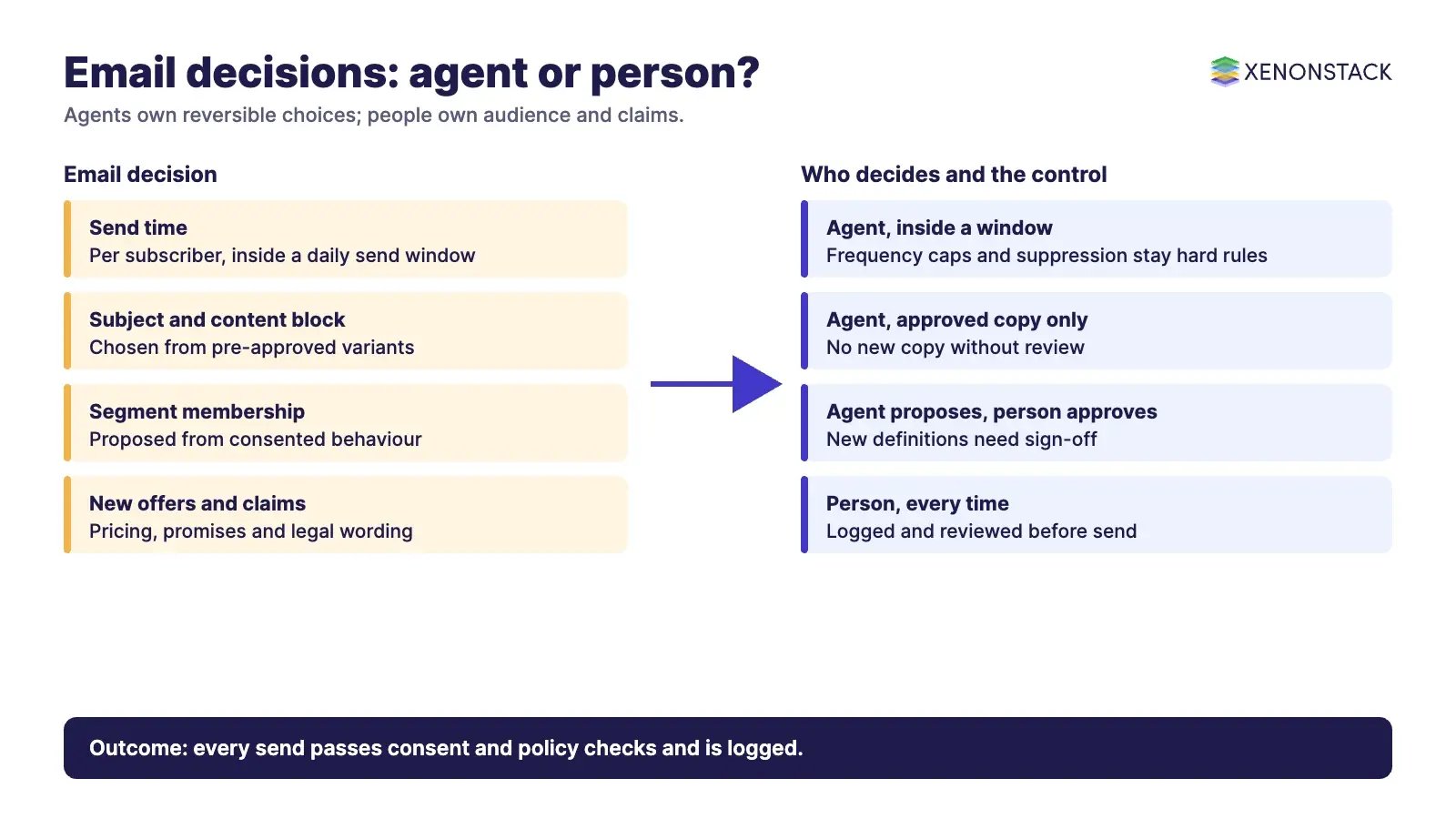
Start with decisions that are reversible and low in risk, and keep a person on anything that changes who is contacted or what is promised.
| Decision | When it fits | Suggested control |
|---|---|---|
| Send time per subscriber | Large lists with enough history per person | Agent decides inside a daily send window |
| Subject line and content block choice | Pre-approved variants exist | Agent picks only from approved copy |
| Segment membership | Behavioural signals are reliable and consented | Agent proposes, person approves new segment definitions |
| Suppression and frequency caps | Always | Hard rule the agent cannot override |
| New offers, pricing or claims | Rarely | Human approval every time |
| Writing new copy | Brand and legal guidance are encoded | Human review before first send of any new template |
How does the agent loop work in an email programme?
- Observe: read consented behaviour from your CRM, product and email platform, such as clicks, purchases and inactivity.
- Decide: choose the next action from the allowed set: send, wait, switch channel, suppress or escalate to a person.
- Check: test the action against policy, such as consent status, frequency cap and approved content.
- Act: send through your existing email service provider, so deliverability settings stay in one place.
- Record and learn: log the input, the decision and the policy result, then feed results back into the next decision.
The check and record steps are where governance sits. ElixirClaw is an agentic OS platform to build, orchestrate and govern AI agents and automation workflows while keeping humans in control, which is the layer that would run this loop.
What has changed for email senders at Gmail and Yahoo?
Mailbox providers now set minimum technical standards for bulk senders. An agent that raises send volume or complaint rates can put a whole domain at risk, so these limits should be written into the agent's policy as hard rules. Figures below are from each provider's own page, read on 12 November 2026.
| Requirement | Google (Gmail) | Yahoo |
|---|---|---|
| Who it applies to | Senders of more than 5,000 messages a day to Gmail accounts | Bulk senders; some rules apply to all senders |
| Authentication | SPF, DKIM and DMARC | SPF and DKIM, plus a DMARC policy of at least p=none that passes |
| Unsubscribe | One-click unsubscribe and a clear link in the body | One-click unsubscribe via List-Unsubscribe header, requests honoured within 2 days |
| Spam complaints | Keep below 0.30% in Postmaster Tools; Google recommends below 0.10% | Keep below 0.3% |
Sources: Google email sender guidelines and Yahoo sender best practices. Both providers say requirements may change, so check the pages before you set thresholds.
How do you govern agents that send email on your behalf?
Consent and law
In the US, the FTC's CAN-SPAM guide says opt-out requests must be honoured within 10 business days, that each violating email can carry a penalty of up to $53,088, and that both the company whose product is promoted and the company that sends the message can be liable. Using an AI agent or a vendor does not move that responsibility. In the UK, the ICO's PECR guidance says marketing email to individuals generally needs specific consent, with a soft opt-in for existing customers of similar products, and every message needs a working opt-out. Your agent should read consent status from a single source of truth and treat it as a block, not a suggestion. Seek legal advice for your own jurisdictions.
Controls to build in
- Consent and suppression checks that run before every send and cannot be overridden by the agent.
- Approved content libraries, with human review for new offers and claims.
- Frequency caps per person and per domain-level complaint thresholds that pause sending automatically.
- A decision log recording the input, the action and the policy result, so a reviewer can explain any message.
- A kill switch and named owner for each agent.
AgentGRC keeps autonomous agent actions inside policy, with the audit trail risk teams need.
Where does agentic email marketing fit by use case?
| Use case | What the agent decides | Human checkpoint |
|---|---|---|
| B2B lead nurture | Which case study, demo or webinar follows a lead's behaviour | Approved content set and CRM stage rules |
| Customer retention | When inactivity triggers a re-engagement flow | Offer approval for any discount |
| Abandoned cart and upsell | Timing and channel of the reminder | Frequency cap and suppression rules |
| Event and webinar promotion | Who is invited and which follow-up they receive | Invitation audience approved in advance |
| Seasonal campaigns | Which regional variant each subscriber sees | Variants approved before the season starts |
For personalisation patterns in a retail setting, see AI-driven personalisation in retail.
How should you sequence adoption?
- Fix the foundations: authentication, consent records, suppression lists and a single customer profile.
- Start with send-time and variant selection: low risk, easy to measure against a control group.
- Add segment proposals: the agent suggests, a person approves.
- Add lifecycle journeys: retention and nurture, with frequency caps and complaint thresholds.
- Widen autonomy only on evidence: move a decision to the agent after its logs and results show it stays within policy.
How do you measure whether it works?
Compare agent-managed audiences with a holdout group that follows your current programme. Track clicks, conversions, revenue per subscriber and customer lifetime value, alongside unsubscribe and spam complaint rates, because a gain in clicks that raises complaints can cost you inbox placement. Also track operational measures such as hours spent on testing and list work, and how often a person overrode the agent. AgentAnalyst lets teams ask questions of enterprise data in plain language and get real-time insights, which suits this kind of campaign review.
When should you not hand email decisions to an agent?
- Consent records are incomplete or held in several systems.
- The programme sends too little for an agent to learn anything useful.
- Messages involve regulated claims, pricing or legal notices that need review every time.
- Nobody owns the agent's decision log.
- Your domain already sits near a provider's complaint threshold; fix list quality first.
To map one email decision your agents should make, and the context and policy it depends on, book a Context Workshop. See what happens in the workshop.
Frequently asked questions
What is agentic AI for email marketing?
It is the use of AI agents that choose send time, content variant, segment and next action for each subscriber within limits set by the business, rather than following a fixed workflow.
How is it different from marketing automation?
Automation executes rules written in advance. An agent selects from allowed actions using live behaviour, and its decisions can be checked against policy and logged.
What do Gmail and Yahoo require from bulk senders?
Both require authentication (SPF and DKIM, with DMARC), one-click unsubscribe and spam complaint rates below 0.3%. Google applies its rules to senders of more than 5,000 messages a day to Gmail accounts, and Yahoo asks for unsubscribes to be honoured within 2 days.
Who is responsible if an AI agent sends a non-compliant email?
Under the FTC's CAN-SPAM guidance, the company whose product is promoted and the company that sends the message can both be liable, so using an agent or a vendor does not remove your responsibility.
Where should a team start?
With send-time and approved-variant selection, measured against a holdout group, once authentication and consent records are in order.
Ready to put AI agents to work? Explore ElixirClaw, the agentic OS platform to build, orchestrate and govern AI agents.
Explore the XenonStack platform family: ElixirData · ElixirClaw · ElixirHub · NexaStack · MetaSecure · Neural AI · AgentGRC · AgentSRE · AgentAnalyst · AgentInstruct · AgentScrum · AgentSearch · AgentForce · AI Aviator · SAIF Aviator · CohortIQ · XenonStack AI · XenonStack UAE
Follow XenonStack on LinkedIn: XenonStack on LinkedIn for new guides on agentic AI, data and platform engineering.


