Key takeaway
- See how agentic AI differs from scripted bots, the main contact centre use cases grouped by area, and the controls and first steps that keep agents safe.
Agentic AI in a contact centre means AI agents that work towards a customer goal, deciding each step, using enterprise knowledge and systems, and handing over to a person when needed, instead of following a fixed script. The use cases range from answering email and voice calls to summarising conversations, checking quality and routing work.
This guide is for contact centre leaders, customer experience owners and operations teams choosing where to start. It explains how agentic AI differs from scripted bots, lists the main use cases by area, shows how to govern them and gives a short first-steps list. For the wider background, see Contact Center Intelligence: A Beginner's Guide.
How is agentic AI different from a scripted chatbot?
A rule-based bot follows predefined conversation paths, so designers must anticipate every step and every digression. Cognigy's product update on agentic AI, which is vendor material, contrasts this with agents that interpret each input using large language models, break a complex task into steps and work towards a goal. It also notes that language models alone lack enterprise context, governance and business rules, so those must be added around them.
| Aspect | Scripted or rule-based bot | Agentic AI agent |
|---|---|---|
| How it decides | Follows predefined paths | Chooses the next step from the goal and the conversation |
| Handling the unexpected | Falls back or hands over when a path is missing | Reasons about the request and tries another route |
| Use of systems | Fixed integrations at set points | Calls tools and updates records as the task needs |
| Memory | Usually within one session | Can use conversation context and stored customer data, within policy |
| Best suited to | Standard, predictable processes | Variable requests, with fixed workflows kept for regulated steps |
The two are not rivals. Many teams keep deterministic flows for standard, regulated steps and use agents for the less predictable parts of a conversation.
What are the main contact centre use cases for agentic AI?
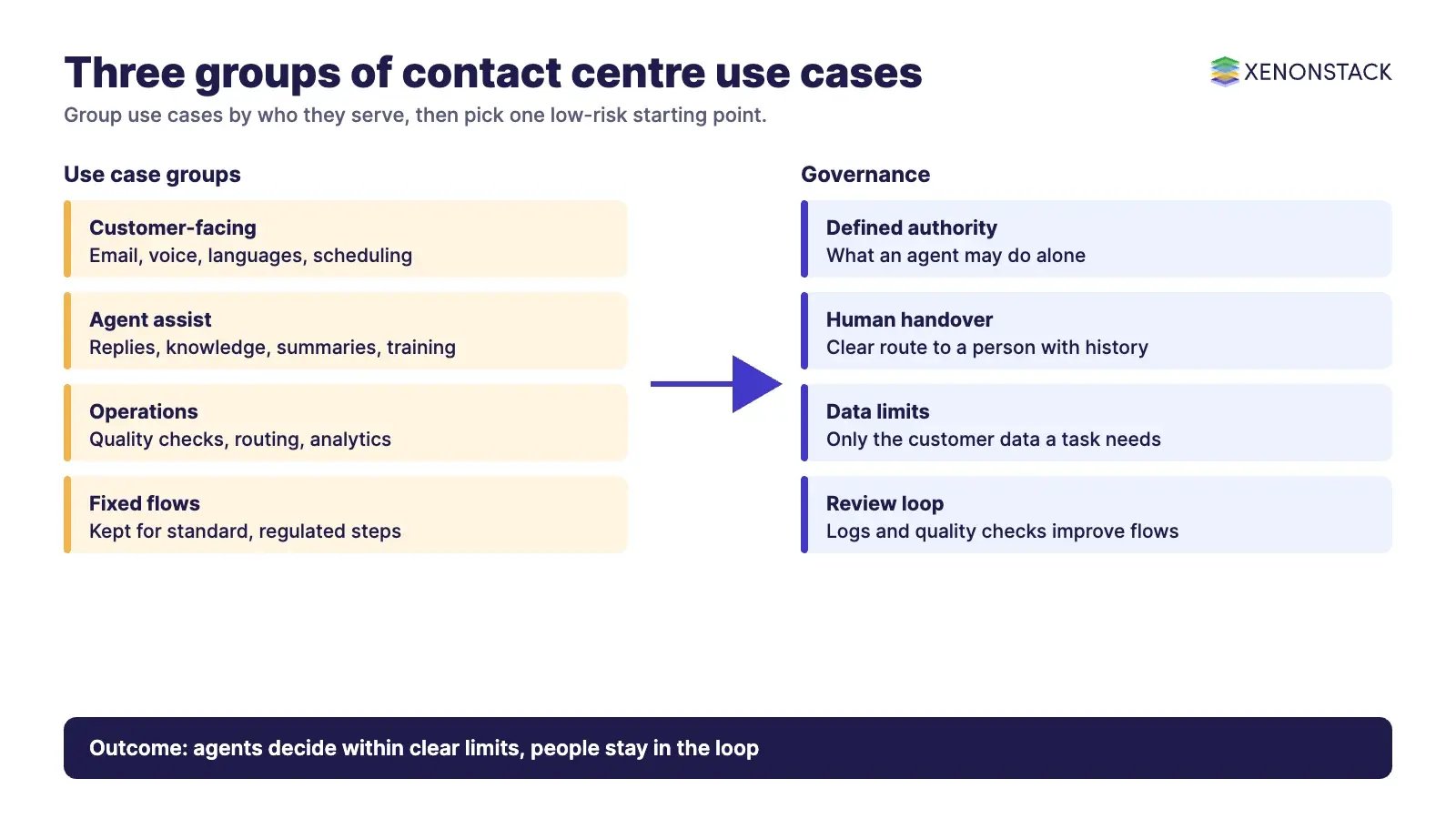
Fourteen use cases are often listed. They fall into three groups, which is a better way to choose a starting point than ranking them.
| Group | Use cases | What the agent does |
|---|---|---|
| Customer-facing | Automated email responses, voice assistants, multi-language support, appointment scheduling, customised marketing messages | Understands the request, answers or acts, and passes the case to a person when it should. Multi-language conversations widen who can be served. |
| Agent assist | Script generation for agents, knowledge base creation and maintenance, call summarisation, sentiment analysis, training simulations | Supports human agents with suggested replies, current knowledge and notes, and gives new staff practice conversations |
| Operations and quality | Quality assurance and compliance checks, call routing optimisation, predictive analytics, voice consistency | Reviews conversations against policy, sends each case to the right queue, and flags patterns for managers |
Voice cloning for consistency needs particular care. Be clear with customers when they speak to an automated voice, and check the consent and disclosure rules that apply in each market before using it.
Why does it matter for contact centres?
Contact centres combine high volumes with moments that matter to customers. Agentic AI helps in three ways: it can take on routine requests so people spend time on complex ones, it can give human agents context and suggested next steps during a conversation, and it can turn conversation data into insight for managers. The strength of each effect depends on your data, processes and design, so measure it in your own environment before claiming results.
How do AI agents change contact centre decisions?
The move is from reactive support to decision-driven operations. An agent does not only answer, it decides whether to refund, escalate, schedule or route, and each decision depends on customer data, policy and permission. That is where design effort belongs: which data the agent can see, which rules bind it and when a human must approve. XenonStack's ElixirClaw, the AI agents computing platform, is one way to build and run such AI agents and the agentic workflow around them. The intelligence-driven decision making page covers the wider decision view.
Underneath, the models draw on machine learning algorithms, deep learning techniques and generative AI, but the contact centre outcome depends more on governance and process than on any single model.
How should you govern AI agents in a contact centre?
| Control | Why it matters |
|---|---|
| Defined authority | Sets what an agent may do alone, such as answer or schedule, and what needs approval, such as refunds |
| Human handover | Gives customers a clear route to a person, with the conversation history passed on |
| Data access limits | Keeps agents to the customer data a task needs |
| Conversation logging and review | Lets quality teams audit decisions and improve prompts and flows |
| Testing before release | Checks agents on realistic conversations, including difficult and abusive ones |
What should you do first?
- Pick one high-volume, low-risk request type, such as appointment changes or order status.
- Write down the data the agent needs and the decisions it may make.
- Keep fixed flows for regulated steps and use agents for variable requests.
- Run the agent alongside human agents, review conversations weekly and adjust.
- Add the next use case only when the first one is stable.
To map one decision your contact centre agents make, and the data and policy it depends on, book a Context Workshop. See what happens in the workshop.
To discuss your contact centre, contact us or talk to a specialist.
Frequently asked questions
What is agentic AI in a contact centre?
It is AI that works towards a customer goal, choosing each step, using knowledge and systems, and handing over to a person when needed. It differs from a scripted bot, which follows predefined conversation paths.
Will agentic AI replace human agents?
The use cases here mostly support people, for example by summarising calls, suggesting replies and handling routine requests. Decisions with high impact or emotional weight should keep a human route.
Which use case should we start with?
Start with a high-volume, low-risk request type where the data is clean and the decision rules are clear. Email responses, appointment scheduling and call summarisation are common first choices.
How do we keep agents compliant?
Define what each agent may do, log conversations, keep regulated steps in fixed workflows and review quality checks regularly. Check the rules that apply to automated voice and customer data in each market.
Can agents work in several languages?
Language models can handle many languages, and multi-language support is a common use case. Test each language you offer on real conversations, because quality varies.
Follow XenonStack on LinkedIn: XenonStack on LinkedIn for new guides on agentic AI, data and platform engineering.
Ready to put AI agents to work? Explore ElixirClaw, the agentic OS platform to build, orchestrate and govern AI agents.
Explore the XenonStack platform family: ElixirData · ElixirClaw · ElixirHub · NexaStack · MetaSecure · Neural AI · AgentGRC · AgentSRE · AgentAnalyst · AgentInstruct · AgentRAI · AgentScrum · AgentSearch · AgentForce · AI Aviator · SAIF Aviator · CohortIQ · XenonStack AI · XenonStack UAE