Key takeaway
- AI ethics explained for leaders: shared principles from UNESCO, OECD, the EU and NIST, what the EU AI Act requires, and how to turn them into controls.
What is AI ethics and why does it matter to leaders?
AI ethics is the discipline of making sure AI systems are fair, safe, transparent and accountable, and that they respect human rights. For leaders it matters because AI now takes part in decisions about customers, candidates, patients and citizens, and each decision needs an owner who can explain it.
This guide covers the principles behind AI ethics, how global frameworks express them, what regulators now require, and how to turn principles into controls. For documented failures, read Ethical Issues of AI: Real Cases and Controls; for the architecture view, see Ethical AI Architecture: Challenges and Controls.
Which principles do the major AI ethics frameworks share?
Four widely used sources set out principles for trustworthy AI. All were read on their official pages on 13 November 2026.
| Source | Published or status | What it sets out |
|---|---|---|
| UNESCO Recommendation on the Ethics of AI | Adopted November 2021 by 193 member states | Four values and ten principles, including proportionality and do no harm, privacy, accountability, transparency and explainability, human oversight, and fairness and non-discrimination |
| OECD AI Principles | Adopted 2019, last updated May 2024 | Five values-based principles: inclusive growth and well-being; human rights and democratic values, including fairness and privacy; transparency and explainability; robustness, security and safety; accountability |
| EU Ethics Guidelines for Trustworthy AI | Published 8 April 2019 by the Commission’s High-Level Expert Group | Seven requirements: human agency and oversight; technical robustness and safety; privacy and data governance; transparency; diversity, non-discrimination and fairness; societal and environmental well-being; accountability |
| NIST AI Risk Management Framework | AI RMF 1.0 released 26 January 2023, voluntary; NIST says it is being revised | Four functions: Govern, Map, Measure and Manage; a Generative AI Profile (NIST AI 600-1) followed on 26 July 2024 |
The wording differs, but fairness, transparency, accountability, human oversight, privacy and safety appear in every source. For a deeper look at how standards bodies shape governance, see AI Governance: Ethical Standards Leaders Need.
How do ethical principles become questions and controls?
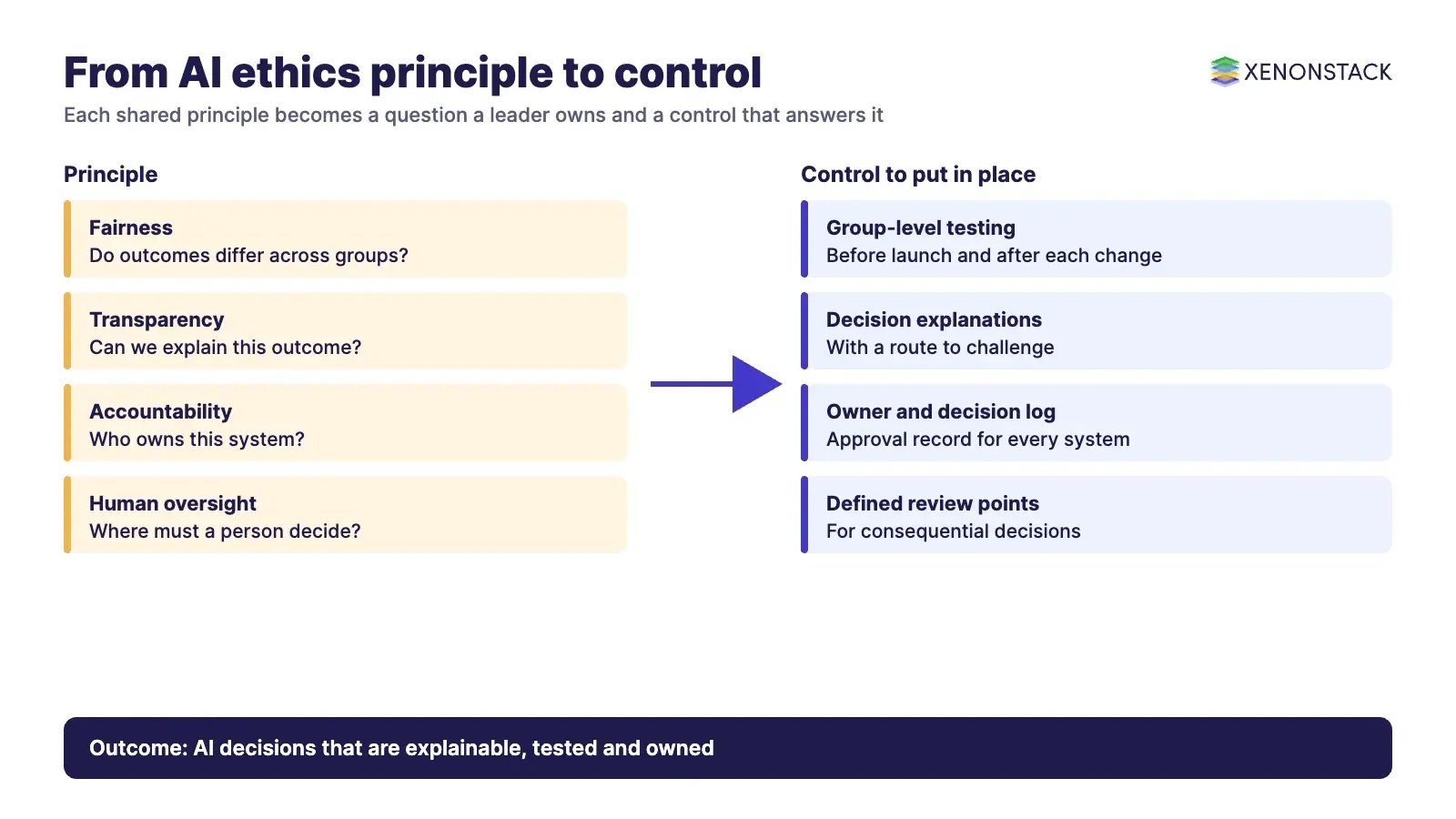
A principle only changes outcomes when someone owns a question and a control answers it. The table maps the themes above to what a leader can ask and what to put in place.
| Principle | Question to ask | Control to put in place |
|---|---|---|
| Fairness and non-discrimination | Do outcomes differ across groups, and why? | Group-level testing before launch and after each change |
| Transparency and explainability | Can we tell a person why this outcome was reached? | Explanations for each decision and a route to challenge it |
| Accountability | Who owns this system and its decisions? | Named owner, approval record and decision log |
| Human oversight | Where must a person decide, not the model? | Defined review points for consequential decisions |
| Privacy and data governance | Do we know what data is used, by whom and why? | Data ownership, access and permission rules |
| Safety and security | What happens when the system is wrong or attacked? | Testing, monitoring, incident process and security review |
Security overlaps with ethics because a compromised model can harm people; our guide to AI and cybersecurity and agentic AI risk management cover that side. For explainability in a regulated setting, see explainable AI in finance and banking.
Which ethical risks come up most often?
Three risks recur. Each has a documented example and a control.
| Risk | What has been reported | Control to ask for |
|---|---|---|
| Bias in outcomes | Our real-cases guide covers healthcare, hiring and justice examples with sources | Test by group; audit what the model predicts |
| Facial recognition errors | In October 2019 the ACLU of Massachusetts reported that Amazon’s Rekognition falsely matched 27 New England professional athletes to a database of 20,000 public arrest photos, nearly one in six of the athletes tested (ACLU of Massachusetts) | Independent accuracy testing, human confirmation, limits on use |
| Deepfakes and synthetic content | The European Commission says the AI Act requires deepfakes to be clearly and visibly labelled, with transparency rules taking effect in August 2026 (Commission page) | Content labelling, provenance checks, verification for sensitive requests |
AI also brings real benefits in public services, security and operations, but those benefits depend on the controls above. Where AI is used in healthcare, see ethics and governance of AI in healthcare.
Where has AI ethics become law?
The European Commission states that the EU AI Act entered into force on 1 August 2024 and uses four risk levels: unacceptable risk (banned), high risk (strict obligations such as risk management, data quality, logging, documentation and human oversight), transparency risk, and minimal risk. Prohibited practices and AI literacy applied from 2 February 2025, general applicability from 2 August 2026, and the page gives 2 December 2027 for Annex III high-risk use cases after the AI Omnibus, which it says entered into force on 27 July 2026.
| Instrument | Binding? | Status per official page |
|---|---|---|
| EU AI Act | Yes, in the EU | In force from 1 August 2024; phased dates, confirm on the Commission page |
| NIST AI RMF 1.0 | No, voluntary | Released 26 January 2023; NIST says it is being revised |
| UNESCO Recommendation | No, a global standard | Adopted November 2021 |
| OECD AI Principles | No | Adopted 2019, updated May 2024 |
This is orientation, not legal advice. Confirm current dates and scope on the official pages and with counsel.
How do AI agents change the ethics question?
A model that recommends leaves a person to act. An agent that acts on its own raises the stakes: an unethical or unauthorised action can run at machine speed. The ethical questions stay the same (who decided, on what basis, within what limits), but they must be answered by controls that run before the action, not by a review afterwards.
That means limits on what an agent may do, human approval for consequential actions, and a decision record for each one. ElixirData Context OS keeps governed context, versioned policy and decision traces in one decision layer above AI agents, and AgentGRC keeps autonomous agent actions inside policy, with the audit trail risk teams need. ElixirClaw is an agentic OS platform to build, orchestrate and govern AI agents and automation workflows while keeping humans in control. For the control framework, see Agentic AI Governance and Compliance.
When are principles not enough?
Principles do not enforce themselves. A published list of values without owners, tests and logs gives false comfort. Voluntary frameworks such as the NIST AI RMF help only when teams apply them to specific systems. Principles can also conflict, for example when explainability competes with performance or privacy limits the data available for fairness testing; the answer is a recorded decision by a named owner, not silence.
Ethics review also cannot replace legal advice, domain expertise or technical testing. Treat it as one layer in a governed operating model. For customer-facing AI, see Responsible AI in Customer Service.
How should leaders sequence an AI ethics programme?
- Set the standard. Choose the principles the organisation will follow, using the frameworks above as a base, and name an executive owner.
- Inventory the uses. List AI systems and agents, who they affect and which are high-impact.
- Map to controls. Use the principle table to assign tests, review points and logs per system.
- Check the rules. Confirm which laws apply, starting with the EU AI Act where relevant, on the official pages.
- Operate and review. Monitor outcomes, log decisions and review the standard as frameworks are revised. Our AI adoption best practices guide helps with the rollout.
To map one AI decision your organisation must be able to defend, and the context and policy it depends on, book a Context Workshop. See what happens in the workshop.
Frequently asked questions
What is AI ethics?
AI ethics is the set of principles and practices that keep AI systems fair, safe, transparent, accountable and respectful of human rights. Frameworks from UNESCO, the OECD, the European Commission's expert group and NIST express these ideas in different words, but the themes overlap.
What are the main principles of AI ethics?
Common themes across the frameworks in this post are fairness and non-discrimination, transparency and explainability, accountability, human oversight, privacy and data protection, and safety and robustness. UNESCO lists ten principles, the OECD five and the EU expert group seven requirements.
Is AI ethics a legal requirement?
Partly. The EU AI Act turns some ethical aims into law, with banned practices, high-risk obligations and transparency duties. The NIST AI Risk Management Framework is voluntary. Dates and scope change, so confirm on the official pages and with counsel; this is not legal advice.
How is AI ethics different from AI governance?
Ethics sets what the organisation believes is acceptable. Governance turns that into owners, policies, tests, logs and approvals that can be audited. Ethics without governance stays a statement; governance without ethics has no standard to check against.
Do AI agents raise new ethical questions?
They raise the same questions with higher stakes, because agents act as well as advise. The practical needs are clear limits on what an agent may do, human review for consequential actions, and a record of every action with its reason.
Where can I read real examples of AI ethics failures?
Our guide to real-life ethical issues of AI covers documented cases in healthcare, credit, hiring and justice, with the control that answers each one.
Follow XenonStack on LinkedIn: XenonStack on LinkedIn for new guides on agentic AI, data and platform engineering.
Explore the XenonStack platform family: ElixirData · ElixirClaw · ElixirHub · NexaStack · MetaSecure · Neural AI · AgentGRC · AgentSRE · AgentAnalyst · AgentInstruct · AgentRAI · AgentScrum · AgentSearch · AgentForce · AI Aviator · SAIF Aviator · CohortIQ · XenonStack AI · XenonStack UAE