Key takeaway
- Retail site selection with decision analytics compares sites on location, customers and competition. See the factors, steps and what to check first.
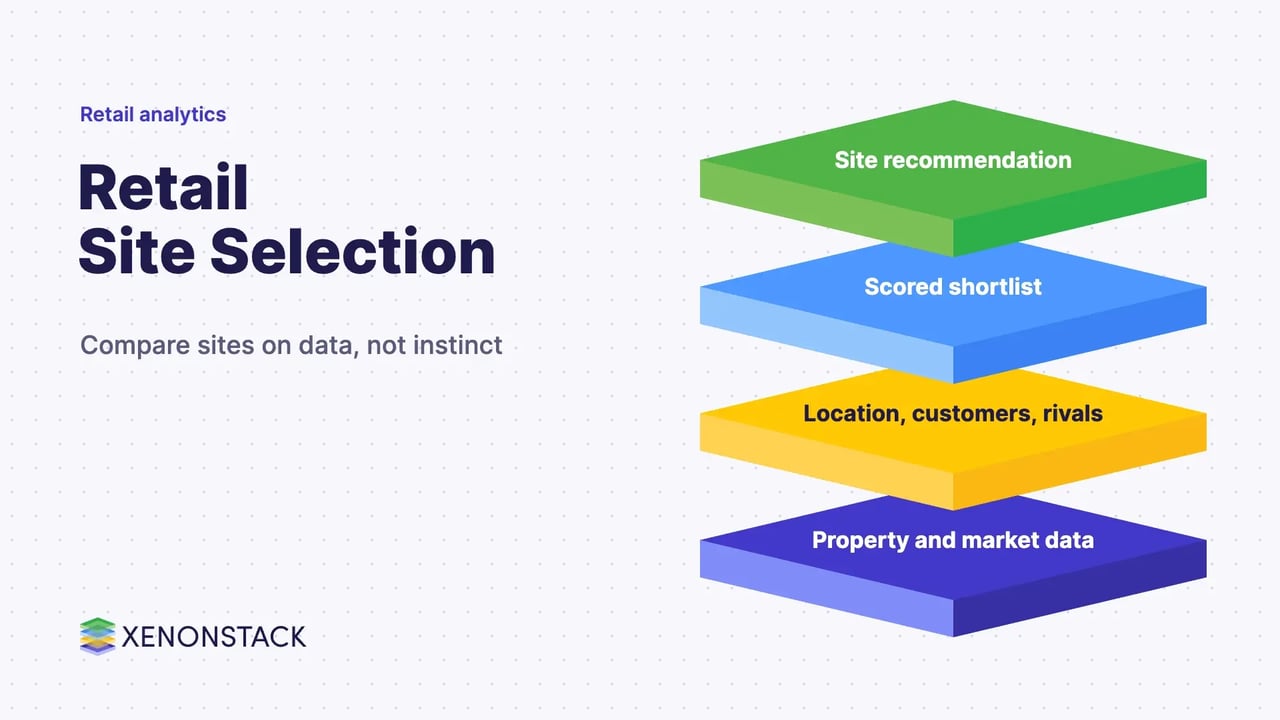
Retail site selection with decision analytics uses data on location, customers and nearby businesses to compare candidate sites and recommend the one that best fits a retailer's needs. It treats the choice as a multi-criteria decision rather than a judgement made on one factor.
This page is for retail, real estate and expansion teams. It covers the problem, the factors to analyse, how a site recommendation works, where AI agents fit and what to check before you adopt it.
What is retail site selection with decision analytics?
Choosing a store location is a critical decision that affects customer satisfaction and profitability, especially under intense competition and changing market conditions. It is also a long-term investment that is hard and expensive to reverse. Analytics models the choice by identifying the factors that matter and scoring each candidate site against them. Wikipedia's article on site selection describes the general process as defining criteria, evaluating communities, shortlisting, analysing specific sites and acquiring one, and notes that retail consultants analyse the volume and travel patterns of cars and pedestrians.
Which factors decide a good retail site?
A site recommendation looks at three groups of factors, each shown on a sample dashboard:
- Location: how prices vary with the neighbourhood, the number of non-retail businesses nearby, the distance to employment centres and access to major routes.
- Target customers: demographic, behavioural and lifestyle factors that define the market segment the store will serve, and how close sites are to public buildings and the central business district.
- Nearby businesses: neighbouring services such as bus stops, parks, hotels and banks, and the number of competing retail stores, which indicates both footfall and competition.
Other considerations include cost effectiveness, site connectivity, traffic flow, street visibility, plot size and the population the area can support.
How does the site recommendation work?
The steps below show how analytics narrows a long list to a recommendation:
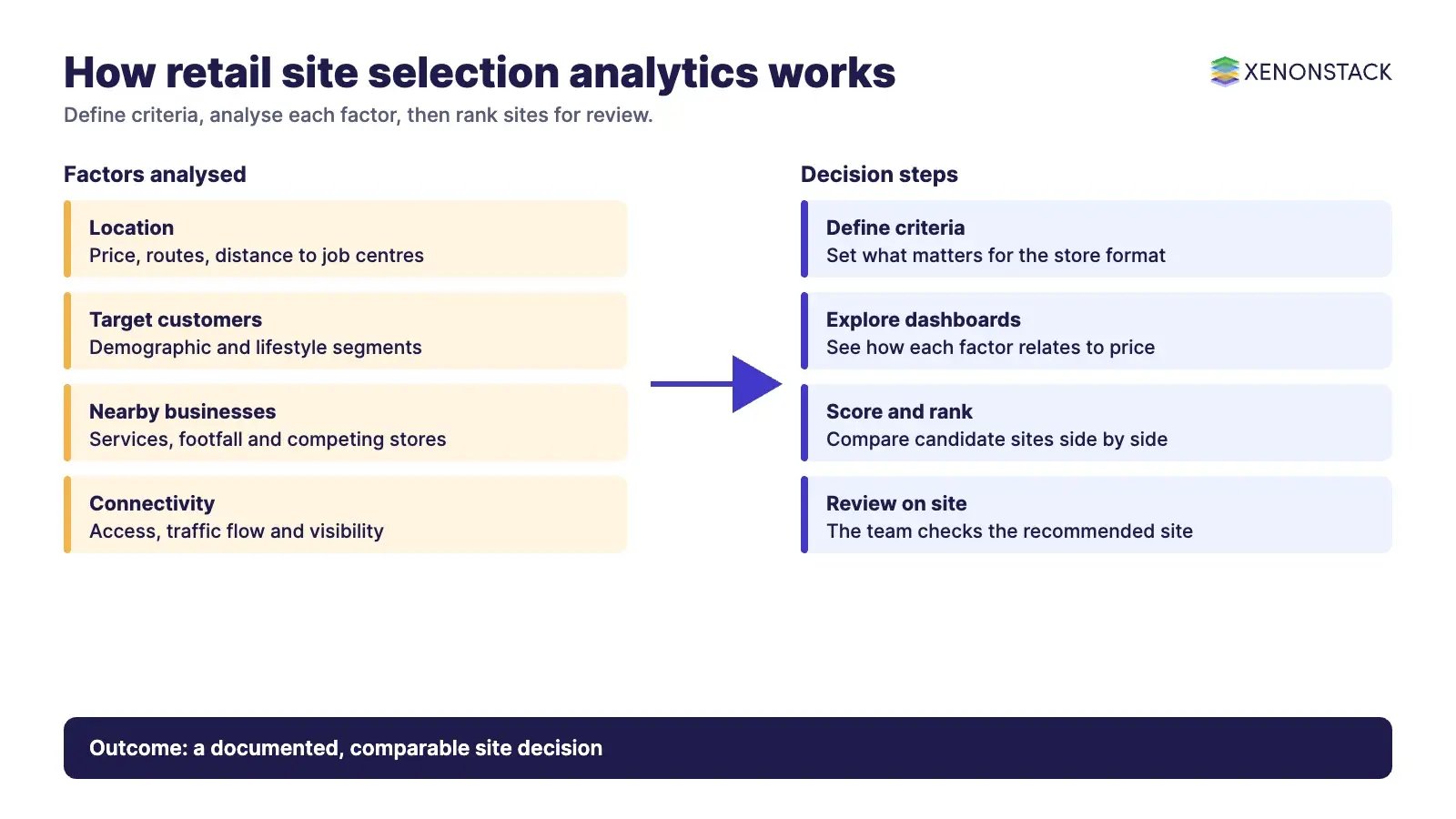
- Define the criteria that matter for the format, such as footfall, target customer access and competition.
- Collect data on candidate properties, their surroundings and the customer segments around them.
- Explore each factor on a dashboard to see how it relates to price and suitability.
- Score the sites against the criteria and rank them.
- An AI based recommendation system suggests the best suited property for the retail business, which the team reviews on the ground.
In a sample dashboard, prices fell as the number of non-retail stores grew, because such areas offer fewer target customers, while a high share of properties near a bus stop suited a retailer whose customers travel by bus. A high number of existing retail stores in an area signalled stiff competition. These readings depend on the data set, so repeat the analysis on your own market.
How does analytics compare with judging a site by instinct?
| Question | Instinct and a site visit | Decision analytics |
|---|---|---|
| Criteria | Informal and varies by person | Defined and applied the same way to every site |
| Comparison | A few sites at a time | Many candidate sites side by side |
| Evidence | Observation and local knowledge | Footfall, demographic, competitor and connectivity data |
| Record of the decision | Often undocumented | Factors and scores can be reviewed later |
Where do AI agents fit?
An agent can gather listings and public data for a shortlist, refresh the factor scores, and prepare a comparison for the expansion team to approve. The site visit and the commercial decision stay with people. ElixirData is XenonStack's Context OS, a decision infrastructure platform for keeping data, policy and decision context together for such agent decisions.
What should you check before you adopt it?
- Which criteria are non-negotiable for your format and which are trade-offs.
- Whether footfall, demographic and competitor data are available for the areas you are considering.
- How fresh the property and price data are.
- Who signs off a recommendation and how it is recorded.
- Whether you want sample dashboards first. You can talk with an expert about site selection analytics.
To map one decision your agents make, and the data and policy it depends on, book a Context Workshop. See what happens in the workshop.
Frequently asked questions
What is retail site selection?
It is the process of choosing the best location for a store by comparing candidate sites against defined criteria.
Which factors matter most?
Location, target customers and nearby businesses are the main groups, along with connectivity, traffic flow, street visibility, plot size and cost.
Why use analytics rather than instinct?
Analytics applies the same criteria to many sites and leaves a reviewable record, although local knowledge still has value.
Can a recommendation system choose the site for me?
It can rank and suggest sites, but people should review the shortlist and make the final commercial decision.
Where do AI agents help?
They can collect data for a shortlist, refresh scores and prepare comparisons for the expansion team to review.
Ready to put AI agents to work? See an ElixirClaw demo: the agentic OS to build, orchestrate and govern AI agents across your enterprise systems.
Explore the XenonStack platform family: ElixirData · ElixirClaw · ElixirHub · NexaStack · MetaSecure · Neural AI · AgentGRC · AgentSRE · AgentAnalyst · AgentInstruct · AgentRAI · AgentScrum · AgentSearch · AgentForce · AI Aviator · SAIF Aviator · CohortIQ · XenonStack AI · XenonStack UAE