Key takeaway
- ModelOps governs the lifecycle of AI, analytics and decision models in production. See how it differs from MLOps, its stages and where to start.
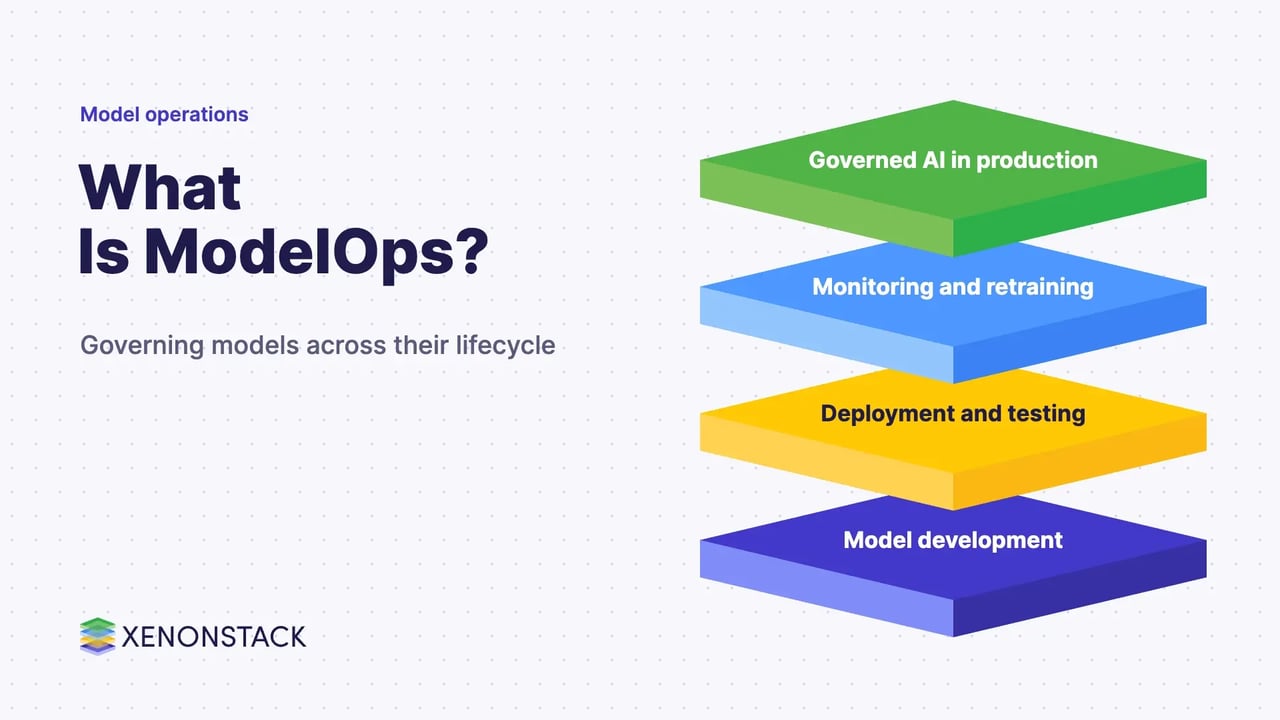
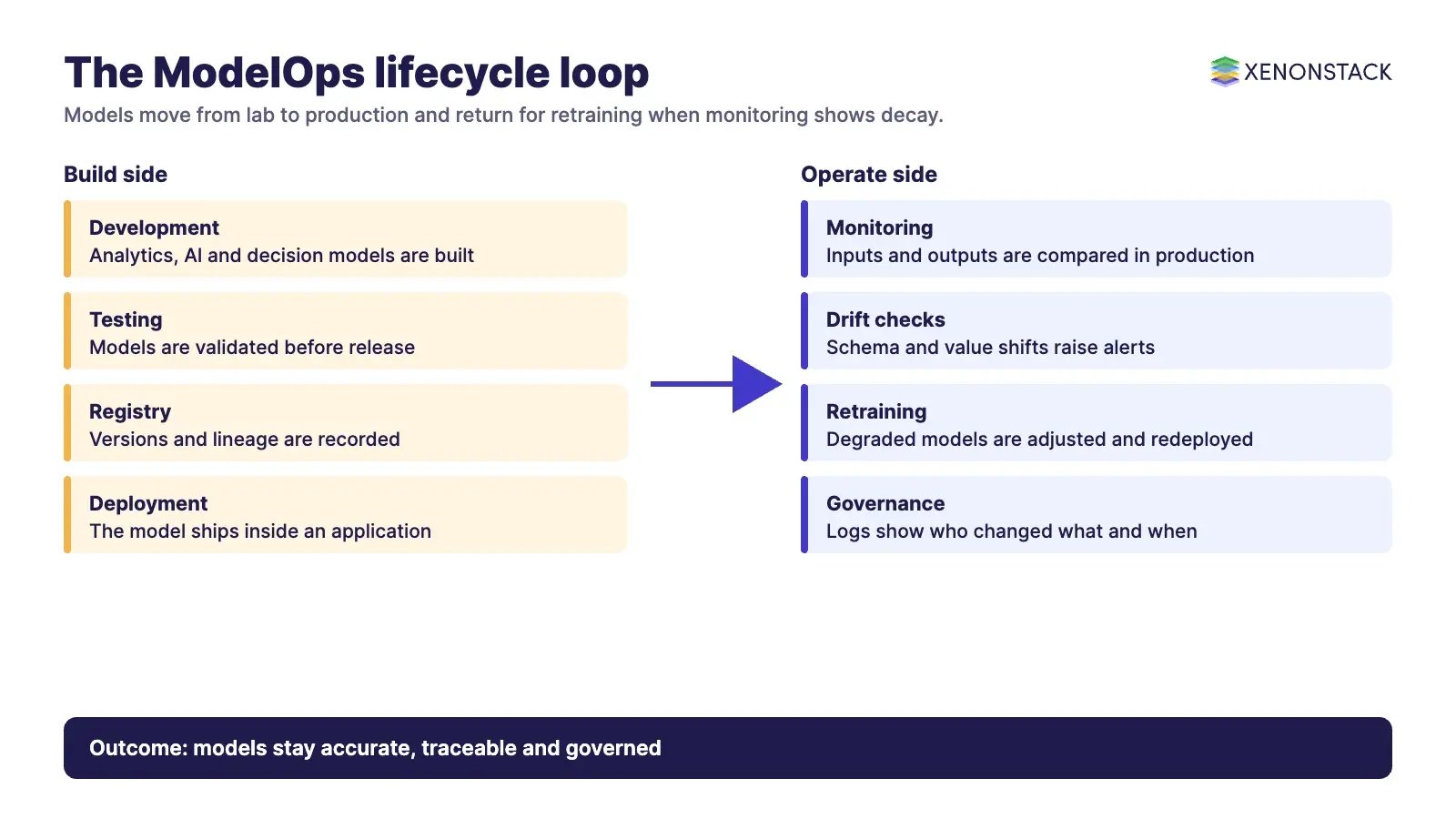
ModelOps is the practice of governing and managing the lifecycle of analytics, AI and decision models, from development and testing through deployment and monitoring in production. It treats a model as a running asset that must be versioned, watched and retrained, not as a one-off project that ends at hand-over.
This page is for data science, platform and risk leaders who have models in notebooks or pilots and need them to run reliably at scale. It covers what ModelOps is, how it differs from machine learning operations, the lifecycle stages, the tools involved and how artificial intelligence agents change the picture.
What is ModelOps?
The TechTarget definition of ModelOps describes ModelOps as "a holistic approach to building analytics models that can quickly progress from the lab to production", and as a variation of DevOps aimed at data analytics rather than application development. It names the core stages as development, testing, deployment and monitoring, and cites Gartner's view that ModelOps covers governance and lifecycle management of all analytics, AI and decision models.
The scope is wider than machine learning alone. The same page says it also covers other decision models, such as knowledge graphs and natural language processing. Working with DevOps teams matters because a model usually ships inside an application, and application development and model lifecycles need to stay in step so that feedback from production reaches retraining.
How does ModelOps differ from MLOps and CloudOps?
The Google Cloud MLOps guide calls MLOps "an ML engineering culture and practice that aims at unifying ML system development (Dev) and ML system operation (Ops)". TechTarget describes MLOps as a subset of ModelOps that deals only with ML models. CloudOps, by contrast, is about running cloud infrastructure and services, which models depend on but do not define.
| Aspect | ModelOps | MLOps | CloudOps |
|---|---|---|---|
| What it manages | Analytics, AI and decision models | Machine learning models and their pipelines | Cloud infrastructure and services |
| Main concern | Governance and lifecycle across model types | Building, deploying and monitoring ML systems | Availability, cost and scaling of cloud resources |
| Typical owner | Data science, risk and platform teams together | ML engineering and data science | Cloud or IT operations |
Many teams use the terms interchangeably. The useful distinction is scope: if rules, optimisation or knowledge-graph models sit beside your ML models, you need the wider governance that ModelOps implies.
What stages does the ModelOps lifecycle cover?
A model moves from development to testing, then deployment, then monitoring. When monitoring shows degradation, the model is adjusted and redeployed, so retraining is part of the cycle. The Google Cloud guide describes three maturity levels that show how far automation has gone.
| Level | What it looks like | What it adds |
|---|---|---|
| Level 0: manual process | Every step from data analysis to validation is manual and script-driven; new versions are released rarely | A starting point, with no tracking of predictions in production |
| Level 1: ML pipeline automation | The training pipeline is automated for continuous training | Automated data and model validation, pipeline triggers and metadata management |
| Level 2: CI/CD pipeline automation | Pipeline code is built, tested and deployed automatically | Faster experimentation, with monitoring output able to trigger new runs |
Why do deployed models need operating?
Google Cloud says models can decay in more ways than conventional software. It separates schema skew (unexpected or missing features, which should stop the pipeline for investigation) from value skew (statistical shifts, which should trigger retraining), and uses concept drift for changes that suggest a model has gone stale.
The Microsoft Learn MLOps page lists the controls that make this manageable: reproducible pipelines, a registry that versions models, lineage data showing who published a model, why changes were made and when it was deployed, and monitoring that compares model inputs and alerts on events such as data drift detection. Beyond accuracy, teams also watch input data volume and update frequency, the business metric the model is meant to move, and compute and memory use, since performance problems often trace back to changes in the data or its sources.
Which tools are used in ModelOps?
No single product covers every stage. Teams assemble a stack by category; the names below are examples, not a ranking, and the right mix depends on your cloud and skills.
| Category | Examples |
|---|---|
| Version control | Git, Mercurial |
| Model serving | TensorFlow Serving, ONNX Runtime |
| Managed ML platforms | AWS SageMaker, Azure Machine Learning |
| Containers and orchestration | Docker, Kubernetes |
| Workflow orchestration | Apache Airflow, Luigi, Argo |
| Monitoring and logging | Prometheus, Grafana, the ELK stack |
For monitoring in depth, see our guide to machine learning observability and monitoring, and for the pipeline side, MLOps challenges and solutions and the MLOps roadmap for model interpretability.
How does ModelOps apply in insurance?
Insurance shows why governance matters, because models influence decisions about people and money. Typical uses include insurance advice that recommends products from a customer profile, claims processing from registration to settlement, fraud detection that flags suspicious claims, and risk assessment that supports underwriters. These uses rest on data analytics and artificial intelligence, and in each case the operating questions are the same: which model version made this decision, on what data, and is it still performing? Audit trails, scores and monitoring reports are what let a risk team answer.
How do AI agents change ModelOps?
Agents add a layer above the model. The IBM guide to AI agents defines an AI agent as "a system that autonomously performs tasks by designing workflows with available tools", so a model is now one component that plans, calls tools and acts. That raises the stakes of every model update, because a drifting model can steer many downstream actions.
The same page recommends guardrails that map onto ModelOps practice: activity logs, the ability to interrupt an agent, unique agent identifiers for traceability, and human approval before highly impactful actions. Running models and agents under shared lifecycle and governance rules is the job of an agent platform such as ElixirClaw, the AI agents computing platform.
What should you do first?
- List every model in production, including rules and decision models, with an owner for each.
- Record the version, training data and approval for each, so lineage exists.
- Define drift and accuracy thresholds, and who acts when one is breached.
- Automate the path from validated model to deployment before adding more models.
- Review monitoring output monthly and feed what it shows back into retraining.
To map one decision your agents make, and the data and policy it depends on, book a Context Workshop. See what happens in the workshop.
Frequently asked questions
What is ModelOps in simple terms?
ModelOps is the practice of governing and managing models across their lifecycle, from development and testing to deployment, monitoring and retraining.
Is ModelOps the same as MLOps?
Not quite. TechTarget describes MLOps as a subset of ModelOps that deals only with machine learning models, while ModelOps also covers other analytics and decision models.
What is model drift?
Model drift is the loss of model quality as the data it sees in production changes. Google Cloud describes concept drift as significant changes in feature distributions that suggest a model has gone stale.
What are the stages of the ModelOps lifecycle?
The core stages are development, testing, deployment and monitoring. When monitoring shows a model degrading, it is adjusted and redeployed.
Do AI agents need ModelOps?
Yes. An agent relies on models and tools, so the models need versioning, monitoring and governance, and the agent needs activity logs and human approval for impactful actions.
Explore the XenonStack platform family: ElixirData · ElixirClaw · ElixirHub · NexaStack · MetaSecure · Neural AI · AgentGRC · AgentSRE · AgentAnalyst · AgentInstruct · AgentRAI · AgentScrum · AgentSearch · AgentForce · AI Aviator · SAIF Aviator · CohortIQ · XenonStack AI · XenonStack UAE