Key takeaway
- A responsible metaverse builds privacy, safety and interoperability into immersive worlds. See its characteristics, risks, use cases and what to do first.
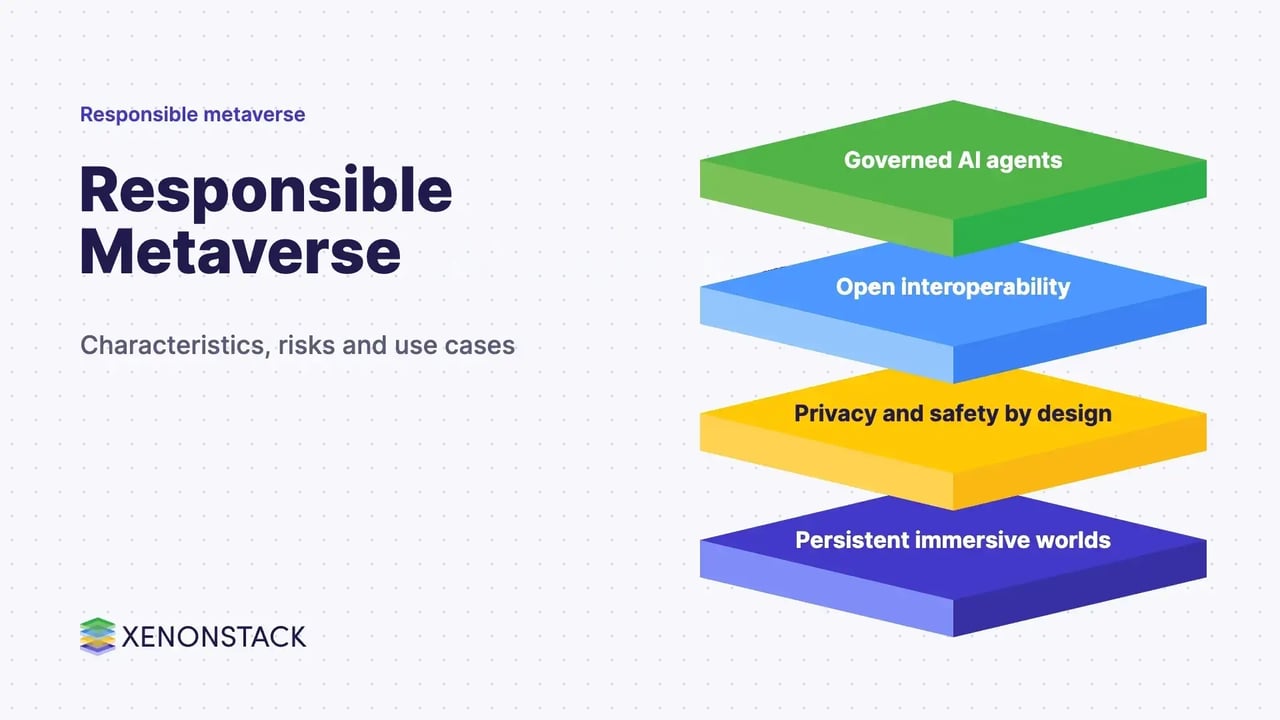
A responsible metaverse is a network of immersive, persistent digital worlds designed from the start for privacy, safety, inclusion and interoperability, so that people and businesses can trust what happens inside it. The term describes how the metaverse should be built, not a separate product.
This guide is for product, legal, data and technology leaders exploring immersive experiences. It explains the core characteristics, how they differ from AR and VR, the data protection, security and competition questions to settle early, the main use cases and what to do first. For related thinking, see our guides to responsible AI in government and ethical AI in healthcare.
What is the metaverse?
The World Economic Forum describes the metaverse as an immersive, interoperable and synchronous digital world. Early discussion of it grew out of remote work and video calls: instead of a flat grid of faces, people imagined meeting as 3D avatars around a shared virtual table, or shopping and attending events in a shared digital space.
It is not a single product. It is meant to be reachable across many computing platforms, including VR headsets, AR devices, PCs, mobile devices and game consoles, which is what separates it from any one VR application.
| Term | What the user experiences | Where it runs |
|---|---|---|
| Augmented reality (AR) | The real surroundings stay visible, with digital items added | Phones and AR glasses |
| Virtual reality (VR) | A fully virtual place replaces the surroundings | VR headsets |
| Metaverse | A persistent shared world that can be entered through several kinds of device | VR, AR, PC, mobile and consoles |
What are the characteristics of the metaverse?
Commentators usually describe the following traits. They are working descriptions rather than a formal definition, and they remain a goal as much as a reality.
| Characteristic | What it means |
|---|---|
| Persistence | Content stays available whenever a user returns, on different devices and connections |
| Synchronicity | People interact with each other and the world in real time |
| Availability | The world keeps running when a user logs off and can serve any number of participants |
| Economy | Participants can supply goods and services in exchange for value others recognise |
| Interoperability | Virtual items and identities can move between experiences and platforms |
What makes a metaverse responsible?
Meta, then trading as Facebook, set out four areas in its September 2021 post Building the Metaverse Responsibly: economic opportunity, privacy, safety and integrity, and equity and inclusion. The post described a two-year, $50 million investment in programmes and external research. That announcement is a dated statement of intent, so check current information from any company before relying on it.
The World Economic Forum governance work frames the goal as a metaverse that is economically viable, interoperable, safe, equitable and inclusive. The two lists overlap, and both point to the same design questions: who controls data, who is accountable when something goes wrong, and how different platforms work together.
Which data protection, security and competition risks need attention?
Immersive worlds can collect more personal data than websites, including movement and other physiological signals. The European Commission explains that personal data is any information relating to an identified or identifiable living person, and that the GDPR sets out seven key principles: lawfulness, fairness and transparency, purpose limitation, data minimisation, storage limitation, accuracy, integrity and confidentiality, and accountability. It also distinguishes the controller, which determines why and how data is processed, from the processor, which acts on the controller's documented instructions.
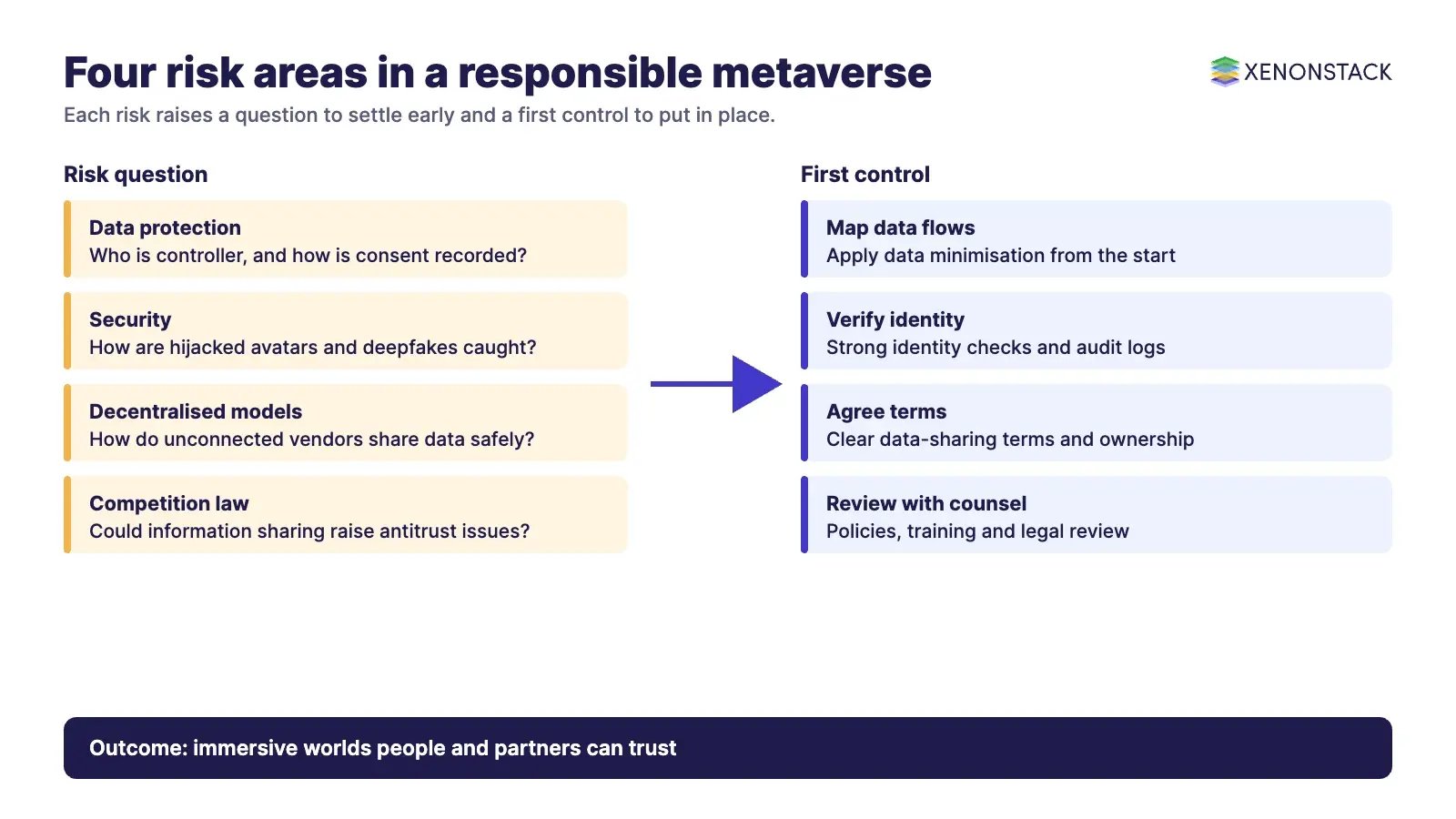
| Risk area | Question to settle | First control |
|---|---|---|
| Data protection | Who is the controller for each data type, and how is consent collected and recorded? | Map data flows and apply data minimisation |
| Security | How are hijacked avatars and deepfakes detected and verified? | Strong identity checks and audit logs |
| Decentralised models | How do vendors with no commercial link share data safely? | Agreed data-sharing terms and clear ownership |
| Competition law | Could sharing information between competitors raise antitrust issues? | Policies and training, with legal review |
Interoperability also needs shared technical standards. The Metaverse Standards Forum says it does not create standards itself but coordinates requirements and resources, with standards developed within partner standards organisations.
What are the main use cases of the metaverse?
Four use cases are most often discussed. Gaming extends massively multiplayer worlds into places where people chat, socialise and attend virtual events. Socialising offers lasting places to meet. Working could make remote collaboration, design review and customer service more engaging. Shopping covers virtual stores, digital-first fashion and avatars as identity. Each use case raises the same questions about data, safety and identity, so a responsible design reviews them before launch.
How do AI agents change the responsible metaverse?
AI agents can staff virtual stores, guide visitors and moderate spaces, which makes them part of how the metaverse behaves. That makes accountability concrete: each agent needs a defined purpose, limited access to personal data, a record of what it did and a route to a human decision. Governed data underpins all of this. See ElixirData, XenonStack's Context OS.
What should you do first?
- Choose one immersive use case and write down its purpose.
- Map the personal data it collects and name the controller and processor.
- Set safety and moderation rules, including how identity is verified.
- Check interoperability and competition questions with legal advisers.
- Review agents and data flows before launch and at regular intervals.
To map one decision your agents make in an immersive experience, and the data and policy it depends on, book a Context Workshop. See what happens in the workshop.
Frequently asked questions
What is a responsible metaverse?
It is a metaverse designed from the start for privacy, safety, inclusion and interoperability, so that people and businesses can trust what happens in it.
What are the main characteristics of the metaverse?
Persistence, synchronicity, availability, an economy and interoperability. These are working descriptions used by commentators rather than a formal definition.
How is the metaverse different from VR and AR?
VR replaces your surroundings with a virtual place and AR adds digital items to your real surroundings, while the metaverse is a persistent shared world that can be reached through several kinds of device.
What data protection risks does the metaverse raise?
Immersive worlds can collect more personal data, including movement and physiological signals, so teams must identify the controller and processor, apply the GDPR principles and collect consent properly.
Which organisation works on metaverse interoperability standards?
The Metaverse Standards Forum coordinates requirements and resources among standards organisations. It does not create standards itself.
Ready to put AI agents to work? See an ElixirClaw demo: the agentic OS to build, orchestrate and govern AI agents across your enterprise systems.
Explore the XenonStack platform family: ElixirData · ElixirClaw · ElixirHub · NexaStack · MetaSecure · Neural AI · AgentGRC · AgentSRE · AgentAnalyst · AgentInstruct · AgentRAI · AgentScrum · AgentSearch · AgentForce · AI Aviator · SAIF Aviator · CohortIQ · XenonStack AI · XenonStack UAE