Key takeaway
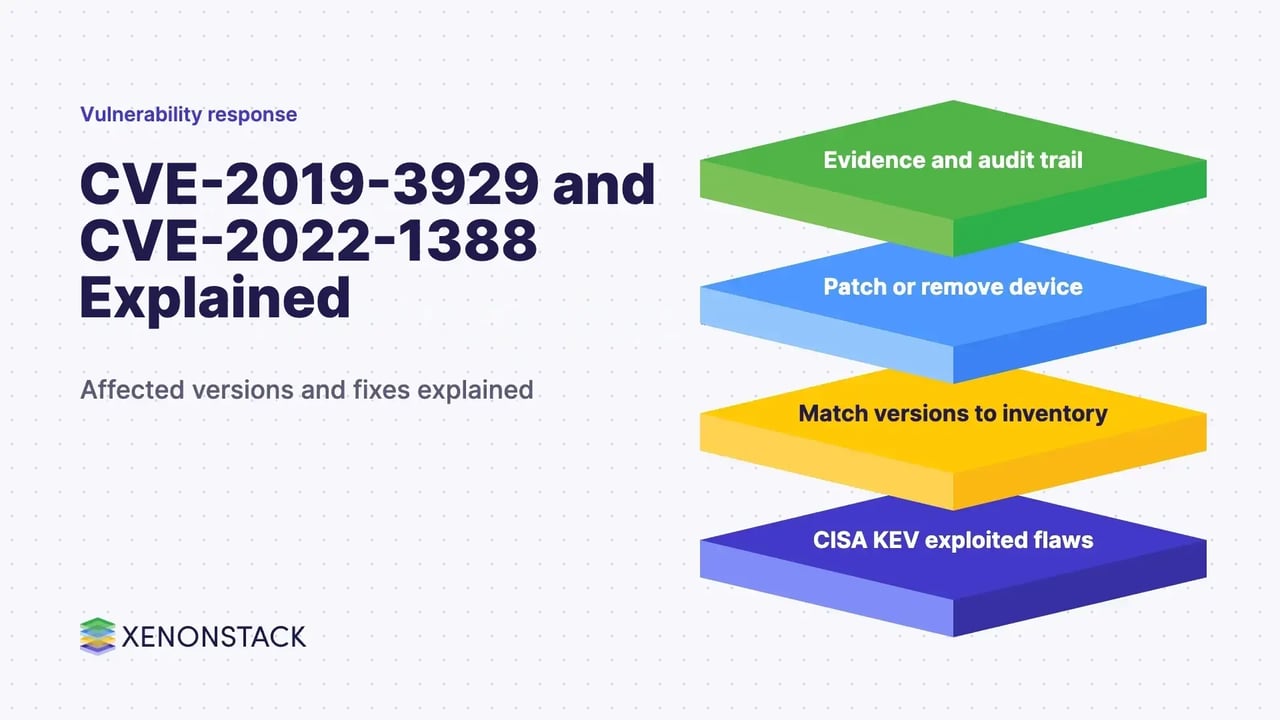
- CVE-2019-3929 hits Crestron and other presentation gateways; CVE-2022-1388 bypasses F5 BIG-IP login. See affected versions, CISA KEV status and fixes.
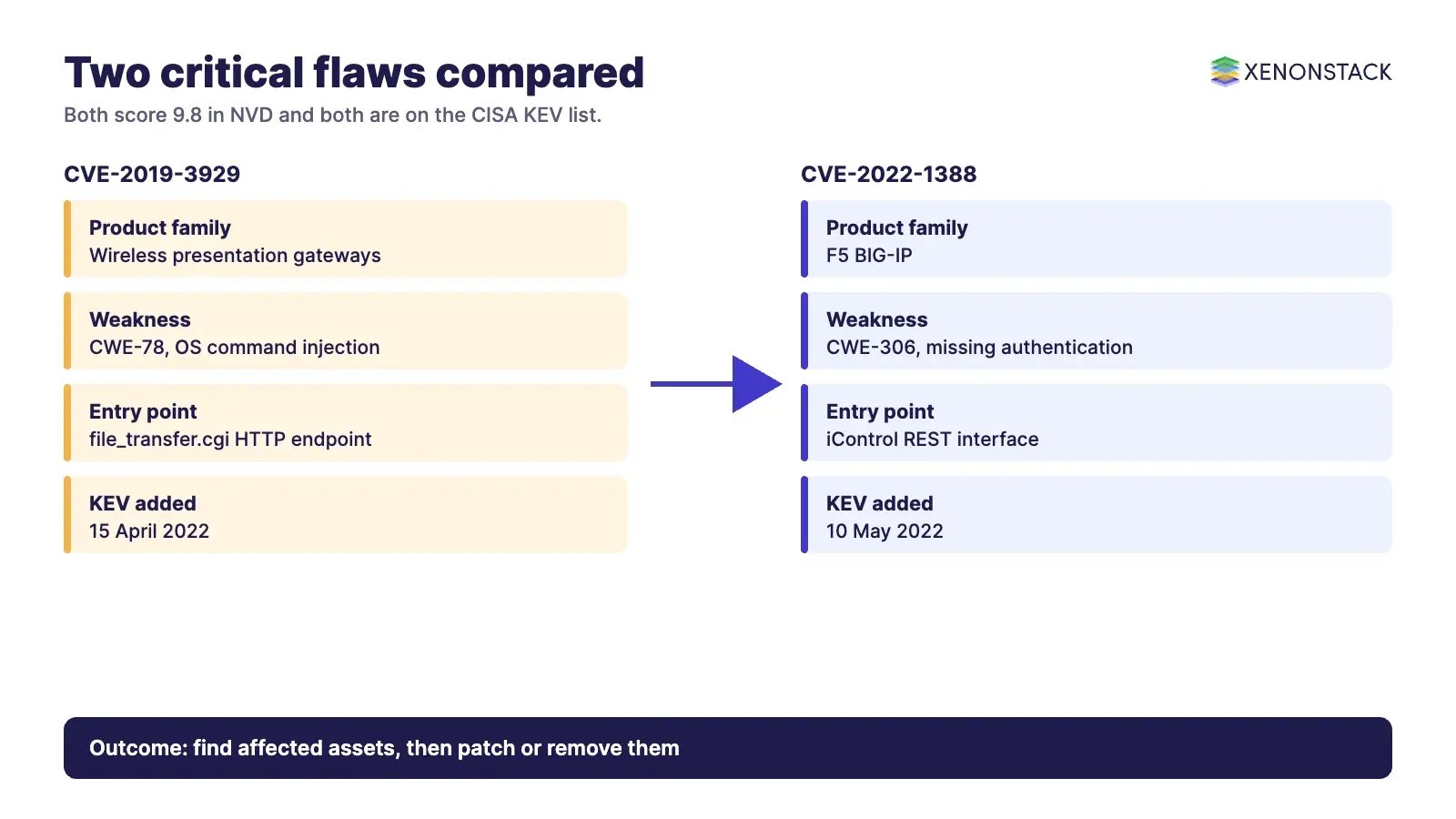
CVE-2019-3929 is a command injection flaw in the file_transfer.cgi web endpoint of several wireless presentation gateways, and CVE-2022-1388 is an authentication bypass in the iControl REST interface of F5 BIG-IP. Both carry a CVSS 3.1 base score of 9.8 (critical) in NVD, and both are listed in CISA's KEV catalog, which means they have been exploited in the wild.
This guide is for security engineers, network teams and IT managers who need to know which products and versions are affected, what the vendors and CISA say to do, and how to keep similar flaws from waiting weeks for a patch. It also covers our cyber security services and how agents can help with triage.
What is CVE-2019-3929?
The NVD record for CVE-2019-3929 describes it as command injection via the file_transfer.cgi HTTP endpoint in multiple Crestron, Barco, Extron, Teq AV, SHARP, Optoma, Blackbox and InFocus products. A remote, unauthenticated attacker can run operating system commands as root. NVD classifies the weakness as CWE-78 (OS command injection) and records a CVSS 3.1 score of 9.8.
These are small network devices used to share screens in meeting rooms. Many are bought by facilities or audio-visual teams, so they are easy to miss in a vulnerability inventory even though they sit on the corporate network.
Which products does CVE-2019-3929 affect?
NVD lists the following firmware versions as vulnerable.
| Vendor and product | Firmware version in NVD |
|---|---|
| Crestron AM-100 | 1.6.0.2 |
| Crestron AM-101 | 2.7.0.2 (NVD description text says 2.7.0.1, so confirm the exact build with the vendor) |
| Barco wePresent WiPG-1000P | 2.3.0.10 |
| Barco wePresent WiPG-1600W | Versions below 2.4.1.19 |
| Extron ShareLink 200 and 250 | 2.0.3.4 |
| Teq AV IT WIPS710 | 1.1.0.7 |
| SHARP PN-L703WA | 1.4.2.3 |
| Optoma WPS-Pro | 1.0.0.5 |
| Blackbox HD Wireless Presentation System | 1.0.0.5 |
| InFocus LiteShow3 | 1.0.16 |
| InFocus LiteShow4 | 2.0.0.7 |
What is CVE-2022-1388?
The NVD record for CVE-2022-1388 says "undisclosed requests may bypass iControl REST authentication" on F5 BIG-IP. NVD maps it to CWE-306, missing authentication for a critical function, and records a CVSS 3.1 score of 9.8 with the vector AV:N/AC:L/PR:N/UI:N/S:U/C:H/I:H/A:H. In plain terms, it can be reached over the network, needs no privileges and no user action, and rates high for confidentiality, integrity and availability impact.
NVD published the record on 5 May 2022. The affected modules include Local Traffic Manager, Advanced Firewall Manager, Application Security Manager, Access Policy Manager and DNS, among others.
Which BIG-IP versions are affected, and what fixed them?
| Branch | NVD affected range | Note |
|---|---|---|
| 16.1.x | 16.1.0 to before 16.1.2.2 | Update to 16.1.2.2 or later |
| 15.1.x | 15.1.0 to before 15.1.5.1 | Update to 15.1.5.1 or later |
| 14.1.x | 14.1.0 to before 14.1.4.6 | Update to 14.1.4.6 or later |
| 13.1.x | 13.1.0 to before 13.1.5 | Update to 13.1.5 or later |
| 12.1.x | 12.1.0 to 12.1.6 inclusive | Listed as affected in NVD; check F5 for your support status |
| 11.6.x | 11.6.1 to 11.6.5 inclusive | Listed as affected in NVD; check F5 for your support status |
| 17.0.x | 17.0.0 listed as unaffected | F5 data lists it as not affected |
Take care with release numbers: the 14.1 branch range ends before 14.1.4.6, so 14.1.4.6 is the first release outside the range.
How do the two vulnerabilities compare?
| Item | CVE-2019-3929 | CVE-2022-1388 |
|---|---|---|
| Weakness (NVD) | CWE-78, OS command injection | CWE-306, missing authentication for a critical function |
| CVSS 3.1 score | 9.8, critical | 9.8, critical |
| NVD published | 30 April 2019 | 5 May 2022 |
| Added to CISA KEV | 15 April 2022 | 10 May 2022 |
| CISA due date | 6 May 2022 | 31 May 2022 |
| CISA required action | Apply updates per vendor instructions | Apply updates per vendor instructions |
The first was public for three years before CISA listed it. That gap is the lesson: an old flaw on a forgotten device can become an active exploitation target long after the first advisory.
What does the CISA KEV catalog require?
The CISA Known Exploited Vulnerabilities (KEV) catalog is described by CISA as the authoritative source of vulnerabilities that have been exploited in the wild. Binding Operational Directive 22-01 requires federal civilian agencies to fix listed vulnerabilities within set timeframes. Other organisations are not bound by it, but CISA strongly recommends they add prompt remediation of KEV entries to their vulnerability management plans. For listed items the action is to apply the vendor update or, if the product is end of life or cannot be updated, remove it from the network. Temporary workarounds are acceptable only when no patch exists.
How do AI agents change vulnerability response?
Most delays in fixing a known exploited flaw come from finding out what you own, who owns it and whether it is exposed. An agent can match each new KEV entry to the asset inventory, check the installed version against the affected range, open a ticket with the owner and the due date, and attach the evidence once the patch lands. Humans still approve the change, and every step needs a log that an auditor can read. ElixirClaw is the AI agents computing platform XenonStack uses for agent and automation work of this kind.
What should you do first?
- Search your asset inventory, including meeting-room devices and network appliances, for the products and versions in the tables above.
- Apply the vendor update, or remove the device from the network if it cannot be updated.
- Confirm the management interfaces of BIG-IP and presentation gateways are not reachable from untrusted networks.
- Subscribe to the KEV catalog and set an internal due date for every entry that matches your estate.
- Record the evidence of each fix so the next audit does not start from zero.
To map one security decision your agents make, and the asset and policy data it depends on, book a Context Workshop. See what happens in the workshop.
Frequently asked questions
What is CVE-2019-3929?
It is a command injection flaw in the file_transfer.cgi HTTP endpoint of several wireless presentation products. NVD says a remote, unauthenticated attacker can run operating system commands as root.
What is CVE-2022-1388?
It is an authentication bypass in the F5 BIG-IP iControl REST interface. NVD describes it as undisclosed requests that may bypass authentication, and classifies it as missing authentication for a critical function.
How severe are these vulnerabilities?
NVD gives both a CVSS 3.1 base score of 9.8, which is the critical band.
Are they being exploited?
Yes. CISA added CVE-2019-3929 to its KEV catalog on 15 April 2022 and CVE-2022-1388 on 10 May 2022, and the catalog lists vulnerabilities exploited in the wild.
How do I fix them?
Apply the vendor update. For BIG-IP, NVD lists the affected branches and the first unaffected releases in each branch. If a device cannot be updated, CISA says to remove it from the network.
Ready to put AI agents to work? See an ElixirClaw demo: the agentic OS to build, orchestrate and govern AI agents across your enterprise systems.
Explore the XenonStack platform family: ElixirData · ElixirClaw · ElixirHub · NexaStack · MetaSecure · Neural AI · AgentGRC · AgentSRE · AgentAnalyst · AgentInstruct · AgentRAI · AgentScrum · AgentSearch · AgentForce · AI Aviator · SAIF Aviator · CohortIQ · XenonStack AI · XenonStack UAE