Key takeaway
- WebAssembly explained: how Wasm works with JavaScript, its core concepts, sandbox security, Wasm 3.0 and WASI, and when enterprise teams should use it.
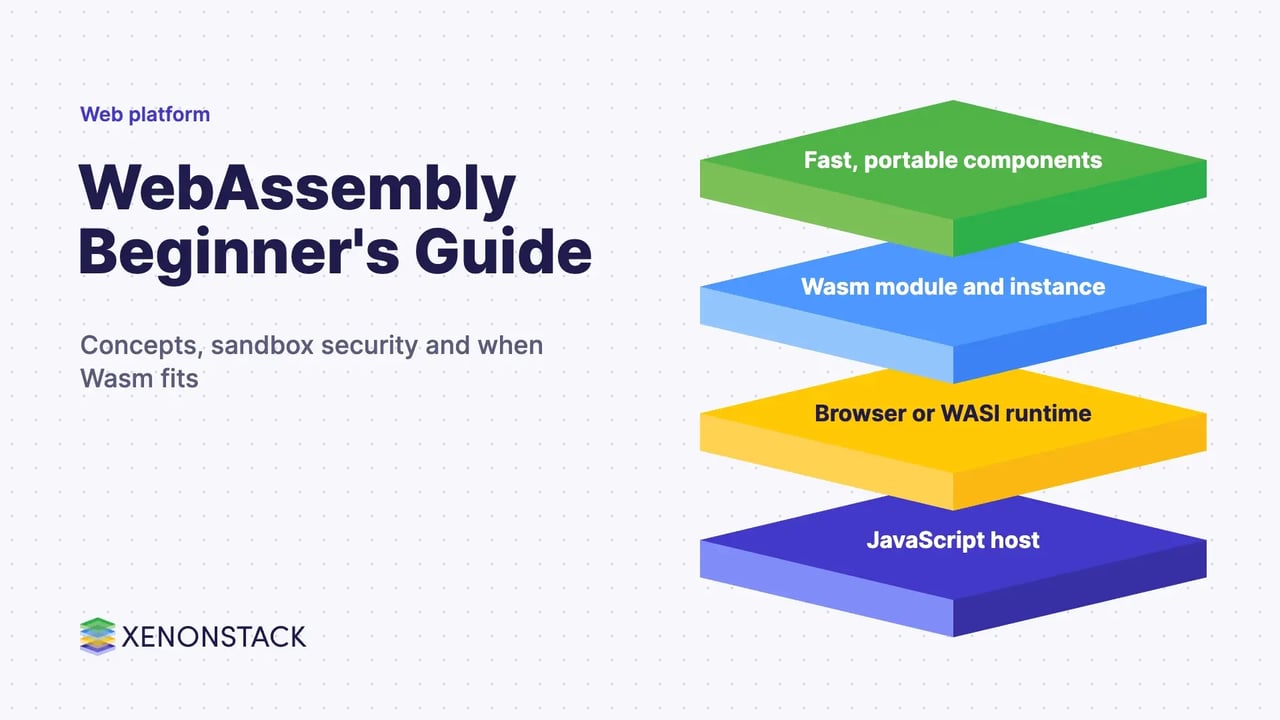
WebAssembly (Wasm) is a binary instruction format for a stack-based virtual machine, designed as a portable compilation target for languages such as C, C++ and Rust. According to webassembly.org, its goals are fast, compact code, a debuggable text format and a place within the open web, with a memory-safe, sandboxed execution environment. It runs alongside JavaScript in the browser and is not a replacement for it.
For enterprise leaders the practical point is narrow: Wasm is a way to ship compiled, sandboxed code to browsers, servers and edge devices from one binary. It suits compute-heavy or portable components. It does not suit ordinary page logic. For a head-to-head comparison read WebAssembly vs JavaScript; for Wasm in AI inference see AI simulations on WebAssembly.
What is WebAssembly and how does it work in the browser?
MDN describes WebAssembly as a low-level bytecode format originally designed for the web, which is not meant to be written by hand and is a compilation target for languages such as C, C++ and Rust (see MDN: WebAssembly concepts). The browser virtual machine now loads two types of code, JavaScript and WebAssembly, and the two can call each other. A typical flow is: write code in a source language, compile it to a .wasm file, then load it from JavaScript, which controls how the module is downloaded, compiled and run.
The quickest way to load a module, per MDN: loading and running, is WebAssembly.instantiateStreaming(), which fetches, compiles and instantiates in one step as the bytes stream from the server. The exported functions can then be called like normal JavaScript functions. MDN also notes that Wasm is not yet integrated with <script type="module"> or import statements.
What are the key concepts: Module, Memory, Table and Instance?
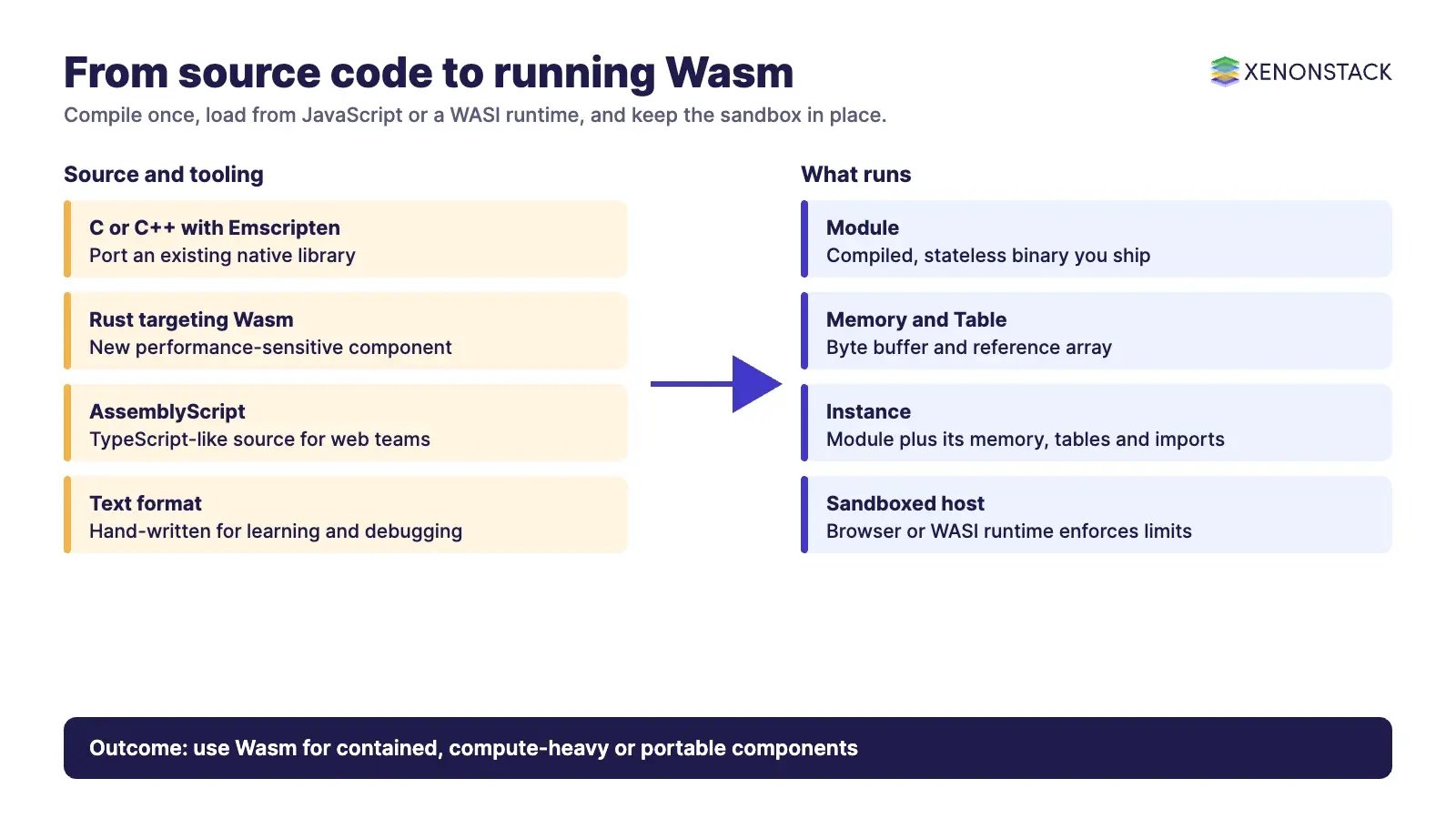
Four terms cover most beginner questions. They map one to one onto the WebAssembly JavaScript API, as defined by MDN.
| Concept | What it is | Why it matters |
|---|---|---|
| Module | A WebAssembly binary already compiled by the browser into machine code. It is stateless and can be shared between windows and workers. It declares imports and exports. | The unit you ship and cache. |
| Memory | A growable buffer: the linear array of bytes read and written by Wasm memory instructions. | The shared space between Wasm and JavaScript, and the main source of performance and risk. |
| Table | A growable array of references, such as to functions, that cannot be stored as raw bytes in Memory for safety and portability reasons. | Supports indirect function calls without exposing raw addresses. |
| Instance | A Module paired with its runtime state: its Memories, Tables and imported values. | What your JavaScript actually calls. |
What are the goals of WebAssembly?
The WebAssembly site lists three headline goals.
Efficient and fast: a compact binary encoding for small size and fast load, with execution approaching native speed on common hardware.
Open and debuggable: a textual format supports debugging, testing, learning and writing code by hand.
Part of the open web: versionless, feature-tested and backward compatible, able to call into and out of JavaScript and to access Web APIs.
Security is built in. Wasm describes a memory-safe, sandboxed execution environment, and in browsers it enforces the same-origin and permissions policies. The open standards are developed by a W3C Community Group and a W3C Working Group.
How safe is the WebAssembly sandbox?
The WebAssembly security documentation says each module runs in a sandbox separated from the host runtime and cannot escape except through appropriate APIs. Linear memory is isolated from the runtime's internal memory and accesses are bounds-checked at region level. Indirect calls are type-checked, and compiled code is immutable, which blocks control-flow hijacking by code injection. The same page lists remaining gaps: overflows inside linear memory can still overwrite adjacent objects, code-reuse attacks on indirect calls remain possible at function granularity, and race conditions and side-channel attacks can occur. Treat the sandbox as strong isolation, not as a substitute for reviewing the code you compile.
How can you start using WebAssembly?
Common entry points are compiling existing C or C++ code with Emscripten, building a Rust application that targets WebAssembly, using AssemblyScript, a TypeScript-like language that compiles to Wasm, or writing the text format directly. Check each toolchain's own documentation for current status before committing.
| Entry point | Best fit | Watch for |
|---|---|---|
| Emscripten (C/C++) | Porting an existing native library or application to the browser | Glue code and build complexity |
| Rust targeting Wasm | New performance-sensitive components with memory safety in the source language | Team skills in Rust |
| AssemblyScript | Web teams who know TypeScript and want a gentle start | A smaller ecosystem than JavaScript |
| Hand-written text format | Learning and debugging | Not meant for production authoring |
What has changed: WebAssembly 3.0 and WASI?
The core standard has moved on since the early browser releases. The WebAssembly team announced Wasm 3.0 on 17 September 2025 as the new live standard. It adds a 64-bit address space (browsers still cap 64-bit memory at 16 GB), multiple memories, garbage collection for struct and array allocations, typed references, tail calls, native exception handling, relaxed vector instructions, a deterministic profile and JavaScript string builtins. The announcement says Wasm 3.0 is already shipping in most major browsers, with standalone engines such as Wasmtime nearing completion. The W3C core specification is published as a Candidate Recommendation Draft that the Working Group plans to keep updating as a living standard.
Outside the browser, WASI (the WebAssembly System Interface) is a set of standards-track APIs for Wasm software. It describes a capability-based sandbox in which applications start with no ambient authority and can only do what the host explicitly grants. Its site lists server and cloud, serverless, plugins and database functions, networking filters, and embedded and edge devices as target uses, and shows milestone releases 0.1, 0.2 and 0.3, with 0.3 adding native async support to the Component Model. Confirm the status of the runtime you choose on its own site. For the edge angle see edge computing.
When does WebAssembly fit, and when should you not use it?
| Situation | Fit? | Why |
|---|---|---|
| Image or video processing, 3D, games, computer vision in the browser | Good fit | Compute-heavy work where native-like speed helps, per the MDN and webassembly.org descriptions |
| Reusing a large C, C++ or Rust codebase on the web | Good fit | Wasm is a compilation target for these languages |
| Sandboxed plugins or functions on servers and edge nodes | Worth testing | WASI describes serverless, plugin and edge uses; benchmark against a container baseline |
| Forms, dashboards and ordinary page logic | Poor fit | MDN notes JavaScript is dynamically typed, needs no compile step and has a huge ecosystem |
| Direct DOM or Web API access | Via JavaScript | Wasm calls Web APIs through JavaScript bindings |
Wasm is not a performance guarantee. Speed depends on the workload, the toolchain and how often calls cross the JavaScript boundary, so measure your own case before committing.
What should enterprise leaders do next?
Start with one contained component that is slow or hard to port in JavaScript, set a benchmark against the current implementation, and review the compiled code like any other dependency. Where Wasm modules are used as sandboxed tools for AI agents, the capability model in WASI gives a natural place to enforce what each tool may touch, which is a design pattern to evaluate rather than a settled practice. ElixirClaw is an agentic OS platform to build, orchestrate and govern AI agents and automation workflows while keeping humans in control, and ElixirData Context OS keeps governed context, versioned policy and decision traces in one decision layer above AI agents. For the wider picture see agentic workflows and our WebAssembly development services.
To map one decision your agents or sandboxed components should make, and the context and policy it depends on, book a Context Workshop. See what happens in the workshop.
Frequently asked questions
What is WebAssembly in simple terms?
A binary instruction format for a stack-based virtual machine, used as a portable compilation target for languages such as C, C++ and Rust. It runs in browsers and in non-web environments, in a memory-safe, sandboxed environment.
Does WebAssembly replace JavaScript?
No. MDN says it is not intended as a replacement and is designed to complement and work alongside JavaScript. JavaScript controls how a Wasm module is downloaded, compiled and run.
What are Module, Memory, Table and Instance?
A Module is a compiled, stateless Wasm binary. Memory is a growable byte buffer. A Table is a growable array of references such as functions. An Instance is a Module paired with its Memories, Tables and imported values.
Is WebAssembly secure?
Modules run in a sandbox separated from the host, with bounds-checked linear memory and type-checked indirect calls. The security documentation also lists remaining gaps, including overflows inside linear memory and side-channel attacks, so code review still matters.
What is new in WebAssembly 3.0?
Announced on 17 September 2025: 64-bit address space, multiple memories, garbage collection, typed references, tail calls, exception handling, relaxed vector instructions, a deterministic profile and JavaScript string builtins.
What is WASI?
The WebAssembly System Interface: standards-track APIs for running Wasm outside the browser, using a capability-based sandbox where applications start with no ambient authority.
Explore the XenonStack platform family: ElixirData · ElixirClaw · ElixirHub · NexaStack · MetaSecure · Neural AI · AgentGRC · AgentSRE · AgentAnalyst · AgentInstruct · AgentRAI · AgentScrum · AgentSearch · AgentForce · AI Aviator · SAIF Aviator · CohortIQ · XenonStack AI · XenonStack UAE