Key takeaway
- Top computer vision companies by solution segment, each described from its own site, with ownership changes, selection criteria and a 3 to 5 year outlook.
Which computer vision companies fit which segment in 2027?
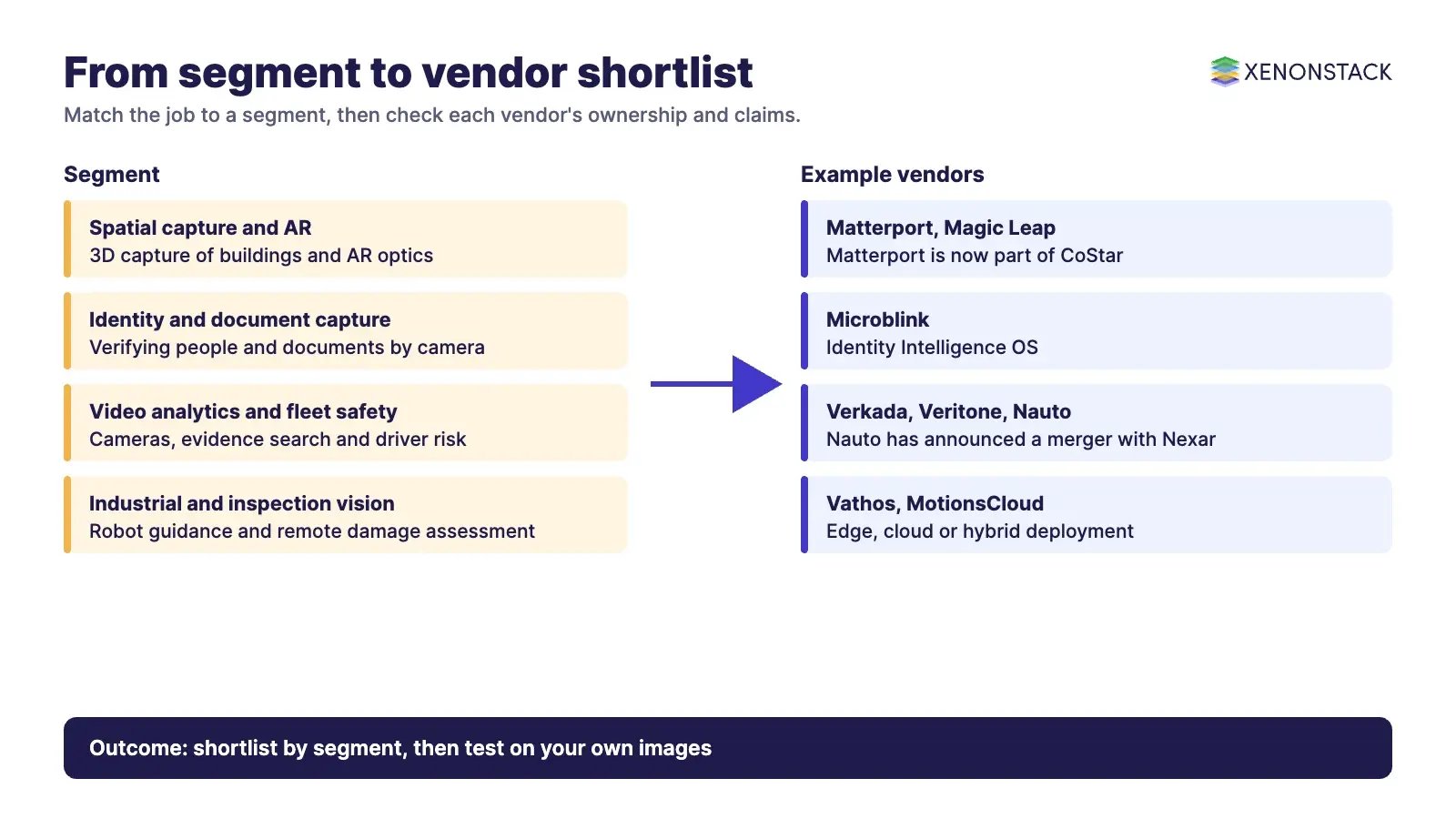
Pick the vendor by the job the camera or sensor must do, not by a single league table. This shortlist groups companies by solution segment: spatial capture and AR, identity and document capture, sensing for vehicles, video analytics and security, industrial and inspection vision, and custom builds. Each profile says what the company states on its own site, and the status notes record the ownership changes we found. For the use cases behind these segments, see our guide to computer vision applications by industry.
Several names from earlier versions of this post are gone from the list because their own pages no longer show a computer vision offering, or the claim could not be verified. Two vendors have changed ownership or are mid-merger (Matterport and Nauto), which matters for contracts and roadmaps. Disclosure: XenonStack builds vision products and appears in the video analytics segment, so weigh that entry accordingly.
How should enterprises choose a computer vision company?
Start from the decision the vision output will drive, then test vendors against that decision. Five questions separate vendors quickly:
| Question | What to ask | Why it matters |
|---|---|---|
| Industry fit | Has the vendor run your use case, in your environment, at your scale? | Lighting, camera placement and defect types change accuracy more than model choice. |
| Deployment | Edge, on-premises, cloud or hybrid? Where does video leave the site? | Latency and data residency decide the architecture; see computer vision on edge. |
| Data and privacy | Who owns the footage, is it used to train models, and how long is it kept? | Biometric and surveillance data carries regulatory exposure. |
| Ownership and continuity | Has the company been acquired, merged or renamed recently? | Roadmaps, pricing and support terms can change after a deal. |
| Integration | Which camera, VMS and workflow standards does it support? | Lock-in grows when analytics metadata is proprietary. |
Which companies lead each computer vision solution segment?
Every company description below is taken from the company's own site, read on 11 November 2026, and worded as such. This is a shortlist for evaluation, not a ranking or an endorsement.
Segment 1: Spatial capture and augmented reality
What it does: According to its site, Matterport offers 3D cameras and a virtual tour software platform, and describes digital twins across real estate, facilities and construction.
Fit: Capturing and sharing buildings as navigable 3D models.
Status: According to Matterport's own press release, CoStar completed its acquisition of Matterport on 28 February 2025. Confirm current commercial terms with the vendor.
What it does: According to its site, Magic Leap pursues see-through augmented reality, promotes its waveguide technology and says its teams guide partners through every phase of AR glasses development.
Fit: Optics and AR glasses prototyping for hardware partners, rather than a vision analytics product.
Status: The homepage does not mention the Magic Leap 2 headset, so check availability directly before planning around it.
Segment 2: Identity and document capture
What it does: According to its site, Microblink is an identity intelligence company; its Identity Intelligence OS connects identity signals, fraud detection, orchestration and policy controls to verify people and detect fraud.
Fit: Onboarding, know-your-customer and fraud workflows where a document or face is captured by camera.
Status: The site shows BlinkReceipt as renamed Actual. It mentions no acquisition.
Segment 3: Sensing for vehicles and infrastructure
What it does: According to its site, AEye is a software-defined lidar company. It lists APOLLO (long range, out to about 1 km), STRATOS (out to 1.5 km) and OPTIS, which it says fuses lidar, perception and AI compute.
Fit: Automotive, intelligent transportation, rail, aviation, defence and smart infrastructure, per its site.
Status: Lidar-led rather than camera-only vision; evaluate it as a sensing supplier.
Segment 4: Video analytics, security and fleet safety
What it does: According to its site, Veritone turns unstructured video, audio and text into AI-ready tokens, with its aiWARE platform, and says its AI is made for law enforcement agencies and legal teams.
Fit: Evidence handling and media intelligence for public-sector and media teams. The homepage does not use the term computer vision.
Status: No change of ownership found on its site.
What it does: According to its site, Verkada sells cloud-managed security cameras with the Verkada Command management platform, footage search by any criteria and alerts on concerning activity. It states that it uses AI to investigate incidents faster, not to train its models or sell private data.
Fit: Multi-site physical security with central cloud management.
Status: Cloud-managed by design; check data residency terms.
What it does: According to its site, Nauto is an AI-powered fleet safety platform that predicts and prevents collisions in real time, with driver risk scoring and coaching for commercial fleets.
Fit: Commercial fleets that need in-cab risk alerts and coaching.
Status: On 1 July 2026 Nauto announced a definitive agreement to merge with Nexar, subject to customary closing conditions; the combined company's name was not given.
What it does: According to its site, XenonStack AI is an agentic video intelligence platform that lets teams search video in natural language, generate evidence-grounded summaries and govern operational actions across edge, on-premises and cloud deployments.
Fit: Operations teams that want camera feeds turned into searchable, governed events. Disclosure: this is our own product.
Status: Live on its site as of 11 November 2026.
Video: how a video analytics platform surfaces incidents for operators (XenonStack AI).
Segment 5: Industrial and inspection vision
What it does: According to its site, Vathos offers vision software for industrial automation in manufacturing and logistics, which lets integrators automate manual processes in unstructured environments, with detection for bin picking, contour picking and plane picking, deployed at the edge, in the cloud or hybrid.
Fit: Robot guidance for integrators.
Status: Its site lists a technology partnership announcement with Wandelbots dated 7 April 2026; no other change found.
What it does: According to its site, MotionsCloud provides AI damage assessment and inspection for vehicles, property and baggage, using guided photos and video, a browser-based augmented reality photo app and live remote video inspection.
Fit: Insurers, rental companies, fleets and airlines that inspect remotely.
Status: No rename or shutdown found on its site.
Segment 6: Custom solutions and integration
What it does: According to its site, GenovaSoft offers AI-based tailored software development with expertise in computer vision, NLP and predictive models.
Fit: Bespoke builds when no packaged product fits.
Status: Verify references for vision projects specifically, since its homepage describes a broad software scope.
Which names were removed, and why?
Infosys, Evolv Technology, Footprint Technologies and ElixirClaw were removed because their own homepages do not state a computer vision offering, so we could not verify the claim. ElixirClaw is an agentic OS platform to build, orchestrate and govern AI agents and automation workflows while keeping humans in control; it is a governance layer rather than a vision vendor.
What do these computer vision solutions have in common?
The earlier version listed fifteen generic capabilities. Four matter most when you compare vendors, and each should appear in a proof of concept.
| Capability | When it fits | What to test |
|---|---|---|
| Custom or pre-trained models | Pre-trained for common objects; custom for your parts, documents or sites | Accuracy on your own images, not vendor demos |
| Real-time video analytics | Security, safety and operations that need alerts in seconds | Latency, false alert rate and operator workload |
| Automated inspection | Quality control on production lines or claims | Defect types covered and how exceptions are reviewed |
| Edge deployment | Low latency or video that cannot leave the site | Hardware cost and update process |
For how data moves from capture to decision, see the workflow of computer vision. For the model side, see agentic AI in computer vision.
What should governance, cost and trade-offs look like?
Vision systems act on people and property, so write the controls before the pilot. Record which camera feeds are in scope, who may view footage, how long it is kept and which actions a model may trigger without a person. Our computer vision services and solutions cover delivery, and NexaStack is described on its own site as an agentic operating platform for physical AI that runs across on-premises, cloud and hybrid environments. For policy and audit trails on agent actions, AgentGRC keeps autonomous agent actions inside policy, with the audit trail risk teams need.
Trade-offs to weigh: packaged products ship faster but fit fewer edge cases; custom builds fit better but cost more to maintain; cloud-managed cameras simplify operations but move footage off site. A pilot on one site with one measurable outcome is a better test than a broad rollout. When not to buy: if the process cannot yet be measured by hand, a vision system will not fix it.
What will change in computer vision companies over the next 3 to 5 years?
Sourced dates below are facts; the rest are XenonStack's own view and are labelled as such.
| Change | Evidence | Label |
|---|---|---|
| Biometric vision use cases face high-risk rules | The European Commission's AI Act page lists Annex III high-risk use cases (including biometrics) from 2 December 2027 and Annex I product-embedded systems from 2 August 2028, after the AI Omnibus entered into force on 27 July 2026. | Sourced, dated |
| More vendor consolidation | Matterport was acquired by CoStar (28 February 2025, per Matterport) and Nauto announced a merger with Nexar (1 July 2026, per Nauto). | Two sourced deals; the trend is XenonStack's view |
| Analytics metadata becomes interoperable | ONVIF Profile M defines analytics metadata, object classification, and face, body, vehicle and licence plate metadata, with events over the metadata stream, the event service or MQTT. | Standard sourced; adoption timing is XenonStack's view |
| Vision moves into physical AI platforms | NexaStack's site describes vision AI and AI vision at the edge within an operating platform for physical AI. | XenonStack's view |
| Video becomes searchable by question | XenonStack AI's site describes natural language video search and evidence-grounded summaries. | XenonStack's view |
Our view for planning: expect fewer, larger vendors, ask for open metadata in every contract, and budget for compliance review of any biometric use before 2027.
Sources: European Commission, AI Act; ONVIF Profile M; Matterport press release; Nauto announcement.
To map one vision decision your agents should make, and the context and policy it depends on, book a Context Workshop. See what happens in the workshop.
What should you plan for in 2027?
Vision systems that identify or assess people may fall under the EU AI Act, so build compliance into the 2027 plan.
- 2 December 2027: the European Commission page, last updated 19 October 2026, says high risk AI systems face strict obligations from this date after the AI Omnibus entered into force on 27 July 2026.
- 2 August 2028: the same page gives an extended transition for AI embedded in regulated products. If a vendor ships vision inside such a product, ask for its timeline.
- Vendor contracts: ask each shortlisted vendor how it will meet these obligations and who carries the cost.
Frequently asked questions
Which computer vision companies should enterprises shortlist?
Shortlist by segment: Matterport for 3D capture, Microblink for identity capture, AEye for lidar sensing, Verkada, Veritone and Nauto for video and fleet analytics, Vathos and MotionsCloud for industrial and inspection vision, and GenovaSoft for custom builds, according to each company's site.
Have any of these companies been acquired or merged?
According to Matterport, CoStar completed its acquisition on 28 February 2025. Nauto announced on 1 July 2026 a definitive agreement to merge with Nexar, subject to customary closing conditions.
Why were some companies removed from the list?
Infosys, Evolv Technology and Footprint Technologies do not state a computer vision offering on their homepages, so the claim could not be verified.
How do I compare vendors fairly?
Test each on your own images and cameras, and compare accuracy, latency, false alert rate, data ownership, deployment options and ownership stability.
What will change in computer vision over the next 3 to 5 years?
High-risk obligations for biometric use cases under the EU AI Act apply from 2 December 2027, standards such as ONVIF Profile M make analytics metadata more portable, and further vendor consolidation is XenonStack's view.
Does a vision project need governance?
Yes. Define feeds in scope, access, retention and which actions a model may take without a person before the pilot.
Follow XenonStack on LinkedIn: XenonStack on LinkedIn for new guides on agentic AI, data and platform engineering.
Explore the XenonStack platform family: ElixirData · ElixirClaw · ElixirHub · NexaStack · MetaSecure · Neural AI · AgentGRC · AgentSRE · AgentAnalyst · AgentInstruct · AgentRAI · AgentScrum · AgentSearch · AgentForce · AI Aviator · SAIF Aviator · CohortIQ · XenonStack AI · XenonStack UAE