Key takeaway
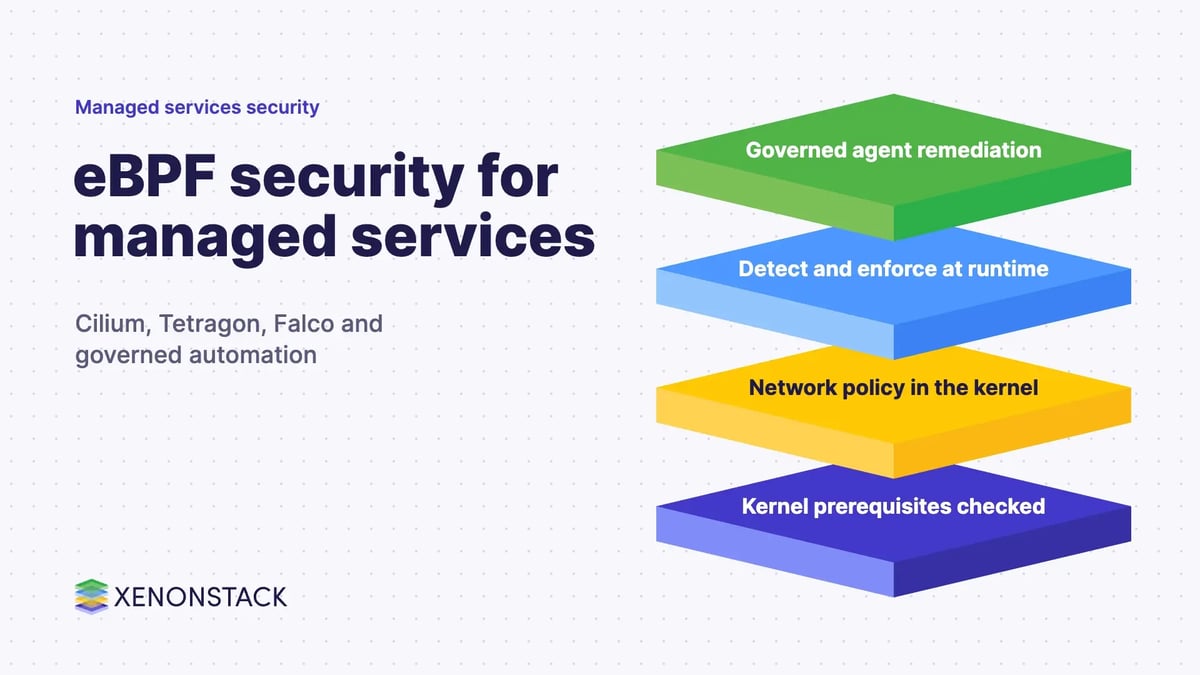
- eBPF for secure managed services in 2027: Cilium, Tetragon and Falco compared, kernel prerequisites, limits, and how to govern agent-driven remediation.
eBPF is a Linux kernel technology that runs sandboxed programs inside the kernel, so a managed service provider can watch and, where policy allows, block process, file and network behaviour without changing kernel source or loading kernel modules (ebpf.io). In 2026 the practical route is not writing eBPF yourself but adopting Cilium for networking, Tetragon for enforcement and Falco for detection, with clear limits on what automation may do.
This guide covers what eBPF is, where each tool fits, the kernel prerequisites, the limits, and how to govern agent-driven remediation. For the wider service model, see our managed services overview and the generative AI in managed services post.
What is eBPF and why does it matter for managed services?
According to ebpf.io, eBPF lets sandboxed programs run in a privileged context such as the operating system kernel. Before a program attaches to a hook, a verifier checks that it is safe to run, meaning it finishes, does not access memory out of bounds and stays within size and complexity limits. The same page states that the verifier is not a security tool inspecting what programs do. It checks safety, not intent.
That distinction matters to a provider. eBPF programs can only be loaded by privileged processes or those with the CAP_BPF capability, unless unprivileged eBPF is enabled. Treat who may load eBPF programs as a privileged-access control, in the same class as root.
ebpf.io lists three main areas: networking and load balancing, observability, and security, including preventive runtime enforcement for applications and containers.
Which eBPF tool fits which job: Cilium, Tetragon or Falco?
| Tool | What its own site says | When it fits | When not to rely on it alone |
|---|---|---|---|
| Cilium | Linux kernel 5.10 or later is the base requirement, with 4.18 accepted on RHEL 8.10 (Cilium system requirements) | Kubernetes networking and network policy built on eBPF | Not a process-level runtime detection tool by itself |
| Tetragon | The Cilium Tetragon component for realtime eBPF-based security observability and runtime enforcement; filtering, blocking and reacting happen in the kernel | Process, file and syscall visibility, with the option to block before a syscall completes | Enforcement rules need testing first, because a wrong rule can stop a legitimate workload |
| Falco | A graduate CNCF project giving runtime security across hosts, containers and Kubernetes, alerting on custom rules; default driver is the modern eBPF probe | Rule-based detection and alerting across mixed estates | Detection feeds a response process; it does not by itself remediate |
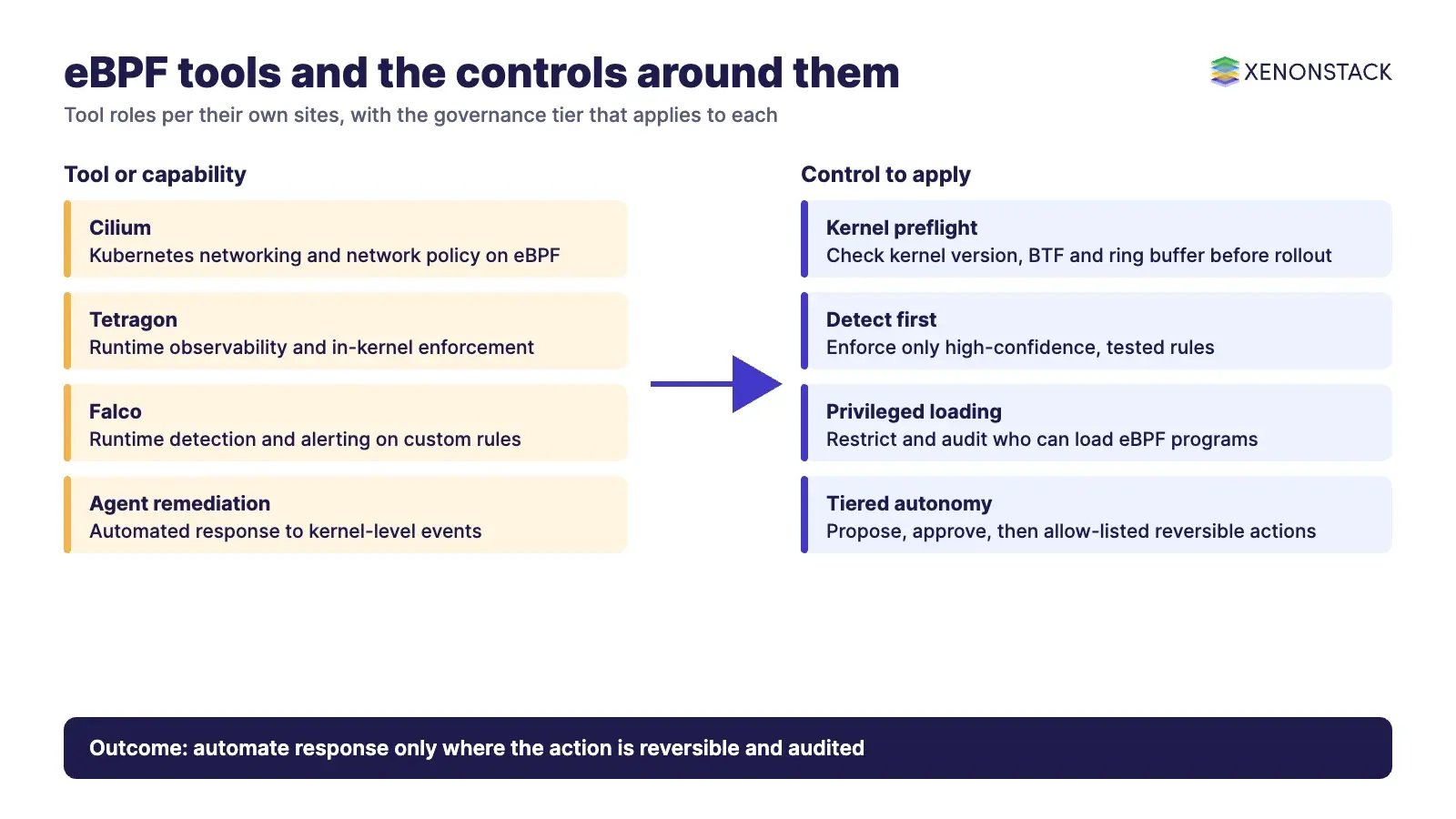
Reading the table: use Cilium for the network layer, and add Tetragon or Falco for runtime behaviour. Many teams start with detection only, then enable enforcement for a small set of high-confidence rules.
What are the main runtime security and network policy use cases?
| Use case | What eBPF gives you | Typical control |
|---|---|---|
| Unexpected process or shell in a container | Kernel-level events for process execution | Alert first; block only after the rule is proven |
| Sensitive file access | File access events tied to the workload | Rule with a named owner and an exception list |
| East-west network traffic | Network visibility and policy in the kernel path | Default-deny policy per namespace, reviewed per tenant |
| Encrypted API traffic | Hooks on user-space TLS libraries can see data before encryption | Use as a signal; confirm it works for your runtimes |
A caution on the encrypted traffic row: visibility depends on how an application links its TLS library, and statically linked or unusual runtimes can reduce what is captured. Treat the capability as something to test per runtime, not a blanket guarantee. Where APIs are the main exposure, pair this with the practices in our API development best practices guide.
What kernel version and prerequisites does eBPF security need?
Requirements differ by tool and feature, so check each against your actual node images. Facts read on 13 November 2026:
| Item | Requirement | Source |
|---|---|---|
| Cilium base | Linux kernel 5.10 or later (4.18 on RHEL 8.10) | docs.cilium.io system requirements |
| Cilium IPv6 BIG TCP | Kernel 5.19 | docs.cilium.io system requirements |
| Cilium IPv4 BIG TCP | Kernel 6.3 | docs.cilium.io system requirements |
| Falco modern eBPF probe | No fixed kernel version; kernels 5.8 or later are usually enough, with BPF ring buffer support and a kernel that exposes BTF | falco.org kernel events page |
| Tetragon | Not stated on its overview page; confirm against the Tetragon docs for your release | tetragon.io |
Falco's documentation suggests running bpftool feature probe kernel to check support. Make this a preflight step in every node image pipeline, and block rollout where BTF or ring buffer support is missing. Managed Kubernetes and older enterprise Linux images are the usual places where this fails.
What are the limits of eBPF security?
| Limit | Why it matters | Mitigation |
|---|---|---|
| Kernel and image variance | Features differ by kernel, so behaviour differs across node pools | Standard node images and a preflight check |
| Privileged loading | Loading programs needs elevated privileges or CAP_BPF | Restrict and audit who can load programs |
| Verifier is not a policy engine | It checks safety, not what a program does (ebpf.io) | Review and sign off every program and rule set |
| TLS visibility gaps | Depends on how libraries are linked | Test per runtime; use other signals alongside |
| Rule quality | Noisy rules lead to alert fatigue; wrong enforcement rules stop workloads | Detect first, enforce later, with a rollback path |
| Skills | Operating and tuning needs specialist time | Plan training or a managed operating model |
Earlier versions of this post claimed eBPF adds almost no overhead. The Tetragon overview states only that filtering in the kernel drastically reduces observation overhead compared with sending every event to user space. Measure overhead on your own workloads before you commit to a number in a service-level agreement.
How should agent-driven remediation be governed?
Detection is easy to automate; response is where risk sits. Tetragon can kill a process before a syscall completes, so an AI agent wired to eBPF events could stop workloads for many tenants in seconds, correctly or not. Our recommended control is tiered autonomy, with evidence at each tier. This is our own operating guidance, not a vendor requirement.
| Tier | Agent may | Human role | Evidence to keep |
|---|---|---|---|
| 1 Observe | Collect and summarise events | Review reports | Event log with timestamps |
| 2 Propose | Draft a remediation with the triggering event | Approve or reject each action | Proposal, approver, decision time |
| 3 Act on allow-listed actions | Run pre-approved, reversible actions (for example isolate one pod) | Review after the fact | Action, policy version, rollback result |
| 4 Enforce in kernel | Block known-bad behaviour via tested rules | Own rule changes through change control | Rule version, test result, owner |
Keep irreversible actions at tier 2 or below. Give every action a named policy, a tenant scope and an audit record. For agent actions kept inside policy with an audit trail, see AgentGRC, which according to its site keeps autonomous agent actions inside policy, with the audit trail risk teams need. For incident and monitoring workflows, see AgentSRE from the ElixirClaw family, and the DevSecOps habits in our DevOps processes guide.
What adoption sequence works, and when should you not use eBPF?
| Step | Action | Exit check |
|---|---|---|
| 1 | Inventory kernels and node images | Every pool has a known kernel and BTF status |
| 2 | Deploy detection only (Falco or Tetragon observe mode) | False-positive rate acceptable to the owner |
| 3 | Add network policy with Cilium per namespace | Tenant traffic maps match policy |
| 4 | Enable enforcement for a few high-confidence rules | Tested rollback; no customer impact in staging |
| 5 | Connect agents at tier 2, then tier 3 | Audit trail passes an internal review |
Do not start with eBPF where nodes run kernels you cannot upgrade, where no one can own rule tuning, or where a managed platform already supplies equivalent controls. In those cases, use the platform's native tooling and revisit later.
To map one runtime response decision your agents should make, and the context and policy it depends on, book a Context Workshop. See what happens in the workshop.
What should you plan for in 2027?
The practical steps follow from the limits covered above. Plan the work as a sequence rather than a single rollout.
- Check kernels first. Inventory node images and run a preflight for BTF and ring buffer support, because features differ by kernel and by tool.
- Detect before you enforce. Start with detection only, then enable enforcement for a few high confidence rules with a tested rollback path.
- Govern agent actions. Keep irreversible actions at human approval, give each automated action a named policy and tenant scope, and restrict who may load eBPF programs.
Measure overhead on your own workloads before you commit a number to a service level agreement.
Frequently asked questions
What is eBPF in simple terms?
eBPF is a Linux kernel technology that runs sandboxed programs in the kernel, so tools can observe and enforce behaviour without changing kernel source code or loading kernel modules (ebpf.io).
What is the difference between Tetragon and Falco?
Tetragon, part of the Cilium project, provides eBPF-based security observability and runtime enforcement in the kernel. Falco is a CNCF graduate project that detects runtime threats and alerts on custom rules.
What kernel version does Cilium need?
Cilium's system requirements list Linux kernel 5.10 or later, or 4.18 on RHEL 8.10, with higher versions for some features such as IPv6 BIG TCP at 5.19.
Does eBPF remove the need for other API security controls?
No. eBPF adds kernel-level visibility, but TLS visibility depends on how libraries are linked, so it should complement API security practices.
Should AI agents be allowed to remediate automatically?
Only within tiers. Allow-listed, reversible actions can be automated with audit evidence; irreversible actions should keep human approval.
Follow XenonStack on LinkedIn: XenonStack on LinkedIn for new guides on agentic AI, data and platform engineering.
Ready to put AI agents to work? Explore ElixirClaw, the agentic OS platform to build, orchestrate and govern AI agents.
Explore the XenonStack platform family: ElixirData · ElixirClaw · ElixirHub · NexaStack · MetaSecure · Neural AI · AgentGRC · AgentSRE · AgentAnalyst · AgentInstruct · AgentRAI · AgentScrum · AgentSearch · AgentForce · AI Aviator · SAIF Aviator · CohortIQ · XenonStack AI · XenonStack UAE