Key takeaway
- AgriTech startups for enterprise leaders: categories, 2025 funding data, governance risks, adoption steps and when not to buy sustainable farming tech.
AgriTech startups sell technology that helps farms grow more with fewer inputs: sensors, drones and satellite data, smart irrigation, livestock monitoring, farm software and controlled-environment growing. For an enterprise leader the useful question is not which startup is fashionable, but which problem it removes, what data it needs, and who is accountable when its recommendation is wrong. The FAO forum on feeding the world in 2050 stated that food production would have to rise by 70 percent to feed 9.1 billion people in 2050, which is why yield, water and input efficiency remain the commercial case.
This guide is written for CTOs, CIOs, heads of digital transformation, solution architects and investors. It maps the main AgriTech categories, shows where each fits, what the funding data says, how to adopt them in sequence, and when not to. Related reading: our guides to IoT analytics platform architecture and edge computing platforms, both of which sit underneath most farm technology.
What counts as an AgriTech startup, and which categories matter?
AgriTech (also written AgTech) covers technology companies serving production agriculture, from input management to farm-to-market logistics. The table groups the categories discussed in this post by the decision they support.
| Category | What it does | When it fits | Main dependency |
|---|---|---|---|
| Precision agriculture | GPS-guided machinery and sensor-based monitoring to apply seed, fertiliser and crop protection where needed | Large, variable fields where input cost is high | Reliable positioning, field data and machinery integration |
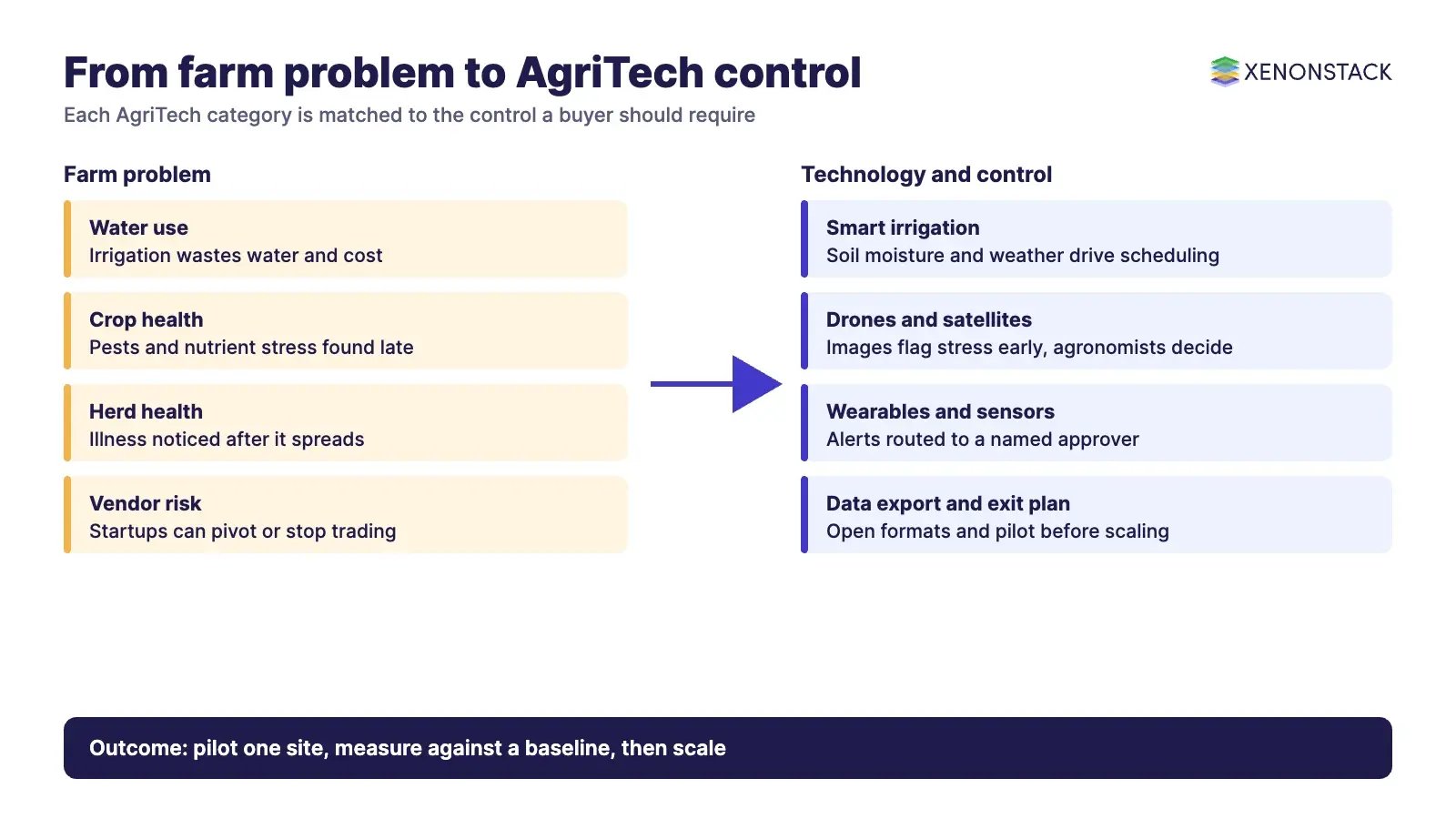
| Drones and satellite imagery | Aerial and orbital images show crop health, nutrient stress and pest pressure | Scouting wide areas faster than walking the field | Image analysis models and agronomy expertise to interpret them |
| Soil and crop sensors | Measure moisture, temperature and soil condition in the field | Irrigation and fertility decisions that depend on current conditions | Connectivity, calibration and maintenance in harsh conditions |
| Smart irrigation | Schedules water from soil moisture, weather and crop requirements | Water-limited regions and high-value crops | Sensor coverage and valve or pump control |
| Livestock monitoring | Wearables and sensors track activity, temperature and feeding patterns | Herds where early illness detection changes outcomes | Per-animal identification and alert workflows |
| Digital marketplaces and supply chain | Connect smallholders to buyers and add traceability | Fragmented supply chains with opaque pricing | Adoption by farmers and buyers, plus data standards |
| Controlled-environment growing | Vertical farming and hydroponics grow crops indoors with managed inputs | Locations with land or water limits and strong local demand | Energy cost and crop mix |
Why does AgriTech matter to enterprise strategy now?
Three pressures push agriculture towards technology. First, demand: the FAO figure above ties the sector to a large rise in output. Second, water: the FAO reports that agriculture accounts for more than 70 percent of global water withdrawals (FAO, 26 November 2020), so water efficiency is a cost and a licence-to-operate issue. Third, volatility: unpredictable weather and extreme events make monitoring and forecasting more valuable.
Traditional methods rely heavily on manual labour and on judgement without continuous measurement. That raises cost, leaves resources unmeasured and slows reaction to disease, drought or price changes. AgriTech replaces some of that judgement with data, but only where the data is trustworthy.
How do AgriTech startups monitor and manage crops?
Crop monitoring combines three layers. Drones and satellites capture images of crop health, nutrient levels and pest infestations. Field sensors and GPS-guided machinery report conditions and apply inputs precisely. A data platform brings both together so agronomists and farm managers can decide what to do and when.
What should buyers check before adopting crop analytics?
| Question | Why it matters |
|---|---|
| Who owns the field data and can it be exported? | Lock-in and benchmarking depend on access to your own records |
| How was the model validated for your crop, soil and climate? | Models trained on other regions can mislead |
| Does the output trigger an action or only a dashboard? | Value comes from the decision, not the map |
| What happens when connectivity drops? | Many farms have patchy coverage, so edge processing is often needed |
| Who approves a recommendation that changes input spend? | Accountability must be clear before automation is allowed |
Connectivity and local processing are the usual architecture issues, which is why farm deployments lean on edge computing platforms and a clear IoT analytics platform architecture.
Where do smart irrigation and water conservation fit?
Smart irrigation monitors soil moisture, weather patterns and crop water requirements, then delivers water in the amounts and at the times the crop needs. Drip irrigation, micro-sprinklers and rainwater harvesting reduce runoff and waste. Given the FAO water-withdrawal figure above, this is often the first category with a clear payback case, though the saving depends on the baseline and the crop.
How is livestock management changing?
Sensors and wearable devices collect activity levels, body temperature and feeding patterns, which helps detect illness or distress early. Precision livestock farming goes further by managing animals individually, for example through automated feeding matched to nutritional need and automated health monitoring. Breeding technologies such as genetic testing help improve herd quality. The operational risk is alert fatigue: a system that flags too many animals will be ignored.
What does the funding data say about AgriTech startups?
AgFunder reports that global agrifoodtech funding in 2025 was $16.2 billion, almost flat against the prior year (down 3 percent), and that upstream startups (technology for farms, food production and biological systems) raised $9 billion, up 7 percent, even though their deal count fell 12 percent (AgFunder Global AgriFoodTech Investment Report 2026). The reading for buyers: capital is concentrating in fewer, larger deals, so vendor viability and funding runway deserve a place in due diligence.
What governance, security and cost issues should leaders plan for?
| Area | Risk | Control |
|---|---|---|
| Data | Farm, yield and location data is commercially sensitive | Contract for ownership, export and deletion; limit sharing to what the use case needs |
| Security | Connected sensors and gateways widen the attack surface | Device identity, patching and network segmentation |
| Decision accountability | Automated recommendations change input spend and animal care | Named approvers, an audit trail and human review for high-impact actions |
| Cost | Hardware, connectivity and maintenance add up beyond licence fees | Pilot on one field or herd and measure input savings before scaling |
| Vendor risk | Startups can pivot, be acquired or stop trading | Escrow or export terms, open data formats and an exit plan |
Where agents or models start to act on farm data, they need controlled autonomy. ElixirClaw is an enterprise operating system where AI agents complete multi-step business tasks across existing systems, with audit trails, human approval points and adjustable levels of independence. For sensor and machine workloads that run at the edge, NexaStack is a control platform for physical-world AI that helps robots and machines sense, reason and act across edge devices and cloud systems, with governance built in. Where an alert needs human judgement, the Exception Handling Agent flags exceptions that need human judgement and routes them to the right approver with context and evidence.
How should an enterprise adopt AgriTech in sequence?
| Step | Action | Exit check |
|---|---|---|
| 1. Define the problem | Pick one measurable issue: water use, input cost, disease losses or herd health | A baseline number you already trust |
| 2. Audit data and connectivity | Map what sensors, machinery and records exist and how they connect | Data can be exported and joined |
| 3. Pilot one site | Run one vendor on one field, greenhouse or herd for a full season | Savings or yield effect measured against the baseline |
| 4. Add governance | Set owners, approval rules and audit logs for automated actions | Every automated action has a named approver |
| 5. Scale selectively | Extend only the categories that proved value | Total cost including support is below the measured benefit |
When is AgriTech not the right answer?
Skip or delay a purchase when the basic agronomy is not yet under control, when there is no connectivity or skills to run the system, when the vendor will not let you export your data, or when the saving cannot be measured against a baseline. Controlled-environment growing in particular depends on energy cost and crop mix, so it suits specific locations and not every operation. Technology does not replace sound crop rotation, soil care and local agronomic advice.
What will change in AgriTech next?
Most of the change comes from applying artificial intelligence to data that farms already collect, so the table below separates what is technically likely from what still depends on data quality.
| Trend | What it means for buyers |
|---|---|
| AI and machine learning on farm data | Better yield and weather forecasting, if data quality and model validation hold up |
| Drones and satellite imagery | Near-real-time insight on crop health, soil and irrigation needs |
| Vertical farming and hydroponics | Growing with less land and water than open-field methods, within energy limits |
| Regenerative practices | Crop rotation and soil health management gain attention for long-term sustainability |
| Agentic workflows | Agents that triage alerts and prepare decisions, with humans approving the high-impact ones |
To map one farm or supply chain decision your agents should make, and the context and policy it depends on, book a Context Workshop. See what happens in the workshop.
FAQ
What do AgriTech startups do?
They build technology for production agriculture, including precision agriculture, drone and satellite monitoring, soil and crop sensors, smart irrigation, livestock monitoring, digital marketplaces and controlled-environment growing.
Why is water efficiency central to AgriTech?
The FAO reports that agriculture accounts for more than 70 percent of global water withdrawals, so smart irrigation and water conservation address a large cost and sustainability issue.
How much funding do AgriTech startups attract?
AgFunder reports global agrifoodtech funding of $16.2 billion in 2025, down 3 percent, with upstream startups raising $9 billion, up 7 percent.
How should an enterprise start with AgriTech?
Choose one measurable problem, check data and connectivity, pilot one vendor on one site for a full season, add approval and audit rules, then scale only what proved value.
What are the main risks of adopting AgriTech?
Data ownership, device security, unclear accountability for automated recommendations, hidden hardware and maintenance cost, and vendor viability.
When should a farm business not buy AgriTech yet?
When the saving cannot be measured, connectivity or skills are missing, or the vendor will not allow data export.
Follow XenonStack on LinkedIn: XenonStack on LinkedIn for new guides on agentic AI, data and platform engineering.
Explore the XenonStack platform family: ElixirData · ElixirClaw · ElixirHub · NexaStack · MetaSecure · Neural AI · AgentGRC · AgentSRE · AgentAnalyst · AgentInstruct · AgentRAI · AgentScrum · AgentSearch · AgentForce · AI Aviator · SAIF Aviator · CohortIQ · XenonStack AI · XenonStack UAE