Key takeaway
- Agentic process automation in insurance: claims, underwriting and servicing use cases, RPA vs agents, NAIC AI bulletin and EU AI Act rules, and a roadmap.
Agentic process automation (APA) in insurance uses AI agents that read documents, gather context from several systems, apply underwriting and claims rules, and act within set limits, handing exceptions and high-impact decisions to people. Where robotic process automation (RPA) repeats fixed screen steps, an agentic workflow can deal with unstructured submissions, missing data and cases that do not fit the script.
This guide is for insurance CIOs, COOs, chief AI officers and architects deciding where agents belong in claims, underwriting, policy servicing and compliance, and how to stay inside the NAIC AI model bulletin and the EU AI Act. For the analytics and data side of the same business, read our guide to data analytics in insurance; for the general concept, see the dawn of agentic process automation.
What is agentic process automation, and how is it different from RPA in insurance?
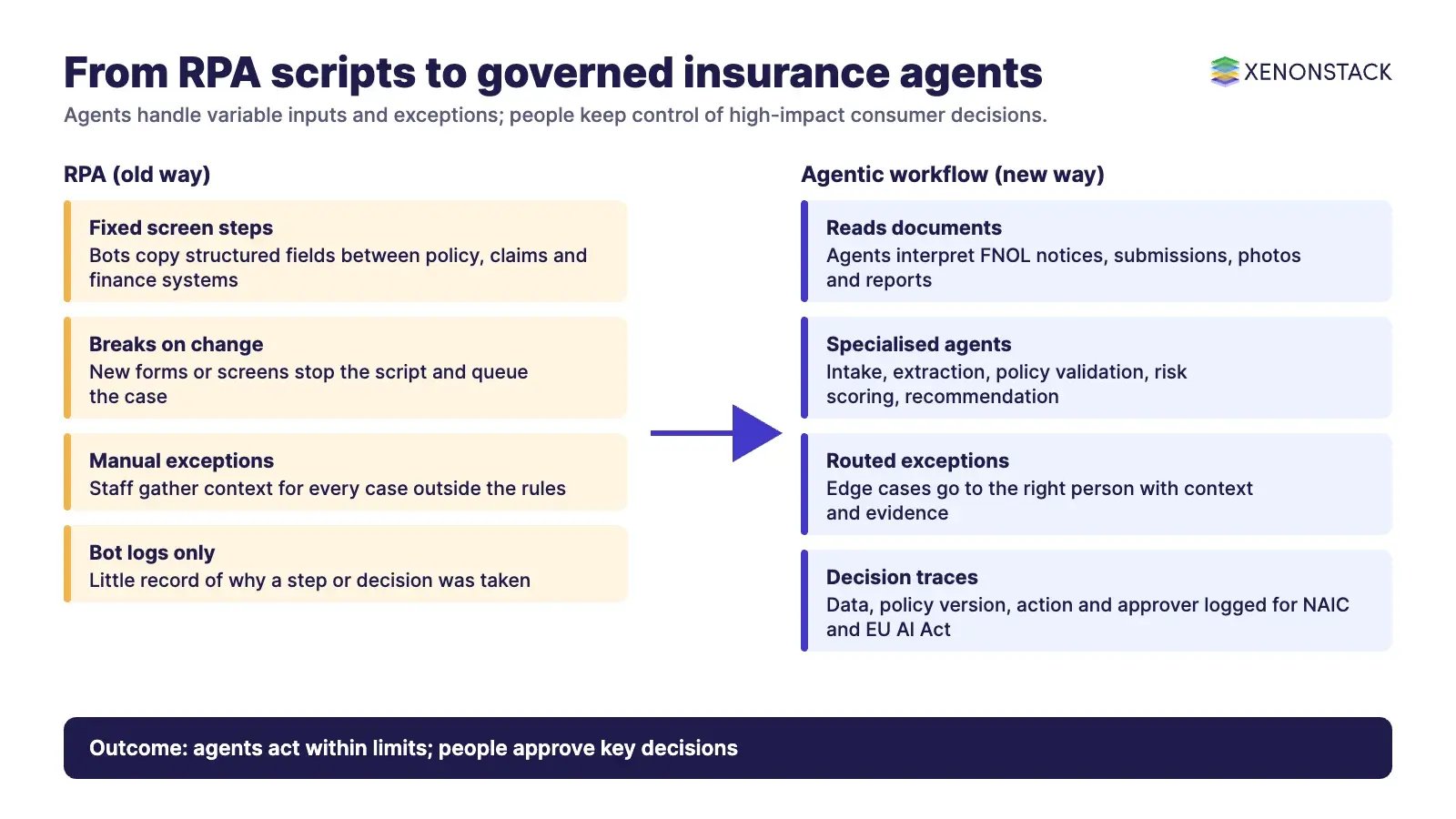
RPA bots follow recorded steps on stable screens. They work well for high-volume, rule-bound tasks such as copying data between a policy administration system and a finance ledger, but they stop when a form changes or a document arrives in an unexpected format. Agentic process automation adds AI agents that interpret inputs, choose the next step, call tools and APIs, and decide when to escalate. The workflow is designed around decisions rather than keystrokes.
| Aspect | RPA | Agentic process automation |
|---|---|---|
| Inputs | Structured fields on known screens | Emails, PDFs, photos, adjuster notes and system data |
| Logic | Fixed rules and scripts | Rules plus model-based judgement within set limits |
| Exceptions | Bot fails or queues the case | Agent gathers context and routes the case with evidence |
| Change | Scripts break when screens or forms change | Agents adapt to new formats; policies are updated centrally |
| Governance | Bot logs and access control | Agent identity, scoped permissions, decision traces and human approval points |
| Best fit | Stable, repetitive back-office steps | Claims, underwriting and servicing work with variable inputs |
Most insurers will run both. RPA remains useful for stable steps, while agents take on the judgement-heavy parts of a workflow and orchestrate the bots and systems around them. Our guide to agentic AI in banking and finance covers the same shift in adjacent financial services.
Why are insurers moving from rule-based automation to agentic workflows?
Insurance operations are document-heavy and exception-heavy. A single claim can involve a first notice of loss, policy wording, photos, repair estimates, medical or police reports and payment details, each from a different system or party. Rule-based automation handles the predictable fraction; the rest goes to manual queues, which is where cycle time and cost build up.
- Unstructured inputs. Submissions, broker emails and claim evidence arrive as documents and images, not clean fields.
- Legacy cores. Policy, billing and claims systems often lack modern interfaces, so work is re-keyed between them.
- Exception volume. Cases that fall outside rules need a person to gather context before any decision is made.
- Regulatory scrutiny. Supervisors now expect insurers to govern, document and test the AI systems that affect consumers.
In our solution work with insurers in 2026, a recurring pattern is finance and operations teams working from spreadsheets and shared folders, re-checking the same data before every decision. The agentic pattern we use breaks a workflow into specialised agents (intake, document extraction, policy validation, risk scoring and recommendation) with a human approval layer on top, rather than one large bot.
Where does agentic process automation fit in insurance operations?
The table below sets out the main use cases, what an agent does in each, and where a person should stay in control.
| Use case | What the agent does | Where people stay in control |
|---|---|---|
| Claims intake (FNOL) | Reads the notice and attachments, checks cover against the policy, creates the claim and requests missing items | Disputed cover, injury claims, large losses |
| Claims assessment and settlement | Assembles evidence, compares estimates, applies authority limits and drafts the settlement | Payments above authority limits, denials |
| Fraud triage | Flags patterns and inconsistencies across claims and documents for investigation | Any referral or adverse action |
| Underwriting submissions | Extracts submission data, enriches it from internal and external sources and checks appetite and guidelines | Pricing and acceptance of non-standard risks |
| Policy servicing | Handles endorsements, renewals, cancellations and status queries across channels | Complaints and vulnerable customers |
| Compliance and reporting | Validates data, prepares regulatory reports and keeps an evidence trail | Sign-off and regulator submissions |
Claims
Claims is usually the first workflow to redesign because cycle time is visible to customers and cost is measurable. An agent can take a first notice of loss, read attached documents, check policy cover, open the claim and request what is missing, then route straightforward claims for fast settlement and complex ones to an adjuster with a summary. ElixirClaw describes this pattern in claim processing with autonomous agents.
Underwriting
Underwriters spend much of their time collecting and re-keying submission data. Agents can extract data from submissions, pull internal history and third-party data, check the risk against underwriting guidelines and prepare a recommendation, leaving the underwriter to judge the risk itself. See agentic AI risk evaluation in underwriting for a worked example.
Policy servicing, finance and compliance
Servicing tasks such as endorsements, renewals and cancellations follow rules but involve many systems. Agents can orchestrate them end to end, including existing RPA bots on legacy screens. When a case falls outside the rules, the Exception Handling Agent routes every edge case to the right person with full context and evidence for faster, better resolutions.
ElixirClaw demonstration: one request starting several connected workflows, the orchestration pattern behind claims and servicing automation.
What do the NAIC AI model bulletin and the EU AI Act require?
Agentic automation in insurance is not lightly regulated. Two frameworks matter most for insurers operating in the United States and Europe.
NAIC Model Bulletin on the Use of Artificial Intelligence Systems by Insurers
The NAIC model bulletin, adopted on 4 December 2023, applies to decisions or actions affecting consumers that are made or supported by AI. Insurers are expected to develop, implement and maintain a written AI Systems (AIS) Program designed to mitigate the risk of adverse consumer outcomes. The bulletin covers governance with senior management accountable to the board, risk management and internal controls (data quality and bias, model inventories, validation, testing and drift monitoring), due diligence and audit rights over third-party AI systems and data, and documentation regulators can request. According to the NAIC adoption map dated 3 November 2026, 29 jurisdictions (27 states, the District of Columbia and Puerto Rico) have adopted the bulletin, and California, Colorado, New York and Texas have separate insurance-specific AI rules or guidance.
EU AI Act
Under the EU AI Act (Regulation (EU) 2024/1689), Annex III point 5(c) lists as high-risk AI systems intended to be used for risk assessment and pricing in relation to natural persons in the case of life and health insurance. Article 27 requires deployers of these systems to perform a fundamental rights impact assessment before deployment, and Article 26 requires deployers to assign human oversight to people with the necessary competence, training and authority. Under the AI Omnibus, which entered into force on 27 July 2026, the rules for Annex III high-risk systems apply from 2 December 2027.
| Requirement | NAIC model bulletin (adopting states) | EU AI Act (life and health pricing and risk assessment) |
|---|---|---|
| Scope | AI used in decisions or actions affecting consumers | High-risk systems in Annex III point 5(c) |
| Core obligation | Written AIS Program proportionate to use and risk | High-risk system obligations, fundamental rights impact assessment for deployers |
| Human role | Governance accountable to the board; escalation protocols | Human oversight by competent, trained and authorised people |
| Third parties | Due diligence, audit rights and cooperation clauses | Obligations split between providers and deployers |
| Evidence | Programme documents, inventories, testing and contracts on request | Documentation, logging and assessment records |
| Timing | In force where adopted | Annex III rules apply from 2 December 2027 |
For agents, this means each automated decision should be traceable: what data the agent used, which policy and version applied, what it did and who approved it. The Compliance Agent enforces policy, approvals and evidence so AI execution stays audit-ready, and ElixirData Context OS keeps governed context, versioned policy and decision traces in one decision layer above AI agents. Our guide to agentic process automation governance covers the controls in more depth.
How should an insurer sequence an agentic automation programme?
- Pick one workflow with a clear measure. Claims intake or submission triage usually works, measured by cycle time, touch rate and leakage.
- Map decisions, not just steps. List each decision in the workflow, its data, its rule or guideline, and who owns it today.
- Classify the risk. Decide which decisions affect consumers and which fall under the NAIC bulletin or EU AI Act, and set human approval points accordingly.
- Fix data and context. Give agents governed access to policy, claims and customer data with agreed definitions.
- Build with specialised agents. Separate intake, extraction, validation, scoring and recommendation, and keep existing RPA where it works.
- Govern before scale. Agent identities, least-privilege access, decision logs, testing and drift monitoring, recorded in your AIS Program.
- Scale by workflow. Reuse agents and controls for the next line of business and retire scripts that no longer pay back.
A platform helps keep these controls consistent. ElixirClaw is an agentic OS platform to build, orchestrate and govern AI agents and automation workflows while keeping humans in control.
What are the trade-offs, and when is agentic automation the wrong choice?
- Stable, simple tasks. If a task is fully rule-based and screens rarely change, RPA or a direct integration is cheaper and easier to audit.
- High-impact consumer decisions. Denials, rescissions and pricing for individuals need human judgement and, in the EU, may fall in high-risk scope. Use agents to prepare, not decide.
- Poor data. Agents acting on inconsistent policy or claims data scale errors. Fix data ownership first.
- Third-party models. Vendor AI still sits inside your AIS Program; without audit rights and documentation, you carry the risk without the evidence.
- Cost and latency. Model calls add cost per transaction. Reserve agents for steps where judgement adds value.
To map one claims or underwriting decision your agents should make, and the context and policy it depends on, book a Context Workshop. See what happens in the workshop.
What should you plan for in 2027?
Insurers running agents on consumer decisions have one dated milestone to plan around in 2027, and it sits inside the regulatory work already covered above.
- 2 December 2027: the European Commission states that the AI Act rules for Annex III high risk systems apply from this date, which is the point to have human oversight and impact assessments ready for life and health pricing and risk assessment. Source: European Commission.
- 2 August 2028: the same page gives this later date for high risk AI embedded in physical products, so it falls outside 2027 planning. Source: European Commission.
- Work backwards from the first date: classify decisions, set approval points and build decision traces during 2027, so the evidence exists before the rules apply.
Frequently asked questions
What is agentic process automation in insurance?
It is the use of AI agents that read documents, gather context from several systems, apply claims and underwriting rules and act within set limits, while handing exceptions and high-impact decisions to people.
How is agentic process automation different from RPA?
RPA repeats fixed steps on known screens and stops when inputs change. Agentic automation interprets unstructured inputs, chooses next steps, calls tools and escalates with evidence. Most insurers use both, with agents orchestrating existing bots.
Which insurance processes suit agentic automation first?
Claims intake and assessment, underwriting submission triage, policy servicing such as endorsements and cancellations, fraud triage and compliance reporting. Claims intake is often first because cycle time and cost are easy to measure.
What does the NAIC AI model bulletin require of insurers?
Adopted on 4 December 2023, it expects insurers to maintain a written AI Systems Program that mitigates the risk of adverse consumer outcomes, with board-accountable governance, risk management and internal controls, third-party oversight and documentation. As of 3 November 2026, 29 jurisdictions had adopted it.
Is insurance AI high-risk under the EU AI Act?
AI systems intended for risk assessment and pricing in relation to natural persons in life and health insurance are listed as high-risk in Annex III point 5(c). Deployers must carry out a fundamental rights impact assessment. Under the AI Omnibus, Annex III rules apply from 2 December 2027.
Where should people stay in control of insurance agents?
On payments above authority limits, claim denials, pricing and acceptance of non-standard risks, fraud referrals, complaints and regulator submissions, with each agent decision logged so it can be reviewed.
Follow XenonStack on LinkedIn: XenonStack on LinkedIn for new guides on agentic AI, data and platform engineering.
Explore the XenonStack platform family: ElixirData · ElixirClaw · ElixirHub · NexaStack · MetaSecure · Neural AI · AgentGRC · AgentSRE · AgentAnalyst · AgentInstruct · AgentRAI · AgentScrum · AgentSearch · AgentForce · AI Aviator · SAIF Aviator · CohortIQ · XenonStack AI · XenonStack UAE