Key takeaway
- Agentic AI in construction: where AI agents fit in scheduling, safety, supply chain, BIM and quality, what to govern, and how to start with a pilot.
Agentic AI in construction means software agents that plan a task, call project systems such as scheduling, procurement and BIM tools, and act within limits set by people. They do not replace the superintendent or the project manager. They take over the coordination work that sits between systems: re-sequencing a programme when a delivery slips, raising a purchase request, drafting a daily log, or flagging a missing hard hat for a supervisor to act on.
For a CIO or head of digital delivery, the decision is not whether agents are possible. It is which decisions an agent may take alone, which need approval, and what evidence you keep. This guide covers the use cases, the architecture, the governance controls and a staged adoption path. It builds on our guides to agentic workflows and autonomous digital operations.
What is agentic AI in construction, and how is it different from earlier tools?
Earlier construction software either follows fixed rules (scheduling templates, approval routes) or predicts a value (a delay score, a failure probability). An agent goes one step further: it is given a goal, chooses which tools to call, checks the result and tries again, and escalates to a person when a rule says it should. The table shows where each approach fits.
| Approach | What it does | Fits when | Limit |
|---|---|---|---|
| Rule-based automation | Runs a fixed workflow, for example routing a submittal for approval | The steps never change | Breaks when the situation differs from the rule |
| Predictive model | Scores a risk or forecasts a value, such as equipment failure | You need an early warning and a person will decide | Does not act or coordinate |
| Generative assistant | Drafts text or answers questions from project documents | A person reviews every output | Does not call systems or follow through |
| Agentic AI | Plans steps, calls scheduling, ERP, BIM and IoT tools, and acts within approved limits | The work crosses several systems and needs timely action | Needs governance, approval gates and a decision trace |
Where do AI agents fit across the project lifecycle?
The table lists the use cases we see most often in enterprise construction programmes. The last column is our own view of where to start, not an industry benchmark: start where the agent recommends and a person approves, then widen autonomy as the evidence builds.
| Use case | What the agent does | Decision a person keeps | Suggested starting mode |
|---|---|---|---|
| Planning and scheduling | Re-sequences activities when weather, labour or deliveries change, and proposes a revised programme | Approving a changed milestone or contract date | Recommend, then approve |
| Site safety monitoring | Reads camera and sensor feeds, flags missing PPE or exclusion-zone entry, alerts the supervisor | Stopping work and any action against a person | Alert only |
| Equipment maintenance | Reads machine telemetry, predicts wear, books a service slot and requests parts | Taking a machine out of service on a live job | Recommend, then approve |
| Supply chain and procurement | Tracks inventory and supplier delivery, drafts purchase requests when forecast demand exceeds stock | Committing spend above a set limit | Draft, then approve |
| Design and BIM coordination | Checks model updates for clashes and proposes changes for review | Accepting any design change | Recommend only |
| Quality inspection | Compares drone or camera images with design information and flags deviations | Rejecting work or ordering rework | Alert only |
| Compliance and reporting | Collects evidence, drafts daily logs and flags missing documents | Signing off regulatory submissions | Draft, then approve |
What has changed recently?
Two developments make this more practical than it was two years ago. First, project platforms now offer agent tooling to customers. Procore announced on 15 October 2025 that its Agent Builder, which lets customers "automate workflows by building custom AI agents", was in open beta for all customers, alongside pre-built agents such as an RFI Creation Agent and a Daily Log Agent, as reported in its Groundbreak 2025 release. Second, the information-management standard for BIM projects, ISO 19650-1, was reviewed and confirmed by ISO in 2024, so the common data environment approach that agents depend on remains the reference, according to the ISO standard page.
The practical consequence is that you can start from the platforms you already run. The harder work is the data and the controls around them, not the model.
How do AI agents handle planning, supply chain and equipment?
Planning and scheduling
A scheduling agent reads the current programme, weather feeds, workforce availability and delivery status. When something changes, it proposes a revised sequence and the cost and date impact, and a planner approves it. Unlike a static schedule, it keeps the plan current between weekly planning meetings. The value depends on how complete and timely the site progress data is, so many programmes begin by fixing progress capture.
Supply chain and procurement
A procurement agent monitors supplier performance and stock against the look-ahead. As an illustration, if forecast concrete demand rises beyond the ordered volume, the agent drafts a purchase request with the supplier lead time, and a buyer approves it within the delegated spend limit. This depends on live links to ERP and inventory systems. The wider AI agent infrastructure stack guide covers how those connections are structured.
Equipment maintenance
Maintenance agents read telemetry from cranes, excavators and other plant, predict wear, and schedule a service when it causes the least disruption. The method is the same as in other asset-heavy sectors; see our guide to AI predictive maintenance for the data and edge-versus-cloud choices.
Design coordination and quality
In BIM coordination, an agent can check each model update for clashes and propose resolutions, leaving acceptance to the design lead. For quality, vision models compare site images with the design and flag deviations such as misaligned steel or surface cracks. See our guides to computer vision applications and AI-driven quality control. Treat every flag as a prompt for inspection, not a verdict.
How can AI agents support site safety, and where are the limits?
Falls are the largest single cause of construction deaths. OSHA reports that falls from elevation accounted for 389 of the 1,034 construction fatalities recorded in 2024, using BLS data, on its Stop Falls Stand-Down page. Agents cannot prevent a fall, but they can shorten the time between a hazard appearing and a supervisor knowing about it.
A safety agent combines camera, sensor and wearable feeds. XenonStack AI describes its workplace safety monitoring as computer vision that flags missing PPE, detects unauthorised people in restricted areas and sends instant alerts. Keep the design honest: the agent alerts, a supervisor decides, and your policy covers camera placement, worker notice and data retention under local labour and privacy law.
Video: AI Safety Monitoring, PPE Checked Every 10 Seconds (XenonStack AI).
What architecture connects agents to project and site data?
Agents are only as good as the systems they can read and write. A workable design has four layers. Data sources hold BIM models and the common data environment, the project management platform, ERP and procurement, and site IoT, drones and cameras. A governed context layer gives agents the current, permitted view of that data. An orchestration layer assigns work to specialised agents. A control layer applies approvals, spend limits and a decision trace before any action reaches a system of record.
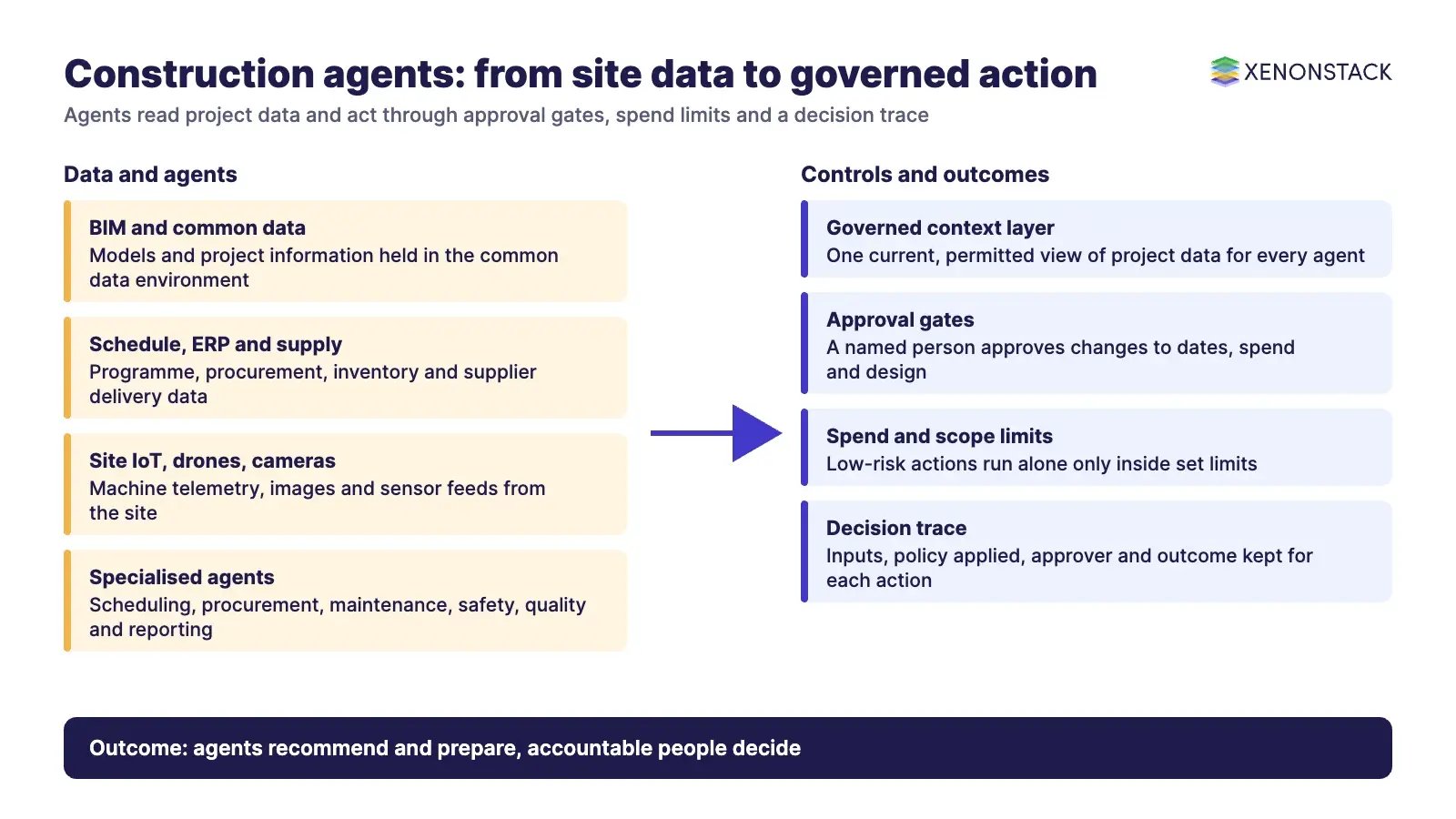
ISO 19650-1 gives the information-management principles for the first layer: exchanging, recording, versioning and organising information across all project actors over the asset life cycle. For orchestration, ElixirClaw is an agentic OS platform to build, orchestrate and govern AI agents and automation workflows while keeping humans in control. Where agents act on equipment, cameras and other physical systems, NexaStack is an agentic operating platform for physical AI that runs across on-premises, cloud and hybrid environments.
What are the governance, security and cost risks?
| Risk | What goes wrong | Control |
|---|---|---|
| Wrong action on a live site | An agent changes a sequence or orders material on bad data | Approval gates, spend limits and a rollback path |
| Stale or conflicting data | BIM, schedule and ERP disagree, so the agent acts on the wrong version | A single governed context layer and data ownership per source |
| Worker monitoring and privacy | Cameras and wearables collect personal data | Notice, purpose limits, retention rules and works-council or legal review where required |
| No audit trail | A change cannot be explained after a dispute or incident | A decision trace per action: inputs, policy applied, approver, outcome |
| Over-trust in alerts | Supervisors act on false flags or ignore real ones | Measure alert precision and keep a person accountable |
| Cost and sprawl | Many pilots, no shared platform or ownership | One platform, a named owner and a cost review at each stage |
Compliance matters here because construction spans safety, labour, environmental and contractual rules. The ElixirData Compliance Agent monitors operations against regulatory, contractual and internal policies, flags risks early, and generates audit-ready evidence. For the wider topic, see our guide to agentic AI in data governance and compliance.
How should a construction enterprise adopt agentic AI?
| Stage | Scope | Exit test |
|---|---|---|
| 1. Read-only | Agents answer questions and draft logs, RFIs and reports from project data | People trust the answers and the data access is correct |
| 2. Recommend | Agents propose schedule changes, purchase requests and maintenance slots | Most proposals are accepted without edits |
| 3. Act with approval | Agents submit actions that a named approver confirms | Every action has a decision trace and a rollback |
| 4. Act within limits | Low-risk actions run alone inside spend and scope limits | Exceptions and overrides are reviewed monthly |
Begin with one project and one use case, such as daily reporting or procurement look-ahead, where the data is clean and the downside is small. Add safety alerts next, with legal review of monitoring. Defer autonomous changes to programme dates or contract positions until the earlier stages have a record.
When is agentic AI not the right choice?
Do not use an agent where a fixed rule is enough, such as a standard approval route. Do not use one where project data is not captured digitally, because the agent will act on gaps. Avoid autonomy for decisions with legal or life-safety consequences, such as stopping work, rejecting structural work or certifying compliance. Those stay with accountable people, with the agent preparing the evidence.
How does XenonStack support construction and infrastructure teams?
XenonStack works with enterprise teams on agent design, integration with project, ERP and IoT systems, and the governance layer that makes autonomy auditable. We usually start with a discovery of one use case, its data and its approval rules, then build a pilot with measures agreed in advance.
To map one construction decision your agents should make, and the context and policy it depends on, book a Context Workshop. See what happens in the workshop.
Related on XenonStack
- ElixirClaw: run governed AI agents with decision boundaries and human approvals.
- Edge and vision AI: computer vision agents at the edge.
- NexaStack for physical AI: run agents on robots, machines and edge devices.
Frequently asked questions
What is agentic AI in construction?
It is software that plans a task, calls project systems such as scheduling, procurement and BIM tools, and acts within limits set by people, escalating to a person when a rule requires it.
Which construction use cases should we start with?
Start where the agent drafts or recommends and a person approves: daily reporting, procurement look-ahead, scheduling proposals and maintenance planning. Add safety alerts with legal review of worker monitoring.
Can AI agents improve construction safety?
They can shorten the time between a hazard appearing and a supervisor knowing, for example by flagging missing PPE or entry to a restricted area. A person decides and acts. Falls from elevation caused 389 of 1,034 US construction deaths in 2024, according to OSHA citing BLS data.
How do agents work with BIM and the common data environment?
They read model and project information through the common data environment, check updates for clashes and propose changes for review. ISO 19650-1 sets the information-management principles for exchanging, recording and versioning that information.
What governance does an agent need on a construction project?
Approval gates, spend limits, a decision trace per action, data ownership per source, and a privacy review for any monitoring of workers.
Do construction platforms already offer AI agents?
Some do. Procore announced Agent Builder in open beta for all customers on 15 October 2025, with pre-built agents such as an RFI Creation Agent and a Daily Log Agent.
Ready to put AI agents to work? Explore ElixirClaw, the agentic OS platform to build, orchestrate and govern AI agents.
Explore the XenonStack platform family: ElixirData · ElixirClaw · ElixirHub · NexaStack · MetaSecure · Neural AI · AgentGRC · AgentSRE · AgentAnalyst · AgentInstruct · AgentRAI · AgentScrum · AgentSearch · AgentForce · AI Aviator · SAIF Aviator · CohortIQ · XenonStack AI · XenonStack UAE
Follow XenonStack on LinkedIn: XenonStack on LinkedIn for new guides on agentic AI, data and platform engineering.